Nature Conservancy’s Zumwalt Prairie: Conservation or Cattle?
Nature Conservancy’s Zumwalt Prairie: Conservation or Cattle?
A behind-the-fence look at TNC’s flagship prairie preserve — and what two decades of “sustainable grazing” have (and haven’t) delivered.
⸻
Originally published on Substack, October 2025.
I hadn’t planned to walk straight into the heart of The Nature Conservancy’s Zumwalt Prairie operation that September day in 2025. I was simply crossing the high prairie to glimpse what’s often described as a conservation stronghold when I pulled into a small cluster of buildings that turned out to be TNC’s field station.

Zumwalt Prairie at sundown. One of the largest intact native grasslands left in North America.
A volunteer welcomed me inside, where a large map of the preserve covered one wall. It was cut into roughly twenty-five polygons — livestock pastures of different shapes but similar size. Later, running the numbers, I realized that even on TNC’s one-tenth slice of the Zumwalt those polygons represented about 85 miles of permanent fence, not including the additional exclosures around streams and aspen stands.
From the road, unless you know the native plants or notice the faint lines of wire stitched across the grasslands, the Zumwalt appears wild and timeless. On the map, though, it looked less like a sanctuary than a feedlot in waiting.
⸻
The Zumwalt Prairie — What’s at Stake
The high, rolling Zumwalt stretches about 500 square miles between the glaciated Wallowa Mountains and the Wallowa-Whitman National Forest. It’s crossed by small streams that eventually drain toward Hells Canyon, forming Oregon’s border with Idaho. Zumwalt is the largest intact Pacific Northwest bunchgrass prairie in North America.
For thousands of years the prairies of North America stretched almost without interruption; a living sea of grasses alive with wildflowers, birds, and an astonishing diversity of large mammals: giant ground sloths, camels, mammoths, and sabertooth cats. These grasslands did not evolve under the pressure of millions of bison; they were shaped by fewer but far larger and more diverse herbivores — and the predators that kept them in check.
In less than two centuries, most of that sea has been turned into cropland, fences, and roads. The tallgrass prairie that once covered the Midwest is now reduced to scattered remnants. Even the drier shortgrass plains have been carved up, irrigated, overgrazed, and crisscrossed with fences and pipelines. What looks like open space from a car window is, in reality, a heavily altered landscape.
When conservation groups say “about half” of U.S. grasslands have been lost in the past 150 years, they’re describing only the latest wave of destruction. The real story began much earlier. Successive waves of settlement, land giveaways, and development took bite after bite out of the prairie until what remains is just a shadow of the original. For some prairie types, only tiny fragments survive. It’s easy to miss this if you’ve never seen the original landscape — but for many of the plants, animals and soils that evolved there, the loss is complete.
As the prairies have vanished, so have the creatures that depend on them. Grassland birds are a stark example. Since 1970, their numbers in North America have fallen by more than half — hundreds of millions of grasshopper sparrows, savannah sparrows, bobolinks, and other species are now absent from the landscape. In some places the decline is even steeper. Grasslands are now among the most imperiled bird habitats on the continent, and the cascading losses of insects, plants, and soil life tell the same story: when the grass goes, everything built around it begins to unravel.
The decline isn’t limited to birds. Insects and pollinators — the quiet engines of prairie life — are also disappearing. Studies from across North America and Europe show steep drops in insect abundance and diversity over just a few decades. Monarchs, bumblebees and grasshoppers that once filled summer skies and meadows now occur in only a fraction of their former numbers. Because insects pollinate plants, feed birds, recycle nutrients and keep soils healthy, their loss ripples outward. When insect life thins out, the entire prairie web begins to fray.

Meadowlark
⸻
The Nature Conservancy Arrives
In 2000, The Nature Conservancy purchased 27,000 acres of the Zumwalt Prairie, the largest Oregon acquisition in the organization’s history. In 2006, 6,065 acres were added, making the 51-square-mile preserve TNC’s largest landholding in Oregon.
⸻
TNC’s Experiment with Ranchers
The Zumwalt Prairie has been prized grazing land for generations of local ranching families. It also embodies one of the West’s enduring tensions: property rights and stewardship. On one hand, ranchers bristle at outsiders telling them how to manage their land; on the other, they press conservation groups and public agencies to accommodate livestock on theirs. The Zumwalt illustrates how hard it can be to be a “good neighbor” while still protecting ecosystems on western rangelands.
Over the past decade, The Nature Conservancy has cultivated relationships with a dozen landowners who raise cattle in an effort to promote “sustainable” grazing practices across the prairie. Ranchers depend on the land for their living and many see themselves as conscientious stewards. Yet a long history of overgrazing in the region has degraded soils, fouled waterways, and damaged plant and wildlife habitat. People responsible for that legacy are often blind to their culpability and sincerely believe they are managing well. In this remote corner of Oregon, tensions flare over everything from gray wolves to a small flowering plant, Spalding’s catchfly, listed as endangered by the U.S. Fish and Wildlife Service.
Initially, local ranchers were wary of TNC’s involvement, suspecting an anti-grazing agenda. Meanwhile, some of TNC’s own donors and staff doubted whether cattle had any place on Oregon’s largest private nature preserve. The Conservancy’s stated goal has been to bridge this divide by using science to show that the interests of livestock producers and conservationists can coexist — and, ideally, make the entire Zumwalt ecosystem healthier. The partnership with ranchers is integral to testing what works — how many cows on a pasture, at what time of year and for how long — so that, at least in theory, both ranchers and prairie might prosper.
Supporters of “holistic” or “adaptive” grazing present it as a flexible, evidence-driven alternative to rigid management plans. In theory, adaptive management means testing a practice, monitoring the results and adjusting to improve ecological outcomes. In practice on Western rangelands, it has too often meant something else entirely. When monitoring shows problems, the “adjustment” is not to reduce livestock numbers but to add another fence, build another water development or shift cattle to a new paddock — essentially doubling down on infrastructure to keep the same or even increase stocking rates. This is framed as innovation, but it amounts to prolonging business as usual under a new label.
At its best, adaptive management should help managers learn and correct mistakes; at its worst, it becomes a revolving justification for expanding the footprint of livestock infrastructure while claiming ecological progress. Each new fence or trough may solve a short-term problem for cattle but creates long-term costs for wildlife movement, springs and the very habitats the programs claim to restore. Rather than a bold experiment, this is often just a slower, more bureaucratic way of doing the same thing — or of doing even more of it.
⸻
The Hidden Costs of “Managed” Grazing
On paper, The Nature Conservancy’s portion of the Zumwalt is only a tenth of the prairie — about 33,000 acres. Yet even here, the infrastructure required to run cattle is substantial. Roughly twenty-five pastures of varying size crisscross the preserve. If each is bounded by fence, that works out to about 85 miles of permanent fencing on the TNC tract alone — before counting the additional exclosure fencing along streams and aspen stands, or the temporary electric lines used to subdivide paddocks. Multiply that across the larger landscape and the “open” prairie starts to look more like a grid of narrow corridors.
For wildlife, those fences are not just visual clutter. Pronghorn have extraordinary eyesight for spotting predators across open country, but not for resolving thin wires at close range. Managers and field biologists routinely document pronghorn running into or getting tangled in fences, which can tear hide and muscle or block migration. Standard livestock fences become low, hidden barriers that cut migration routes and trap animals in winter storms. Mule deer can usually leap fences, but does and fawns often get tangled or separated.
For species that can jump fences — mule deer, and in some cases elk — barriers create a different kind of cost. Clearing a four-strand barbed-wire fence isn’t just a momentary inconvenience; it’s a burst of energy at a time of year when animals are already running an energy deficit. In summer and early fall, when forage is plentiful and fat reserves high, the cost of hopping fences may seem trivial. In mid-winter, when deep snow forces animals to burn those reserves just to stay warm, every unnecessary exertion counts. Studies from Wyoming and Colorado have shown that mule deer faced with multiple fence crossings expend more energy, travel less efficiently, and are more likely to become entangled or separated — especially does with fawns. Even when they clear fences cleanly, repeated jumps can lead to cumulative stress and injury, or force animals to avoid otherwise good habitat.

Mule deer jumping fence
Pronghorn face a different but equally serious problem: they rarely jump at all and instead try to crawl under fences, which can be impossible if the bottom wire is too low. In effect, both jumping and crawling extract an energy cost compared to moving unimpeded across open ground. Add winter cold, snow cover and fragmented habitat, and the fences that are barely noticed by livestock become a significant barrier for native wildlife trying to survive the season. On the Zumwalt, where roughly 85 miles of permanent fence crisscross just the Conservancy’s tract — and even more on neighboring lands — those hidden costs multiply, forcing mule deer, elk and pronghorn to burn extra energy, alter their movements, or avoid key habitat entirely just to navigate a landscape that once lay open.
Even birds are affected. Low strands and posts interrupt the low-level flight of grouse, short-eared owls and other grassland species, leading to collisions and predation at fence lines. Raptors, which almost certainly include short-eared owls and other native hunters on the Zumwalt, use fence posts as perches, which can alter predator — prey dynamics for ground-nesting birds.
Water developments add another layer of impact. No pasture can be grazed by livestock without a reliable source of drinking water. In a dry landscape like the Zumwalt, that usually means diverting or pumping water from natural streams, hauling it in tanks, or “developing” springs by digging them out, installing culverts and piping the flow to a trough. Yet those springs and seeps are often the most valuable pieces of biodiversity on the entire prairie — true oases in a dry environment. They support amphibians, insects, rare plants and serve as crucial stopovers for birds. Converting them into livestock watering points changes not only the flow but the community of species they support.
By fencing off stream corridors, the Conservancy can point to visibly healthier riparian vegetation. Yet at the same time, some of the flow that once nourished those fragile areas is being pumped or piped away to supply water for livestock troughs. The result is a paradox: plants along the streams are allowed to recover and regenerate, but the water-dependent habitats themselves shrink from their natural extent, supporting fewer insects, amphibians and other species than they once did — a hidden cost of trying to blend conservation with ranching.
In the Zumwalt, most grassland birds nest from May through July. Studies on the preserve and in similar western rangelands show that grazing during that window can depress nest success through trampling and by reducing the vegetation structure birds need to conceal nests. Scheduling cattle to avoid the peak nesting period rather than concentrating use in May — June would better align with grassland-bird conservation. Across the western rangelands, many of these quiet losses aren’t tallied. Early-season grazing almost always overlaps peak nesting for most grassland birds.
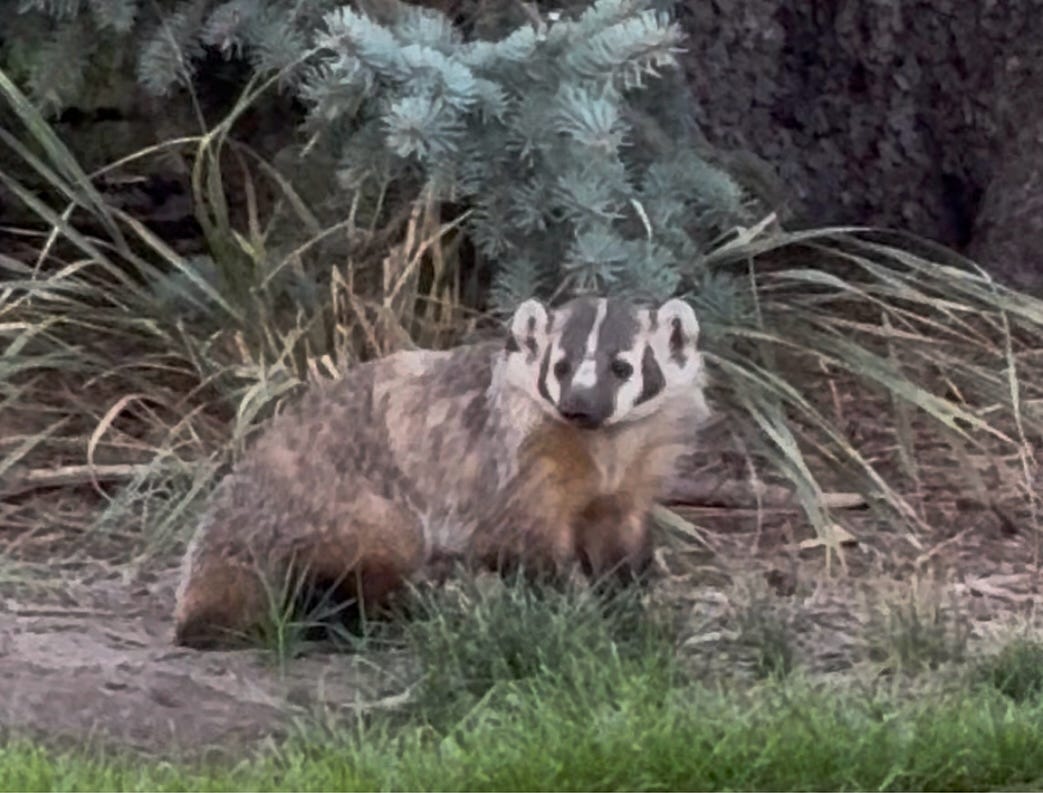
Badger
Across much of the West, American badgers can be legally killed with few restrictions. Ranch outlets routinely describe removing “problem badgers” that dig hazardous holes. Given badgers’ key role as burrow makers for species like the burrowing owl, the quiet loss of badgers almost certainly carries ecological costs — even if it rarely shows up in official reports.
⸻
Questioning the “Evolved Under Grazing” Narrative
TNC personnel and many academics routinely assert that all prairies “evolved under grazing,” sometimes pointing to Nez Perce horses and cattle as evidence of a long grazing tradition. But the Nez Perce had neither horses nor cattle until roughly 300 years ago. Range managers cherry-pick this recent history while ignoring deep-time ecology — the era of megafauna, locust swarms and apex predators. The native plant community we see today is the product of evolution over millennia, not a few centuries. Yet humans consistently ignore deep time, behaving as though evolution unfolds within a handful of human lifetimes.
Historically, mid-size herbivores like bison were only a brief chapter in a much larger story. Although bison seem large to us now, that perception reflects a shifting baseline: far bigger animals once roamed these grasslands. Before the arrival of hominins, prairies were shaped by fewer but much larger herbivores and by the predators that kept them moving. The modern belief that prairies “evolved under heavy grazing by millions of bison” is one of the most widely accepted fallacies in contemporary ecology. The disappearance of megafauna changed which plants and animals dominated the landscape but left the soils, geology and climate largely intact; overall photosynthesis continued at similar rates. Only after the loss of giant herbivores did mid-size ungulates like bison step into center stage.
Livestock, by contrast, dominate modern landscapes in ways that bear little resemblance to either megafauna or bison. They are tethered to water, cannot travel the long distances bison can, and are stocked at densities far beyond anything these systems experienced historically. As a result, domestic herds do not recreate the grazing conditions under which these ecosystems evolved — either before or after the megafaunal extinctions. The idea that cattle are “mimicking” natural patterns is a myth stacked on top of another myth.
⸻
Overlooked Organisms and Processes
Despite decades of fieldwork, even the most intensive ecosystem monitoring is often surprisingly superficial. Beneath our feet, soil organisms such as springtails, mites, and countless larvae are quietly driving organic matter decomposition, recycling nutrients, and sustaining the fertility that underpins plant and animal life. Ongoing research continues to uncover the extraordinary diversity of their ecological roles and interactions. Likewise, endophytic fungi living within plant roots and tissues form symbiotic relationships that enhance growth and improve resistance to environmental stressors — processes largely invisible in conventional monitoring.
Insects, too, are fundamental to ecosystem function but are often overlooked until their numbers crash. They pollinate plants, disperse seeds, decompose organic matter, prey on pests, and form a vital food base for birds, reptiles, and mammals. Their abundance and diversity shape everything from soil fertility to nutrient cycling and energy flow through food webs. Yet many insect populations are declining worldwide due to habitat loss, pesticide use, climate change, and altered land management. Because they respond quickly to environmental change, insects are also among the most sensitive indicators of ecosystem health and resilience.
Above the soil, lichens form a vital part of biological soil crusts — thin, living layers that bind soil particles together across many grassland and dryland ecosystems. By stabilizing the surface, fixing nitrogen (in the case of cyanolichens), and adding organic matter, these crusts help maintain soil fertility and serve as sensitive indicators of ecological change. Research across rangelands shows that livestock grazing, especially at high intensities, can damage these crusts through trampling and soil disturbance. The resulting loss of cover reduces soil stability and alters the balance between infiltration, runoff, and evaporation. How far this translates into changes in groundwater recharge varies widely with climate, soil type, and geology, and remains an active area of study. Even so, the weight of evidence indicates that intact crusts generally support better surface-water retention and soil health, whereas repeated disturbance undermines these functions.
Claims of improved soil health, water infiltration, and biodiversity under various grazing regimes are widespread but, with rare and highly context-specific exceptions, remain unverified by independent, long-term studies. This persistent gap between marketing and measurement illustrates how powerful land-use industries can shape narratives of stewardship long before the science is settled. It also highlights the kind of monitoring that is routinely missed — not only on the Zumwalt Prairie, but across much of the planet.
⸻
Holistic Management’s Global Pattern
What’s being promoted on the Zumwalt is not a bold new experiment but a familiar pattern repeated for decades. From the Challis Experimental Stewardship Program in Idaho, launched in 1978, to the Modoc — Washoe and East Experimental Stewardship Programs, agencies and nonprofits have tried variations of “collaborative” or “holistic” grazing. None has produced clear, long-term benefits for native ecosystems. Instead, these efforts typically make rangelands more livestock-friendly by adding fences, water developments and predator control — measures that fragment habitat and erode watershed and biodiversity values while being presented as innovation.
TNC’s Zumwalt Prairie “experiment” is a microcosm of a much broader trend. Savory-style grazing schemes have been exported to multiple continents, marketed as a way to reverse desertification and even climate change. In practice they rely on the same fencing- and water-intensive model and on removing or suppressing predators to protect livestock. The result is a form of greenwashing: negative ecological effects are obscured by carefully chosen photos and the language of sustainability, while the underlying model of maximizing livestock access to grass remains unchanged. What looks like a bold new conservation project on the Zumwalt is in fact the latest version of this well-worn model. The language may be different and the signage greener, but the underlying approach — more fences, more water developments and fewer predators — stays the same. In that sense, the Zumwalt isn’t a departure from the global trend; it’s a window into it.
⸻
Toward Evidence-Based Stewardship
In media reports, the private-land elk population on the Zumwalt has reportedly dropped from roughly 4,500 to 2,600 over recent years — a decline widely attributed to rancher pressure and increased antlerless hunts. Agency documents confirm that in 2019 alone, ODFW authorized 770 cow-tags on the Zumwalt portion of the Chesnimnus unit, specifically to reduce elk impact and shift herd distribution. At the same time the lead rancher on TNC’s land increased his cattle from 900 to 1,100 head — a neat reversal of wild grazers for domestic ones, dressed up as range restoration.
There is still no credible evidence that introducing domestic cattle into ecosystems that did not evolve with them — or even with a comparable wild surrogate — produces net ecological benefits. In fact, decades of research show the opposite: repeated livestock use has degraded soils, altered hydrology, simplified plant communities and displaced wildlife across much of the world. Whether The Nature Conservancy’s experiment on the Zumwalt Prairie reflects optimism about “sustainable grazing” or a desire to maintain goodwill with ranchers is beside the point. Half a century of grazing experiments have failed to produce consistent, measurable benefits for ecosystems. Attempting to be a “good neighbor” to an industry that has long degraded public and private lands inevitably requires compromising the very resource ethic conservation is supposed to defend.
⸻
The Bottom Line
The Zumwalt is only one prairie, but it encapsulates a much larger dilemma. Conservation groups eager to be “good neighbors” risk normalizing practices that have never been demonstrated to benefit the ecosystems they are meant to protect. Real stewardship begins with rigorous, independent monitoring and a willingness to change course when the data don’t support the narrative. Without that, the language of sustainability becomes just another story we tell ourselves while the land continues to erode beneath our feet.

Livestock grazing in the American west.
In the two decades since The Nature Conservancy purchased the Zumwalt Prairie, there are more cows and fences, fewer elk, less water for native plants and wildlife, and grassland birds and small mammals are still in decline. It’s easy to be a “good neighbor” if you sacrifice wildlife and ecosystems and bend the knee to king cow. That’s not stewardship; it’s marketing.
All photos © 2025 by the author or used with permission from contributing photographers.
메타데이터
- post_id
- 7be7bec6724d
- slug
- nature-conservancys-zumwalt-prairie-conservation-or-cattle-7be7bec6724d
- url
- https://medium.com/@zrvdhdp/nature-conservancys-zumwalt-prairie-conservation-or-cattle-7be7bec6724d
- canonical_url
- https://medium.com/@zrvdhdp/nature-conservancys-zumwalt-prairie-conservation-or-cattle-7be7bec6724d
- author_url
- https://medium.com/@zrvdhdp
- status
- ok
- fetched_at
- 2026-07-30 13:41:11