🔁 AI Society 8.29.25
· Nvidia beat — headwinds lurk. Blowout Q2 rev/profit, but China limits and capex digestion hint at deceleration risk.
🔁 AI Society 8.29.25 — Nvidia’s roar, recalibrated bots, doctor de-skilling, Claude threat intel, grid crunch, and the NFL’s AI playbook
Source: ChatGPT
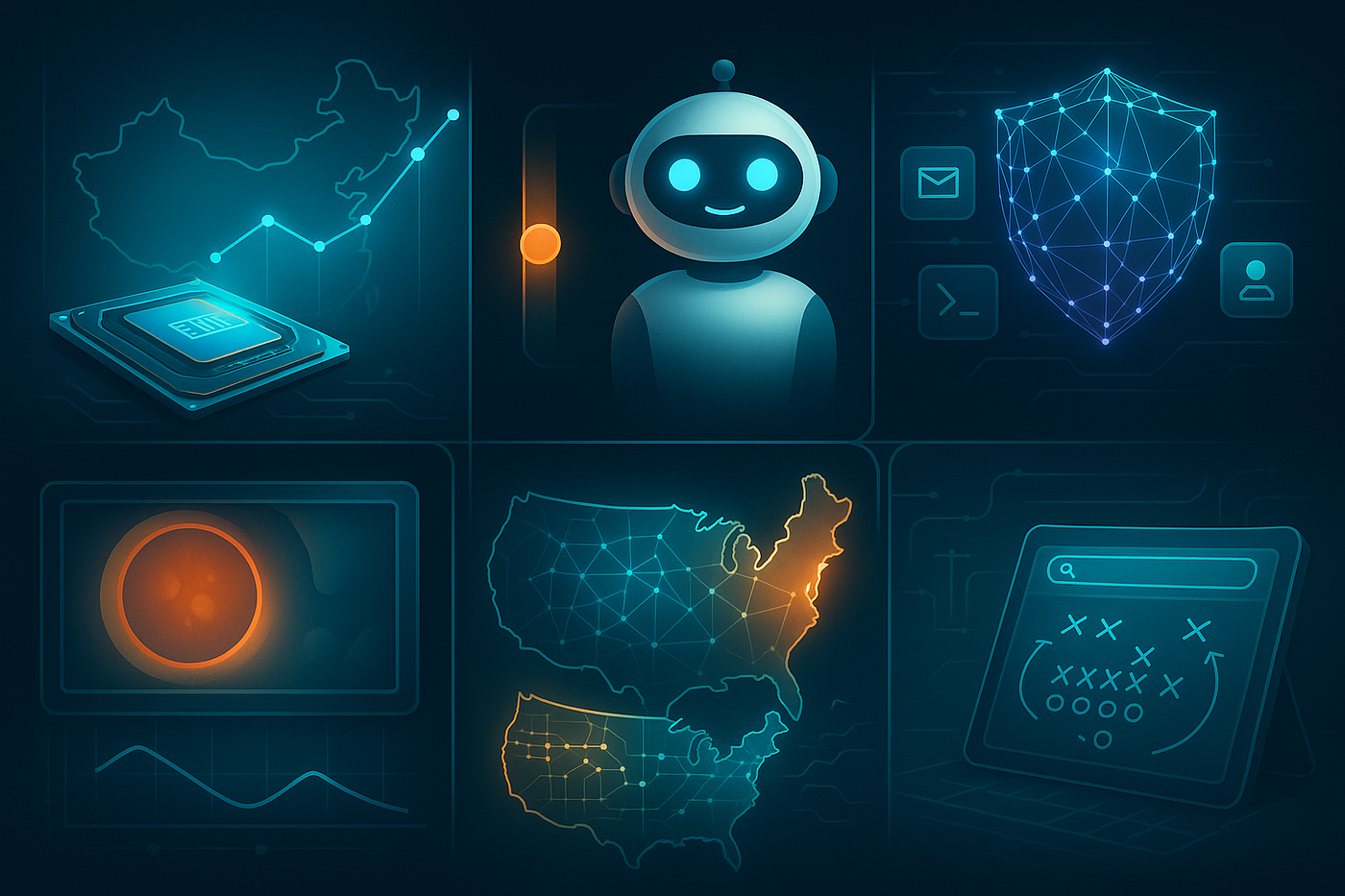
· Nvidia beat — headwinds lurk. Blowout Q2 rev/profit, but China limits and capex digestion hint at deceleration risk.
· Consciousness vs. calibration. “Self-aware” model debates meet OpenAI’s shift to warmer and safer guardrails after a tragic misuse case.
· Skills at risk. New study finds clinicians’ detection fell after routine AI assistance — simulation and “AI-off reps” matter.
· Threat intel reality check. Anthropic details agentic misuse (extortion, job fraud, ransomware) and countermeasures — applies well beyond Claude.
· Power = strategy. U.S. grid constraints vs. China’s surplus shape the AI build-out.
· On the field. NFL rolls out Copilot+ PCs for faster, filterable play analysis — AI meets real-time decision-making.
· Of interest: MemDec (a third path beyond retraining/RAG), best open-source AI UIs (Ollama/LM Studio/Open WebUI), Lightning AI’s multi-cloud GPU marketplace, and why brands must disclose AI use (see J.Crew flap).
— — — — — — -
To begin, and probably old news by now, Nvidia’s earnings. Pretty positive, but are there headwinds? From the ‘NY Times’ reporting:
Concerns over whether tech companies would continue shelling out billions to build A.I. data centers — spending that has helped prop up the economy — had mounted in recent months. But Nvidia’s sales rose 56 percent to $46.74 billion in the three months that ended in July, just topping Wall Street’s expectations. Profit increased more than 59 percent to $26.42 billion.
The ‘Mercury News’ follow-up focuses more on potential decelerating growth, with the following:
The outlook adds to concern that the pace of investment in AI systems is unsustainable. Difficulties in China also have clouded Nvidia’s business. Though the Trump administration recently eased curbs on exports of some AI chips to that country, the reprieve hasn’t yet translated into a rebound in revenue.
On the road to AGI/ASI, can you tell if you’re bot is conscious? Rakib.ai at ‘AI Advances’ shows how certain LLM interactions would lead one to believe there is a hint of self-understanding. He describes four levels, with a few LLMs achieving Level 3 capabilities:
Level Three is where things get interesting. Only four models achieved this: Claude-4.1-Opus, Llama-3–70b-instruct, Reka-core, and Command-R. These systems display genuine self-expression capability. They don’t just recognize themselves — they reflect on the experience of recognition. Claude-4.1-Opus particularly stands out, often expressing uncertainty about its own consciousness in ways that mirror philosophical debates among humans.
And what really defines consciousness, if it is based on the fidelity of the interaction? Along this line of thought, what happens when your bot companion is less ‘there?’ As a reaction to models becoming too close to their users, OpenAI dialed down the emotion on GPT-5 compared to previous models, in line with Sam Altman’s concerns:
“People have used technology including AI in self-destructive ways; if a user is in a mentally fragile state and prone to delusion, we do not want the AI to reinforce that,” Altman wrote. “We value user freedom as a core principle, but we also feel responsible in how we introduce new technology with new risks.”
But, as Thomas Smith at ‘The Generator’ posts, they are now recentering the bot to strike a balance, including restoring access to earlier models. There are known dangers, however, and in parallel with adding back some of the warmth and friendliness, OpenAI plans additional guardrails. This after another suicide where the teen relied on ChatGPT as a life coach. From the ‘Mercury News’ reporting:
In its post Tuesday, OpenAI said it tells users who express thoughts of suicide to contact professional help. The company has also begun to push people toward local assistance in the US and Europe — and will enable clickable access within ChatGPT to emergency services. The company said it’s also considering how to help people earlier when they’re experiencing a crisis, such as by potentially creating a network of licensed professionals that users could connect with via the chatbot.
Looking forward, how do we preserve essential skillsets in a world of AGI? This may become a concern earlier than we expected, with the ‘NY Times’ weighing in on the risk that doctors are losing essential skillsets as they rely more on AI. From the article:
A study published in the Lancet Gastroenterology and Hepatology found that after just three months of using an A.I. tool designed to help spot precancerous growths during colonoscopies, doctors were significantly worse at finding the growths on their own.
And:
· Dr. Ahmad (of UCHL) said it might also be the case that after months of relying on a helper, the cognitive stamina that’s required to carefully evaluate each scan had atrophied.
· Either way, medical education experts and health care leaders are already considering how to combat the effect. Some health systems, like UC San Diego Health, have recently invested in simulation training, which may be used to help doctors practice procedures without A.I. to keep their skills sharp, said Dr. Chris Longhurst, chief clinical and innovation officer at the health system.
Turning to security, Anthropic’s new ‘Threat Intelligence Report: August 2025’ addresses how bad actors abuse Claude but is also a good proxy for all models. The report notes that:
- Agentic AI has been weaponized.
- AI has lowered the barriers to sophisticated cybercrime.
- Cybercriminals and fraudsters have embedded AI throughout all stages of their operations.
Jump to the report for ways to detect and counter these abuses before they occur!
As you probably know, I have an interest in understanding how AI is influencing our energy outlook (and investments). MKWriteshere describes the current state of play in China, and how the US is at risk of being left behind in the AI race, amongst other things, due to a lack of grid capacity. He notes:
· While we’ve spent decades cutting infrastructure budgets and celebrating tax breaks, China built something we can no longer compete with a power grid that works. Not just works — overdelivers by 100%. They maintain twice the electrical capacity they need, while we operate on 15% margins that collapse during heat waves.
· The powerful in China understand their strength depends on national capability. American elites think power comes from personal wealth accumulation. This explains why oil and gas lobbyists actively sabotage renewable energy development even as renewables become cheaper than 90% of fossil fuel projects globally.
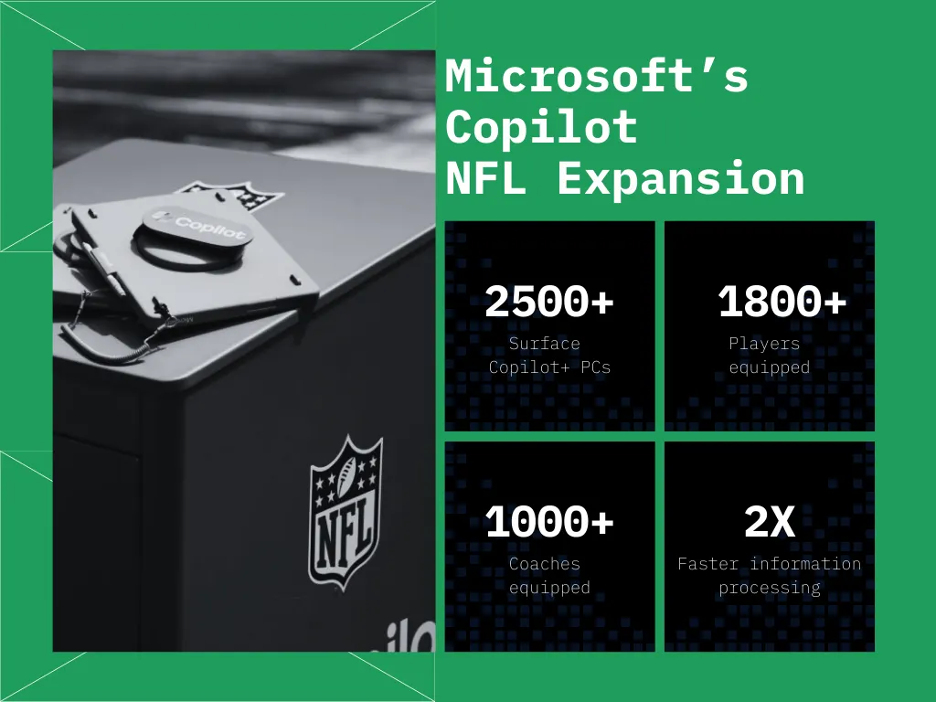
To close, most (some?) of us probably watch football, and if you remember, several years so the NFL brought Surface tablets to the sidelines. As Omar Zahran writes, they’ve now taken the next step with ‘Copilot+ PCs’ with AI hardware:
When you boil down the machismo and violence of the sport, football often becomes directional math. On any given play, there is a symphony of patterns and orchestration that can be looked at as a complex equation. On a simple running back dive play, for instance, the offensive linemen need to block in certain directions at the same time to create space for the runner. When executed properly, it becomes a positive play, but when it is not, it becomes a massive negative. Success rates of various formations and situations create an opportunity to optimize using a treasure trove of data.
And:
The inclusion of AI allows for massive data processing, which enables coaches to filter plays of interest by quarter, play type, etc. This makes in-game decision-making dynamic and smarter — where coaches can see what plays have worked in certain situations and the types of tendencies that their opposition likes to call in those situations. This data has the potential to lead to smarter decision-making but also has the potential to take away the idea of “gut calls” and general coaching intuition.
Omar rightfully concludes:
The irony of it all is that the way that NFL teams will be using Copilot and other Microsoft AI services is the way that most consumers should be using it as well — as a supplementary tool and not an all-seeing divine source of truth. Generative AI is at an inflection point, where the investment needs to have a payoff. And the way that happens is through practical applications that visibly address specific needs and use cases.
Source: NFL
A link to the NFL PR.
Of Interest:
· MKwriteshare at ‘Towards AI’ on a potentially better option than full retraining or RAG to update a model’s knowledge, a technique called ‘MemDec’
· A listicle by Taha Azizi at ‘Towards AI’ on the best open-source AI UIs, including Ollama, LM Studio, Open WebUI, and others
· R. Thompson (PhD) at ‘Towards AI’ on Lightning AI’s new multi-cloud GPU marketplace, breaking the shackles tying developers to only AWS, Google Cloud, or Azure
· ‘AdAge’ on the need for brands to be transparent in their AI use, with J.Crew as an example as to what not to do
메타데이터
- post_id
- 7bf3ba0a50c3
- slug
- ai-society-8-29-25-7bf3ba0a50c3
- url
- https://medium.com/a-i-society/ai-society-8-29-25-7bf3ba0a50c3
- canonical_url
- https://medium.com/a-i-society/ai-society-8-29-25-7bf3ba0a50c3
- author_url
- https://medium.com/@daveginsburg
- status
- ok
- fetched_at
- 2026-06-11 05:11:55