E=mc² Artifact: Potential, Kinetic, Total, or Particle Energy? NONE!️
But Time Potential 0.5 c²/D² Is All of the Above!
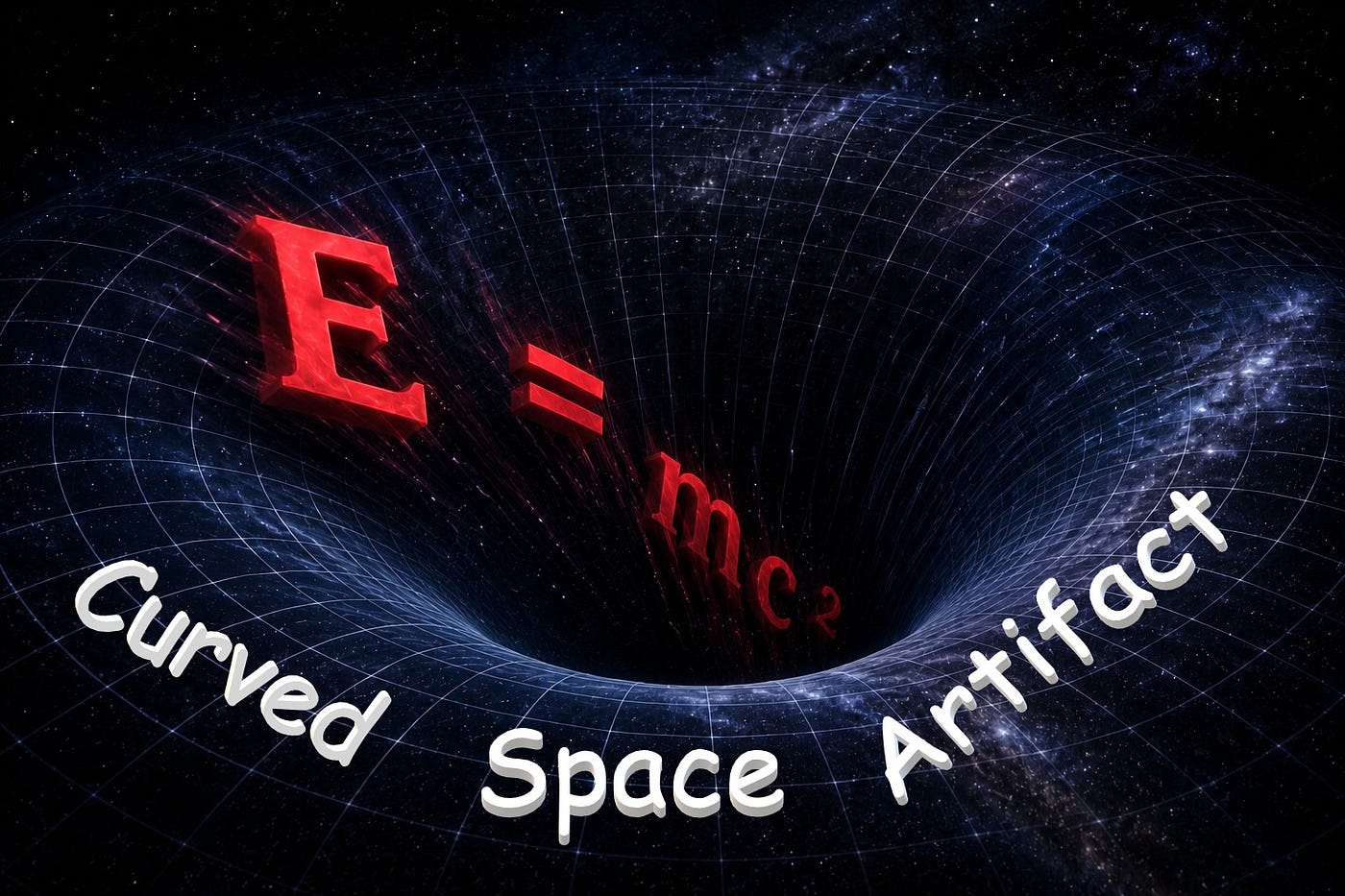
E=mc² Artifact: Potential, Kinetic, Total, or Particle Energy? NONE!️
But Time Potential 0.5 c²/D² Is All of the Above!
[embed]“The Most Common Mistake in Physics Is by a Factor of Two.” Lev Landaumedium.com
Free eBook↗️ exposed Einstein’s motivation for the curved space artifact, which led to multiple consequences, one of which was his energy formula. Let’s review it and alternative Time Potential from the perspective of various energy types.
Potential and Potential Energy
Potential is a numeric value assigned to every point in space, allowing us to easily determine the energy required to move a unit mass between any two points as the difference in their potentials. Potential energy is a product of mass and potential. So, if E=mc² were a potential energy, then the corresponding potential would be the same c² everywhere, meaning, no energy would be needed for motion.
On the contrary, for the Time Potential 0.5 c²/D², where D is local time dilation rate (compared to D=1, not dilated far-away), energy is required for navigation between differently time-dilated points. For example, to move mass m from distance R from an attractor to distance r, energy
m × [ 0.5 c²/D(r)² — 0.5 c²/D(R)² ]
is required (and formula for D(r) is known ↗️).
Kinetic And Particle Energy
For mass m moving at a speed v, kinetic energy is 0.5 m v². Because v≤ c, E=mc² cannot represent kinetic energy.
On the contrary, 0.5 c²/D² potential, or 0.5 m c²/D² energy, represents kinetic energy of mass moving at the speed c/D, which is the observed speed of light (vs local speed of light c↗️). All elementary particles are composed of time dilated shells/blobs with entrapped photons. To be precise, there are 3 types of elementary particles:
- free photons
- time dilated blob with entrapped photons (electrons, protons, neutrons…)
- time dilated blob only (neutrino)
Photons and neutrinos are restless (“massless” is not the correct term) particles moving at the observed speed c/D. Their kinetic energy combined is 0.5 m c²/D².
Total Mechanical Energy
Einstein’s formula for time dilation D for an object moving at a speed v is
D = 1/ √ (1–v²/c²). No worries, it does not come from the curved space artifact.
Using it in Time Potential formula:
Potential = 0.5 c²/D² = 0.5 c² (1–v²/c²) = 0.5 c² — 0.5 v² => Potential + 0.5 v² = 0.5 c² => m × Potential + 0.5×m×v² = 0.5×m×c² => Potential energy + Kinetic energy = mc²/2
Therefore, total mechanical energy is mc²/2 and not mc². And mc²/2 is the energy of mass m at rest (for v=0, D = 1) by 0.5 c²/D² = c²/2 potential.
Conclusion
If that raises eyebrows, then congratulations: you are not braindead. Explore more in
[embed]Or click here to download Physics.pdf free eBookon drive.google.com
메타데이터
- post_id
- 7c065c1f3b4a
- slug
- e-mc²-artifact-potential-kinetic-total-or-particle-energy-none-️-7c065c1f3b4a
- url
- https://medium.com/timematters/e-mc%C2%B2-artifact-potential-kinetic-total-or-particle-energy-none-%EF%B8%8F-7c065c1f3b4a
- canonical_url
- https://medium.com/timematters/e-mc%C2%B2-artifact-potential-kinetic-total-or-particle-energy-none-%EF%B8%8F-7c065c1f3b4a
- author_url
- https://medium.com/@alexkass700
- status
- ok
- fetched_at
- 2026-06-11 12:34:08