API: A comprehensive journey through Domain-Driven Design, the Synergetic Blueprint, and the…
APIs are a rich topic and there are many books on the subject. Some are entirely dedicated to APIs, while others cover them as part of…
API: A comprehensive journey through Domain-Driven Design, the Synergetic Blueprint, and the evolution of modern software architecture .
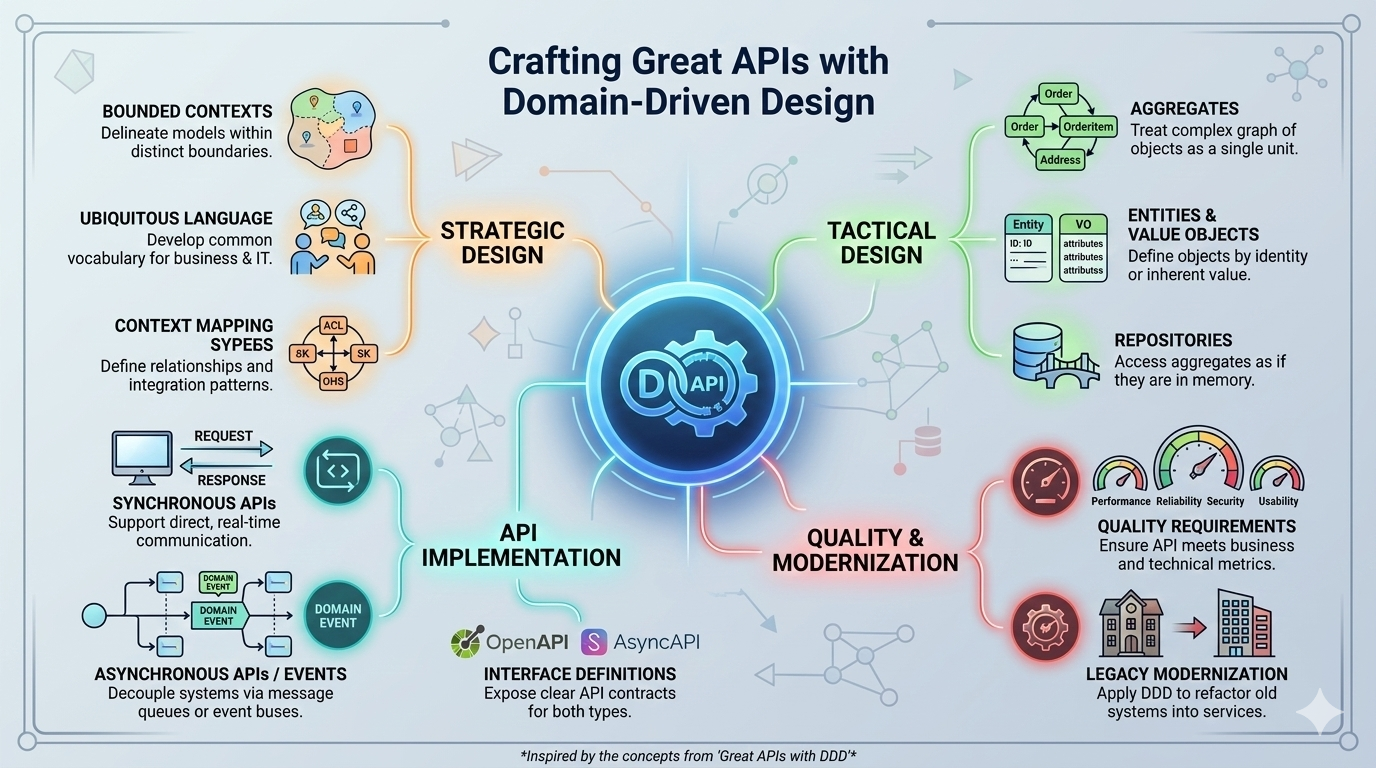
APIs are a rich topic and there are many books on the subject. Some are entirely dedicated to APIs, while others cover them as part of broader technical topics. In the first part of my Course “API”- https://youtube.com/playlist?list=PLvQtM9gpAYgJtUZ27UcxBhR9eso-r74MU&si=Deso8CdnTBhGM44U -
we took a deep dive into the O’Reilly classic “Learning API Styles”. For Part 2, I want to start with another essential work: the 2025 Apress book “Crafting Great APIs with Domain-Driven Design.”

At 412 pages, this book is both highly detailed and easy to understand. The diagrams are clear and easy to understand. Each of the 15 chapters is followed by an extensive list of sources — Chapter 6 alone, for example, lists 136 references. Every chapter also concludes with ‘Points to remember’ and ‘Review questions,’ making it an excellent learning resource.While the authors suggest it is suitable for anyone interested in the topic, I would personally recommend it as a perfect starting point for those with absolutely no prior experience or knowledge of API development.
If I were to characterize this book in a few words, I would call it a very honest book. Throughout the text, the authors emphasize the necessity of meticulous documentation and the use of a language that is understandable to all stakeholders (Ubiquitous Language).They truly practice what they preach: the book itself is carefully formulated, highly detailed, and easy to follow. The authors believe what they write. If you will read this book, you will understand what I mean.
The explanations of DDD, for example, begin with a detailed explanatio of the Simple, Complicated, Complex, and Chaotic domains. This is done to clearly illustrate the creator’s Eric Evans original intent: that Domain-Driven Design is specifically designed to manage complexity. Hier is diagram for this explanation:

The book also covers the historical evolution of the technologies mentioned and provides precise definitions for every term used. If you want a quick overview of the content, the ‘Introduction’ at the beginning of the book offers a short summaries of each chapter. I’d want to share what resonated with me personally. Let’s start with the core concepts and ideas.
I. The most important findings.

API as a Product: A fundamental shift in perspective: APIs should be treated as standalone products. This means the developers using the API are your ‘customers.’ Success depends on Developer Experience (DX) — prioritizing seamless integration, stellar documentation, sandboxes, and meaningful error messages.
The Symbiosis of DDD and API Design: The book demonstrates that Domain-Driven Design (DDD) is the ideal toolkit for managing modern software complexity:
Bounded Contexts: APIs should be designed along clear functional boundaries to avoid ‘World-Domination APIs’ (overloaded interfaces that try to do everything at once).
Ubiquitous Language: The terms in your API specification must match the shared language used by both business stakeholders and IT to minimize misunderstandings.
The Collaborative Process (Synergetic Blueprint): A central methodological insight is the Synergetic Blueprint, which guides teams from a business idea to a finished API:
Domain Storytelling & Event Storming: These workshops help visually capture functional requirements and identify context boundaries and data flows.
Visualization before Implementation: Every business decision should be visualized (e.g., through a Visual Glossary or Context Map) before a single line of code is written.
A Strict API-First Approach: The book makes a strong case for API-First over Code-First. By defining the ‘contract’ (the interface) first, stakeholders can provide early feedback, documentation is never an afterthought, and frontend and backend teams can work in parallel.
Quality Beyond Functionality: API design must go beyond pure logic. It must integrate Quality Attributes (based on ISO 25010) such as resilience, security, observability, and maintainability from the very start. As the authors put it: An API is ‘forever,’ while code is transient.
Technical Strategy & Decision Models: There is no ‘one-size-fits-all’ solution for protocols. The book provides models to help you decide when to use synchronous REST, gRPC, or GraphQL, versus asynchronous events (AsyncAPI/Kafka), based on factors like user interaction, performance, and team skills.
Modernizing Legacy Systems (Brownfield): The book offers invaluable strategies for modernizing legacy systems. Using patterns like the Strangler Fig Pattern and Anti-Corruption Layers (ACL), you can build modern API structures over outdated database models without disrupting ongoing operations.
In summary, the most important finding is that collaborative design and technical precision form the basis for APIs that not only work technically, but also create real business value.
II. The Toolkits

The book presents a wide array of tools and methodologies covering the entire lifecycle — from the initial business idea to the technical implementation of an API. These can be divided into several key categories:
Strategic and Analytical Methods (Workshops):
Business Model Canvas: Used to outline business plans and identify key partners, activities, and resources.
Capability Map: Helps structure business capabilities into core, supporting, and generic subdomains.
Wardley Map: A crucial tool for prioritizing requirements based on user visibility and market evolution.
Domain Storytelling: An interactive workshop format to visually capture functional requirements through storytelling- https://domainstorytelling.org/
Event Storming: A method used to describe business processes via domain events and to define Bounded Contexts and Aggregates.
Context Mapping: Visualizes the dependencies between different Bounded Contexts and the necessary data flows.
Specialized Documentation Canvases:
Bounded Context Canvas: Used for the detailed description and documentation of a single Bounded Context, including its “Ubiquitous Language.”
Architecture Communication Canvas: Provides a condensed overview of a service’s architecture, core decisions, and quality requirements.
API Product Canvas: A tool developed by the authors specifically for designing the synchronous and asynchronous interfaces of a Bounded Context. https://apievangelist.com/
Specification and Data Formats:
OpenAPI (formerly Swagger): The industry standard for defining synchronous REST interfaces.
AsyncAPI: A specification standard for asynchronous messages and events, supporting protocols like Kafka or AMQP — **https://www.asyncapi.com/de**
gRPC and GraphQL: Presented as alternative approaches for high-performance Remote Procedure Calls and flexible, query-based APIs, respectively.
Data Schemas: The book covers various formats such as JSON, XML, Protocol Buffers (Protobuf), and Apache Avro. https://json-schema.org/
Development and Testing Tools:
Linters (e.g., Spectral): Static analysis tools that automatically validate API specifications against defined rules and standards.
Contract Testing (e.g., Pact): A method to ensure that both the provider and consumer of a service adhere to the agreed-upon contract.
Schema Registry (e.g., Apicurio): A central repository for managing and checking the compatibility of different schema versions.
AI Assistance (ChatGPT / Claude): Demonstrates how generative AI can be used to create initial API drafts directly from workshop visualizations.
Visualization Tools: Recommends remote whiteboards like Miro or Mural, as well as specialized tools like egon.io for workshops.
III. The Synergetic Blueprint: A Methodology for API Success

The book introduces a comprehensive process called the Synergetic Blueprint, which methodically guides teams from the initial business idea to the technical implementation of an API. This workflow is divided into three main phases:
1. Strategic Design (Strategic Analysis): The goal here is to understand the business domain and draw functional boundaries:
Business Model Canvas: Used to outline the business plan and identify key partners and activities.
Capability Map: Structures business capabilities into core, supporting, and generic subdomains.
Wardley Mapping: A strategic tool to prioritize functions based on user visibility and market maturity (Genesis, Custom, Product, Commodity).
Domain Storytelling: A collaborative workshop where experts tell stories that are visually documented to establish a Ubiquitous Language.
Event Storming: Helps describe business processes through domain events to identify Bounded Contexts and Aggregates.
Context Mapping: Visualizes relationships, data flows, and team dependencies between different contexts.
2. Tactical Design (Detailed API Design): In this phase, the individual contexts and their interfaces are concretely defined:
Bounded Context Canvas: Documents the specifics of a single context, including its business rules and terminology.
Architecture Communication Canvas: Provides a high-level overview of architectural decisions and quality attributes for a service.
API Product Canvas: A specifically developed tool to design synchronous and asynchronous interfaces based on business requirements.
3. Implementation and Process Methodologies: The book advocates for modern software engineering practices to ensure sustainable development:
API-First Approach: The specification (the contract) is created before the code, enabling parallel development and early feedback.
Contract Testing: Using tools like Pact to ensure providers and consumers adhere to the agreed API spec without relying on expensive end-to-end tests.
Strangler Fig Pattern: A strategy for the incremental modernization of legacy systems (Brownfield) by gradually migrating functionality to new microservices.
ApiOps: Applies DevOps principles (automation, CI/CD) to the entire API lifecycle.
Data Mesh: A decentralized data management concept where domain teams provide their data as independent Data Products via APIs.
Team Topologies: Organizes teams (e.g., Stream-aligned or Platform teams) to align perfectly with the chosen software architecture.
Additionally, the authors highlight supplementary techniques like User Story Mapping for release planning and Example Mapping to define business rules through concrete scenarios.
VI The Logical Architecture of the Book

What impressed me is also the underlying logical architecture I identified while reading. The book isn’t just a collection of chapters; it’s a structured journey that mirrors the actual lifecycle of a software product. To me, this logical progression is a masterclass in how we should approach API projects in the real world. The transition from chapter to chapter and part to part follows a strict logical progression that mirrors the lifecycle of a software product. This logic is rooted in the authors’ Synergetic Blueprint, tracing the journey from the initial business idea to stable API operations. The overarching flow can be summarized as: Why do we need API design? → What exactly are we building (Methodology)? → How do we implement it technically and organizationally? → What have we learned (Best Practices)?
Part I: The Significance of API Design (The “Why”). This part lays the foundation.
Logic: Before designing a solution, one must fully understand the problem.
Transition: It begins by analyzing poor APIs (Ch. 1), moves to defining communication styles (Ch. 2) to establish a common language, and finally sets the quality benchmarks (Ch. 3) against which every API must be measured.
Part II: Domain-Driven API Design (The “How do we design?”). This is the methodological core of the book.
Logic: Moving from abstract business desires to a concrete technical contract.
Transition: After clarifying the theory, Chapter 4 introduces a continuous real-world example (Online Library). Chapter 5 demonstrates how to carve out the domain using Strategic DDD (Business Model, Domain Storytelling). Chapter 6 introduces technical standards (OpenAPI, AsyncAPI), which are then directly applied to the example in Chapter 7 (Tactical Design).
Part III: Enabling Transformation (The “How do we implement and evolve?”). The focus shifts from design to the reality of daily software operations.
Logic: A design is worthless if it cannot be implemented, tested, and adapted to change.
Transition: Chapters 8 and 9 cover technical execution (testing, versioning) and the necessary agile mindset. Chapters 10 to 13 extend this logic to real-world scenarios: iterative improvements, handling legacy systems (Brownfield), process shortcuts, and the specifics of the cloud-native world.
Part IV: Summary (The “Results”). This part serves as a reflection and conclusion.
Logic: Consolidating knowledge through positive and negative archetypes.
Transition: Chapter 14 shows how to avoid the mistakes identified in Chapter 1. Chapter 15 presents “Beautiful APIs” as the target state, and Chapter 16 summarizes the entire journey.
The Core Message of This Logic: The structure reinforces that great APIs do not happen by accident. They are the result of a collaborative process that synchronizes Business and IT.
V. Resolving the Paradox: “API is Forever” vs. Continuous Evolution

At first glance, the statement “API is forever” seems to contradict the later chapters on adaptation and change. However, there is no fundamental conflict; rather, it is a crucial distinction between the stability of the contract and the evolution of the product. Based on the book’s core principles, here is how this apparent contradiction is resolved:
1. The Meaning of “API is Forever”.
The mantra “APIs are forever — code is for the moment” primarily concerns abstraction and coupling. While the underlying implementation (the code) can be refactored or replaced at any time, the interface must remain a stable anchor for the consumer. Once published, external systems rely on this specification; any unmanaged change would break their integration.
2. The Necessity of Change (The VUCA World).
Simultaneously, the book acknowledges that we live in a VUCA world (Volatility, Uncertainty, Complexity, Ambiguity), where business requirements are in constant flux. Rigidly refusing to update an API would prevent a software product from responding to market shifts.
3. The Solution: Versioning and Backward Compatibility.
Methodical discipline bridges the gap between stability and change, as detailed in the later chapters:
Backward Compatibility: APIs can be extended by adding new (optional) fields without impacting existing clients.
Semantic Versioning (SemVer): Using Major, Minor, and Patch versions clearly communicates which changes are safe and which (in the case of a Major version) constitute a break in the contract.
Coexistence: In practice, it is common to run two versions of an API in production simultaneously (“two in production”), giving consumers ample time to migrate.
Double Writing: For asynchronous APIs (Events), the book recommends sending both versions of an event in parallel during major transitions. This guarantees stability for legacy consumers while allowing new ones to benefit from updated data.
4. Agility vs. Stability.
The book clarifies that an agile mindset and stable APIs are not contradictory. Stability does not mean stagnation; it means the reliability of the contract. Through collaborative design (the Synergetic Blueprint), changes are planned alongside consumers. The API remains “forever” in the sense of a dependable promise, even as it iteratively evolves.
In summary: “Forever” means that the specification contract remains valid for a consumer as long as they need it, while extensions and new versions enable the necessary business progress.
VI. Evolving the Ecosystem: Feature Expansion and Integration

The overarching theme is that APIs must be viewed as living products that evolve through close collaboration between business experts and IT specialists. Even after the initial release, the “Synergetic Blueprint” continues to guide the development.
1. The Process of Change (Iterative Expansion): Software is never “finished.” It requires continuous, iterative development to adapt to shifting business and technical landscapes. This section details how changes are structured to maintain a clear business alignment:
Domain Storytelling: Even small extensions (e.g., adding a feature to invite non-members) are first visualized to clarify functional requirements and impacts.
New Bounded Contexts: Large new features may require the creation of new, modular contexts to allow independent development teams to scale without friction.
Living Documentation: Technical and functional specifications — such as the Visual Glossary, API Product Canvas, and OpenAPI/AsyncAPI files — must be updated immediately to reflect the new state of the product.
2. Connecting with Other APIs (Integration Strategy): Integrating external or new internal APIs requires robust stability measures to prevent “context leakage”:

Anti-Corruption Layer (ACL): A crucial pattern where an adapter protects the internal domain model from being “polluted” by changes in an external partner’s model.
Collaborative Workshops: Specifications with partners are defined through joint storytelling and canvas-based design sessions to ensure shared understanding.
Event-based Integration: For asynchronous internet connections, the book highlights why Webhooks are often preferred over internal event brokers due to easier security management and lower coupling.
3. Post-Go-Live Strategies: Ensuring Zero Disruption: To maintain the “API is Forever” promise while evolving, the book outlines several strategies for a seamless transition:
Semantic Versioning (SemVer): A strict numbering system to clearly signal breaking vs. non-breaking changes.
Backward Compatibility: Prioritizing designs that allow legacy clients to continue functioning while new clients leverage updated features.
Parallel Operations: Running multiple API versions concurrently in production (“Two in Production”) to provide consumers with a safe and flexible migration window.
VII. APIs and Events in a Serverless World

The shift from classic Three-Tier Architecture to a cloud-native, serverless ecosystem is driven by a change in quality requirements. Today, apps must be globally available 24/7, with zero tolerance for maintenance windows or single points of failure.
1. From Monolithic Databases to Distributed State: In classic architectures, a single relational database (RDBMS) handled transactions. However, this model faces limits today:
Scaling: Traditional RDBMS often scale only vertically (bigger instances), which fails under modern global workloads.
Independence: Independent teams need to deploy fast. A single, shared database becomes a bottleneck and a risk.
Resilience: A cloud-native ecosystem requires a distributed state, ensuring that the failure of one component doesn’t bring down the entire system.
2. Understanding the CAP Theorem (ACID vs. BASE): To design modern APIs, one must understand the trade-offs described by the CAP Theorem (Consistency, Availability, Partition Tolerance).
ACID (Traditional): Provides “immediate consistency.” It’s simple but sacrifices availability and horizontal scaling.
BASE (Modern): “Basically Available, Soft state, Eventually consistent.” While harder to implement, BASE systems are the backbone of scalable microservices.
Impact on API Design: Understanding these models is essential because asynchronous APIs are often a direct necessity of using BASE data stores.
3. The Power of Statelessness: Even when an interface feels “stateful” — like a chatbot — the underlying API is often strictly stateless.
Example LLMs: Systems like OpenAI’s ChatGPT or Anthropic’s Claude require you to resend the conversation context with every request.
The Benefit: This makes load balancing and scaling much simpler, as any available instance can handle any request. It’s an elegant way to turn a complex session into a manageable, scalable deployment.
4. Implementing Serverless APIs: The book explores practical implementations, such as using AWS Lambda in combination with an Amazon API Gateway. This allows routing REST calls directly to serverless functions that process endpoints on demand, removing the need for permanent server management.
Conclusion: From Theory to Practice.
Reading “Crafting Great APIs” was more than just a theoretical exercise for me; it was a validation of how modern software should be built. The core message is clear: Great APIs aren’t built in isolation — they are the result of a collaborative, domain-driven, and product-oriented mindset.
Appendix: To better navigate the vast amount of information in this book, I have created some comprehensive Mindmaps that translate the core concepts into a visual format. I am making these available to you here as a reference for your own API journey:


메타데이터
- post_id
- 7c08d17201e8
- slug
- api-a-comprehensive-journey-through-domain-driven-design-the-synergetic-blueprint-and-the-7c08d17201e8
- url
- https://medium.com/@humannativ/api-a-comprehensive-journey-through-domain-driven-design-the-synergetic-blueprint-and-the-7c08d17201e8
- canonical_url
- https://medium.com/@humannativ/api-a-comprehensive-journey-through-domain-driven-design-the-synergetic-blueprint-and-the-7c08d17201e8
- author_url
- https://medium.com/@humannativ
- status
- ok
- fetched_at
- 2026-06-22 12:55:45