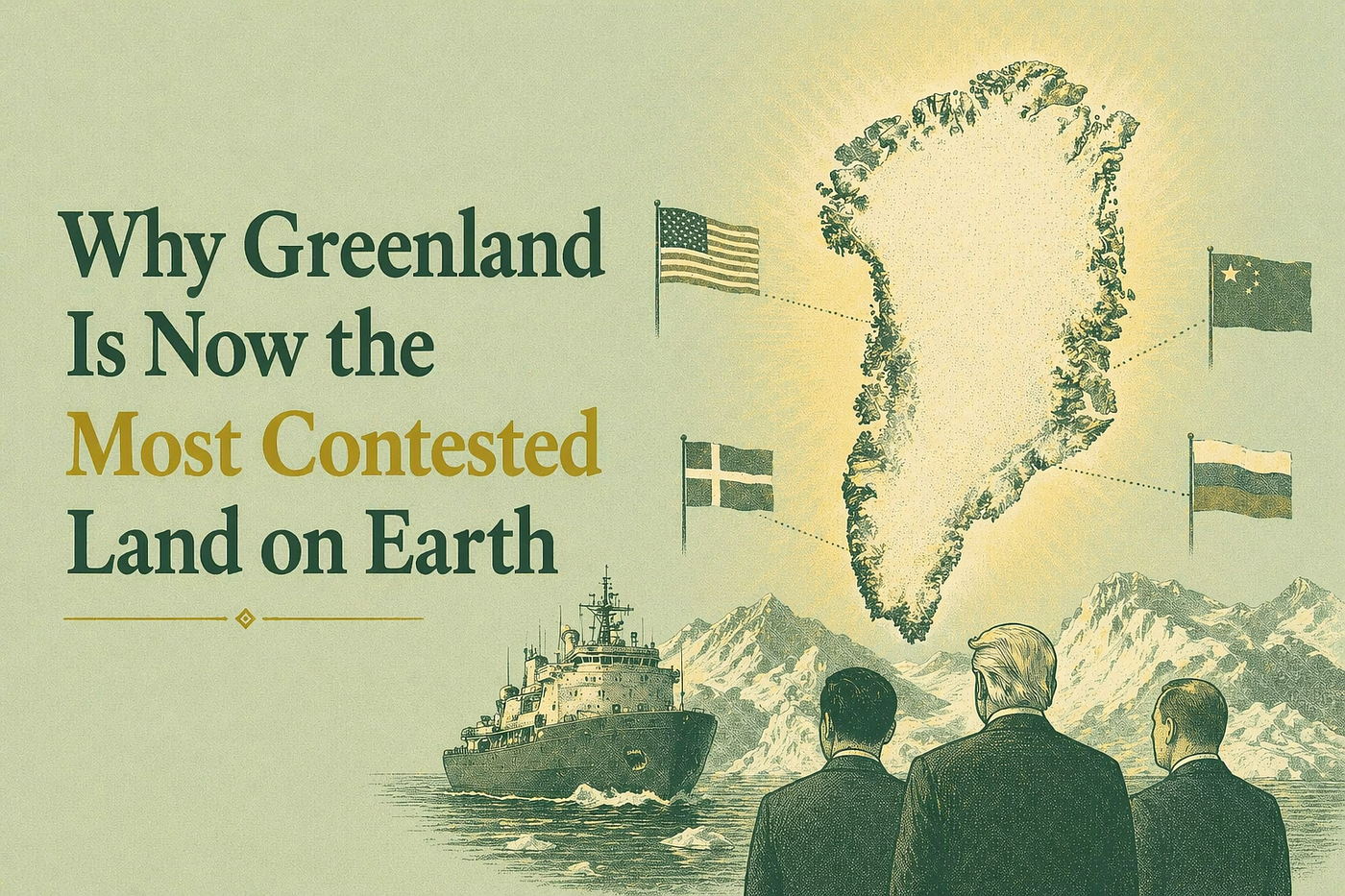
Why Greenland Is Now the Most Contested Land on Earth
How climate, resource race, and great-power rivalry reshape Arctic power
Why Greenland Is Now the Most Contested Land on Earth
How climate, resource race, and great-power rivalry reshape Arctic power
The Image You Already Have
You’ve seen the headlines pass by.
A joke about buying Greenland. A satellite image of melting ice. A photo of a base under snow.
It registers as trivia.
- Strange
- Mildly interesting
- Easy to dismiss
Greenland feels far in every sense that matters.
No crowds. No chaos. No crisis breaking today.
So the story gets filed where quiet places go.
Between climate news and geopolitical curiosity.
Important later. Not urgent now.
Even when officials visit, it looks ceremonial. Even when infrastructure upgrades appear, they sound routine. Even when analysts mention the Arctic, the tone stays abstract.
There’s no alarm to react to. No trigger. No reason to slow down.
The situation feels stable. Predictable. Managed.
Nothing felt wrong.
That’s what made it invisible.
The Belief That Keeps Greenland Peripheral
There’s a belief that settles in almost automatically.
Greenland is:
- Far
- Cold
- Thinly populated
It doesn’t behave like the places that usually matter.
- No conflict
- No rush
- No forcing function
Serious attention feels unnecessary.
This belief isn’t careless.
It’s disciplined.
Analysts are trained to prioritise:
- Heat
- Escalation
- Movement
Greenland offers none of that.
Treating it as marginal feels responsible.
It avoids exaggeration. It resists hype.
There’s comfort in this framing.
If something truly mattered, it would announce itself loudly.
Markets would react. Diplomacy would harden. Conflict would surface.
Since none of that is happening:
Greenland can wait.
That belief earns nods in briefing rooms.
It sounds grounded. Practical.
And that’s why it lasts.
When the Assumption Still Works — Until It Doesn’t
For a long time, the belief holds.
Greenland stays quiet. Shipping remains seasonal. Projects move slowly or stall.
Even changes arrive politely.
- A facility expands
- A radar is modernised
- A study is commissioned, then shelved
Each event fits the story.
Routine. Maintenance. Long-term planning without urgency.
The belief doesn’t just survive.
It performs.
The fracture condition
When strategic value forms before outcomes become visible.
Not after routes are crowded. Not after extraction scales.
Earlier.
At the moment:
Access improves faster than attention does.
When presence becomes easier than reversal.
The belief doesn’t collapse.
It fails selectively.
It still explains why nothing is happening.
It just stops explaining why preparation has already begun.
Greenland doesn’t need to become busy to matter.
It only needs to be positioned.
Nothing breaks. Nothing escalates.
But the conditions that justified ignoring it begin to thin.
What Quietly Disappears
The cost doesn’t arrive as loss.
It arrives as narrowing.
Options don’t vanish.
They compress.
Decisions that could be delayed:
Become quietly assumed.
Alternatives remain open.
But practically distant.
Nothing breaks.
Something thins.
Where thinning shows first
- Timing
Attention arrives late → under pressure
- Sensitivity
Shifts stop being noticed
- Perception
Presence becomes background
This is how erosion works.
Not by removing capability.
By dulling the instinct to test it.
How Strategic Value Forms Without Announcement
Strategic relevance doesn’t arrive through declaration.
It assembles.
- Ice retreats
- Distance shrinks
- Operating windows widen
- Access improves
No one has to “want” Greenland.
Geography does the work.
As access normalises:
Presence becomes easier to justify.
Each move looks reversible. Each feels reasonable.
That’s how access replaces ownership.
Control requires confrontation.
Access requires normalcy.
Once reachable:
It becomes part of planning by default.
By the time doctrine catches up:
Positioning is already done.
Power doesn’t rush to claim.
It ensures it won’t be excluded.
The Signal Almost Everyone Misses
The early signal isn’t escalation.
It’s humour.
When serious actors joke about a place:
It has already entered planning.
Ridicule requires safety.
If it didn’t matter, it wouldn’t be referenced.
Signal progression
- Jokes → Entry into planning
- Technical language → Formalisation
- Flat discussion → Stabilisation
By the time discussion becomes serious, the signal has passed.
Control is loud.
Positioning is quiet.
What Usually Gets Lost
Most strategic positions aren’t lost through mistakes.
It’s lost through reasonable explanations trusted for too long.
- Comfort mistaken for stability
- Silence mistaken for safety
By the time something feels important:
The space to decide has already thinned.
Nothing dramatic marks the shift.
That’s why it works.
About the Book
Greenland on the Table — How Trump Tried to Buy the Arctic
This article looks at one place.
The book looks at the system that made it matter.
It examines how:
- Geography
- Climate
- Resources
- Security planning
Converge before outcomes become visible.
Not through predictions. Not through personalities.
Through incentives, constraints, and timing.
It doesn’t argue right or wrong.
It explains why certain ideas keep returning.
If this article felt slightly off in timing or attention:
The book sits inside that gap.
Legal Disclaimer
This article is for educational and informational purposes only and does not constitute investment advice. Examples mentioned are illustrative, not recommendations. Readers are responsible for their own decisions. Full disclaimer: Click me
메타데이터
- post_id
- 7c0b4ba5cee5
- slug
- why-greenland-is-now-the-most-contested-land-on-earth-7c0b4ba5cee5
- url
- https://medium.com/activated-thinker/why-greenland-is-now-the-most-contested-land-on-earth-7c0b4ba5cee5
- canonical_url
- https://medium.com/activated-thinker/why-greenland-is-now-the-most-contested-land-on-earth-7c0b4ba5cee5
- author_url
- https://medium.com/@MrChandravanshi
- status
- ok
- fetched_at
- 2026-06-09 15:37:30