American Revolution: Reason and Religion
The Enlightenment meets the Great Awakening
History Series: American Revolution: Reason and Religion
American Revolution: Reason and Religion
The Enlightenment meets the Great Awakening
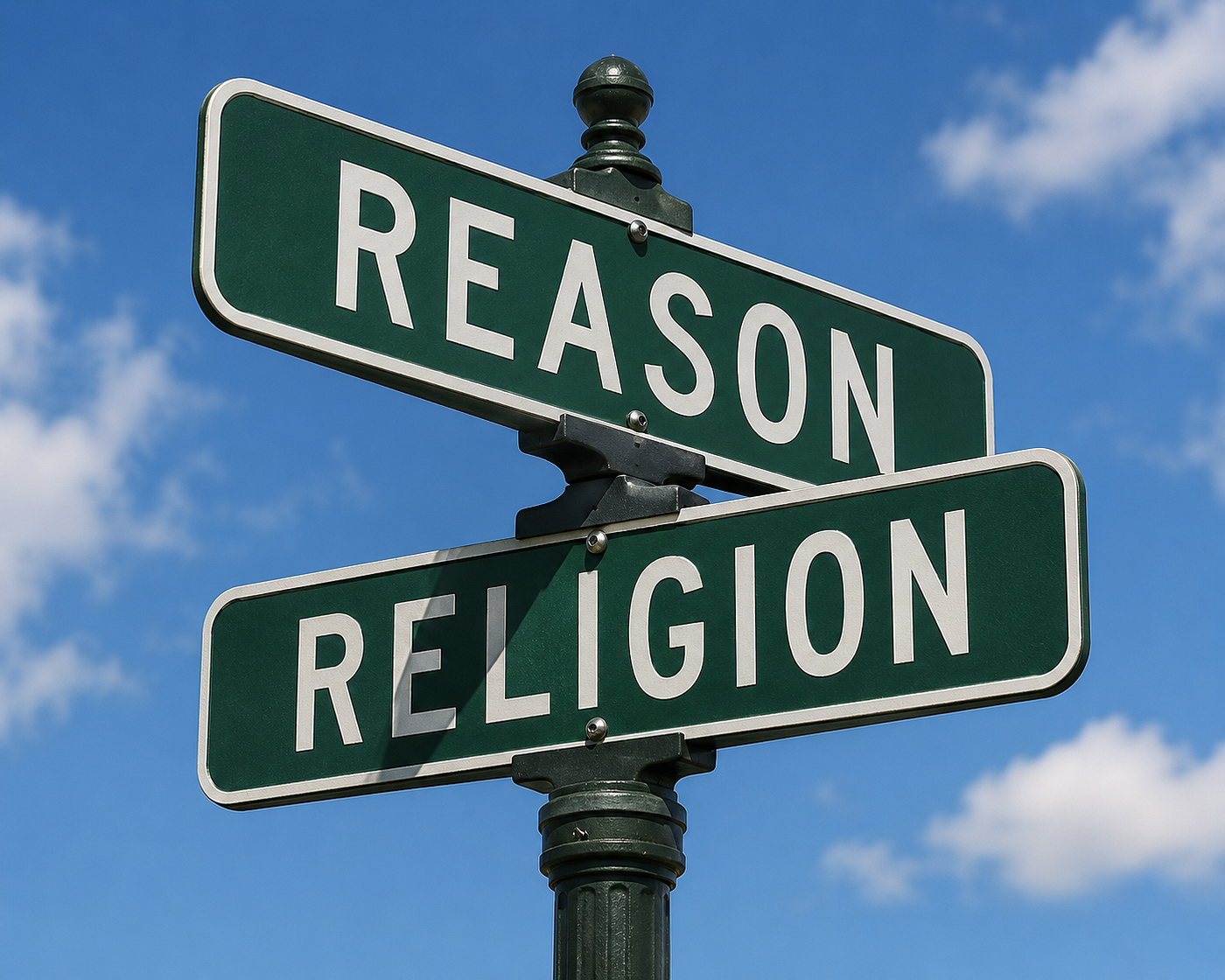
Created with ChatGPT
Part of the series on **America 250**, the US Semiquincentennial
[In my previous article, I discussed how America’s experiment in self-government has been unique across 250 years.]
Two waves propelled the 13 colonies into the prospect of independence from England and a call to write a Declaration of Independence: the Enlightenment, the Age of Reason… and Religion, the predominantly Protestant Christian faith driven by the revival of the Great Awakening.
Each was a major force in 18th-century America and greatly influenced the worldview of the Founding Fathers.
The Enlightenment: the Age of Reason
Lloyds Coffee House, London by William Holland. Image: Wikimedia
The Age of Enlightenment was a period of intellectual and cultural transformation in the late 17th century that reached its peak in the 18th century.
Arising in Europe, it spread across Western Europe and to North America. It was called the Age of Reason because it was the rise of reason and rationality. Emphasis on empirical evidence (what is perceived by the five senses) and the scientific method (repeatable experimentation) helped fuel the Scientific Revolution, which began in the 16th and 17th centuries.
This led to ideas such as religious tolerance (in contrast to state churches), natural rights (in contrast to the divine right of kings), and, especially, the idea of liberty, both religious and political.
Enlightenment Thinkers
Influenced by French philosophes and English scientists and philosophers, the Enlightenment spread to the 13 Colonies. Indeed, some of the Founding Fathers lived in Europe for a time, including Benjamin Franklin, John Adams, Thomas Jefferson, and John Witherspoon
. Here are just a few of the most influential Enlightenment thinkers:
- Voltaire, a French philosopher who advocated freedom of speech, freedom of religion, and the separation of church and state.
- René Descartes, a French philosopher who doubted everything unless there was a well-founded reason to accept it, developed the idea of Cogito, ergo sum: “I think, therefore I am.”
- Isaac Newton, an English scientist who published Principia Mathematica, which presented “natural laws.”
- Thomas Hobbes, an English philosopher and one of the founders of modern political philosophy, popularized the “social contract” theory.
- John Locke, an English philosopher and physician, advocated for government by “consent of the governed” (self-government) and the right to revolt against a tyrannical government.
All of these had a profound impact on the Founding Fathers who wrote the Declaration of Independence and later the Articles of Confederation and the U.S. Constitution.
Enlightenment Features
Some of the notable features of the Enlightenment were:
- **Coffeehouses**, sometimes called “dens of dissent”
- **Salons** in Europe and America
- Print culture, encouraged by the efforts of **Ben Franklin**
- Pamphlets, like **Thomas Paine*‘s Common Sense,* that advocated “human rights” and called for independence from England
Religion: The Great Awakening
George Whitefield preaching during the Great Awakening. Image: American Heritage
At the same time as the Founders were in school in the early 18th century, the (First) Great Awakening, a religious revival, was taking place across Great Britain and the 13 Colonies. It reshaped several denominations that originated in Europe and had immigrated to America (Congregational, Presbyterian, Dutch, and German Reformed) and strengthened the smaller Methodist and Baptist denominations.
I have written previously about this movement in my review of the film “*A Great Awakening*.”
Great Awakening Preachers
Evangelical Protestant ministers on both sides of the Atlantic Ocean drove the revival of the 1720s to 1740s:
- Solomon Stoddard, a Congregationalist minister in Western Massachusetts Bay Colony, liberalized church policy while calling for revival. He was called the “Puritan Pope of the Connecticut River valley.”
- Jonathan Edwards, Stoddard’s grandson and successor, was a Congregationalist minister in Northampton, Massachusetts. He was both a chronicler of the Great Awakening and a participant. He was the most famous American preacher of the Great Awakening. I’ve written more about his life and work *here*.
- George Whitefield made seven trips to America from his home in England. He was a “Calvinist” Methodist minister who preached Calvinist theology, the doctrine of human sinfulness that later made the Founders deeply suspicious of concentrated power. He preached in both places to crowds reported at 25,000–30,000. I’ve written more about him *here*.
- John Wesley, the founder of Methodism in England, traveled to Georgia intending to preach to the Native Americans, but ended up ministering mainly to colonists in Savannah. He later wrote the book “An Earnest Appeal to Men of Reason and Religion.” I’ve written more about him *here*.
Great Awakening Results
The impact of the Great Awakening on America was profound.
- It encouraged preaching to Native Americans and enslaved African Americans.
- Calvinism energized a greater emphasis on education. One example: a building associated with Whitefield’s ministry in Philadelphia was later repurposed by Benjamin Franklin as the academy that ultimately became the University of Pennsylvania.
- In turn, the Great Awakening helped propel Americans into the Revolution. People assumed new responsibilities in religious affairs and became skeptical of dogma and authority. These attitudes were the beginnings of a sense of independence and equality that would set the stage for the American Revolution.
- The group of patriotic clergy who actively preached in favor of independence and supported the revolutionary cause was collectively labeled by the British as the Black Robed Regiment. For example, the Reverend John Witherspoon, himself a Founding Father and signer of the Declaration of Independence, rose to read the Declaration’s words to his congregation, a moment that would spark independence in America and elsewhere. See my next article on the life and work of John Witherspoon.
- It later saw the dissolution of “established” state churches in North Carolina (1776) and Virginia (1786), and eventually in all states.
Map of Religious State Disestablishment in the United States. Image: Bill of Rights Institute
Cooperation between Reason and Religion
With the passage of the U.S. Constitution, including its Bill of Rights and the First Amendment, the role of religion at the federal level was markedly different from that at the state level. The federal expression of religion was a “least-common-denominator” consensus — generalized beliefs that were held in common by the majority of people.
This was not the case at the individual state level, where belief in Christian faith was often the standard for holding office. It seems that the states were often willing to embrace a weak view of religion at the highest level because they never envisioned a federal establishment that would overshadow and dictate to the states.
It is puzzling that in the construction of the new nation, Christians (Religion) and rationalists (The Enlightenment) could find significant agreement of purpose in the context of significant religious differences.
Both sought separation from England and embraced the same documents of state, though for different reasons.
Reason or Religion?
George Washingtonn Image: Gecko And Fly
Which had a greater impact on the American Revolution, the rationalists of the Enlightenment or the Christians of the Great Awakening? Historians have long debated this question. Serious scholars have landed on both sides of the issue.
Some see the Enlightenment as contrary to the Christian faith, while others, including some of the Founders, see the two as complementary.
It is safe to say that the Revolution would neither have been commenced nor sustained on the strength of one of these groups alone.
- The Enlightenment, with its intellectual justification and legal architecture, would have remained a drawing-room philosophy were it not for the revivalism of the Great Awakening.
- The Great Awakening created the psychological and social preconditions with a broader and deeper influence on the Revolution as a social and popular movement, supplying the emotional fuel and moral vocabulary.
Both Christians and rationalists argued for the Revolution within a compelling religious framework, assuring devotees of both camps, especially those who would fight and even die for the cause of independence, that their efforts were “looked upon with favor from Heaven.”
So, was the American Revolution motivated primarily by Enlightenment or Christian ideas?
One scholar, one of my old history professors, put it this way:
“Though the answer is complex, we can probably answer primarily Christian. Much of the Revolution’s ideological underpinnings were theological arguments advanced by Christians. And even when rationalists fueled the independence movement, they often employed, if not the exact words, certainly the prevailing tone of orthodox Christianity.” – Professor John D. Hannah, Invitation to Church History: America (Volume 2)
Despite the complexity of the issue, what do you think?
Bill Petro, your friendly neighborhood historian billpetro.com
Podcast:
[embed]
*Subscribe* to have future articles delivered to your email.
메타데이터
- post_id
- 7c0ca5f1324a
- slug
- american-revolution-reason-and-religion-7c0ca5f1324a
- url
- https://medium.com/illumination/american-revolution-reason-and-religion-7c0ca5f1324a
- canonical_url
- https://medium.com/illumination/american-revolution-reason-and-religion-7c0ca5f1324a
- author_url
- https://medium.com/@billpetro
- status
- ok
- fetched_at
- 2026-07-26 19:11:32