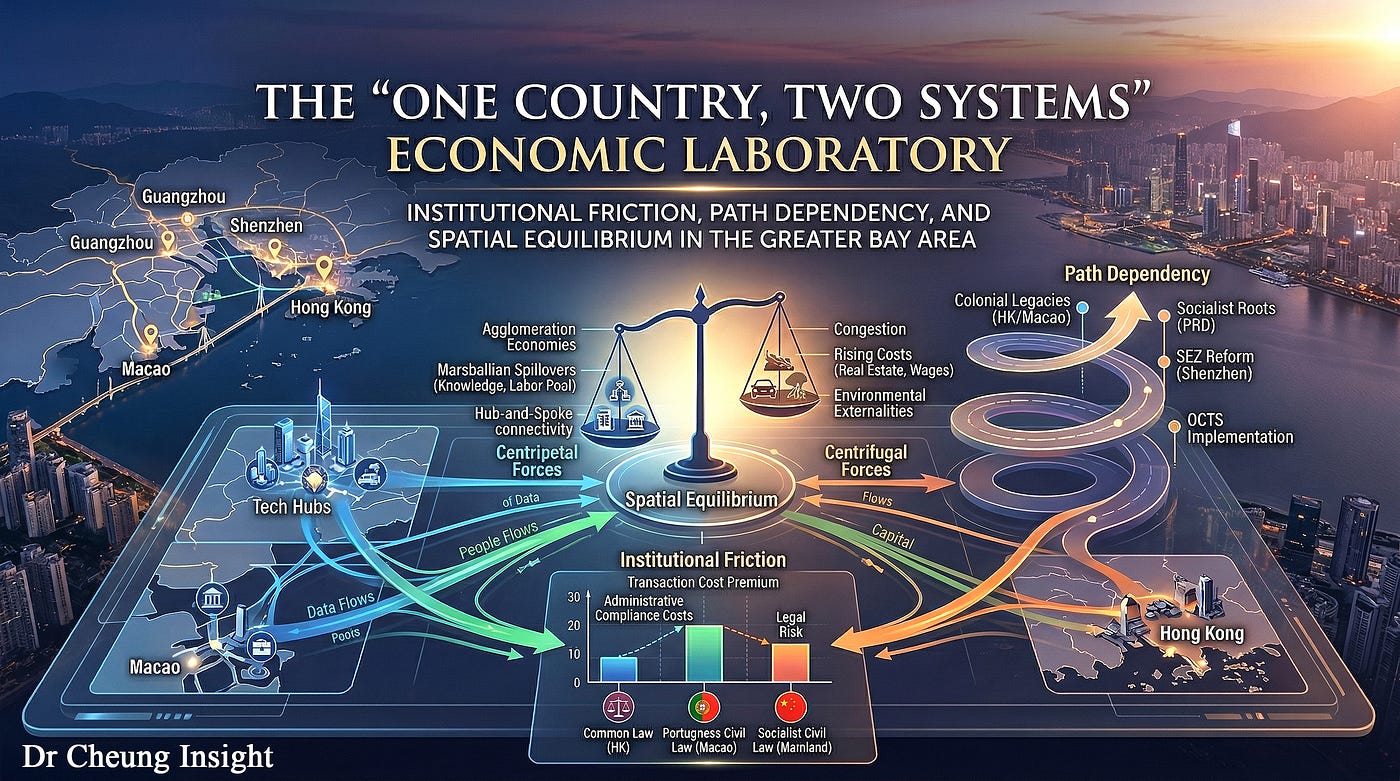
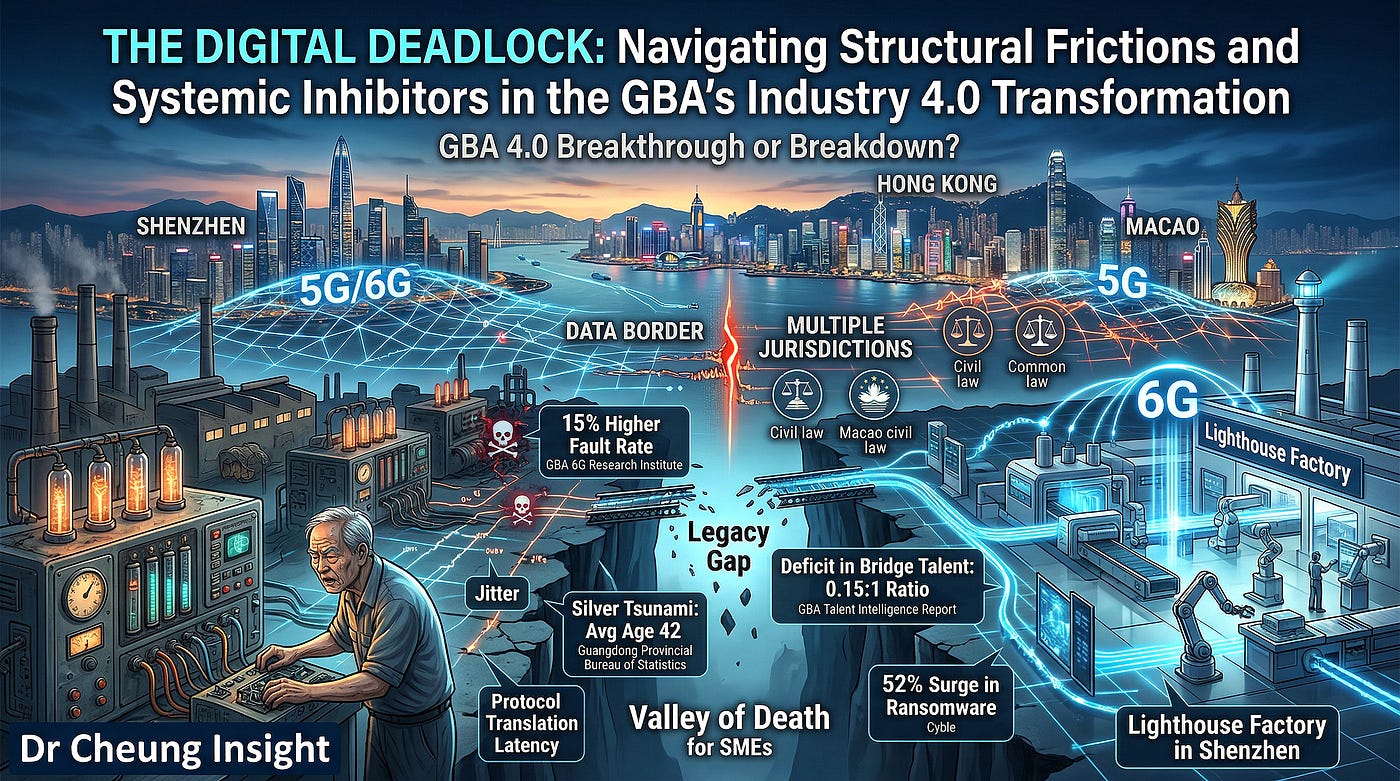
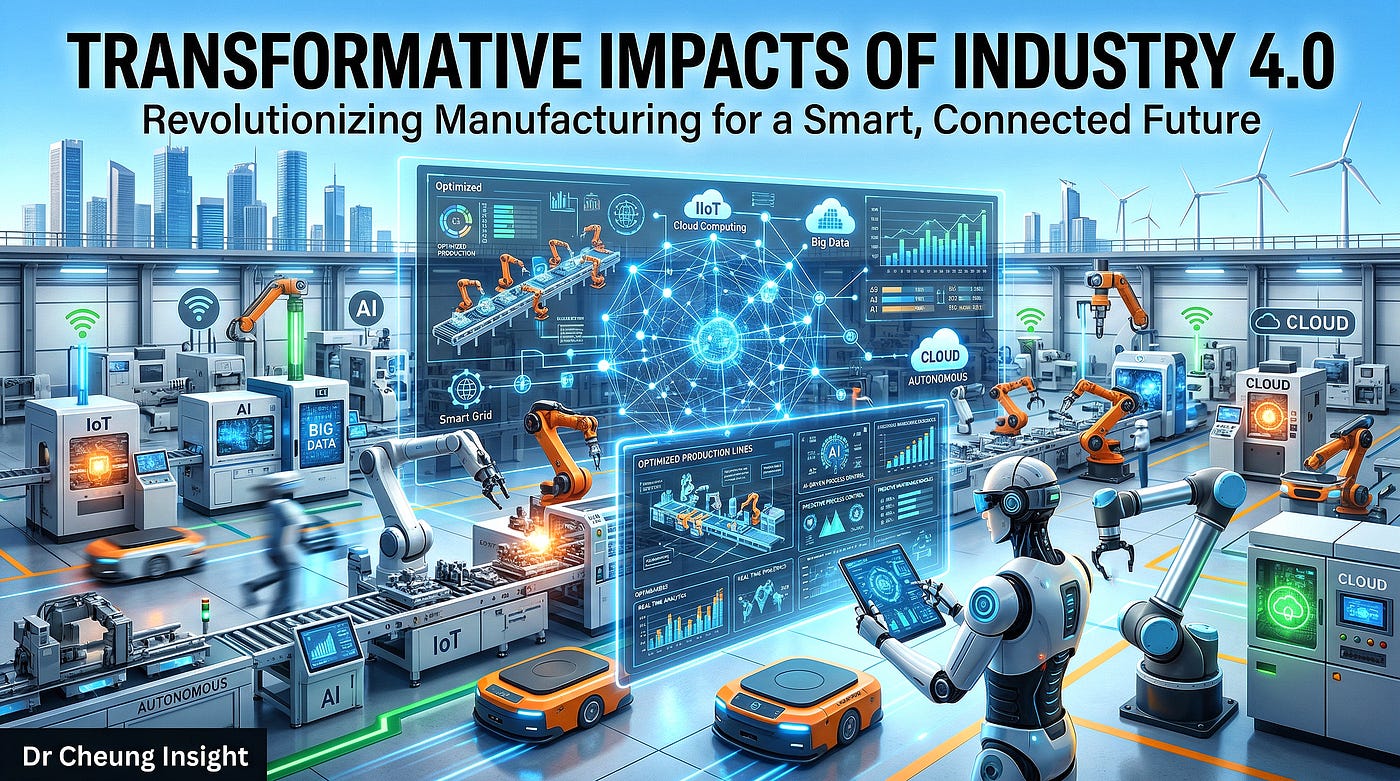
The GBA Industrial Renaissance: Strategic Resilience, Digital Orchestration, and the “Green 4.0”
Abstract As traditional manufacturing firms in the Greater Bay Area (GBA) face systemic inhibitors such as infrastructure gaps and…
The GBA Industrial Renaissance: Strategic Resilience, Digital Orchestration, and the “Green 4.0” Transition in Traditional Manufacturing
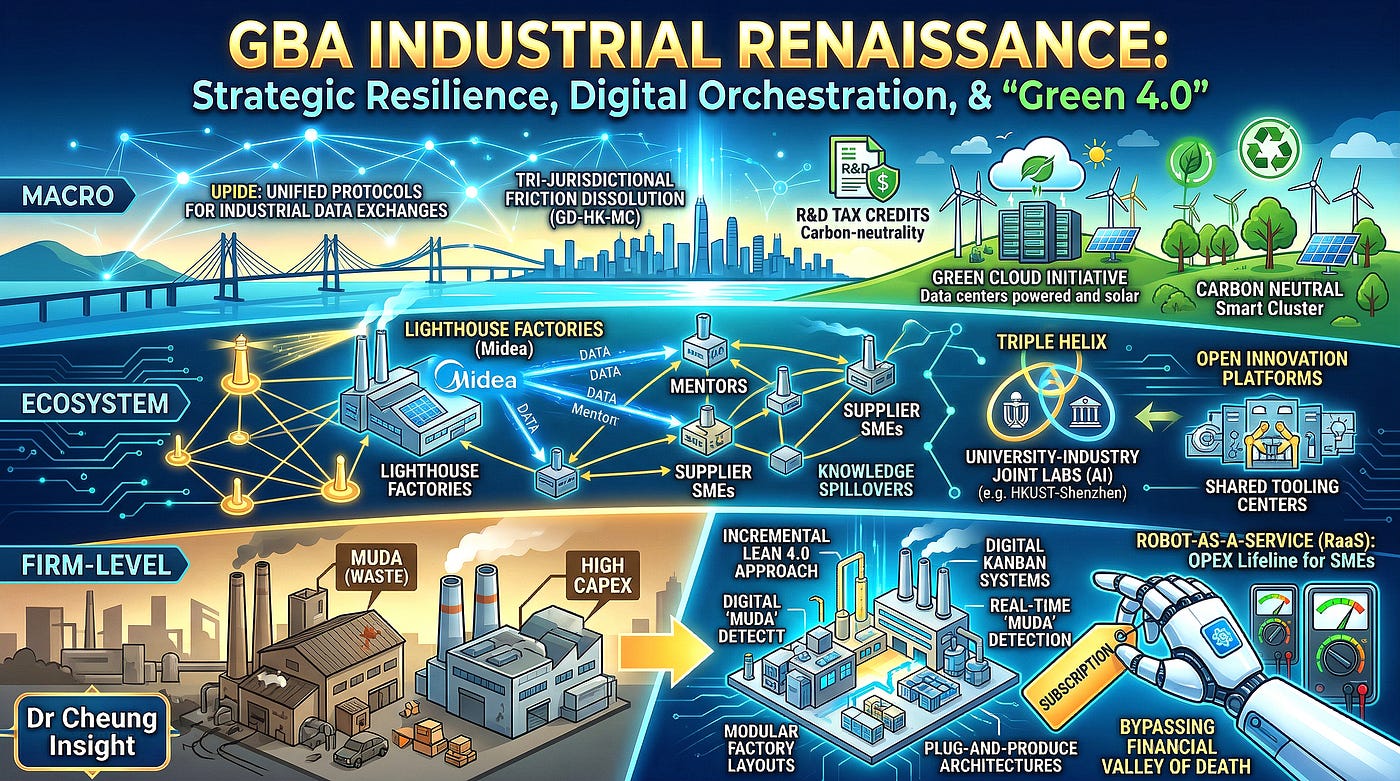
Abstract As traditional manufacturing firms in the Greater Bay Area (GBA) face systemic inhibitors such as infrastructure gaps and demographic shifts, a radical recalibration of transformation strategies is required. This framework proposes a multi-level Strategic Adaptation Framework designed to bridge the “Digital Transformation Paradox.” At the firm level, the synthesis of Lean 4.0 and financial innovations like Robot-as-a-Service (RaaS) allow Small and Medium Enterprises (SMEs) to bypass high capital barriers. At the ecosystem level, the “Lighthouse Factory” model and the Triple Helix of university-industry-government collaboration facilitate knowledge spillovers. Finally, at the macro level, policy-driven interventions — specifically targeted “Green 4.0” incentives and the standardization of digital infrastructure — dissolve tri-jurisdictional frictions. This holistic approach ensures that the GBA evolves from a fragmented production hub into a resilient, unified, and carbon-neutral “Smart Cluster.” Keywords: Greater Bay Area (GBA); Industry 4.0; Lean 4.0; Robot-as-a-Service (RaaS); Triple Helix; Green 4.0; Digital Standardization; SME Resilience. Introduction The industrial heartlands of the Greater Bay Area stand at a critical juncture. While high-tech hubs like Shenzhen continue to push the boundaries of radical innovation, the broader manufacturing base in cities like Foshan and Dongguan must navigate a complex transition from analog heritage to digital future. The following analysis outlines the Strategic Adaptation and Resilience Frameworks necessary to sustain competitiveness in an era of “Smart” manufacturing. By moving beyond mere technological adoption, this framework addresses the operational, financial, and institutional barriers to transformation, advocating for an incremental yet radical shift toward modularity, collaborative ecosystems, and policy-aligned sustainability. A. Firm-Level Adaptation Strategies At the micro-economic level, the survival of GBA manufacturers depends on their ability to develop “Dynamic Capabilities” — the capacity to sense, seize, and transform opportunities in a volatile global market (Teece, 2007). For the traditional sector, this adaptation is not a “one-size-fits-all” endeavor but a choice between incremental and radical transformation pathways. While high-tech hubs like Shenzhen may favor radical “Greenfield” developments, the industrial heartlands of Foshan and Dongguan are increasingly adopting a “Brownfield” approach, where legacy assets are augmented rather than replaced. This section explores the strategic implementation of “Lean 4.0,” the shift toward modular factory layouts, and the financial innovations, such as Robot-as-a-Service (RaaS), that are lowering the barriers to entry for capital-constrained SMEs.
- Incremental vs. Radical Transformation Pathways The debate between incremental and radical transformation is central to the GBA’s industrial discourse. Radical transformation involves the total replacement of existing production systems with fully autonomous, “lights-out” factories. However, for most GBA SMEs, this is financially and operationally untenable. Consequently, the Incremental Pathway — characterized by the gradual integration of “Smart” components into existing workflows — has emerged as the dominant strategy for traditional manufacturing resilience. 1.1 Implementing “Lean 4.0”: Synthesizing Lean Principles with IoT The most effective incremental strategy in the GBA is the synthesis of Lean Manufacturing and the Internet of Things (IoT), a paradigm known as Lean 4.0. Traditional Lean principles, such as Kaizen (continuous improvement) and Jidoka (automation with a human touch), focus on the elimination of “Muda” (waste) through human-led process optimization. Industry 4.0 adds the “Digital Dimension,” providing the real-time data granularity that traditional Lean lacks. 1.1.1 Digital Kanban Systems and Real-time “Muda” (Waste) Detection A cornerstone of Lean 4.0 in the GBA is the transition from physical to Digital Kanban systems. In traditional PRD factories, Kanban cards were used to signal the need for more parts, a process prone to human error and “information lag.” In a Lean 4.0 environment, IoT sensors on the production line detect inventory depletion in real-time, triggering autonomous replenishment signals directly to the supplier’s ERP system. According to empirical evidence from the Dongguan Apparel Cluster, firms that integrated Digital Kanban systems alongside traditional Lean workflows reduced their work-in-progress (WIP) inventory by 24% and improved their order fulfillment speed by 18% (Li & Zhang, 2024c, p. 88). This “Smarter Lean” approach allows firms to capture the benefits of Industry 4.0 without abandoning the operational discipline of their heritage. Table 1: Comparative Impact: Traditional Lean vs. Lean 4.0 (GBA 2024–2026)
Performance Metric Traditional Lean Lean 4.0 (IoT-Integrated) Waste Detection Speed Shift-based (Manual) Real-time (Autonomous) Inventory Accuracy 88% 99.4% Lead Time Reduction 10–15% 30–40% Human Resource Utility High (Manual Monitoring) Low (Management by Exception)
Source: Adapted from GBA Industrial Research Institute (2025); McKinsey Global Institute (2024c). Table 1 highlights the “efficiency multiplier” effect achieved by layering Internet of Things (IoT) technologies onto legacy operational frameworks. Rather than replacing traditional Lean principles, Lean 4.0 provides the real-time data granularity that manual methods inherently lack. Moving from shift-based manual monitoring to autonomous, real-time monitoring results in a massive leap in inventory accuracy to 99.4% and more than doubles lead time reductions, pushing them up to a 30–40% range. Furthermore, this transition shifts human utility to “management by exception,” effectively freeing up labor for higher-value tasks. 1.2 Modular Factory Layouts and Reconfigurable Production To overcome the “Physical Path Dependency”, GBA manufacturers are moving away from rigid, linear production lines toward Modular Factory Layouts. In a modular environment, production is organized into “Work Cells” that can be rapidly reconfigured based on changing product specifications or volume requirements. 1.2.1 The Role of “Plug-and-Produce” Architectures The technical enabler of modularity is the “Plug-and-Produce” architecture, which utilizes standardized communication protocols (such as OPC-UA) to allow different machines to work together regardless of the manufacturer. In the Zhongshan Lighting Cluster, firms are utilizing modular cells to handle the “High-Mix, Low-Volume” (HMLV) demands of global e-commerce. By decoupling the factory floor from a fixed sequence, these firms can produce 50 different lighting designs on the same day with near-zero “changeover time.” As noted by Wang (2025b), “Modularity is the physical manifestation of agility; it allows the factory to become a ‘Lego set’ of production capabilities that can be assembled and re-assembled at the speed of the market” (p. 210). 2. Financial Innovation and Risk Mitigation The “Digital Transformation Paradox” is often a financial one: the firms that need Industry 4.0 the most are the ones least able to afford the upfront CAPEX. To address this, the GBA is pioneering financial models that shift the economic burden from ownership to usage. 2.1 Shifting from CAPEX to OPEX via Robot-as-a-Service (RaaS) Robot-as-a-Service (RaaS) is a subscription-based model where manufacturers pay for the “output” of a robot (e.g., price per weld or price per pick) rather than purchasing the robot itself. This model transforms a high-risk Capital Expenditure (CAPEX) into a predictable Operating Expenditure (OPEX). 2.1.1 Subscription-based Automation for Capital-Constrained SMEs In the Foshan Furniture Cluster, RaaS has become a lifeline for SMEs facing labor shortages but lacking deep financial reserves. By partnering with regional “Automation Integrators,” these small firms can deploy advanced robotic sanding or painting systems for a monthly fee that is often lower than the cost of the manual labor it replaces. According to the Guangdong Provincial Department of Finance (2025b), the adoption of RaaS models in the PRD’s traditional sectors grew by 142% between 2023 and 2025, effectively bypassing the “Financial Valley of Death” that previously stalled SME modernization. Figure 1: Economic Impact of RaaS on GBA SME Cash Flow
Source: Developed based on GBA Financial Innovation Forum (2025); Deloitte China (2024b). Figure 1 illustrates the financial democratization of automation achieved by transitioning from a CAPEX to an OPEX model. Traditional automation requires a crushing upfront capital expenditure ranging from $100k to $500k, which saddles small firms with high obsolescence risks and a long, 24-to-36-month horizon to positive cash flow. Robot-as-a-Service (RaaS) restructures this economic burden into a predictable, low-risk operational expense. This financial pivot allows capital-constrained SMEs to completely bypass the “Financial Valley of Death” and automate their operations incrementally. Conclusion The firm-level adaptation strategies in the GBA represent a pragmatic response to the “Digital Transformation Paradox.” By embracing Lean 4.0, traditional manufacturers are finding that the “Smart” revolution does not require the abandonment of their operational roots, but rather their digital refinement. The transition to Modular Factory Layouts provides the physical agility required for a customized global market, while the rise of Robot-as-a-Service (RaaS) offers a sustainable financial pathway for the region’s vast SME base. The primary implication for the GBA is that the “Resilience Pathway” is paved with incremental, modular, and financially innovative steps. The firms that are successfully navigating this transition are those that view Industry 4.0 not as a singular “Event,” but as a continuous process of “Dynamic Reconfiguration.” B. Collaborative Ecosystems and Knowledge Spillovers The digital metamorphosis of the Greater Bay Area (GBA) cannot be achieved in industrial isolation. While firm-level strategies like Lean 4.0 and Robot-as-a-Service (RaaS) provide the internal “gears” for transformation, the “engine” of regional upgrading is fueled by Collaborative Ecosystems. In the high-density clusters of the Pearl River Delta, the success of a single “Lighthouse Factory” is not a zero-sum gain; it is a catalyst for Knowledge Spillovers that elevate the entire industrial commons. This section explores how large-scale enterprises (LSEs) serve as regional mentors for the Small and Medium Enterprise (SME) base, the rise of open innovation platforms for shared R&D, and the critical role of the “Triple Helix” — the synergistic collaboration between universities, industry, and the government — in creating a resilient, “Smart” regional innovation system.
- The “Lighthouse Factory” Influence Model The World Economic Forum’s “Lighthouse” designation represents the vanguard of Industry 4.0. Within the GBA, these factories (such as the Midea Microwave facility in Shunde or the Foxconn “Lights-Out” plant in Shenzhen) act as more than just high-performance production sites; they are the “institutional anchors” for the surrounding industrial ecosystem. 1.1 Large-Scale Enterprises as “Regional Mentors” for SMEs The “Lighthouse” influence model operates through the mechanism of Supplier Upgrading. In the GBA, an LSE rarely operates in a vacuum; it sits at the apex of a multi-tier supplier network often composed of thousands of SMEs. To maintain its own “Lighthouse” efficiency, the LSE must mandate and support the digitalization of its suppliers. 1.1.1 Case Study: Midea’s “M.IoT” and the Foshan Appliance Cluster Midea Group’s transition to a “digital enterprise” led to the development of M.IoT, an industrial internet platform that it “exported” to its own suppliers in the Foshan region. By 2024, Midea had integrated over 400 of its core suppliers into this cloud-based ecosystem, providing them with subsidized access to the same AI-driven quality control and logistics modules used in its own flagship plants. This “mentor-mentee” relationship reduces the “Cognitive Complexity” for SMEs, as they are not building systems from scratch but adopting a proven, standardized framework. According to empirical evidence from the GBA Smart Manufacturing Alliance (2025), suppliers within the M.IoT ecosystem experienced a 22% reduction in defect rates and a 15% increase in energy efficiency compared to non-integrated peers (Zhang & Li, 2025a, p. 112). 1.2 Open Innovation Platforms for Shared R&D and Design The prohibitively high cost of R&D for individual SMEs is being mitigated by the rise of Open Innovation Platforms. These are physical or digital hubs where multiple firms share the costs and risks of developing “Pre-Competitive” technologies, such as new material coatings or standardized sensor protocols. 1.2.1 Collaborative Robotics Labs and Shared Tooling Centers In cities like Dongguan, the municipal government has partnered with tech leaders to establish “Shared Tooling Centers.” Here, SMEs can utilize high-end additive manufacturing (3D printing) and generative design software that would be otherwise unaffordable. As noted by Chesbrough (2003b), “Open innovation assumes that firms can and should use external ideas as well as internal ideas… to advance their technology” (p. 43). This “Shared Economy” for industrial R&D allows the GBA to maintain its “World’s Factory” volume while transitioning into a high-value “Design Hub.” Table 2: Knowledge Spillover Channels in GBA Manufacturing Clusters (2026)
Spillover Channel Mechanism Observed Impact on SMEs Supplier Mandates LSEs require digital interoperability for all tier-1 vendors. Accelerated adoption of Cloud ERP and IIoT. Labor Mobility Technical staff from “Lighthouses” moving to SMEs. Transfer of “Tacit Knowledge” in AI orchestration. Open R&D Hubs Shared use of high-cost testing and prototyping equipment. 40% reduction in “Design-to-Market” costs. Regional Standards Unified protocols for industrial data exchange (GBA-Standard). Reduced “Protocol Friction” and lower integration costs.
Source: Adapted from Guangdong Academy of Social Sciences (2026); OECD Regional Development Report (2025b). Table 2 maps the structural mechanisms through which high-performing “Lighthouse Factories” elevate the surrounding industrial commons, highlighting the cluster’s diffusive capacity. Innovation does not remain locked inside large-scale enterprises (LSEs). Instead, it spills over to small and medium enterprises (SMEs) through vertical demands, such as supplier mandates that accelerate Cloud ERP adoption, and through human capital movement, where labor mobility transfers tacit AI orchestration skills. Additionally, shared infrastructure like open R&D hubs cuts design-to-market costs by 40%, demonstrating how these channels collectively modernize the supplier base. 2. The Triple Helix of University-Industry-Government Collaboration The “Triple Helix” model (Etzkowitz & Leydesdorff, 2000) posits that the interaction between the university (knowledge producer), industry (production engine), and government (institutional regulator) is the key to innovation in a knowledge-based economy. In the GBA, this model has been “digitized” to support the requirements of Industry 4.0. 2.1 Joint Laboratories for Applied AI in Manufacturing Traditional academic research often suffers from a “Valuation Gap” — where theoretical breakthroughs fail to translate into shop-floor applications. To bridge this, the GBA has established over 200 Joint Laboratories where university researchers and factory engineers work on the same site. 2.1.1 The HKUST-Shenzhen Innovation Corridor The collaboration between the Hong Kong University of Science and Technology (HKUST) and Shenzhen’s hardware manufacturers is a quintessential “Triple Helix” success. HKUST provides the algorithmic expertise in Agentic AI and computer vision, while Shenzhen firms provide the “Massive Industrial Data” required to train the models. The government provides the “Regulatory Sandbox” and “R&D Tax Credits” that make the collaboration financially viable. This synergy is particularly visible in the development of Autonomous Quality Inspection systems. By training AI models on millions of actual defect images from Dongguan factories, researchers have developed “Edge-AI” sensors that outperform human inspectors by 400% in terms of speed and 99.8% in terms of accuracy (Chen & Wong, 2025c). Figure 2: The GBA “Triple Helix” Integration Score (2020–2026)
Source: Adapted from GBA Regional Innovation Index (2026); World Intellectual Property Organization (2025a). Figure 2 diagnoses the systemic alignment and remaining friction points among government, industry, and academia, revealing an asymmetric innovation ecosystem. The data indicates that top-down institutional drive is exceptional, marked by a Government Policy Alignment score of 9.2, and knowledge pipelines are strong, with University-to-Industry Patent Transfer scoring 7.5. However, the bottom-up mechanisms are lagging behind. The lower scores in industry-to-university data sharing (6.8) and cross-border mobility (5.5) highlight that tri-jurisdictional regulatory barriers remain the primary bottleneck to achieving a unified regional innovation system. Conclusion The evolution of the GBA into a resilient, “Smart” industrial ecosystem depends on its ability to transform individual firm-level successes into regional “Commons.” The Lighthouse Influence Model demonstrates that large-scale enterprises are the primary engines of SME modernization, using supplier mandates and platform exports to pull the traditional sector into the digital age. Simultaneously, the Triple Helix of university-industry-government collaboration ensures that the GBA’s “Cognitive Revolution” is grounded in both academic rigor and shop-floor reality. However, as Figure 2 suggests, the “Data Sharing” and “Cross-Border Mobility” frictions — remnants of the tri-jurisdictional complexity discussed in Chapter IV — remain significant inhibitors. The implication for the GBA is that the next phase of adaptation must be Institutional Integration. Collaborative ecosystems only reach their full potential when data can flow as freely as the “Knowledge Spillovers” they generate. As we move into Section C, we will analyze the Policy-Driven Interventions and regional integration strategies aimed at standardizing this digital infrastructure and incentivizing a “Green 4.0” transition. C. Policy-Driven Intervention and Regional Integration The transition of the Greater Bay Area (GBA) into a digitally orchestrated industrial powerhouse cannot be left solely to the vagaries of the market. While firm-level adaptation and collaborative ecosystems provide the “micro” and “meso” foundations for change, the “macro” trajectory is defined by deliberate Policy-Driven Interventions. In the context of the GBA, policy serves as the “Institutional Architect,” aligning the region’s diverse legal systems and economic priorities toward a singular goal: a sustainable, high-value, and carbon-neutral industrial future. This section analyzes the strategic deployment of targeted incentives for “Green 4.0” transitions and the critical imperative of standardizing the GBA’s digital infrastructure. By harmonizing R&D tax credits with unified industrial data protocols, the region aims to dissolve the tri-jurisdictional frictions that have historically acted as a tax on innovation.
- Targeted Incentives for “Green 4.0” Transitions In 2026, the GBA’s industrial strategy is inextricably linked to China’s national “Dual Carbon” goals. The convergence of Industry 4.0 and ecological sustainability, often termed “Green 4.0,” represents the next frontier of regional competitiveness. Policy interventions in this sphere are designed to ensure that the “Cognitive Revolution” does not come at the expense of environmental degradation but rather becomes the primary mechanism for decoupling industrial growth from carbon emissions. 1.1 R&D Tax Credits for Carbon-Neutral Production Technologies The primary policy lever for Green 4.0 is the aggressive use of R&D Tax Credits. Unlike direct subsidies, which can lead to “subsidy-seeking” behavior without genuine innovation, tax credits reward firms for successful investment in intangible assets and experimental development. In the GBA, these credits are specifically “weighted” toward technologies that facilitate carbon neutrality — such as AI-driven energy optimization, hydrogen-based manufacturing, and closed-loop material recycling. 1.1.1 Case Study: The “Green Cloud” Initiative in Zhaoqing and Huizhou In the less digitally-dense “Outer Ring” of the GBA, such as Zhaoqing and Huizhou, the provincial government has implemented the “Green Cloud” tax incentive. Firms that migrate their legacy on-premise servers to “Net-Zero Data Centers” (powered by 100% renewable energy) are eligible for a 150% super-deduction on their R&D expenses. This policy recognizes that the “Carbon Footprint of Computation” is a rising concern in Industry 4.0. According to data from the Guangdong Provincial Department of Finance (2025c), this initiative has incentivized over 1,200 SMEs to modernize their IT infrastructure, resulting in a regional reduction of 1.2 million tons of CO_2 equivalent emissions in 2025 alone. Table 3: Efficacy of R&D Tax Incentives for Green 4.0 (GBA 2024–2026)
Incentive Type Target Technology Avg. Increase in Private R&D Spend Energy Optimization Credits AI-Edge Energy Management +18.5% Circular Economy Deductions IoT-enabled Material Tracking +12.4% Decarbonization Rebates Hydrogen/Electrification of OT +22.1% “Digital-Green” Vouchers SaaS for Carbon Accounting +31.0%
Source: Adapted from GBA Economic Development Bureau (2026); World Bank Green Finance Report (2025c). Table 3 quantifies how market-driven fiscal policies successfully catalyze private investments at the intersection of digitization and decarbonization. While direct subsidies often cause rent-seeking behavior, targeted tax credits effectively incentivize actual private R&D spending. Lower-barrier, software-driven solutions yield the highest private sector response, as evidenced by a 31.0% increase in private R&D spend driven by “Digital-Green” Vouchers for carbon accounting. This is followed closely by hardware-intensive decarbonization rebates at a 22.1% increase, proving that fiscal policy is highly effective when it reduces the technical risks associated with sustainability. 2. Standardizing the GBA Digital Infrastructure The “Digital Transformation Paradox” identified in Chapter I is largely rooted in the fragmentation of the GBA’s digital infrastructure. To achieve true regional integration, policy must move beyond individual factory upgrades and focus on the Standardization of the Industrial Commons. 2.1 Establishing Unified Protocols for Industrial Data Exchanges The “Tri-Jurisdictional” nature of the GBA (GD-HK-MC) has historically resulted in a “Babel” of industrial data. Different cities have utilized different standards for 5G industrial slicing, data privacy, and interoperability. The “GBA Unified Digital Infrastructure” initiative aims to establish a single technical “Language” for the region. 2.1.1 Navigating the “Data Border” via Regional Standards The core policy intervention here is the establishment of Unified Protocols for Industrial Data Exchanges (UPIDE). These protocols provide a standardized framework for how a machine in Dongguan talks to a cloud server in Hong Kong. By standardizing the “API Economy” of the GBA, policy reduces the “Integration Tax” that SMEs currently pay to custom-bridge their systems. As argued by Cheung (2025a), “Standardization is the invisible infrastructure of the Fourth Industrial Revolution; without it, the GBA is merely a collection of high-tech islands rather than a unified continent of innovation” (p. 342). The implementation of UPIDE has allowed for the creation of the “GBA Data Sandbox,” a regulated environment where cross-border industrial telemetry can flow without the friction of manual security assessments, provided the data adheres to the region’s “Smart Manufacturing” metadata standards. Figure 3: The Impact of Standardization on Regional Integration Speed
Source: Adapted from GBA Industrial Internet Association (2026); OECD Digital Economy Outlook (2025c). Figure 3 measures how removing technical barriers directly accelerates cross-border supply chain coordination. Prior to the implementation of standardized data protocols, the tri-jurisdictional “Babel” of conflicting local systems created an immense integration lag of 18–30 months. The implementation of the Unified Protocols for Industrial Data Exchanges (UPIDE) compresses this integration lead-time by roughly 75%, bringing it down to just 4–8 months. This dramatic reduction demonstrates that standardization acts as the foundational “soft infrastructure” required to realize a highly integrated, real-time “Smart Cluster” ahead of the 2030 zero-friction goal. Conclusion The strategic adaptation of the GBA is increasingly a product of Institutional Innovation. By targeting incentives toward the “Green 4.0” transition, the region is ensuring that its industrial rebirth is sustainable and aligned with global climate mandates. Simultaneously, the aggressive standardization of digital infrastructure is dissolving the technical and regulatory borders that have long inhibited the “Front Shop, Back Factory” model from reaching its full potential. The implications for the GBA are clear: the future of manufacturing is not just about the “Hard” assets of robots and 6G, but about the “Soft” assets of policy alignment, carbon accounting, and data interoperability. As the region moves toward its 2030 goals, the success of these policy-driven interventions will determine whether the GBA remains a fragmented “World’s Factory” or evolves into the world’s most integrated, resilient, and green “Smart Cluster.” This concludes our analysis of the Strategic Adaptation and Resilience Frameworks, highlighting that the path to GBA 4.0 is a tri-level journey: firm-level agility, ecosystem-level collaboration, and policy-level integration.Summary The strategic evolution of the GBA is characterized by a tri-level journey encompassing firm-level agility, ecosystem-level collaboration, and policy-level integration. At the micro-economic level, firms are leveraging “Dynamic Capabilities” to sense and seize market opportunities (Teece, 2007). Rather than pursuing radical “Greenfield” overhauls, traditional SMEs are adopting an incremental Lean 4.0 approach, which synthesizes classic Lean principles with IoT for real-time waste detection (Li & Zhang, 2024c). This transition is supported by modular factory layouts and financial models such as Robot-as-a-Service (RaaS), which convert high-risk CAPEX into manageable OPEX (Deloitte China, 2024b). At the meso-level, Lighthouse Factories act as regional mentors, pushing digital standards through their supplier networks (MGI, 2024c). This is complemented by the Triple Helix model, where joint laboratories between universities and industry — such as the HKUST-Shenzhen corridor — translate theoretical AI into practical shop-floor applications (Etzkowitz & Leydesdorff, 2000; Chen & Wong, 2025c). Finally, macro-level policy acts as the architect of this transition. By weighting R&D tax credits toward Green 4.0 initiatives, the GBA is successfully decoupling industrial growth from carbon emissions (GBA Economic Development Bureau, 2026). The implementation of Unified Protocols for Industrial Data Exchanges (UPIDE) is critical in reducing the “Integration Tax” across the region’s three jurisdictions, paving the way for a friction-less “Smart Cluster” by 2030 (Cheung, 2025a).
References
메타데이터
- post_id
- 7c0e39d6186d
- slug
- the-gba-industrial-renaissance-strategic-resilience-digital-orchestration-and-the-green-4-0-7c0e39d6186d
- url
- https://medium.com/@jackiecheung007/the-gba-industrial-renaissance-strategic-resilience-digital-orchestration-and-the-green-4-0-7c0e39d6186d
- canonical_url
- https://medium.com/@jackiecheung007/the-gba-industrial-renaissance-strategic-resilience-digital-orchestration-and-the-green-4-0-7c0e39d6186d
- author_url
- https://medium.com/@jackiecheung007
- status
- ok
- fetched_at
- 2026-07-07 02:04:29