The Allure of Cuba
In My Life, a spoken autobiography, the revolutionary dictator Fidel Castro said, “… quality of life lies in knowledge, in culture. Values…
The Allure of Cuba

Rashidah in Plaza Vieja, Havana
In My Life, a spoken autobiography, the revolutionary dictator Fidel Castro said, “… quality of life lies in knowledge, in culture. Values are what constitute true quality of life, the supreme quality of life, even above food, shelter, and clothing.”
What a paradox. On one hand, the island of Cuba, home to almost 11 million people, is a cornucopia of riches. Its natural resources range from nickel, cobalt, and petroleum, to arable land, forests, coastal mangroves, and rich biodiversity. On the other hand, fiscal mismanagement and a 66-year United States trade embargo have led to a quality of life on the island that is more impoverished than “supreme.”
Afro-Cubans, who comprise at least one-third of Cuba’s population, experience widespread discrimination. As a result, they have higher poverty rates, less access to stable currency and low rates of property ownership. Afro-Cubans also suffer more police violence than white Cubans. (McCollugh)
Despite these contradictions, Cuban identity is evoked through a strong national pride, a deep appreciation for their storied history, and a daily expression of heritage through art, music, dance, and diverse local traditions, including the most adaptive car culture in the world. The allure of Cuba and my desire to learn about it up close lie in its greatest natural resource: the people themselves.

Convertible Pontiac (or Packard?) with Jose Marti in background
“Pleasure” tourism to the island is still prohibited by the U.S. government, but there are work arounds. Our visit in August of 2017, organized through Family Go Global, began with dancing at a nightclub along the famous Avenida Malecón. The music was rhythmic and infectious. We couldn’t wait to hit the dance floor! An hour into our visit, everyone in the club made space for this presentation:
[embed]Cuban dancers August 2017
And one afternoon in Plaza Vieja, we were treated to this:
[embed]Cuban stilt performers August 2017
There is art everywhere, from paintings and murals, to sculptures and installations in local parks, to formal galleries, to the incredible Fábrica de Arte, a combination night club, performance space, and art gallery that also serves food and signature Cuban mojitos.

Our children took art walks and enjoyed daily Spanish classes in Havana
Yet, the average monthly income in Cuba is between $15–$40. Even though we didn’t experience much social unrest during our stay, street protests are common because many Cubans struggle to obtain basic food and medical necessities. Their sustenance is tied to a socialist economy that fewer and fewer Cubans support. Most citizens receive monthly food rations. American currency is accepted at some businesses which helps a robust underground market. However, Cuba does not accept U.S. issued credit cards, and bank ATMs block American debit cards.

Photo Courtesy of Havana Times
Needless to say, there are many daily struggles, including infrastructure issues. Blackouts are common. It’s not unusual to see exposed wires protruding from the side of a building, and the roof of José Marti International Airport sprung a large leak on the day of our departure. It took several buckets in the passenger lounge to keep water from flowing across the floor.
Our casa particular (similar to an American B&B), was peeling and decaying on the outside, a familiar architectural sight around the island. But the casa was well-maintained inside. The bathroom was spacious and modern. We did not have a television or reliable wifi, and this allowed us to focus much more on personal conversations and the richness of our surroundings.

Our room at a privately owned casa particular in Havana

Breakfast at the casa particular in the Vedado neighborhood of Havana
Enterprising Habaneros open tiny coffee kiosks out of their own kitchens. These are “no frills” counters selling a demitasse of delicious Cuban coffee for people walking to work each day. I was happy to speak to the people I met at one of the kiosks. I asked questions about Cuban history and culture, and everyone I spoke to was both kind and knowledgeable which was not surprising given the literacy rate on the island.

Tacita de la ventanilla (a small cup of coffee purchased from a home kitchen)
Cubans have a rich history of creativity, innovation, and intellectual drive, including the revolutionary José Antonio Aponte, the incomparable Celia Cruz, ballet dancer extraordinaire Osiel Gouneo, and the Russian trained cosmonaut Arnaldo Tamayo Méndez, the first black man in space.
Fidel Castro likened his homeland to “an immense university.” Indeed, thanks to his National Literacy Program of 1961, Cuba has long enjoyed one of the highest adult literacy rates in the world. Eduardo (below in white) was one of several expert tour guides we had. He spoke four languages fluently: Spanish, English, French, and Russian. However, he made it clear that the government consistently refuses exit visas to travel to the United States, making it unlikely that he will ever move (legally) from the island.

Though the government runs many of the hotels (including Hotel Ambos Mundos below) and most local restaurants, there are other establishments, privately owned, that cater primarily to visitors. El Cocinero was a superb restaurant serving many chef quality dishes. Cuban agricultural and livestock production is almost completely organic, and this is noticeable in how vibrant and flavorful everything is, from meat, to fruit, to coffee to bread.

Rooftop dining at El Cocinero

Hotel Ambos Mundos in Old Havana, a favorite haunt of American writer Ernest Hemingway
While Nicaragua and the Dominican Republic can now claim top prize as the world’s best makers of cigars, Cuba is not far behind. We visited a tobacco farm and learned about the centuries old drying and fermenting process at a local barn.

Rashidah and Ziyadah (mom) at a Viñales tobacco farm
There are beautiful local beaches in Havana, like Playa Santa Maria, and the larger resorts, like El Vadadero along the Hicacos Peninsula, are as sprawling as those we find in the U.S. These resorts often feature state-managed hotels which means the food is served cafeteria style and some American creature comforts are missing. An in-room television may not always work, and housekeepers might be sparse, but the grounds are beautiful and the turquoise ocean waters are pristine.
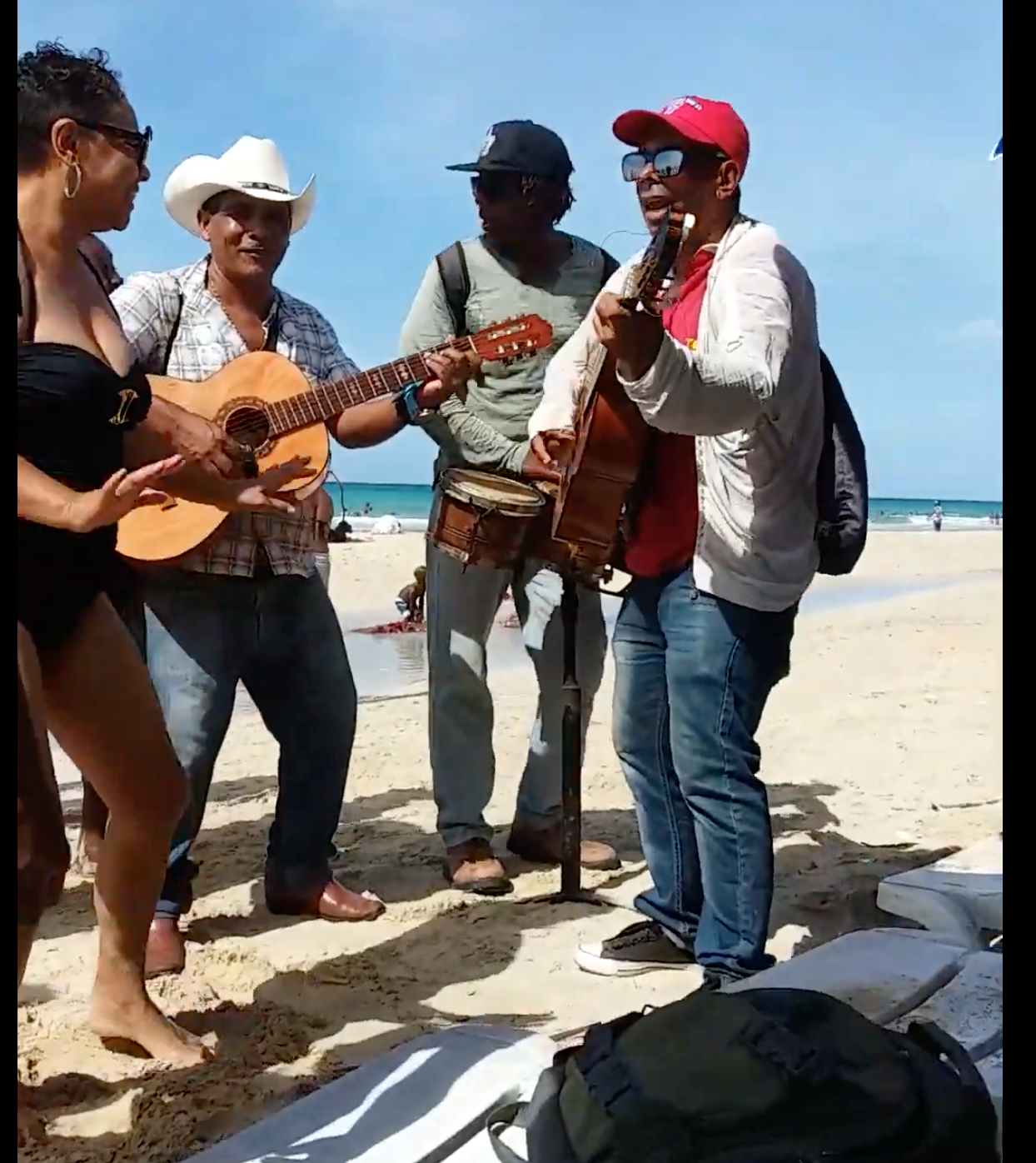
Local musicians at Playa Santa Maria in Havana

Playa Santa Maria

Large resort pool in Vadadero

Boat slips at Hotel Meliá Marina in Vadadero
As always, there is music everywhere! It was not unusual for local workers in Vadadero, who might cook or stack dishes in the hotel kitchen, to be scheduled as performers for hotel guests later in the evening. Some staff were professional pianists; some workers sang opera. This is life in Cuba where cultivation of the human spirit and celebration of the heart and mind, not monetary gain, are supreme.

My son says so long to Havana! ❤
How we determine a supreme quality of life differs from country to country, culture to culture, person to person, but what Cuba lacks in material comfort it makes up for in its joie de vivre, its self-awareness, its national pride. Visiting this remarkable island was a rare educational experience that I will treasure for the rest of my life.
If you’ve been to Cuba or plan to visit one day, please let me know! Or click the clap button which helps others find the post. Thank you.❤️
Works Cited
“Blackouts of up to 12 Hours in Cuba Despite More Fuel — Havana Times.” Havana Times, 7 Nov. 2023, https://havanatimes.org/features/blackouts-of-up-to-12-hours-in-cuba-despite-more-fuel/.
Ramonet, Ignacio, and Fidel Castro. Fidel Castro: My Life. Simon and Schuster, 2008.
McCulloch, Caroline. “5 Ways Americans Often Misunderstand Cuba, from Fidel Castro’s Rise to the Cuban American Vote | FIU News — Florida International University.” FIU News, Florida International University, 19 Dec. 2024, https://news.fiu.edu/2021/5-ways-americans-often-misunderstand-cuba,-from-fidel-castros-rise-to-the-cuban-americanvote.
메타데이터
- post_id
- 7c22dc69b219
- slug
- the-allure-of-cuba-7c22dc69b219
- url
- https://medium.com/@rnbdsbdb/the-allure-of-cuba-7c22dc69b219
- canonical_url
- https://medium.com/@rnbdsbdb/the-allure-of-cuba-7c22dc69b219
- author_url
- https://medium.com/@rnbdsbdb
- status
- ok
- fetched_at
- 2026-07-13 16:57:44