Analysis of Indonesia’s General Election using the concept of Tyranny Majoritarian and…
The General Election Commission (KPU) has determined the results of the 2024 Presidential Election (Pilpres) with the Prabowo Subianto —…
Analysis of Indonesia’s General Election using the concept of Tyranny Majoritarian and Administrative Despotism
Source: Edgar Su/Reuters
The General Election Commission (KPU) has determined the results of the 2024 Presidential Election (Pilpres) with the Prabowo Subianto — Gibran Rakabuming Raka pair as the winner, ahead of the Anies Baswedan — Muhaimin Iskandar and Ganjar Pranowo — Mahfud MD. Direct general elections are held once every five years in order to emphasize that our country is a democracy, and the transition to change leadership involves active participation of the community through voting activities on the ballot paper. Active participation by the public in the life of the state is a value adhered to in the republican tradition, where in the context of elections in Indonesia, this active participation is symbolized by the aspiration of the ballot box once every five years. This has resulted in the climate of Indonesian political discourse being focused only on the once-every-five-years celebration, so that the existence of active public participation after the one-day general election agenda is being questioned. When compared with comparative time figures, general elections once in five years only take one day, while approximately 1,799 days (five years minus one day) tend to be put aside. 1 to 1,799 is a very wide ratio, considering that power is exercised in everyday aspects. Thus, the political climate in Indonesia, especially active public participation in the state system, can be said to still need to be further distributed and not focused on one day in five years.
As a result of the centralized political climate, elections are considered the only means of legitimizing power. Starting from case studies in Indonesia in the 2024 Election, various issues emerged which were considered to delegitimize democracy, starting from the issue of political dynasties, unresolved violations of Human Rights (HAM), the use of state instruments for campaigns, and so on. This can happen because politicians design a strategy that this one day is a legitimate way to justify everything for the sake of victory and put aside state morals. The unequal distribution of the political climate also delegitimizes judicial power in Indonesia, namely the Constitutional Court (MK), which is linked to issues of conflict of interest. And whether coincidental or not, the party associated with various violations of constitutional ethics and a bad track record in the past is the winner in this contest. This raises the real question of
whether electoral democracy can really be interpreted as active public participation in the state system, or just the use of loopholes provided once every five years. It is natural for the public to express objections that their active participation is limited to such a narrow space and time.
The general elections held by Indonesia are the embodiment of liberal democracy. In data collected over approximately 14 years, liberal democracy has had the consequence that elected politicians have become very insensitive to the differences in voices and interests that exist among individual citizens (Diamond 2020; Freedom House 2019) . So, it is not surprising that politicians will not listen to public protests regarding the nomination procedures for one of the vice-presidential candidates, or the issue of the track record of one of the prospective candidates. Society and politicians together have been trapped and have been forced into a partisan paradigm and a win-lose perspective, thus forming a political culture that tends to be pragmatic. Pragmatic political culture can lead society to an attitude of not caring about public interests as long as individual interests and group interests are met. As a result, fragmentation between the majority and minorities will actually appear to occur in the field. This phenomenon will be analyzed using the concepts of Tyranny Majority and Administrative Despotism proposed by Alexis de Tocqueville.
Analysis: Tyranny Majority and Administrative Despotism
Anton Raharjo/Anadolu Agency
Tocqueville expressed his concern that the democratic political system would be overshadowed by the fear of Tyranny Majority, or a situation where the state system does not serve the general interest but rather the interests of the majority group of society. Tocqueville stated that the majoritarian system of direct election was one of its manifestations (de Tocqueville 1835) . Meanwhile, Administrative Despotism is an extension of coercive power over society. Over time, citizens will become insensitive to forms of abuse by the government (Abrams 2022) . People who experience this situation are apolitical citizens, and this condition is contrary to republican ideals. Society will truly surrender all its life needs, including its habits, to be controlled by other people… and in the end it will be controlled by a single master (de Tocqueville 1835) . Unfortunately, this form of tyranny is very often married to democratic values — full suffrage, a representative system, and an independent judiciary, but on the other hand perpetuates persecution, discrimination, and injustice against civilians (Abrams 2022) . In Indonesia’s political history itself, majority rule brought about the bleakest tragedy ever recorded in Indonesia, namely the massacre of certain ethnicities as a result of political instability and the failure of the state to provide space for participation for civilians, especially in practical political aspects (Mann 2004) .
The consequences of democracy’s failure to involve and protect the rights of civilians encourage the emergence of alternative ideas. An emerging trend of leftist anarcho-populism ideas rejects the electoral hypothesis and states that popular power is a tool to legitimize the state. Tocqueville stated that this era was entering an era of despotic majoritarianism, where citizens were massively excluded from political life, while elected officials claimed that all forms of their activities in politics were to represent the people (Abrams 2022) . Democratic citizens find themselves tied to two ties; on the one hand they are trapped by the active participation of majoritarian governments, and on the other hand they passively accept it. The situation of a country like this is associated with the concept of “hybrid regime” which explains that a country is not sufficiently categorized as democratic, on the other hand it does not resemble classic authoritarianism (Freedom House 2020) .
One of the characteristics of despotic majoritarianism is excessive emphasis or coercion on the legitimacy of procedural matters, such as general elections, referendums, etc., as a tool to legitimize political actions. Apart from that, there are also efforts to increase state control over its own citizens administratively (Abrams 2022) . This can be seen in the 2024 election process in Indonesia, how many parties make all kinds of efforts to win one candidate, and how public sentiment is simply ignored by them. It is important to continue to question the concept of “citizen” and question procedural political activities such as elections to see to what extent these activities facilitate community participation. Citizens are required to do more than just go to the polling place. This responsibility is carried out by politicians, educators and activists to continually reframe the concept of popular sovereignty in democracy so that citizens are no longer positioned as political accessories. Advocacy for democracy is the main demand and urgency of state life in this modern era. It is also necessary to advocate the concept of “the people” as a political community beyond procedural activities such as elections (Abrams 2022).
Conclusion
Dok/rri.co.id/Epi Wahab
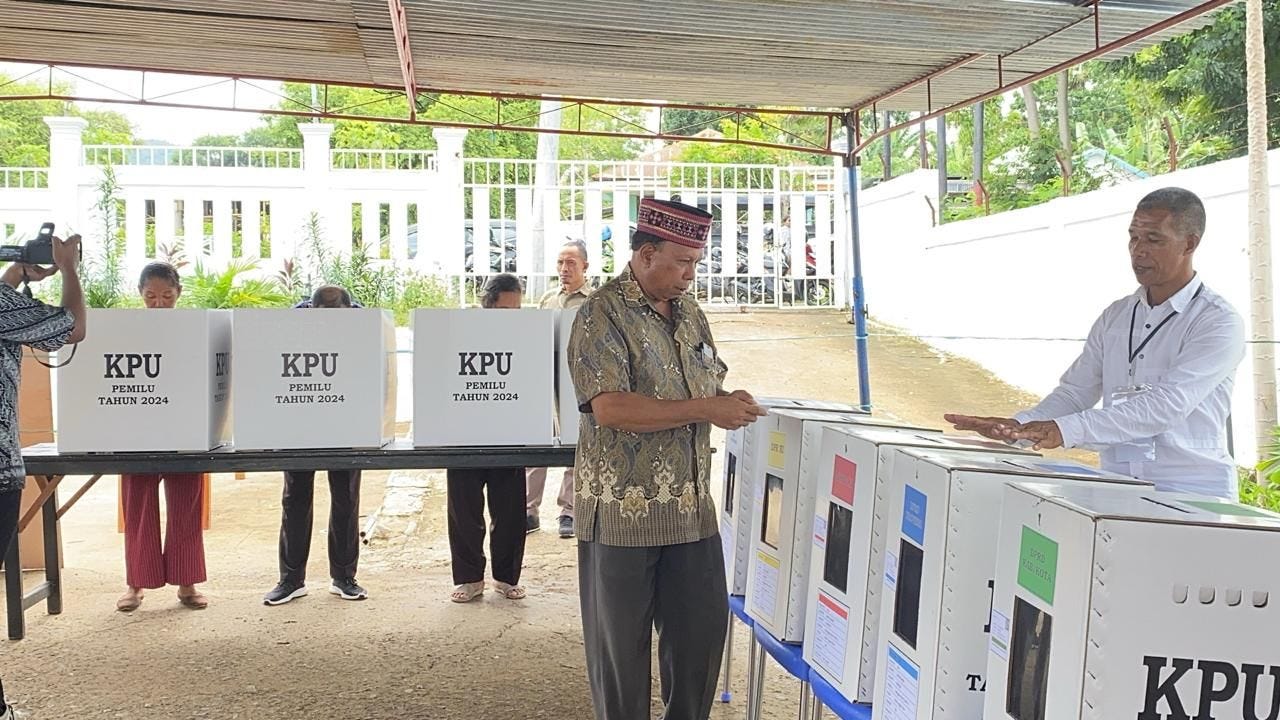
The 2024 election is a manifestation of democracy in Indonesia still running. However, “still running” does not mean that it is an ideal condition. Public findings regarding how politicians position citizens as mere political accessories mean that democracy and the concept of “the people” need to be reexamined. Public participation must be opened to the widest possible space and time and not just stop at procedural activities.
The public’s accusations that certain candidates’ strategies are considered to violate ethics are proof that public participation has not been properly accommodated because in the end the politicians and all kinds of machinations they have have achieved victory. Perhaps, the concept of Tyranny Majority is not very relevant to what happens in the 2024 elections in Indonesia, especially as this contestation does not involve significant ideology and conflict between groups, especially compared to previous elections. However, the concept of Administrative Despotism becomes very relevant in analyzing the series of events in the nomination process for one of the candidates. For example, the process of nominating the child of a president who is still in office has never been proven to violate any legal procedures, and this condition is continuously legitimized, thereby ignoring ethical aspects and public sentiment regarding the issue of political dynasties. The label “legitimate” in the nomination process is an instrument that until now has not been defeated, so that the administrative regime is considered to have enormous power, and defeats the regime of morality and social norms.
Bibliography
Abrams, Benjamin. 2022. “Critical Commentary The Rise of Despotic Majoritarianism.” Democratic Theory 9(1):73–86. doi: 10.3167/dt.2022.090105.
Diamond, Larry. 2020. “Democratic Regression in Comparative Perspective: Scope, Methods, and Causes.” Democratization 28(1). doi: 10.1080/13 510347.2020.1807517.
Freedom House. 2019. “‘Democracy in Retreat’. Freedom in the World 2019.” Freedom House . Retrieved (https://freedomhouse.org/report/freedom-world/2019/democracy-retreat).
Freedom House. 2020. Freedom in the World 2020: A Leaderless Struggle for Democracy . Washington DC.
Mann, Michael. 2004. The Dark Side of Democracy: Explaining Ethnic Cleansing . Cambridge: Cambridge University Press.
de Tocqueville, Alexis. 1835. Democracy in America . edited by E. Nolla and J. Schleifer. Indianapolis: Liberty Fund.
메타데이터
- post_id
- 7c41981f4623
- slug
- analysis-of-indonesias-general-election-using-the-concept-of-tyranny-majoritarian-and-7c41981f4623
- url
- https://medium.com/@azfatihmift02/analysis-of-indonesias-general-election-using-the-concept-of-tyranny-majoritarian-and-7c41981f4623
- canonical_url
- https://medium.com/@azfatihmift02/analysis-of-indonesias-general-election-using-the-concept-of-tyranny-majoritarian-and-7c41981f4623
- author_url
- https://medium.com/@azfatihmift02
- status
- ok
- fetched_at
- 2026-07-27 05:20:27