The Genie Mesh, Evolved
Data + AI Summit 2026: Genie One, Genie Agents, Genie Skills, Genie MCP, and the Genie Ontology. A follow-up to The Genie Mesh.
The Genie Mesh, Evolved
Data + AI Summit 2026: Genie One, Genie Agents, Genie Skills, Genie MCP, and the Genie Ontology. A follow-up to The Genie Mesh.
The Genie Mesh defined the blueprint: domain-aligned Genie Spaces on Unity Catalog business semantics, governed by Unity Catalog, consumed by business users through Genie and by agents through MCP. The Data + AI Summit 2026 announcements keep that pattern. They rename two parts, deepen what they do, and add two pieces that is new in kind: a glossary for hand-curated descriptions, and a context layer the mesh learns.
Curation moves down a layer. It does not vanish.
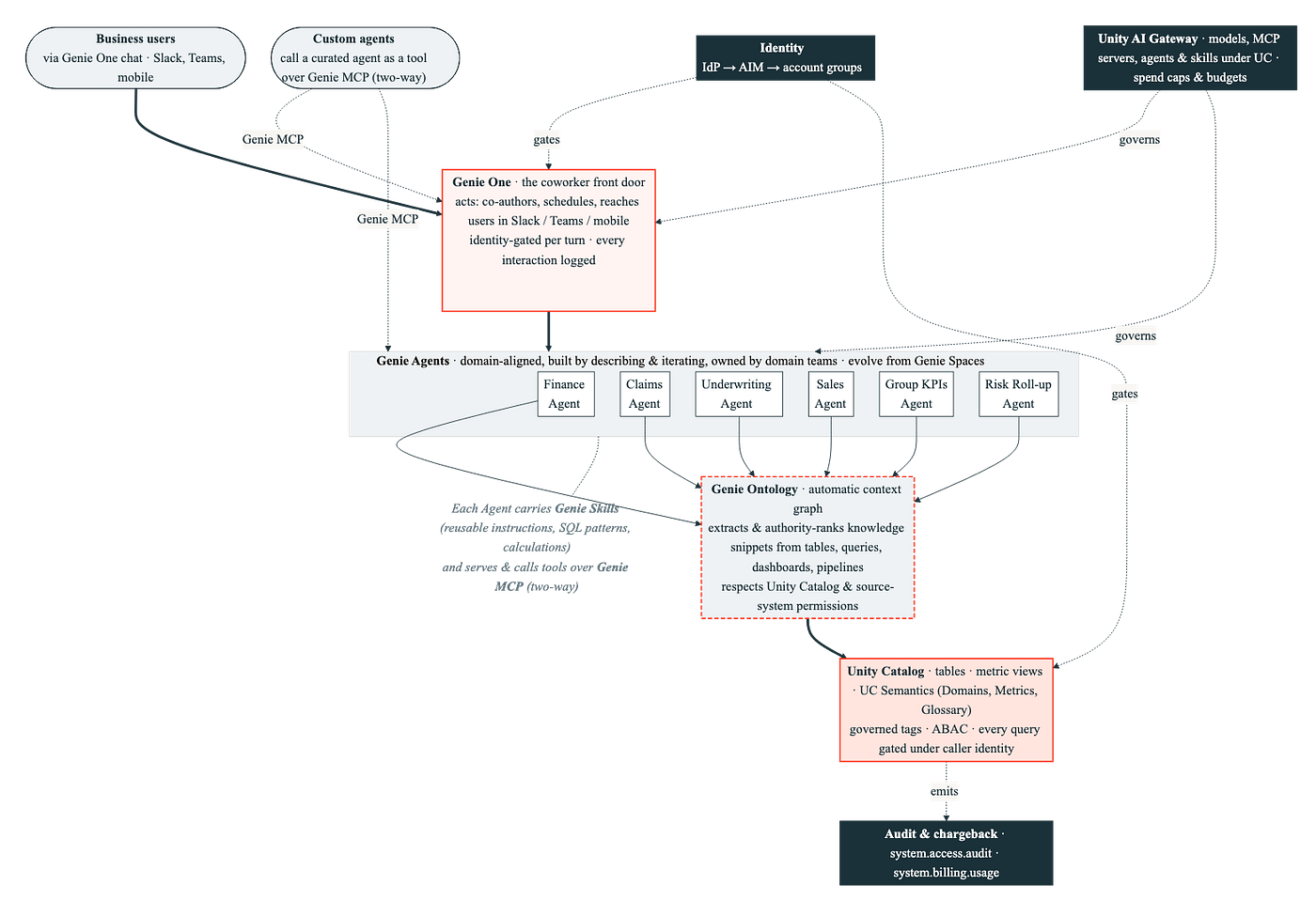
The Genie Mesh after Data + AI Summit 2026. Five changes from the original Genie Mesh, all on one governed substrate. The front door is now Genie One, a coworker that acts. Genie Spaces become Genie Agents, each carrying reusable Genie Skills and reachable both ways over Genie MCP. A new layer, the Genie Ontology, learns business context automatically instead of curating it by hand. Unity Catalog and the Unity AI Gateway govern every call. The composition is unchanged; the named parts are what moved.
The front door is now Genie One
The business-user surface is now **Genie One**. The change is more than a label. Genie One acts: it co-authors documents, runs tasks on a schedule, reaches users in Slack, Teams, and on mobile (iOS, Android), and calls other systems. The front door moved from answering questions to doing work.
The governance pattern from the Genie Mesh is untouched. Genie One is reached through the Consumer access entitlement, and is share-gated for discovery. A coworker that can act raises the stakes on that identity gate; it does not replace it.
Genie Spaces become Genie Agents
The mesh’s building block was the Genie Space: a curated bundle of metric views, synonyms, SQL templates, and skills over one data product. That building block now becomes a Genie Agent. You build one by describing what it should do and iterating in plain language, through Genie Code or Genie One, with no pipeline to write. It reasons over structured and unstructured data and takes action through tool calls.
This is the evolution Databricks describes: Genie Spaces are evolving into Genie Agents, curated chat experiences becoming curated agents that can act. The governance does not change. A Genie Agent runs on behalf of the caller, downscoped to that caller’s identity. The semantic surface a domain team curates is now directly callable as an agent, on the same policy plane.
Skills and connections: what the agent carries, what it reaches
Two mechanisms set what a Genie Agent knows and how far it reaches. The first is skills. A **Genie Skill** is a packaged, reusable capability: an instruction, a SQL pattern, a calculation, or a formatting rule the agent loads only when a question calls for it. You author one in plain language following the open Agent Skills standard: in Genie One. Unity Catalog now provides a governed inventory of reusable skills, where teams register, publish, secure, and audit them as governed assets under the Unity AI Gateway, alongside the data they sit on. A domain team authors a skill once, and Genie One and Genie Agents reuse it.
The second is connectivity. Genie One and Genie Agents reach beyond the Data Intelligence Platform through Lakeflow Connect and managed MCP, and they act on what they find. A Genie Space is also reachable as a Databricks-managed MCP server, so any agent can call a curated domain as a tool.
The original Genie Mesh called a Genie Space the instantiation of a domain’s business knowledge. That instantiation has grown. The same curated unit now carries reusable skills and reaches a set of governed external tools, so a domain’s business knowledge is no longer only its tables and metrics. It is the data, the skills, and the tools the agent can act through, all behind one governed interface.
The governance plane does not widen with the surface. Every call runs through Unity Catalog and the Unity AI Gateway, downscoped to the caller’s identity and recorded in system tables. A skill cannot grant access its author lacks; a tool call inherits the caller’s permissions. The wire got wider. The gate did not move.
Genie Ontology: curation moves down a layer
Business semantics live in Unity Catalog as a hand-curated layer: Domains, UC Metrics, and the new UC Glossary. It is curated increasingly with agent assistance, and it is the authoritative definition of what your business terms mean.
The Genie Ontology sits on top and extends that reach automatically. It is an automatic context graph (rolling out by region) that extracts knowledge snippets from the assets the enterprise already produces: tables, queries, dashboards, pipelines, and connected apps. From those it captures metric definitions, business terms, unique calculations, and the relationships between concepts, metrics, tables, and teams. Grouped by where they come from, those assets fall into three classes: the business semantics curated in Unity Catalog, the usage signals already in the Data Intelligence Platform (queries, dashboards, pipelines), and external assets reached through connected apps. It ranks snippets by authority with a PageRank-style signal that weighs where a definition came from, the authority of its author, how often people rely on it, how closely it ties to certified and widely-used assets, and how fresh it is. The output is one living graph of business context that grounds Genie One and Genie Agents.

Three asset classes feed the Genie Ontology. Business semantics curated in Unity Catalog are the highest-authority layer. Usage signals already in the lakehouse and external assets reached through connected apps extend the graph to the context you never curated by hand. Permissions are applied throughout, so a snippet a user may not see never reaches their answer.
Your curated semantics do not become redundant. They are the highest-authority seeds in the graph, the assets a graph-rank signal trusts most. The Ontology extends reach from the handful of domains you curated by hand to the long tail you have not. Curation moves down a layer rather than disappearing.
The Ontology respects source-system access controls and Unity Catalog permissions, so a snippet a user may not see never reaches that user’s answer. The graph changes what Genie knows, not who is allowed to ask. Grounding Genie in a context graph of this kind raises first-attempt accuracy on real production questions.
The evolved stack
The layers still stack the same way, with a curated semantic layer and a new automatic graph between the data and the agents:
Data products (Unity Catalog)
  -> Unity Catalog Semantics: Domains & tags, UC Metrics, UC Glossary (hand-curated)
  -> Genie Ontology: automatic context graph on top of the semantic layer
  -> Genie Agents: built by describing, skills + connected tools (federation, Lakeflow Connect, MCP)
  -> Genie One: the coworker front door
Governed underneath by Unity Catalog (ABAC, AIM identity, audit) and the Unity AI Gateway.
The governance spine is unchanged in shape and wider in reach. UC ABAC, AIM-synced identity, and system-table audit still gate every query. The Unity AI Gateway now extends that control to the agentic layer: it brings models, MCP servers, agents, and skills under Unity Catalog and adds spend caps and budgets. A CRO or DPO can still defend the same three things to a regulator: that the user was allowed to ask, where the answer came from, and that the interaction is on record.
메타데이터
- post_id
- 7c72702a2dcd
- slug
- the-genie-mesh-evolved-7c72702a2dcd
- url
- https://medium.com/@philipp.tiefenbacher_42173/the-genie-mesh-evolved-7c72702a2dcd
- canonical_url
- https://medium.com/@philipp.tiefenbacher_42173/the-genie-mesh-evolved-7c72702a2dcd
- author_url
- https://medium.com/@philipp.tiefenbacher_42173
- status
- ok
- fetched_at
- 2026-06-23 19:38:28




