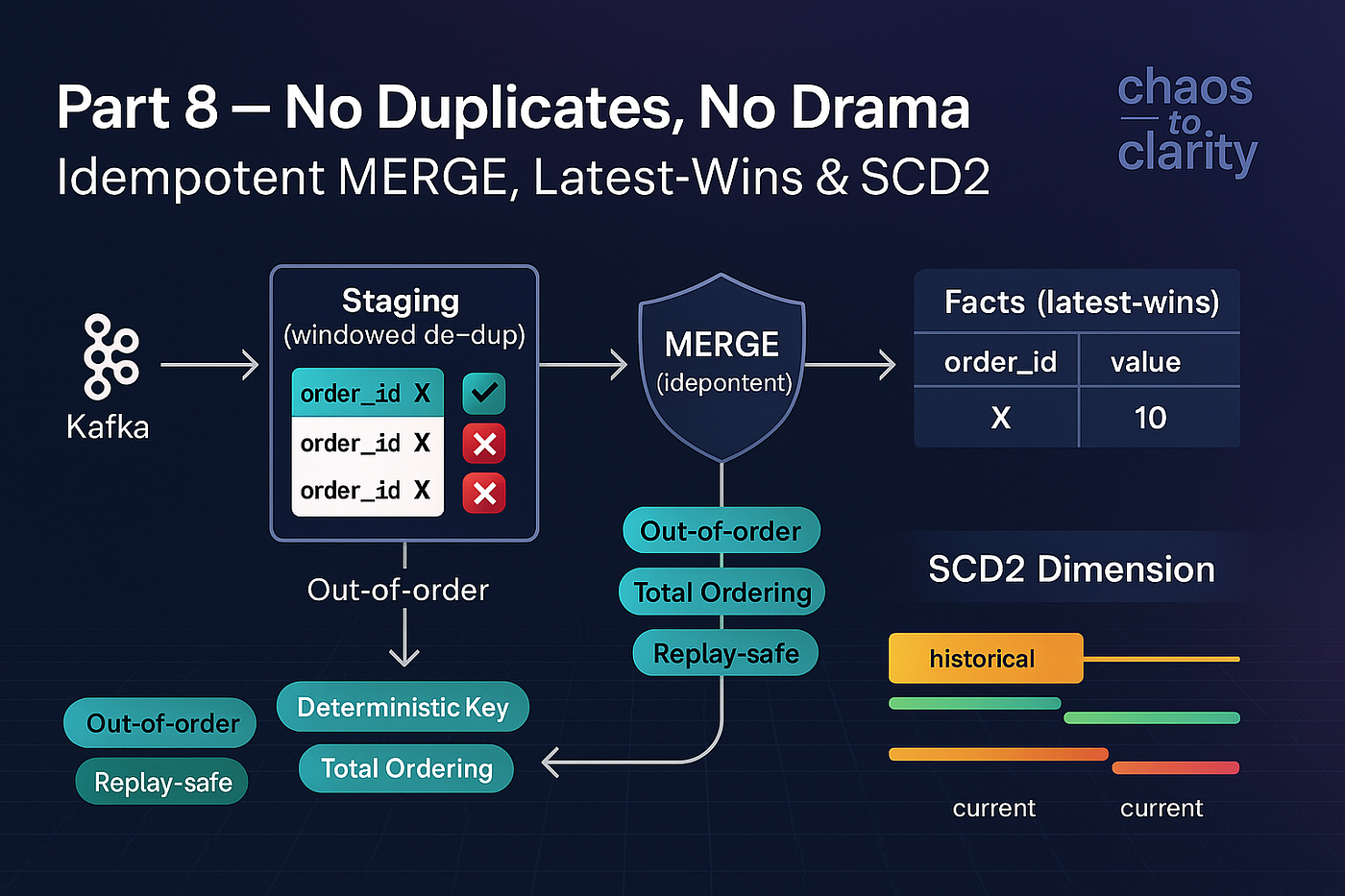
🧭 Part 8 — No Duplicates, No Drama: Idempotent MERGE, Latest-Wins & SCD2
Deterministic keys + total ordering = replay-safe facts and auditable dimensions.
🧭 Part 8 — No Duplicates, No Drama: Idempotent MERGE, Latest-Wins & SCD2
Deterministic keys + total ordering = replay-safe facts and auditable dimensions.
⬅️ Previous: 📦 Part 7 — Manifests, Compaction & Load Jobs | 🔗 All Parts (Series Hub) | ➡️ Next: ⏪ Part 9 — Backfills & Replays: Fast Recovery Without Duplicates
🏷️ Topics: Data Engineering · BigQuery · Idempotency · De-duplication · SCD2
If you’re new here, Follow and read the series in order — each part builds on the last.
Why Part 8 matters
Your micro-batches are reliable and your loads are cheap — but analytics are only trustworthy if your tables converge to the same answer every time, even when:
- producers resend data,
- events arrive out of order,
- you replay an hour/day,
- or you run backfills.
Today we’ll make your fact tables idempotent with latest-wins de-dup and your dimensions auditable with SCD Type 2. Everything here is re-runnable — no hand-waving “exactly-once” needed.
1) Idempotency pillars (recap & apply)
- Deterministic identity: a business key or event_id that uniquely identifies a fact row.
- Total ordering: a deterministic tie-breaker (e.g.,
event_time, theningest_time, thenrun_id). - Monotonic convergence: repeated runs pick the same winner for each key (latest-wins).
- Ledgering: a
processed_partstable ensures you don’t re-LOAD the same file; but even if you do, the MERGE makes results stable.
2) De-dup in staging (window functions)
Always deduplicate in staging first so each key has one “champion” row before you MERGE into the silver table.
-- Champion per business key using a deterministic order:
-- 1) event_time (latest wins)
-- 2) ingest_time (latest wins as a tiebreak)
-- 3) run_id (highest/lexicographically last wins as final tiebreak)
WITH ranked AS (
  SELECT
    s.*,
    ROW_NUMBER() OVER (
      PARTITION BY order_id
      ORDER BY event_time DESC, ingest_time DESC, run_id DESC
    ) AS rn
  FROM `proj.stage.orders_hour` s
)
SELECT * EXCEPT(rn)
FROM ranked
WHERE rn = 1;
Why this works: Whatever order files arrive, the same row wins for each order_id. Your MERGE then becomes deterministic and idempotent.
Tip: If producers don’t have a stable business key, mint one upstream (e.g., a deterministic hash over natural keys) or require an event_id from producers.
3) Latest-wins MERGE (facts)
Now take the champions from staging and MERGE into your silver fact table.
-- Silver table schema sketch:
-- order_id STRING PRIMARY KEY
-- amount NUMERIC, status STRING, event_time TIMESTAMP, ingest_time TIMESTAMP, src_run_id STRING
MERGE `proj.silver.orders` T
USING (
  WITH ranked AS (
    SELECT
      s.*,
      ROW_NUMBER() OVER (
        PARTITION BY order_id
        ORDER BY event_time DESC, ingest_time DESC, run_id DESC
      ) AS rn
    FROM `proj.stage.orders_hour` s
  )
  SELECT * EXCEPT(rn) FROM ranked WHERE rn = 1
) S
ON T.order_id = S.order_id
WHEN MATCHED AND (
  -- Only replace if S is strictly "newer" under our total order
  S.event_time >  T.event_time OR
 (S.event_time = T.event_time AND S.ingest_time >  T.ingest_time) OR
 (S.event_time = T.event_time AND S.ingest_time = T.ingest_time AND S.run_id > T.src_run_id)
) THEN
  UPDATE SET
    amount      = S.amount,
    status      = S.status,
    event_time  = S.event_time,
    ingest_time = S.ingest_time,
    src_run_id  = S.run_id
WHEN NOT MATCHED THEN
  INSERT (order_id, amount, status, event_time, ingest_time, src_run_id)
  VALUES (S.order_id, S.amount, S.status, S.event_time, S.ingest_time, S.run_id);
Properties
- Replays: inserting the same (or older) record does nothing.
- Late arrivals (out-of-order): a truly newer record wins and updates the row.
- Idempotent: running this again yields the same table.
4) Out-of-order arrivals without tears
Use two timestamps consistently (see Part 3):
event_time= when the thing actually happened (producer-declared).ingest_time= when your pipeline saw the event.
Your ordering should be event_time first, then ingest_time to break ties. Why?
- It reflects business truth (not network luck).
- It naturally handles late arrivals that are truly newer in time.
If producers sometimes lie or drift, consider:
- a skew budget (e.g., “accept events up to 24h late”), and
- enforcing a monotonic floor per key (reject far-future timestamps to DLQ; see Part 6).
5) SCD Type 2 for dimensions (auditable history)
Facts use latest-wins. Dimensions often require history (who was the account owner last month?). That’s SCD2.
Table design (SCD2 dim)
dim_customer_scd2
- customer_sk       INT64      -- surrogate key (unique row id)
- customer_id       STRING     -- business key
- attributes_hash   STRING     -- hash of attrs for change detection
- name, email, plan, ...      -- current attributes
- valid_from        TIMESTAMP
- valid_to          TIMESTAMP  -- NULL means "current"
- is_current        BOOL
Step A — Detect changes (staging vs current)
-- 1) Prepare champion rows per customer in staging (same window de-dup idea)
WITH champions AS (
  SELECT * EXCEPT(rn) FROM (
    SELECT s.*,
           ROW_NUMBER() OVER (PARTITION BY customer_id
                              ORDER BY event_time DESC, ingest_time DESC, run_id DESC) rn
    FROM `proj.stage.customer_changes` s
  ) WHERE rn = 1
),
-- 2) Current snapshot
current AS (
  SELECT * FROM `proj.dim.dim_customer_scd2` WHERE is_current = TRUE
),
-- 3) Changes: new customers or attribute changes (hash compare)
diff AS (
  SELECT
    c.customer_id,
    TO_HEX(SHA256(TO_JSON_STRING(STRUCT(c.name, c.email, c.plan)))) AS new_hash,
    cur.attributes_hash AS old_hash,
    c.* EXCEPT(run_id)  -- remove volatile fields if any
  FROM champions c
  LEFT JOIN current cur USING (customer_id)
  WHERE cur.attributes_hash IS NULL       -- new
     OR cur.attributes_hash != TO_HEX(SHA256(TO_JSON_STRING(STRUCT(c.name, c.email, c.plan))))
)
SELECT * FROM diff;
Step B — Apply SCD2 (close old row, open new row)
-- Close any current row that changed
UPDATE `proj.dim.dim_customer_scd2` cur
SET valid_to   = CURRENT_TIMESTAMP(),
    is_current = FALSE
WHERE is_current = TRUE
  AND customer_id IN (SELECT customer_id FROM diff);

-- Insert new current rows
INSERT INTO `proj.dim.dim_customer_scd2`
  (customer_sk, customer_id, attributes_hash, name, email, plan,
   valid_from, valid_to, is_current)
SELECT
  GENERATE_UUID(),                  -- or a sequence if you prefer ints
  d.customer_id,
  d.new_hash,
  d.name, d.email, d.plan,
  CURRENT_TIMESTAMP(),              -- valid_from
  NULL,                             -- valid_to
  TRUE                              -- is_current
FROM diff d;
Why hash? Hashing a deterministic shape of attributes avoids per-column “did it change?” complexity and makes updates easy to reason about.
Idempotency: Running the detection logic again yields no additional changes because current/old rows already reflect the latest attributes.
6) What about “same event_time” collisions?
When two rows share the same event_time for a key (it happens), you still need a stable tie-breaker:
ingest_time(later wins)run_id(higher wins)source_rank(optional: assign priority to sources)
This triple makes ordering total and deterministic. Encode the same order in both staging de-dup and MERGE WHEN MATCHED conditions.
7) Hardening tips (production)
- Normalize timestamps to UTC at ingest; store with microsecond precision.
- Do not cast away precision in staging or MERGE (e.g., avoid
DATE(event_time)in ordering). - Prefer numeric/ENUMs for status flags; avoid free-form strings that drift.
- Guard rails: DLQ anything with future timestamps beyond your skew budget, null keys, or malformed payloads.
- Test late data: simulate an event arriving hours late and confirm your latest-wins logic replaces the row.
- Monitor: “duplicate key attempts” and “rows updated vs inserted” per run.
8) Validation queries (trust but verify)
8.1 One row per key in silver
SELECT COUNT(*) AS total_keys, COUNT(DISTINCT order_id) AS distinct_keys
FROM `proj.silver.orders`;
-- Expect equal counts
8.2 Only one current row per key in SCD2
SELECT customer_id, COUNTIF(is_current) AS current_rows
FROM `proj.dim.dim_customer_scd2`
GROUP BY customer_id
HAVING current_rows != 1;
-- Expect 0 rows
8.3 Latest-wins truly wins
WITH winners AS (
  SELECT order_id, MAX(event_time) AS max_et
  FROM `proj.stage.orders_hour`
  GROUP BY order_id
)
SELECT s.order_id, s.event_time, w.max_et
FROM `proj.silver.orders` s
JOIN winners w USING (order_id)
WHERE s.event_time < w.max_et
LIMIT 10;
-- Expect 0 rows
8.4 Out-of-order sanity check
SELECT
  COUNTIF(event_time < ingest_time) AS arrived_late,
  COUNT(*) AS total
FROM `proj.stage.orders_hour`;
-- Expect some late arrivals in real systems; track % over time
9) Putting it on rails (ops flow)
- Load job writes to staging (Part 7).
- A de-dup view (windowed ROW_NUMBER) exposes champions.
- A MERGE job runs: latest-wins into
silver.orders. - SCD2 job updates
dim_customer_scd2. - Dashboards show rows inserted/updated, late arrival rate, duplicates suppressed, SCD2 changes.
10) Common pitfalls (and fixes)
- Pitfall: Using only
ingest_timefor ordering → network luck decides truth. Fix: Order byevent_timefirst, theningest_time, thenrun_id. - Pitfall: Non-deterministic tiebreakers (e.g., random UUIDs in ORDER BY).
Fix: Deterministic
run_idor fixed source_priority. - Pitfall: Pre-aggregating before de-dup. Fix: First de-dup champions, then aggregate.
- Pitfall: Changing the ordering later. Fix: Treat it as a breaking change; re-MERGE from the lake with the new order.
Production checklist
- Business key or
event_idis present for every fact row. - Staging de-dup view (ROW_NUMBER … ORDER BY event_time, ingest_time, run_id).
- Idempotent MERGE logic mirrors the same ordering.
- SCD2 dimension with
valid_from,valid_to,is_current, andattributes_hash. - Validation queries are saved and monitored.
- Late data tests included in CI (simulate hours-late events).
- DLQ rules catch null keys and far-future timestamps (Part 6).
Final thought
Idempotency isn’t magic — it’s just deterministic identity + deterministic ordering. Add a small de-dup window in staging, a latest-wins MERGE in silver, and (for dimensions) a simple SCD2 pattern. Your tables will converge to the same answer after every replay, retry, or backfill — exactly what trustworthy analytics demand.
⬅️ Previous: 📦 Part 7 — Manifests, Compaction & Load Jobs | 🔗 All Parts (Series Hub) | ➡️ Next: ⏪ Part 9 — Backfills & Replays: Fast Recovery Without Duplicates
🙌 Enjoyed this?
If this helped, tap the Clap (up to 50×!) and **follow me** for more hands-on serverless guides. Your claps + follows tell Medium to show this to more builders — thank you!
Read next (hand-picked)
- 🚀 Run Jupyter Notebooks in VS Code — No Browser Required
- 🧵Kinesis Partial Batch Failure, Done Right (Deep-Dive)
- 🔑 GitLab and GitHub on One Machine: The Ultimate Guide to Handling Two Repos Seamlessly
- ⚡DynamoDB Lambda Done Right: NAT-Free, Idempotent, Scalable
- 🛡️ Injecting Chaos into AWS Architectures with Diagram-as-Code
- 🔐 Least-Privilege by Construction: Policy-as-Code for OpenSearch
- 🔵🟢 Blue/Green OpenSearch Ingestion — Snapshots as Your Safety Net
- 🔎 Forensic Snapshots Opensearch: Root-Cause in Minutes
- 🚀 Snapshot-Driven Staging Environments for Every Pull Request
- 🌐High Availability in AWS: Designing for Resilience and Uptime
🧭 More deep-dive content is on the way!
☁️I’ve just started a new technical series on Cloud Architecture. Stay tuned
메타데이터
- post_id
- 7c7361491bb7
- slug
- part-8-no-duplicates-no-drama-idempotent-merge-latest-wins-scd2-7c7361491bb7
- url
- https://medium.com/@sonal.sadafal/part-8-no-duplicates-no-drama-idempotent-merge-latest-wins-scd2-7c7361491bb7
- canonical_url
- https://medium.com/@sonal.sadafal/part-8-no-duplicates-no-drama-idempotent-merge-latest-wins-scd2-7c7361491bb7
- author_url
- https://medium.com/@sonal.sadafal
- status
- ok
- fetched_at
- 2026-06-27 07:40:21