No, Our Metabolism Doesn’t “Slow Down” in Our Late 20s. This Is What Actually Happens
This recent study shows we can maintain a youthful metabolism for many years, as long as we regularly engage in this type of exercise
No, Our Metabolism Doesn’t “Slow Down” in Our Late 20s. This Is What Actually Happens
This recent study shows we can maintain a youthful metabolism for many years, as long as we regularly engage in this type of exercise

Photo by Los Muertos Crew on Pexels
“From about the early twenties till about the late fifties, people’s daily energy expenditure is not really — we don’t see a slowdown in middle age. It doesn’t happen.”
This is what Dr. Herman Pontzer — a professor of evolutionary anthropology and global health at Duke University, known for his research on human metabolism — recently shared during a fascinating interview.
What?
Impossible.
If you’re like me, that word immediately popped into your head. Most of us have had the experience of not being able to eat like in our early twenties. Surely this must be a prank.
And, although this truly seems impossible, Dr. Pontzer actually has the data to back him up.
In 2021, he published an eye-opening study that analyzed the calories burned by more than 6,400 people, from one-week-olds to nonagenarians, as they went about their lives. And what Pontzer saw went against the common belief that everything goes downhill after our early twenties.
In truth, our metabolism stays mostly the same throughout midlife — even if it doesn’t feel that way.
However, our shared experience is also true. Why? Because our metabolism can stay the same, but only if we maintain our size and body composition, which is why one type of exercise could be the key to us maintaining our youthful metabolism throughout adulthood.
This is something I’ve experienced myself.
In my early twenties, I gained weight, and by the time I was 26, I was 100% convinced my metabolism had slowed down.
But then I went deep into a metabolism-research hole and got myself to where I’m now, leaner than in my early twenties (I’m 32 years old) and able to eat around 2,600 Kcal every day, even though I’m a 114-pound female.
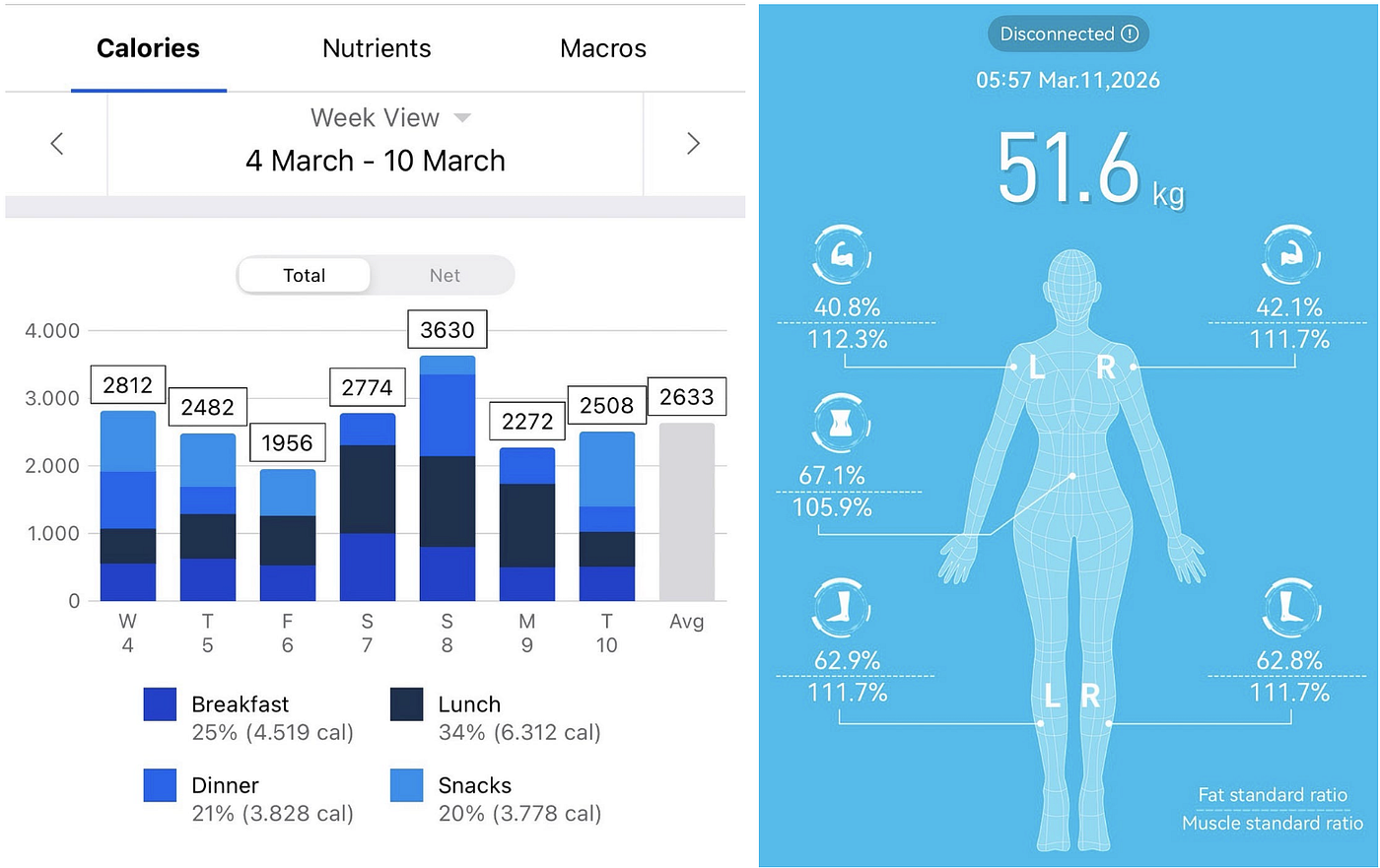
Left (What I ate on an average week — data from the MyFitnessPal app). Right (My current weight and body composition — data from the Lepulse app). Source: author.
Here’s what Dr. Pontzer’s study found and what that means for us:
Note: If you’re interested in watching or listening to Dr. Pontzer’s interview, I’m linking it below. The part where he discusses the myth of the metabolism slowing down in middle age starts around the 50-minute mark, although I highly recommend watching/listening to it all.
[embed]Dr. Pontzer’s interview
The Study’s Findings
To determine the average daily energy expenditure across a human lifetime, Dr. Pontzer and his team compiled data from hundreds of doubly labeled water measurements of men and women into a plot of daily energy expenditure against body weight.
You can read more about what this method entails here, but it’s basically the current gold standard for estimating daily energy expenditure.
With this data, Dr. Pontzer was able to see that “The biggest predictors of daily energy expenditure are the size and composition of your body. Bigger people are made of more cells, and more cells doing more metabolic work burn more calories each day.” (All following quotes are from Dr. Pontzer’s fascinating book, *Burn: The Misunderstood Science of Metabolism.)*
In other words, we can estimate how many calories a person burns each day based on their weight and lean tissue.
According to Dr. Pontzer, “a 140-pound woman has an estimated daily energy expenditure of 2,300 kcal per day. For a 160-pound man, the expected daily expenditure is 3,000 kcal per day.”*
However, our daily energy expenditure per pound of body weight does change throughout our lifetimes, which is what Dr. Pontzer’s study discovered.
The four phases of our metabolism are:
- The first year of life: Babies burn around 50% more calories per pound of body weight than adults. No wonder this is the time when we experience the most growth.
- Childhood and adolescence (1 to 20 years): The daily energy expenditure per pound of body weight starts to decline until we reach our twenties, when it plateaus. In Dr. Pontzer’s words: “Each pound of a typical three-year-old kid burns about 35 kcal per day. That number steadily declines through childhood and adolescence, flattening out at around 15kcal per pound each day in our early twenties.”
- Adulthood (20 to 60 years): Total daily energy expenditure per pound of body weight remains stable throughout these four decades, debunking the myth that our metabolism slows down after our twenties. However, there’s one variable that seems to be at fault (at least partly) for the perceived slowdown, which I’ll explain in the next section.
- Older adulthood (60+ years): Total daily energy expenditure per pound of body weight — even when accounting for muscle loss — declines by around 0.7% per year, with people in their nineties having a 26% slower metabolism than middle-aged adults. Dr. Pontzer believes this decline may be a reflection of age-related metabolic decline at the organ level.
All in all, what we can take from Dr. Pontzer’s research is that our metabolism peaks in the first year of our life, then it slowly declines until we’re 20, plateauing for about 40 years, and then declining as we go over our sixties.
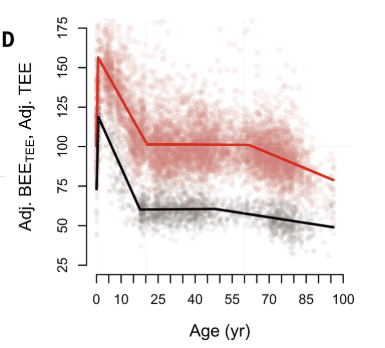
Segmented regression analysis of adjusted total (red) and adjusted basal expenditure (black) (calculated as a portion of total, Adj. BEETEE) indicates a peak at ~1 year of age, adult levels at ~20 years of age, and decline at ~60 years of age. Source: Daily energy expenditure through the human life course by Dr. Pontzer and his team, published in Science.
*Remember that, as with any average, half of the population will fall above the trend line (people with a “fast” metabolism) and the other half below it (people with a “slow” metabolism), so you can see 140-pound women who need more or less than 2,300 Kcal per day.
What That Means for Us
If you’ve listened to the interview I linked to above, you’ll realize that Dr. Pontzer repeatedly says there’s still much more to research when it comes to metabolism. Many, many questions remain unanswered.
What he knows for sure, though, is that size and body composition are the biggest predictors of total daily energy expenditure, which does give us some clue as to what we can do to maintain a youthful metabolism throughout adulthood.
Why?
Because not all cells burn the same amount of calories.
In Dr. Pontzer’s words: “Fat cells burn a lot less energy than lean tissue, the cells that make up our muscles and organs. If fat cells make up a larger proportion of your body weight, you will burn fewer calories than a person who weighs the same but is leaner.”
In other words, the better our body composition (more muscle, less fat), the more calories we’ll burn daily — which is likely the reason why most of us experience a metabolism slowdown in our mid-to-late twenties.
After a probably more active lifestyle that required us to have more muscle, we start sitting more and stop challenging ourselves. Our bodies, as a result, let go of our valuable muscle, bringing our metabolism down.
This is what happened to me.
Once I started working, my lifestyle became more sedentary. But once I started lifting weights and walking more steps — returning to an activity level and body composition similar to what I’d had before — my total daily energy expenditure went back up and has stayed up since.
So, if our goal is to keep the healthiest metabolism we can as we age, lifting weights — or any other form of resistance training — becomes fundamental.
Maintaining our lean tissue maintains our metabolism.
“Boosting” Our Metabolism
Dr. Pontzer laughs at the idea of “boosting” our metabolism because, as he showed with his research, our metabolism is pretty stable throughout adulthood — as long as we maintain our size and body composition, of course.
However, there are different science-backed strategies — beyond resistance training — we can use to keep our engines at max speed.
I discussed them in great detail in my article on how I boosted my metabolism (yes, I know Dr. Pontzer would mock my title). But here’s a short summary of the key points:
- Engage in progressively harder resistance training 2 to 4 times per week.
- Ensure you get enough sleep, hydration, and food to avoid metabolism crashes.
- Practice regular cold exposure to “beige” your fat tissue.
- Add metabolism-boosting foods like Brazil nuts, jalapeño peppers, green tea, coffee, and ginger.
- Make protein a priority in every meal.
- Stand and move every 30 minutes to break long bouts of sitting.
- Opt for three larger, less frequent meals when possible.
- Walk as much as you can and more than a set goal.
- Try High Intensity Interval Training (HIIT).
- Raise your calves and shake your legs when sitting.
- Find an active hobby that complements your life.
- Embrace the sauna as a regular weekly practice.
These habits helped me increase my daily calorie intake by 30%, which is why I considered that they “boosted” my metabolism.
So, although there are still many unknowns when it comes to metabolism, one thing’s for sure: It’ll stay the same throughout midlife, so let’s make the most out of it by keeping our youthful body composition and — perhaps even— by trying some of the habits that’ve helped me and many others.
메타데이터
- post_id
- 7c8b3cc930a0
- slug
- no-our-metabolism-doesnt-slow-down-in-our-late-20s-this-is-what-actually-happens-7c8b3cc930a0
- url
- https://medium.com/in-fitness-and-in-health/no-our-metabolism-doesnt-slow-down-in-our-late-20s-this-is-what-actually-happens-7c8b3cc930a0
- canonical_url
- https://medium.com/in-fitness-and-in-health/no-our-metabolism-doesnt-slow-down-in-our-late-20s-this-is-what-actually-happens-7c8b3cc930a0
- author_url
- https://medium.com/@alealevs
- status
- ok
- fetched_at
- 2026-06-17 08:20:12