Ramanagiri Biography, Part Two
Here the story of Per Westin, Swami Ramanagiri, continues
Ramanagiri Biography, Part Two
Here the story of Per Westin, Swami Ramanagiri, continues


Out of all human beings, 108 are chosen. Out of these 108, nine are selected. Out of these nine, seven go mad. One goes knowingly back to maya, and one goes to the Supreme.

India 1950–55
Per’s final five years of life would be transformative.
He now emerged as an independent spiritual teacher, with his own disciples and plans for an ashram. At the same time, his illness began to assert itself. Everything began with a vision of his guru Bhagavan, and with a profound inner experience on a beach in Madras.
Influential Friends

N S C Bose Road 1950
Mylapore, Madras, a hot morning in May 1950.
Outside the temple, pedestrians hurry past. Musicians play the piercing sound of the nadaswaram to the rattle of drums on a street corner while a horse-drawn cart is overtaken by an Austin taxi carrying businessmen. People gather for a procession beneath gigantic film posters depicting divine heroes. The scents of teahouses and stalls selling spiced fried food fill the dusty air.
Into this South Indian metropolis, about the size of present-day Stockholm, arrived a by now fairly well-travelled Per. He had actually intended to return to Almora, but a friend persuaded him to remain in the city for a few days.
The friend was no ordinary man. S. Parthasarathy, twenty years older than Per, lived at the prestigious address of 30 Luz Church Road in the heart of the city. His father, S. Srinivasa Iyengar, had been a renowned Congress politician, industrialist, and lawyer. Parthasarathy’s sister, Ambujammal, was a committed advocate of women’s rights and a close associate of Mahatma Gandhi.
In her memoirs, the family is portrayed as unusually open-minded and free from prejudice. They also offer a glimpse of how Westin may have come into contact with them. Parthasarathy had served his legal apprenticeship under the Ramana devotee Doraiswamy Iyer, who in turn had been trained by his father.
Parthasarathy himself visited Ramanasramam on several occasions, making a meeting there entirely possible. He would become an important friend, contact, and source of financial support right up until Per’s death. Indeed, he was more than that; one source states that Per “treated him like a father.”
The insurance company he founded, Prithvi Insurance Company, had an unusual and altruistic structure. A commercial branch providing general insurance supported a more generous life insurance division, which financed hospital treatment for policyholders at three institutions, including the tuberculosis sanatorium at Perundurai.
Through the family’s network, Per came into contact with several of his later followers. K.C. Sastri, who would later become his disciple, served as the company’s trustee or administrator. Swamy also relates that Ramanagiri helped his own father obtain employment there.
Later, Parthasarathy left the business world to live the simple life of a sannyasi under the name Swami Anvananda. He founded a Devi temple that remains well attended today, where members of the staff were able to confirm the connection to Per’s address. Both Per’s devotion to the Goddess and his interest in the epic Thiruppugazh may have had their roots in this acquaintance.
The bustling city of Madras was both a religious and cultural metropolis. The Ramakrishna Order, the tradition in which Vivekananda had worked, maintained a strong presence, but above all the city was home to many great Shiva temples that testified to a living and deeply rooted Tamil bhakti tradition.
A few days became several, but something soon drew him away from the noise of the city. He was looking for a quieter environment.
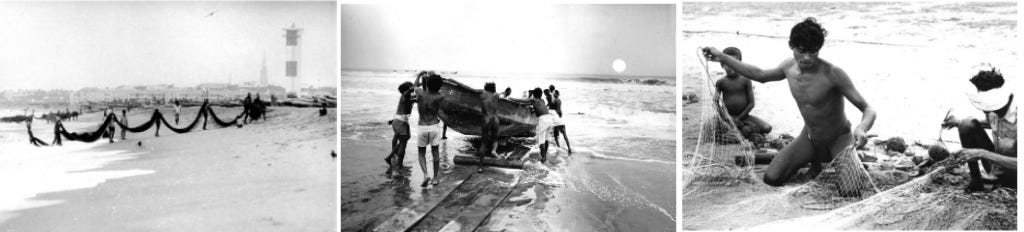
Fishermen on the beach. Photo by Harry Miller (1923–1998) who lived in Madras most of his life and married Revanti, the daughter of S. Parthasarathy.
Just south of the city stretch miles of sandy beaches. There is also a large park-like estate, with colonial buildings scattered among the trees: the headquarters of the Theosophical Society at Adyar. An international public was drawn there for meetings and study, and the atmosphere was considerably calmer than in the city.
Per visited the library, filled with religious manuscripts. Afterwards he wandered along winding paths flanked by palms and enormous banyan trees. As he made his way eastward towards the beach, the greenery gradually gave way to more barren vegetation until the horizon opened before him. At the water’s edge, fishermen worked to haul in their nets from narrow boats beneath the cries of gulls. The sand glittered in the intense sunlight and the scent of salt drifted in from the deep blue sea.
A peaceful walk.
Yet within him, something both strange and dramatic was taking place.
The Vision on the Shore

In a letter to Sunyata, Per writes:
“The same day as I was going back to North India I visited the Theosophical Library at Adyar. And while walking in the garden, Sri Bhagavan Ramana Maharshi appeared before me. He asked me to follow him. I went along the seacoast to a little place where I sat down for meditation.”
The beach to which he was led lay below the small fishing village of Tiruvanmiyur, facing the open sea of the Coromandel Coast. A disciple of Per, the anonymous “A Chela,” further recounts that Ramanagiri there sank into deep samadhi. When his host had not heard from him for a long time, concern began to grow. A search was organized, and at last they found him there on the beach beneath the blazing sun.
When Per, in A Chela’s words, “came back to the physical plane,” he was asked to come back to Madras. But he firmly refused. Bhagavan had instructed him to remain there, and that was what he intended to do. The host, presumably S. Parthasarathy, then had a simple hut of dried coconut palm leaves erected and arranged for food to be sent there daily. Often, however, it is said that he was surrounded by the local fishing people and would instead give the food away to them.

Swami Suresananda; Madras beach in the 1950–60s and an older photo.
At some point Swami Sureshananda, a long-time devotee of Bhagavan, joined him. It is said that for a period the two sat together absorbed in meditation, almost unaware of the world around them. A biographical article about Sureshananda describes how they lived “an austere lifestyle practising penance,” sustaining themselves on fruit and tender coconuts and, contrary to what A Chela states, building the hut themselves. In the biography Per is referred to as Swami Ramanananda Giri, which suggests that he had not yet shortened his name.
During the months from April to June, temperatures could rise to nearly 40 degrees Celsius. It is in this heat that the following strange anecdote takes place:
“One hot summer’s day they were both feeling really hungry but there was nothing to eat. They would have had to walk two miles to reach the nearest village. Reluctantly both remained hungry, but soon there was a knock at their door.
A lady carrying a big tiffin carrier had brought cooked rice meals for both the swamis. She had come as a result of a dream which had directed her to serve these sadhus.
The lady was Eleanor Noye, an American devotee of Bhagavan.”
According to one source, it was Bhagavan himself who in the dream instructed her to prepare the food. If one wishes, the story may be interpreted as an attempt to express the invisible fellowship said to unite Ramana’s followers. Yet there is also a relatively solid basis for believing that the event truly took place. Among others, M. Highburger from the ashram confirmed that it was known within Bhagavan’s circles.
That Per and Noye met there is also entirely possible. Directly after Maharshi’s death, Eleanor stayed for six weeks with the Nambiar family in Gandhi Nagar, Adyar. Noye departed for the United States via Bombay on September 1, 1950, which places the event sometime between late April and August of that year. According to Dennis Hartel, Per remained on the beach for around two to three months.

Noye travelled home via Haifa and appears to have made a detour to the Sea of Galilee, where she picked up a stone and sent it to Per in Madras. Another indication that the two were close.
Sureshananda, then in his fifties, was a lawyer who later became a respected spiritual teacher, known for his self-sacrificing devotion. He would later found an ashram in his hometown of Palakkad in Kerala in Bhagavan’s honor. Sureshananda may have been a valuable support for Per during the transition toward a more independent spiritual teaching role.
A Chela describes how Per would sometimes sink so deeply into samadhi that he completely lost awareness of the body and its needs. This neglect, he argues, contributed to tuberculosis taking hold. At first Per refused medical care, but in the end he was persuaded by his host to return to the city.
The Letter to Sunyata
We must return to the letter to Sunyata. Here, not only the vision of Bhagavan is described, but also a spiritual awakening. If any doubt remained after the first experience, something now occurs that is more profound and enduring.

Dearest Sunya,
In this letter I must tell you that I have sailed away. I have sailed to a far-off place, a place which cannot be described by words. To describe it is to pollute it. The steamer on which I sailed is a very powerful one, but it rolls hard in the sea if the weather is stormy. The place is called by many names, but still no name can cover its reality.
Some used to call the place nirvikalpa, others satchitananda or nirguna Brahman — some call it God or Self, others call it pure consciousness or the egoless state. To describe it, I have to put up a big wall before it.
The name of the steamer is ‘mind’. With the help of prana one reaches the place that for the jiva seems so far away; but really speaking, is nearer than one’s own breath. If the sense-weather is stormy, the steamer will roll badly on the samsaric ocean. By now, you must understand the art of my sailing, and why I have been so silent. Let me tell you what happened and why I have been so silent.
The same day as I was going back to North India I visited the Theosophical Library at Adyar. And while walking in the garden, Sri Bhagavan Ramana Maharshi appeared before me. He asked me to follow him. I went along the seacoast to a little place where I sat down for meditation. There Sri Bhagavan’s voice told me that my only duty (dharma) from now onwards was the Self. Further, he gave me some upadesa which I followed for some days.
One night, between 12 and 2, kundalini was aroused to sahasrara and the jiva merged into the Self. On account on the sound Om from the waves of the sea, I was brought back to body awareness; otherwise I would have left my body because in that state there is no one to come back, and no one to make any effort. After having regained body-consciousness, I discovered that I had lost all my memory. All events before the time of Sri Bhagavan’s appearance in the garden had gone out of my mind. Friends who had been very close to me looked like strangers. People whom I thought I had never met before came and told me that we had met in Madras only a few days before. Everyone and everything looked so new and strange and unreal.
Now I am getting back my memory, but mostly recollections connected with spiritual experiences and deep love. That is why I am writing to you, because those who are near my heart turn up again in this mind, which is so different from the previous one.
The village people have built a little hut for me, but there is no post office in this little fishing village, the name of which I do not even know, so I cannot give you any address yet. I don’t think any postman will take the trouble to come down to the sandy beach, but I shall let you know later.


Here, something like a birth is described. A new Per emerges, wholly devoted to the Self, pure consciousness. It is a matter-of-fact yet deeply charged account of spiritual transformation.
This inner change helps us understand what follows. It makes it possible for Ramanagiri to function as an independent spiritual teacher. Now, speaking from his own experience, he gives voice to Brahman. He is no longer merely a disciple of Ramana Maharshi; he stands on his own. This is not an unreasonable interpretation, especially considering how Sunyata responded to the letter.
In his account of Ramanagiri’s spiritual journey, Sunyata, after some hesitation, describes Per as “one in a million,” a rare individual who genuinely succeeded in his aim. He sees the letter from the shore as decisive proof that the awakening had taken place. He calls it Per’s “‘last’ word-stuttering about the ineffable”.
According to him, the process began in the encounter with Ramana Maharshi, when all prejudices and “blinkers” fell away:
“In and through him he, later on, came to complete awakening, conscious Self-awareness or Adwaita-Experiencing, although his tools had to go. Hanuman dropped off and Ramanagiri emerged.”
At the same time, Sunyata later suggested that Per assimilated these insights too quickly and too intensely. It burned him out and contributed to the illness that would shorten his life. This “crucifixion of the ego,” Per’s sadhana, was not something Sunyata himself recommended. Better, he argued, was “the Taoist middle way,” where development unfolds gradually and settles into a “mature awareness.” Despite this, he maintained that Ramanagiri ultimately became firmly established in non-dual consciousness. He appears as evidence of the transformative power of self-awareness.
Sunyata himself would, in time, attain a relatively high spiritual standing. That he so clearly affirmed Ramanagiri’s “complete awakening” strengthens the image of Per as a genuine spiritual master. Few Westerners received such unreserved recognition from him.

Original photographs; surroundings digitally extended.
At the same time, room should be left for other interpretations. The letter was written close to the experience itself. Ramana Maharshi spoke of different forms of realization, or samadhi: a temporary absorption, kevala nirvikalpa, where “it opens and then closes again,” and a more stable state, sahaja nirvikalpa, where it remains open and the I-thought, the ego, finally dissolves into the Heart.
Where was Per situated? It is impossible to say with certainty. Yet, considering the direction of his later life, much suggests a lasting breakthrough.
He himself seems not to have attached much importance to such distinctions. He was grounded and simple in the way he spoke about his experiences. His language is gentle and disarming:
“To speak about realised souls is to me as to speak about a piece of air.”
The letter also contains motifs reminiscent of the Bhagavad Gita. The mind is likened to a ship tossed about by storm winds on the “ocean of death and birth.” At the same time, Per’s imagery is deeply personal and seems to echo the steamships of his childhood in the Roslagen archipelago.
The description of the awakening of kundalini, in which the jiva (the individual soul) merges into the Self, has roots in the Shakta Tantric yogic tradition. Yet the foundation remains Ramana’s simple instruction, upadesha: to follow the I-thought back to its source.
Shortly thereafter, Per’s health deteriorated, and he was forced to remain in Madras longer than planned. Through A Chela, we know that he was there in October and November 1950. On December 27, Per collected his passport from the Swedish consulate, and in January of the following year, A Chela meets him.
We will soon return to that meeting.
Becoming Tamil

The experiences on the beach seem to have rooted Ramanagiri in a state he had previously only glimpsed. With a more mature spirituality, he could now draw closer to India’s lived, popular religious world — a world he had been in all along, yet in some way had still stood apart from.
One key to this was the visions and prophetic dreams he now dared to share with those around him. What in Sweden might have been seen as tragic and deviant took on a different meaning in South India. There it could become part of a religious language in which visions, dreams, gods, and saints still belonged to everyday life.
A central figure in Tamil religion is Murugan, the god of war, victory, and wisdom, who upholds justice and honour in the world. He is the son of Shiva and Parvati and carries the spear, vel, given to him by his mother. With it he defeats the forces of evil. But in South India it is not only his warrior aspect that stands at the centre. There he is also the compassionate, eternally young and beautiful god, closely bound to the mother.
From there, the step to goddess worship is not far. In the village temples one encounters Amman, the mother, who protects against disease, brings rain, and watches over people’s everyday lives. Murugan belongs to the mountains, Amman to the villages and plains. In everyday religious life they are like two sides of the same coin: victory over evil and the protection of life.
In Ramanagiri this found expression in the worship of Manonmani. She became a form in which the mother goddess and the yogic experience could meet: the protective mother, but also the force that leads the human being beyond fear, desire, and division. That Per embraced this refined form of worship, while also showing a serious interest in Murugan, may have meant a great deal for his being accepted and himself venerated.
Ramanagiri did indeed adopt outward things such as clothing and language, but what mattered most was how he expressed his inner experiences. That was how he finally came truly close to the Tamil religious world.
The First Steps

Vallimalai; S. Parthasarathy at Sri Vaishnavi Temple, Thirumullaivoyal; Swami Anvananda.
Through his friend S. Parthasarathy, Per found a natural introduction to Tamil religious life. Parthasarathy was closely associated with Vallimalai Swami, a saint closely linked to the worship of Murugan and to the revival of the Tiruppugazh hymns of the fifteenth-century saint Arunagirinathar. Vallimalai lived until his sudden death during a ceremonial celebration in Madras in November 1950, at the age of eighty.
On 12 January 1950, Vallimalai established his spiritual power in a murti (idol) of Devi, which was kept in Parthasarathy’s home. Later that year, Per stayed there as his guest in Madras. In 1954, Parthasarathy founded a temple dedicated to the Goddess Sri Vaishnavi Devi in Tirumullaivayal, near Chennai, which remains active today.
In this way, Per gained an insight into the everyday life of a devotee of Devi.
Vallimalai Swami had also received guidance from Ramana Maharshi, who revealed to him the non-dual meaning of the hymns and encouraged him to spread them more widely. Summa iru (“Be still”) was a central teaching for both Bhagavan and the mystical tradition of Arunagirinathar, uniting devotional song with the wisdom of silence. In a vision at the ashram, Vallimalai saw Bhagavan transformed into Murugan.
There is a story about Arunagirinathar that brings to mind Per’s childhood fall. After a period of moral decline and deep personal despair, he broke with his family and attempted to take his own life. According to tradition, he threw himself from the tower of a temple, but Murugan intervened, riding his dancing peacock. As the god caught him, he said:
You were not born to fall. You were born to help others rise. You were not born to remain silent. You were born to sing the glory of Lord Muruga.

These words transformed Arunagirinathar, who repented deeply. He devoted the rest of his life to spiritual practice and sacred poetry. The result was the Tiruppugazh, a collection of powerful hymns dedicated to Murugan.
The hymns also describe how his own family strongly opposed him, adding to his despair. If this was what Per recognised in Arunagirinathar remains unknown, but he himself felt a deep affinity with the hymns, and likely also with the saint, whose name means “Lord of (the mountain) Arunagiri”:
“There is no other difference between Arunagiri and Ramanagiri than the difference between the left and right hand. Both hands belong to the same body.”
This helps explain Per’s growing interest in the Tiruppugazh. According to Swamy, one hymn in particular, Avanithanile, was especially dear to him. It carries the same gentle spirit that characterises his own spirituality. Here is an excerpt, translated from Tamil:
I, a humble soul, wander restlessly, overwhelmed by desire and suffering, like the multitude, caught in ignorance – lead me to the refuge of Your feet!
You ride upon the shimmering back of the peacock, and the earth trembles beneath Your steps. You are Murugan, Prince of Peace, enthroned high upon the heights of Palani.

Here Murugan appears not merely as a mythological warrior, but as a living presence, perhaps most clearly in the face of suffering. As a god, he both fights and guides. He shows how to live a righteous life on earth and calls people to seek true happiness in God. These ideals were close to Per’s own, and, from a Swedish perspective, naturally bring to mind another “Son of God.”
The Way to the Impersonal
At first glance, the two worlds may seem very different: the quiet simplicity of the Mission Church and the colourful, deeply embodied Shaivism of Tamil Nadu. Yet beneath the surface they share the same inward devotion.
In Sunday school, children were encouraged to develop a personal relationship with Jesus through prayer and song. The aim was to give them a “simple faith”: it was enough to believe, without having to understand or explain everything. The image of the child resting in Jesus’ lap expresses the same trust and surrender found in bhakti devotion.
In popular Tamil religion, this devotion is directed towards Shiva or Murugan through vows (vrata) and reverence for saints. The gods may even be regarded as a friend or an elder brother. Although the Lutheran Church had toned down the ritual life and mysticism that permeate South Indian culture, these survived in the believer’s personal relationship with Christ.

Bhakti emphasises personal devotion and surrender to God. Advaita, by contrast, understands Brahman in its highest form as nirguna — impersonal, without attributes, will, or relationships. Why, then, was Per drawn in that direction?
As Per increasingly sought the impersonal understanding of God, he entered experiences that lay beyond traditional religious forms. He wanted to go deeper, towards the experience of unity that marks the ultimate goal of Advaita Vedanta: Aham Brahmasmi (“I am Brahman”). There he became the vision itself and was absorbed into it. Like a “holy fool”, he moved beyond conventional boundaries and gradually shaped his own spiritual landscape. At heart, he became a mystic, at least in the beginning.
His uncompromising nature drove him forward, but it also came at a cost. Ramanagiri’s path lay in the tension between God as Thou and God as That. Perhaps this was precisely why the Tamil tradition became so important to him: it embraced both.

Per’s path was marked by inner tensions. He had turned away from the Mission Church, which claimed to place morality above all else while at the same time accepting the eating of slaughtered animals. The “frog story” may be read as expressing an aversion to authoritarian and patriarchal family structures. An aversion to sexuality also seems to have developed during his childhood, something that in India was understood as a natural inclination towards celibacy, brahmacharya.
Vegetarianism, celibacy, and the longing for the one divine reality finally found a natural home in India.
Out of this creative tension, Ramanagiri emerged in his own right. Here the foundations were laid for the teacher his disciples would soon come to know.
The disciple’s love for the Guru is more important than the Guru’s power.

Per’s disciples

Per with dog and with Mr. Balasubbhia
“Why people come to this ignorant fool, God only knows. Not can he [Ramanagiri about himself] cure any diseases, nor can he make people rich or give children to barren women. Nor does he know how to read others mind or to fly like a crow in the air, neither whistle through the nose as the real Siddhas are doing. But it may be a matter of amusement to come and have a peep at a halfnaked savage, who is supposed to come from West, at least according to the Police authorities.” — From Ramanagiri’s Letter drafts, 1952–53
After Ramana’s death, the ashram quite naturally lost some of its attraction. The internal disputes over ownership hardly helped matters. Ramanagiri may have drawn some of the seekers who had previously been devoted to Bhagavan. As one of the few personally instructed by the guru, he possessed a particular spiritual legitimacy.
But what were Per’s own thoughts about his role as a teacher? One writer notes:
“He neither made any disciples nor became a guru. He used to say, ‘Bhagavan Ramana had not entrusted me with any mission to make disciples or give teachings to followers. Therefore, neither am I anyone’s guru, nor is anyone my disciple.’ Despite this, some devoted and faithful people would gather around him and serve him in every possible way.
Everything about them was apparent to Swami Ramanagiri. He knew their sins and merits. He could read the thoughts of others, and he possessed a healing power through which the sorrows, sufferings, and diseases of others would be alleviated. But he always said that healing power belongs only to God or to an incarnate being like Bhagavan Ramana.”
This quotation comes from an article in Urdu that I had translated. It presents Per as a somewhat reluctant guru who, contrary to his own claims, was attributed both supernatural abilities and healing power. Several sources testify to the same.

How, then, could he acquire disciples despite his resistance?
Some form of word of mouth must have been at work, perhaps even a simple kind of “promotion.” Around 1949–50, a black-and-white photograph was taken, the image that would become almost iconic in its portrayal of Ramanagiri as an enlightened saint, with clear eyes (which were blue) and a gentle smile. The head of the ashram recounts that the photograph was taken in Almora using Per’s own camera.
The portrait was later colorized and given a faint suggestion of a halo, and has since been used in many different contexts, not least by the ashram itself. This and other photographs may have played an important role in spreading the image of Ramanagiri as an authentic saint.
“A Chela” was one of those moved by the photograph. His account of meeting Ramanagiri, which follows next, shows that Per at this time did not resist receiving unknown visitors. He even did so during the periods of silence he had begun to observe.
Perhaps it was as simple as this: Per actually appreciated being able to offer guidance in spiritual development.
A Disciple’s First Encounter

Around the time of Per’s return from the beach in 1950, A Chela was stationed in Delhi. One morning in September–October, his immediate superior, who was visiting and staying with him as his guest, finished his ablutions early, took out from his bag a photograph of Ramanagiri, placed it on the table, lighted a few incense sticks, and sat down for meditation. One look at the photograph and A Chela’s heart seemed to stand still. He was absolutely captivated by the radiant personality in the photograph. He wanted to know all about him and to meet him, but this only became possible in January of the following year.
When he reported for duty in Madras, almost the first thing he asked his superior was when he would take him to Ramanagiri. He said he was going to him that very evening and that A Chela could come with him. Hardly able to contain his excitement, A Chela went through the work of the day and immediately rushed to the officer’s chamber. Imagine his consternation when he found it empty. The watchman told him that his superior officer had left early.
Feeling sullen and frustrated, he waited around restlessly, not knowing what to do in this predicament. Then, slowly, a question formed in his mind: why should he not go and see Swamiji by himself? After all, to meet a sannyasi, no formal introduction is necessary. Having convinced himself, he started off. Fortunately, the destination was within walking distance.
He later came to know that when his superior reached Ramanagiri, who was observing silence at that time, the latter wrote on a slate: “Someone wanted to come with you. Why did you not bring him?” His superior, also an ardent devotee, then realised that in his eagerness to meet Swamiji he had forgotten all about him. He therefore offered to fetch him, but Per wrote: “Don’t worry. He will come by himself.”
A little later, A Chela walked in.
When he saw Ramanagiri, he felt so thrilled that his head began to reel and he became confused. “My God, I am in the presence of Christ!” were the words that formed in his mind. A Chela adds that “Swamiji had a really remarkable resemblance to Jesus in all aspects.” This state lasted for some minutes.
He then sat there for some time in awe and reverence.
He now wanted to be accepted as a disciple. He had to speak to him. At the next visit, Ramanagiri was no longer observing silence, but he was talking to two other persons. Yet A Chela did not feel impatient, only indescribably happy to be in his presence.
As time passed and it grew dark, a sudden fear assailed him. Would this meeting also prove fruitless? He looked towards Per, who had suddenly become serious and was looking out of the window. Then he closed his eyes. A Chela also closed his eyes.
Everything became very still.
Then, abruptly, he felt a shock in his heart which shook him, and at the same time a tremendous pull from Ramanagiri, like that of a jet engine sucking air. His whole being seemed to go totally still, yet he felt no panic, only a great peace enveloping him:
“My Guru had pierced my heart and taken my mind in very deep into it. Mentally I asked Swamiji: ‘Will you please take me as your disciple?’ The answer ‘Yes’ was also an unspoken one. But it was a very firm and unhesitating ‘Yes.’”
After this experience, it seemed as if they both opened their eyes at the same time and looked at each other. Ramanagiri bent towards him with a bewitching smile and peered into his eyes, as if enquiring whether he had understood the message and whether he was happy and satisfied with it.
Filled with relief and joy, A Chela offered a pranam and left.
He knew that he had been accepted as a disciple.
Meeting in Madurai

Ramanagiri was now attracting an increasing number of disciples, both through personal meetings and correspondence. The core group seems to have consisted of five or six close followers, including the ashram head’s grandfather and his two brothers, together with a few others scattered across India: Ramu in Bombay, K.C. Sastri in Bangalore, Kalyanam, and Babaji and Devidal in Almora.
Here Swamy recounts how his grandfather first met Ramanagiri.
In his version, Per travelled directly from Tiruvannamalai to Madurai, where he is said to have first arrived together with a devoted follower in order to bless a wedding. There he met Balasubbiah, the grandfather of the present ashram head, whom Per would later call Balu. He was also introduced to Balu’s mother and the family’s wider circle of acquaintances.
The family lived near the centre of the city, close to the great Meenakshi Amman Temple, which they visited frequently. They observed an annual tradition in which food was offered to five sadhus on a particular day, inspired by South Indian saints who emphasised the spiritual value of charity, not least Ramalinga Swamigal. It was in this way that Ramanagiri was first invited into their home.
Swamy describes Balu, who was ten years older than Per, as “a great spiritual leader” in Madurai who was involved in the activities of many of the city’s temples. He had four children, three of them daughters. During this period, Swamy’s father, who would later become the head of the ashram, was studying in a Pre-University Course.
Per and Balu are said to have immediately felt a strong bond of brotherhood. Swamy describes it as a “holy meeting”, parisutham nadakuthu, in which something powerful and intangible united them. Balu was captivated by the Swede’s light energy, his shiny face, and by his words and truthfulness. This developed into a deep devotion on Balu’s part, which eventually culminated in a complete spiritual surrender to Ramanagiri. For his part, Ramanagiri seems to have accepted the role of guru.
Balu had previously been devoted to the revered Shaivite master Shri Kripananda Variyar (1906–1993), whom some regarded as the sixty-fourth Tamil Nayanar saint.
That a deeply religious man, rooted in this ancient tradition, should instead choose to follow a young man raised in a Christian home in Djursholm must be regarded as highly remarkable. It testifies to how far Per’s spiritual development had progressed by this time. In just a few years, he had been transformed fundamentally.
Guidance from a Spiritual Mentor

In the draft letters from 1952–53, Ramanagiri appears both as a spiritual guide and a practical advisor. The tone is consistently personal, tender, and warm.
Ramu is encouraged to complete his studies in order to build the discipline required for meditation, and Per asks him eventually to move to the ashram.
With K.C. Sastri (“Sashiji”), more in-depth discussions on sadhana take place. In one letter, he is instructed to observe the flow of the breath in the nostrils under different states of consciousness. He is also given a detailed description of atma vichara in Ramanagiri’s own interpretation and is urged to move to the ashram when “the time is right.”
Kalyanam receives concrete health advice and is encouraged to strengthen the body so that it can sustain a spiritually mature mind, with the aim of becoming a “usable instrument for the Experience” Here the tone is respectful, though somewhat reserved.
To Devidal, he writes more freely, with less emphasis on guidance.
Babaji seems to have been particularly close to him. Here a more equal relationship emerges, with elements of both humor and criticism. He evokes strong emotions in Per, which also find physical expression. One may speculate whether Babaji might have been Sunyata (Sunya Baba), but there is nothing to confirm this.
The draft letters are always direct and unadorned, and Ramanagiri remains consistently focused on being of help to the recipient. When he himself asks for something, he does so with great humility and apologizes for the “bad wishes” that may arise from “this beggar” or “fool.”
The Guru-Disciple Relationship

What, then, was Ramanagiri like as a spiritual teacher?
Here we must rely to a large extent on the accounts of his disciples. A few quotations from the Urdu article provide a good picture of him in this role.
He appears to have been unusually strict when it came to pride, as the following story illustrates:
“Once some devotees came with fine fruits as prasad (blessed offering) and thought arrogantly: ‘Only I have brought such excellent gifts — what could anyone else contribute?’ As soon as they thought this, Swami Ramanagiri saw through their thoughts and said, while pointing to the basket: ‘Put the prasad there.’ In the basket already lay even more beautiful and fragrant apples, and the shame was immediate.”
Another episode shows how strictly Per adhered to his sannyasi vows:
“Once a devotee came with a basket of apples, but Swami did not eat a single one. When asked why, he answered that they did not suit his bodily system. He was told: ‘Maharaj, you like tomatoes very much — why don’t you ask someone to fetch them for you?’ Swami replied: ‘It is not fitting for a sannyasi to ask for anything. A beggar does not ask for his favorite delicacies. Whatever alms someone puts in the bowl is sufficient.’”
Several disciples testify to the peace and joy he radiated, something he himself regarded as the mark of a true teacher:
“In the presence of a true saint, the mind spontaneously experiences spiritual bliss (ananda). The second sign is that when one sits at the feet of a true saint, no bad thoughts arise in the mind.”
He was also said to be able to read the thoughts and wishes of others.
K.C. Sastri recounts:
“One day a devotee brought a Nandi [a bull figure] for pooja [worship]. While buying the image it crossed his mind that it would be nice if Swami took the one he bought and gave him his own. When he finally showed the Nandi to Swami he immediately said: ‘I will keep this; you can take this one which is with me.’ The devotee told him about his thought, but Swami simply laughed.”
Another story, recounted by Swamy, is said to demonstrate his prophetic ability:
A young man once came to the ashram with his father. They sat before Ramanagiri. During the visit, the man was bothered by insects and began killing them as soon as they landed on him.
Ramanagiri, who could otherwise become upset if someone even plucked a flower from the trees, now sat completely calm and said nothing. Swamy’s grandfather, however, became angry and reprimanded the young man, but he continued nonetheless.
After they had left the ashram, the grandfather asked why Swamiji had not reacted. Ramanagiri replied quietly: “His karma is coming to an end. Soon he will leave the body.”
Only a few months later, the man died.

The disciples often emphasized these supernatural abilities (siddhis), while Per himself seems to have downplayed them. At times they nevertheless appear in his own reflections, as in this account of levitation from Cold Fire. For him, they seem rather like harmful side effects. He appears to have experienced such phenomena himself, but regarded them with skepticism:

Last evening I could not get to sleep on account of some noisy music going on nearby. So, I was lying and mentally repeating the pranava. Suddenly everything became so quiet, so quiet that it gave me a surprise that it could ever be so quiet.
Then I found myself floating on a most beautiful silvery ocean.
Then the body started to move backwards on the surface as if taken away by some stream. I did not do anything to or for [it] as I enjoyed the effortless moving like a little leaf in a big, big river. Then I regained the waking consciousness on account of a terrible shaking as if an earthquake had broken out and Mother started to climb the dreadful back of Mount Meru.
My first thought was: ‘I had better be in a sitting position if samadhi occurs.’ Along with that thought I contracted the anus so that Mother might not return. That made the upper portion of the body swing up like a spring without the help of any muscular effort except for the contraction of the anus. The result was that the whole body [rose] into the air … As long as I was contracting the anus, the body was hanging self-suspended in the air. When I released the contraction, the body came down again in the bed.
I felt very sad, and was on the point of weeping, because Mother returned and I did not get samadhi. Again I felt I was a prey to these rubbish powers, which do not make a person more spiritual. On the contrary it gives ego, and that too a very bad and strong one, which is very, very difficult to overcome.
Certain traits recur: humility, the peace he radiated, and the mysterious powers attributed to him. The question is whether these were truly unique to Ramanagiri, or whether they are emphasized because they fit well into the image of a saint.
One trait, however, stands out as unmistakable: his strong sense of justice and equality, which was always evident in his relationship with his disciples.
Ramanagiri became a respected teacher, forming unusually close and strong bonds with his disciples. It was also these devoted followers who would prove indispensable when the plans for his own ashram were soon to be realized.
The Search for Ramana Padam

Original photographs; surroundings digitally extended.
At first, Bhagavan’s instruction had been to find a place for himself alone. There he would attain enlightenment, mukti, in accordance with the exhortation: “Go and practise alone, be in solitude.”
But somewhere along the way, the idea of creating an ashram of his own gradually emerged. Perhaps Per drew inspiration from other Western ashrams, such as Mirtola and Shantivanam. The decision seems to have developed in consultation with his new disciples.
Much still remained unclear. According to Swamy, he thought that “as long as Bhagavan lives, I must remain in the South.” He wanted to stay close to his master, who would indicate the place and give his approval.
Swamy’s account moves around the time when Ramana was still alive, around 1949. More likely, however, the search gained momentum after his passing, when Per increasingly began to act as a spiritual teacher himself. A combination of the two is, of course, also possible. But if Ramana was dead, how could he then approve the place?
Ramanagiri held firmly to his sannyasi principles, among them the rule not to store food for future meals. This was, Swamy explains, a kind of test of his trust in the divine. If food came, he ate. Otherwise not. It was the same with Bhagavan’s command. It would come. He did not know how, only that it would.
Wanderings in South India
With this trust he set out wandering together with a few friends, Swamy recounts, without specifying who they were. At the same time as they searched for a place, they would visit the great temples of South India and learn more about how other ashrams functioned.
Per proceeded systematically. First they moved through the northern regions, from Trichy up toward Madras. They then turned south toward Rameswaram, on the island facing Sri Lanka. The journey probably involved several days of travel and visits to magnificent temples such as Brihadisvara in Thanjavur.
The undertaking, however, proved more difficult than expected. No command came from Bhagavan during the journey.
On another occasion the friends planned a pilgrimage from Madurai to Kanyakumari, the southern tip of India, where an ancient goddess temple stands. For the journey they arranged a car, a Plymouth. But Per refused to ride in it; he insisted on walking. Those who were able walked with him, while the others drove.
In every town they passed through, the friends had arranged fruit and food for him. The journey crossed many different regions, and Swamy mentions, without further details, that many miracles occurred along the way.

The islands outside Kanyakumari before the big statue was built.
At last they arrived. About a hundred meters off the coast lie two small islands. Today a large saintly statue stands on one of them, but at that time it was completely bare. Per removed his clothes, jumped into the water, and swam across. The distance was short, but the currents dangerous. The friends crossed by boat to the other island, where they waited.
Per sat down and entered a deep, trance-like meditation. After six hours of tapas, penitential austerities, he was finished. By then it had grown late, and afterward they made their way home.
Once again, no signs had come. A certain frustration probably began to creep in. Why did Bhagavan not reveal himself to him?

R.R. Nagar (a suburb in southwestern Bangalore) → Sattur → Tiruchendur → Sattankulam → Tandupattu → Suchindram → Valliyur → Nanguneri → Seranmadevi (Cheranmahadevi) → Ambasamudram → Senkottai → Kutralam → Vasudevanallur → Srivilliputtur → Vadipatti → Chinnalapatti → Palani → Udumalaipettai → Kerala Border → Nallappillai. Google Maps.
The search intensified. Another wandering journey was undertaken, this time westward and northward, lasting a couple of months. In the ashram there is an undated list of places visited, including the village of Vadipatti near the Sirumalai Hills, together with the number of days he stayed in each place. Per is said to have travelled on foot, though at times the friends’ car was also used.
They moved northward along the green mountains bordering present-day Kerala to the west. At the northern boundary they turned south once more. They passed small villages, beautiful temples, and scenic places with mountains, waterfalls, and a mild climate. Yet no place was the right one.
One of the most important pilgrimage sites they visited was Palani, one of Murugan’s six mythical “abodes.” Per probably climbed the town’s sacred hill, where according to tradition the god began his journey around the world upon the back of a peacock.
According to the myth, Shiva’s sons competed to see who could circle the world three times the fastest. The winner would receive the fruit of knowledge. Murugan exerted himself to the utmost, but Ganesha proved more cunning — he realized it was enough simply to walk around his parents to fulfill the requirement.
Perhaps the legend awakened the thought of searching closer to Madurai.

Cheranmahadevi. Murugan. Ambasamudram. Bild: Wikipedia.
Toward the Hills Around Madurai
Now Balu and Per began looking around in the nearby region. Their attention turned toward places near the hill country: Kodaikanal, Alagar Kovil, Thiruparankundram, and Pandrimalai.
Some friends had a house in Kodaikanal and tried to persuade Ramanagiri to remain there, arguing that the environment resembled Sweden. But the strategy failed. He replied that “a true jnani is one who has conquered the fear of death.” Besides, he added, the decision did not rest with him but with Bhagavan.
During these journeys many of the photographs now seen in the ashram were taken. In one of them, Per sits at dawn meditating on a high rocky ledge in Kodaikanal known as “Suicide Rock.” The photographs were taken with his own camera, a simple and easy-to-use Jiffy Kodak Six-20, nicknamed “Pey”.
Per also visited Balu’s home village of Vadugapatti, where they shared dinner with the family. On the way back, near Alanganallur north of Madurai, they caught sight of Vaguthumalai Hill. Ramanagiri turned to Balu and said:
“Let us go over to the hill and then return. Come, Balu.”
They went there and settled into a narrow rock crevice. There they practised spiritual exercises and entered a deep contemplative state, where the boundary between themselves and nature seemed to dissolve.
But no sign came from Bhagavan there either.
The Vision at the Banyan Tree

A feeling of failure may have begun to creep in. But giving up was not in Per’s nature.
“All right, why only this mountain? Come, Balu, let us continue,” he said.
They continued toward the Sirumalai hills a few kilometers away. The forest there was far denser than it is today, filled with thorny mesquite, or karuvelam, as it is called locally. When Ramanagiri arrived there, he felt revived. He bathed at the waterfall and spent a long time climbing in the hills. At last they descended to the area at the foot of the mountain, where the terrain was flatter but still heavily wooded.
They walked for some time and then followed a small stream northward. Suddenly they found themselves standing before a magnificent banyan tree.
Something was revealed to him, an inner image or perception beyond our ordinary senses. He experienced, as it is described, “a vision of Bhagavan’s feet.”
There were no doubts. This was the sign he had been waiting for from Bhagavan.
In a firm voice Ramanagiri said:
“The command from Sri Bhagavan Ramana has been received. We must buy this place.”
He told Balu about the vision, and Balu immediately decided to do everything possible to gain access to the land.
“It is my guru’s order,” said Balu.
Since Per was a Swedish citizen, it was Balu who carried out the purchase, after which the land was registered in Ramanagiri’s name.
The road leading there had been long, but now Per stood upon land of his own.
The Consecration

Jathagam ritual (Tamil for Vedic astrology, Jyotisha). Rahu and Ketu are twin forces. Rahu ignites the fire of manifestation, while Ketu opens the gate to stillness.
The place was given the name Ramana Padam.
The words mean “Ramana’s (holy) feet.” The name signals surrender and refuge in the path toward enlightenment — a place dedicated to yielding oneself to the divine, to Bhagavan. It is a Sanskritized Tamil form, pronounced “Ramana paadam.”
It is sometimes difficult to understand the ashram head’s way of speaking, but here he seems to be describing a consecration ceremony:
“This place was called Ramana Padam because Swamiji saw Bhagavan’s feet here. It was declared through Swamiji’s holy words, from his own holy mouth, that this was the name of the place. Here Swamiji consecrated Vinayagar with his holy hands. He also consecrated Rahu and Ketu.”
The consecration was about creating order and balance within the energies of the place. A sacred space was opened and brought to life. Vinayagar, another name for Ganesha, represents an auspicious beginning and the removal of obstacles. Offerings of food were placed before the figure, and mantras may have been chanted.
The “shadow planets” Rahu and Ketu are transformative forces within Vedic astrology. Through the installation of these figures, their unpredictable influence is calmed and balance is created. The ceremony may also have included a fire ritual, homam, as well as the drawing of an astrological diagram. Together, the rituals established the place as a powerful spiritual hub. That is also what Swamy calls it today. Not an ashram, but “a spiritual center.”
Most significant of all, however, was that it was Ramanagiri’s own holy hands that performed the blessings. The ashram head repeatedly emphasizes the power contained within them. In one anecdote it is said that Per could cause a stone by the stream to move, even though it is still regarded as impossible to shift to this day.
The first things later erected on the site were a temple dedicated to the goddess Manonmani and a simple tin-roofed shed. There Ramanagiri could sit in seclusion during his fortnight-long periods of silence.
Life in the Countryside
The ashram head’s accounts may sound simple and straightforward, but arriving in the rugged countryside must have been a challenge. What kind of environment and religious culture did Per encounter in South India?

The Sirumalai Mountains
In the Ramayana, it is told how the monkey god Hanuman, in his desperate search for the sacred herb sanjeevani, which was to heal a wounded warrior in Lanka, was forced to lift a part of the Himalayas in order to return before sunrise. On the way, he is said to have dropped a fragment, which according to local legend became the Sirumalai Hills. Somewhat unexpectedly, they rise from the plains, like an isolated outlier of the mountains in the west.
When Per arrived in the Sirumalai Hills above the small village of Kutladampatti, he was met by a rich natural environment. It is a lush, forest-covered landscape rather than dense jungle, at times reminiscent of the Swedish primeval forest. The air is clear and fresh, and springs in the area provide water year-round. In stark contrast to the hot lowlands, the climate here is mild and pleasant. Both lovers of the wilderness and spiritual seekers are drawn to this place, and Per was perhaps a bit of both.

There was much to discover during his walks. On the slopes grow tall teak trees and rare orchids, and hidden among the greenery is a large waterfall, especially impressive during the monsoon season. The wildlife is fascinating, with species such as gaur, jungle cat, and bonnet macaques. Seven years earlier, Per had lived by one of Sweden’s richest bird lakes, but here the birdlife was even more varied and captivating.
The Sirumalai Hills are also home, often in a semi-nomadic way, to the region’s indigenous population, which during Ramanagiri’s time numbered around 2,000 people. Rock paintings show that humans have lived here for thousands of years, and for just as long, siddhas and monks have been drawn to the sacredness of the hills.
It is a landscape filled with natural beauty, seemingly made for a peaceful ashram. Here, Per appears to have felt at home.
But great challenges also lay ahead.
Rural South India
The Benedictine monk Jules Monchanin gives a vivid glimpse of the Tamil village environment of the period:
“Villages are made up of small thatched roofed houses built very close together. The narrow streets bordered by covered shops become quite busy toward the end of the day. Animals freely roam the streets … To the north or outside the town there are a few wells set aside for the different castes and a pond for irrigation and ablutions.
The furnishings inside the houses are quite rudimentary: a few kitchen utensils, sometimes one or several rope beds. There are no chairs. People sit on the floor for talking and eating. The food, primarily made from milk, curds, and red pepper is quite unvaried. It is served on banana leaves and eaten with the fingers. Both before and after meals the people purify themselves by means of ablutions.
On the whole, Indians lead a frugal life. The peasant population, both men and women, work in the fields from sunrise to sunset. The women must in addition take care of domestic tasks: weave and dye clothes, carry water in huge earthen-ware or brass jars, cook the food, and take care of the children and the animals.”

Photo: Public resource
After Madurai, Per was now to encounter and live in an entirely different world. The Census of India 1951 gives a revealing picture of rural life: the population was only a quarter of what it is today, life expectancy stood at thirty-two years, and literacy was below ten percent.
In some ways, he arrived in conditions resembling those his own relatives had lived under a hundred years earlier. Large families in which many died. Farmers struggling against dry, stony soil.
The region around Madurai contained both textile industries and agricultural cultivation across the plains and in the Sirumalai Hills, where bananas and some coffee were mainly grown. Otherwise, rice, millet, groundnuts, cotton, and tobacco dominated.
Living conditions here had long been demanding; during the nineteenth century, missionaries in the Sirumalai region were forced to abandon their efforts because of malaria. In an uncertain world, many sought security in religion. In Ramanagiri’s time, nine out of ten people were Hindus, while the rest were Muslims and Christians. While the study of sacred scriptures was mainly the responsibility of the priests, popular religion expressed itself through rituals and stories. Per was now drawn ever deeper into this Tamil bhakti religiosity.
When illness and unexplained forces troubled the village, a person who radiated calmness, lived simply, and renounced worldly desires could be regarded as being in contact with the unseen. What was different inspired unease, but could also be revered as holy. Many great saints had unusual appearances or lived with some form of disability. The mere fact that Per was several inches taller than most people may itself have aroused wonder.

The northeastern monsoon failed around 1947–48 and again in 1952, leading to severe crop failures. The effects were felt far into the new decade. Housing shortages in Madurai became acute as many fled the countryside, which may have influenced Per’s decision to leave the city. Many poor people did not even have a handful of rice and had to rely on missionary aid, he recounts in one of his draft letters.
At the same time, the rural population was also growing rapidly. There was an increasing shortage of cultivable land, and dependence on imported food grew steadily. Major investments in irrigation and expanded wetland cultivation often produced good results. There were therefore strong reasons for the authorities to support initiatives such as Ramanagiri’s rice fields, which, according to Per himself, aimed to feed two thousand poor people each year.
Here the ashram’s rice cultivation came to play an important role. If Ramanagiri was regarded as an important figure in the question of food supply, it not only benefited the poor but also strengthened the position of the ashram — and perhaps even his chances of obtaining Indian citizenship.
In the countryside, Per underwent another kind of “stripping away” beyond the purely spiritual. He was forced to ground himself in practical action and seva, selfless service. Here, what was required was not primarily a pure mind, but strong hands capable of digging a well and endless patience in the face of food shortages, language barriers, and thorny bushes. The struggle was no longer only about attaining spiritual goals, but about confronting a harsh material reality.
Amid Upheaval

Swamy’s relatives and their friends. The photo was taken at the head’s grandfather’s house in Madurai. On the left is the head’s aunt with their children and their grandmother. His grandfather is standing by the window upstairs, the others are his friends and disciples of Ramanagiri. Colorized photo.
The basic conditions for selfless work were therefore favourable, but other forces were also at play and had a significant impact. During this period, what is now Tamil Nadu underwent one of the greatest social revolutions in modern India. Per Westin found himself in the midst of a movement that sought to dismantle the old feudal order which had granted the Brahmins considerable privileges.
Purchasing land required connections with the local elite, who were almost exclusively Brahmins. Although they constituted only four per cent of the population, they nevertheless controlled a large share of power and wealth. By acquiring land, Per became a landowner at a time when rural communities were demanding that the land should belong to those who cultivated it. There was therefore some risk that he might be perceived as a coloniser, as the very enemy.
Periyar’s radical Self-Respect Movement, which fuelled the Dravidian revolt, promoted Tamil language and culture, rationalism, and atheism, and was strongly critical of North Indian influence, of which Sanskrit culture and the ashram tradition were important components. A foreigner arriving to purchase land for an ashram therefore risked arousing suspicion among both officials and activists.

Photograph by Ramanagiri
Per’s connection with the family in Madurai would prove invaluable. According to Swamy, they owned the textile store Royal Stores in the city centre (263 West Masi Street) and were also deeply involved in religious life. Well known at the Meenakshi Temple, they played an important role in preserving and sustaining Tamil traditions.
The family provided Westin with important social and practical support. Their experience of business dealings, government offices, and local conditions helped him establish himself in the area. The highly respected Balasubbiah could introduce Per to the village council, the panchayat, in Kutladampatti and testify that he was not a colonial exploiter but a deeply spiritual person who stood on their side.
When reading accounts of Ramanagiri, we should bear in mind that powerful tensions existed beneath the surface and could erupt at any moment. At the same time, many young Brahmins were leaving the region and heading north. If local Dravidian activists directed accusations against the ashram, Balasubbiah’s family and friends could, in their own language, help defuse the conflict.
As businessmen, the family also had access to the logistical networks that made the construction possible. They knew how food, tools, and building materials purchased at wholesale prices could be transported the twenty miles from Madurai into the countryside. Without their support, Per Westin would most likely never have been able to establish his ashram.
Culture Clashes

The writer Kevin Bundall lived in Sirumalai for six months in 1980. He recounts how children would call out “Vellakaran!” — white man — after him. He jokingly replied “brown man” in Tamil, but it was clear that he was regarded as a stranger. Over time, however, he was accepted and welcomed into the village community. The older people were more skeptical and sometimes wondered what he was doing there. In a similar way, Per must have experienced many amusing cultural encounters when he arrived in the countryside.
Four distinct hierarchies determined the respect one received in the village: age, wealth, gender, and caste. Bundall notes, however, that as a white, educated visitor he was not defined as strictly within these frameworks. Even so, he was sometimes questioned about his parents’ background and social standing. For Per, this was not entirely unfamiliar — he had grown up within the strict moral framework of the Mission Church, with similarly clear divisions. In some ways, he may have been better prepared than many others.
Although caste rules were formally abolished for a time after independence, they persisted in rural areas. Rules of purity were complex and conveyed through language, gestures, and behavior — for example, who could receive food and water from whom. A marriage between castes could result in a family member being regarded as “dead” in the eyes of society and, among other consequences, no longer allowed to use the village well.
Per, too, became involved in this social division between Brahmins and “untouchables.” Yet by dressing traditionally, learning the language, and following local customs, he was likely more readily accepted. He was probably perceived more as a wise man than as a foreigner, and was treated accordingly.
Per’s disciples likely handled much of the practical side of daily life: fetching water, shopping at the Friday market, and managing contacts with the authorities. In photographs, Ramanagiri is sometimes seen wearing wooden sandals — not easy to walk in, but indicative of spiritual status. He seems to have accepted this role, yet did not regard himself as superior to others. As with Bhagavan, his task was to be present for his disciples and to offer darshan and guidance.
Elusive Forces

Popular religion is often intertwined with what we in the West call “superstition”: exorcism, the evil eye, black magic, astrology, and various beliefs about what brings fortune or misfortune. Bundall encountered this during his time in Sirumalai:
“Spirits were often used as a scare tactic for children who misbehaved, as were other beings: devils, demons, ghosts, the dead, evil spirits in a nearby tree, or a local variant of vampires said to perform puja in the cemetery at night. They also spoke of possessed women, dogs or cats that could bite, and — elephants. Some of our neighbors even threatened their children with me!”
Remedies against these forces included the chanting of mantras and offerings, often in the form of flowers, preferably in numbers such as 108 or 1,008. Prayers were usually directed to the gods Murugan, Ganesha, and Shiva. Guardian deities such as Karuppuswamy protected buildings and places, and the many festivals, with their intense purification rituals, helped to keep these forces in check. When society functioned well, it was interpreted as a sign of harmony between humans and the gods. But the balance was fragile, and the signs were many.
The seriousness shown toward astrologers and fortune-tellers in the marketplaces says something about how little control people felt they had over their lives — materially, socially, and in relation to the forces believed to govern existence. It points to something vulnerable and deeply human. In moments of helplessness, even many non-believers likely utter a quiet prayer.
For Ramanagiri, Vedic astrology, jyotisha, was significant. He often spoke of auspicious days, and intuition and feeling were central elements of his spirituality. He perceived nature, humanity, and life as an interconnected whole, in which cosmic forces strove for balance. By living in harmony with these, both the past and the future became more comprehensible.
Perhaps he also sensed a special connection between spirits and trees. During his search for a place for the ashram, he paused reverently before a large banyan tree. There, beside the tree, the ashram was eventually founded. Something about the place must have captured him, whether it was a clear vision or merely a fleeting intuition.
Next, we will follow how Ramanagiri’s ashram took shape. It is a winding story of determination, networking, and entrepreneurship.
Selfless activity will give the power of introversion.
The construction of the ashram

An older photo of Per’s ashram.
The letter drafts from the period between the summers of 1952 and 1953 offer an unusually intimate insight into Ramanagiri’s ambition to establish an ashram and gather his disciples around him. What had first been only a vague idea of a simple life in seclusion gradually began to take on a more concrete form.
New ideas emerged about a kind of spiritual collective founded on cultivation and self-sufficiency. Step by step, the development moved forward. Over time, the plans for a permanent ashram became more focused and purposeful, though the process itself seems to have unfolded organically.
The Plans

Thiruparankundram 1955
Ramanagiri had begun to make the acquaintance of a growing number of spiritually minded people, and for several of them he became a trusted mentor and guide. Sometime around the beginning of 1951, he moved from Madras to Madurai, where he attracted a new circle of followers.
He eventually found a home in Balu’s family house in Thirunagar, about seven miles southwest of Madurai. Life moved at a gentler pace in the newly built suburb, which was also home to the Murugan temple of Thiruparankundram (“the Sacred Rock”), regarded as one of the god’s six holy abodes. Per also liked to return to the Meenakshi Temple in the city centre, where the family maintained another residence near West Masi Street.
The idea of having a place of his own soon began to take shape, and one senses a certain restlessness. “my mind refuses to attach itself to this place,” he remarked. Alongside the desire to move grew a longing to become an Indian citizen and to change his name. It is clear that he was seeking a more settled life. The wandering existence had probably begun to wear on him, and matters were not helped by the fact that his tuberculosis was becoming increasingly troublesome.
In August 1952, he visited Balu’s home village of Vadugapatti, just north of Madurai. He became very fond of the place, which he said had “Arunachalam, Kodaikanal and the Ganges in one place.” Yet something seems to have been missing. Perhaps the flat countryside did not fully appeal to the “mountain man” Per. One can almost picture his gaze drifting toward the blue hazy hills in the distance.
The letter drafts suggest that the idea of a shared residence was initially driven by his friends. It is in the letters from the autumn of 1952 that Ramanagiri himself first mentions the idea of an ashram. He writes that his disciples Iyer and Ramu had expressed a wish to live with him permanently. It was an idea he welcomed, though he pointed out that it would require land for growing vegetables, fruit and nuts. A crossed-out sentence reveals that he was already considering the possibility of self-sufficiency.
From this point onward, a certain dreamlike vision begins to emerge in the letter, and soon it is he who is trying to persuade them. He warns that life in the countryside lacks such pleasures as cinemas, hotels, tea and coffee. Yet in the very next breath he paints a different picture: a life close to nature, two small houses to live in, and the companionship of peacocks, birds and squirrels.
The letter ends enthusiastically: “we can have a jolly time together!”
Land Purchase
As before, Ramanagiri lived in seclusion and silence during the waxing phase of the moon. In a draft letter from the autumn/winter of 1952, written under the light of the full moon, he writes to Balakrishnan Iyer that the plans had now begun to gain momentum.
There would be “a small ashram, where people with spiritual inclination should be able to come and do meditation.”
Now came the measuring and assessing. He concluded that approximately two acres of rice fields and just under four acres of dry land would be needed for vegetables, fruit trees, and huts. One acre is about 4,000 square meters, meaning that the entire area would correspond to a little more than three soccer fields.
The first step was the purchase of a rice field measuring 1.70 acres. The cost corresponded to roughly 10,000 US dollars today — a considerable sum. The purchase was made possible largely thanks to Balu, whom Per describes as a generous soul despite limited means. Exactly when the transaction took place is unclear, but it must have been an occasion for joy and celebration.
More contributions followed. The mother and brother of the disciple Ramu promised 3,000 rupees (roughly 5,000 US dollars today) toward the purchase of the dry land. In the same letter, Per appeals to Shri Balakrishnan Iyer for support, referring to the fact that Iyer’s father — whom Ramanagiri describes as one of his closest friends — “would have offered his life” for the cause. Here Ramanagiri displays some of his most convincing entrepreneurial qualities. He is still an ascetic, but also an organizer.
A note attached to a residence permit application from October 1952 confirms that the land purchases had now become reality. The intended purpose was also stated to the authorities: the rice fields would be used to provide food for the poor, while three acres of dry land “are being purchased for a small ashram.”
It was now clear that the land was intended for more than a few simple huts. Something more lasting was beginning to be planned and take shape.
By February 1953, the scale had grown even further. By then they had acquired a full eight acres of dry land.
But land alone was not enough. Without water, no life. Ramanagiri therefore asked his friend Samba Shivan for help locating two wells on the property, something he had previously succeeded in doing in Tirunnagar.
In another letter to his friend Devidal, Per explains that he will not have time to visit him in the Himalayas that year, since the work on the ashram requires his presence. The wandering life is evidently over.
Construction Work
During February–March, the work on the ashram seems to have begun in earnest. What had previously existed only as sketches and calculations was now being realized at a rapid pace. The place was undergoing transformation.
Per writes that he had been extremely busy during the past month. He expresses it with a touch of humor:
“This place has now developed to a busy city with roads full of cars, beautiful saris and growling cement-machines which would frighten even Lord Yama.”
The “beautiful saris” he mentions most likely refers to female laborers who, day after day, carried away soil in the heat. According to Swamy, the concrete foundation laid during this period is still the very same one upon which the ashram rests today. Only the tin roofs and similar parts have been replaced over the years.
Alongside the construction work, he continued his strict spiritual routines. He gave advice to his disciples concerning both education and illnesses, and received visits from local villagers seeking help. Per mentions that many probably also came out of pure curiosity, to see the Western “half-naked savage.”
The construction likely attracted considerable attention in the surrounding area. It may have aroused both joy and irritation, perhaps even aggression among certain activists. Who was this white sadhu? Why had he come here, to their village?
The Move Draws Near
According to later legal records, three deeds of sale, covering a total of 8.86 acres of land, were registered on 20 April 1953. The date marks the conclusion of the process in bureaucratic terms, but the establishment of the ashram was clearly a development that unfolded over a longer period rather than a single purchase.
Further along in the letter drafts, one senses that something is nearing completion. The tone changes. Now only the final steps remained before the ashram could become a home.
Ramanagiri wanted to move his “physical vehicle” as soon as possible. But water was still lacking. Only once the wells produced enough could the place become habitable. Unfortunately, we are not told when the breakthrough came, but Swamy says that they still use the same spring today, whose water is also believed to possess healing qualities.
The move could under no circumstances take place after June 28, 1953, Per emphasizes. According to Vedic astrology, two especially auspicious lunar conditions coincided on that date (Nakshatra and Tithi), something that had not occurred since his birth. So from that day onward, he intended to remain permanently.
At the same time, he welcomed Sashiji, though with a warning: at first they might have to make do with living in the jungle, in caves or tents.
In his last preserved draft letter, addressed to his mother, Per asks for at least 2,500 rupees (roughly 3,000 US dollars today) in order to move from Tirunnagar, where his friend would no longer be staying. He also mentions that he planned to buy a cow for the ashram, with the simple explanation: “milk is terrible expensive here!”
The small life meets the great. Here we glimpse something of the idea behind an ashram. The divine and the human are allowed to meet in everyday life. Illiterate villagers and scholars gather around the same altar. Human beings, animals, and the changing seasons are woven together into a shared story.
By September 1953, Ramanagiri’s permanent address was this: Ramanapadam, Katchakatti village P.O., Nilakottai Taluk, Madurai district.
At last, he had found the place on earth he had sought for so long. The vision of an ashram of his own had become reality. But he himself was not meant to stand at the center. He was part of something greater.
A Higher Purpose

“Those who possess insight renounce the fruits of action. Thus they are freed from the bonds of birth and attain the state that lies beyond all suffering.” Bhagavad Gita, Chapter 2
There is a fascinating tension between the Ramanagiri who held fast to the ascetic principles of his time as a sannyasi monk, and the Ramanagiri who pragmatically came to strive to build a physical legacy in the form of an ashram. How did these two things fit together?
My interpretation is that Ramanagiri was guided by the dharmic principle of performing ‘right actions’ from an altruistic or higher motive. His perhaps most important literary source of inspiration, the Bhagavad Gita, centres to a large extent on the moral dilemmas surrounding action and dharma, or duty.
When the warrior Arjuna stands on the battlefield, about to fight his own relatives, he is overcome by great sorrow. The god Krishna advises him to look beyond the mortal body and direct his attention towards divine eternity. Anchored in one’s eternal being, a person should focus on the task itself and not on the result. In this way, one acts from divine rather than selfish motives.
Ramanagiri may have seen the building of an organisation as a form of surrender, in which the dispassionate mind served a higher purpose. In this way, it could still be in keeping with the path of renunciation he had entered.
Per understood how to use the enterprise he had inherited from his father and from Lundsberg School. But he did so not in order to make a name for himself, but to build a centre that united spirituality with charity. An ashram was a divine instrument for knowledge and annadanam, the distribution of food to the poor. There he and his disciples would act ‘in the world, but not of it’.
Asking his mother for money for a cow, and similar actions, may therefore have been understood as parts of a larger plan, governed by the cosmic laws of dharma. This went beyond the rules about not handling money that had previously been necessary for him. Perhaps it can be seen as a sign that Ramanagiri had now reached a higher degree of spiritual maturity, more characteristic of a self-sacrificing siddha. By embodying the divine, actions could now arise naturally by themselves, without being limited by selfish motives or even by anxiety that they might be perceived as such.
The Ashram During Ramanagiri’s Final Days

The documents show that the last months of Per’s life were marked by financial difficulties as well.
A letter from the Swedish Consulate in Madras, dated 22 March 1955, shows that Per was no longer receiving money from Sweden. As he himself had suggested in an earlier text quoted in this biography, this may indicate that contact with his family had become more limited. The reason, however, remains unknown.
Among the material I received from David Godman is also a photograph of part of a handwritten letter, most likely a draft addressed to the Swedish Consul, Hyltén-Cavallius. It was written some time before Per’s death in May 1955 and suggests financial difficulties during his stay at the tuberculosis sanatorium in Perundurai. At that time, he considered selling the dry land, but the sale appears never to have taken place. The letter also shows that Per still hoped to recover.
Since the letter was written in confidence, I considered carefully whether it should be published. However, in order to present as truthful and complete a picture of him as possible, I have chosen to include it. It adds nuance to the idealised image that later came to surround his jeeva samadhi and the founding of the ashram.
“Then about the dryland. I have requested my friends to sell but nothing has happened so far. I have been telling you all these details under the confidence that these matters will be kept confidential between yourself, the consulate, and myself. These things are not to be intimated to anybody else, particularly not to any member of Parthasarathy’s family. When the cash at Madurai has been spent (Personally I hope that I will be out of the sanatorium before that) money from home will be sent.”

Taken as a whole, the draft letters and other documents show that Ramanagiri had a clear vision of a spiritual centre and worked actively to bring it into being. He acquired land, gathered resources, and dealt with practical and physical difficulties while remaining faithful to his spiritual discipline and maintaining close relationships with friends and supporters.
“This fool,” as he called himself, showed no sign of foolishness in practice. On the contrary, he emerges as determined, practical, and resourceful — qualities very much in keeping with his own family tradition.
A Reflection: Entrepreneurial Genes

03:38
When I first began researching the life of Per Westin, I thought the task would be relatively straightforward. There was still a close relative alive, Per’s nephew, the son of his sister Siv, a recently retired businessman and family man. I hoped to find letters and family stories, but was met with a firm refusal.
One of my contacts had met him and found him genuinely interested in his uncle’s remarkable life in India. Yet, for some reason, he later refused to speak about it. When I called, he simply said that Per’s life had been tragic and that his mother had been deeply saddened by the way everything had turned out. He sounded uncomfortable and wanted only to end the conversation.
Considering how popular genealogy is in Sweden, this struck me as unusual. The surviving members of the family showed little interest, or even some resistance, to my research. Something made the subject difficult to talk about.
At the same time, the family’s history tells a story of success. Per’s nephew played an active role in building Jan Stenbeck’s mobile telecommunications empire during the early 1980s. In a television documentary about the businessman, he speaks openly about his work, including his position as Technical Director. Under the slogan “Technology Beats Politics,” Stenbeck broke Sweden’s state monopolies in telecommunications and media despite fierce opposition. It remains one of the most remarkable transformations in Swedish business history.
The entrepreneurial spirit can also be seen in the next generation. The nephew’s children run a craft business. Going further back in time, we meet Per’s grandfather, the skipper August, who, like many others, transported goods to Stockholm. As co-owner of the large vessel John, he was less vulnerable than many of his competitors to the economic fluctuations that affected shipping after the wars and the introduction of strict customs regulations. Firewood, for example, could be bought more cheaply in the Baltic countries and along the northern coast of Sweden. He took greater risks than many others, but they paid off.
Sadly, August died at an early age. Yet the same drive lived on in his son Robert, now directed towards the rapidly growing industrial society. At the General Art and Industrial Exhibition of 1897, the Swedish flag flew high above an age intoxicated by technological progress. New inventions were displayed, supported by banks eager to invest in the future. Six-year-old Robert may well have accompanied his mother Amanda and his three sisters, partly for enjoyment and partly for inspiration. In one corner of the Nordic Museum hall, the engraver Per Engström displayed his speciality: the engraving of medals and weapons. It was there that Robert became his apprentice.

03:51
By 1920 we see a cheerful Robert strolling along Österlånggatan, close to the entrance of the building where he lived, with Westin’s engraving workshop next door. It is perhaps no coincidence that he happened to be captured on film there.
The Enköping Exhibition of 1935. The first visitors were probably specially invited guests, and Robert’s company had produced the exhibition’s commemorative plaques. Could that be the Westin family standing beside one of the displays: a teenage Per, his father Robert, and the back of his sister Siv? The son looks slightly uncomfortable, almost uninterested. He turns away while his father smiles. Robert was probably, like many fathers in his position, worried that his son would have no desire to take over the family business.
A magazine report from 1940. The youth magazine of the Swedish Mission Covenant Church visits the workshop. Robert proudly demonstrates the “Sire” process, a technique that produced plaques and sculptures with greater three-dimensional effect. Thirty years later, the accountant Jarlebring locks the workshop door for the last time. Few people care about medals anymore. The following year, a new mobile telephone system is introduced in Sweden, opening new and faster ways of satisfying human desires.
Per’s nephew now looks out from the window of the apartment on Strandvägen that has remained in the family. He can look back on a successful business career. But who were the people who paved the way for him? Perhaps one day he will begin searching through the family’s old letters and papers, tucked away in some attic. There he may read about an entrepreneur from another age, who through determination built an institution that continues to live and flourish.
Perhaps then he will realise that what his uncle created ranks among the greatest achievements in the family’s history.
The Ashram’s Continuing Legacy


Sri Balasubbiah (born 1911) and Sri Kannan.
According to the present head of the ashram, it was Per’s friend Balasubbiah (Balasubbayya) Naidu, “Balu,” who was then years older than him, who arranged the purchase and registration of the land in Ramanagiri’s name. He and his mother Kamatchi are said to have cared for Ramanagiri until his death. Responsibility for the ashram then passed to the son Ramakrishnan, also known as Sri Kannan (1935–2013), and his sisters Uma, Kalavathi, and Neelavathi.
During Ramanagiri’s lifetime, the Swami Ramanagiri Charitable Trust was also established to administer the ashram’s activities and assets.
Swamy relates that when Per arrived in 1950, there were no trees at all on the ashram grounds, nor was there any cultivation in the surrounding area. He planted a number of mango seeds, which grew into trees, some of which still survive today. Swamy’s family continued planting mango trees generation after generation, and the groves became an important source of income for both the family and poor people in the surrounding area. Swamy regards this as one of the many miracles that have come through Ramanagiri’s blessings.
An older YouTube comment by Yesh Prabhu from Bush Hill, USA, says that he visited the ashram after reading about Ramanagiri on the internet, so sometime after 1995. At that time, there was only a small one-room building with a photograph of Ramanagiri on the wall. It stood in the middle of the jungle, with no other buildings nearby. When he returned a couple of years later, there was a priest who took care of the temple and kept it clean.
Today it is run by Balu’s grandson, Swamy Ramana Pirasananda Giri, who has taken sannyasa and lives permanently at the ashram. He has developed the site with offices, a kitchen, toilets, and other facilities. Food is distributed to the poor, and the animals on the grounds are cared for. A multilingual website is currently being developed. The ashram eventually became the spiritual home that Ramanagiri had spent the final years of his life trying to create.
Life at Per’s Ashram

The word ashram suggests something dignified and spiritual, yet the reality was often far more ordinary and complicated.
During Per’s stay in Almora, he likely gained some insight into a Western-style ashram, Mirtola, which one reached after a long walk through the mountains from Sunyata’s home region. During this period, the British former fighter pilot Krishna Prem and his circle received few visitors at the Radha-Krishna temple. One of the group’s five members at the time, the intense Indian woman Moti Rani, had begun suffering from severe emotional outbursts, causing one of the others to leave the ashram. It says something about how important group dynamics are for the cohesion of such a community.
But it was not only the internal relationships that had to function. The surroundings also played a major role.
When the two French monks settled near Trichy in 1950, life at the ashram soon became harsh. Heat, scorpions, snakes, and screaming monkeys made daily life difficult. The simple huts in the mango grove contained little more than a rope bed and a few shelves to protect the books from termites. At night one had to go outside carrying a stick for fear of reptiles. Visitors rarely stayed long, and the project, which attempted to unite Advaita and Trinitarian theology, did not become any major establishment until much later.
Westin’s small ashram likewise had to balance between a familial atmosphere and discipline in order to function. At first the place was little more than a shack in a grove of trees and could easily have passed for an ordinary South Indian farm. Yet together with his friends, a positive atmosphere for spiritual practice seems to have emerged there, marked by focused calm.
Life at Ramanagiri’s ashram followed a strict and recurring rhythm. The days began early and were filled with prayer, mantra repetition, yogic exercises, and meditation. Swamy recounts:
“Immersed in meditation, he spent his time wholly occupied with spiritual activities.”
The Day

Ramanagiri and his disciples awoke shortly after three o’clock in the morning. This time is called Brahmamuhurta, literally “the Creator’s hour” or “the time of Brahman” — the absolute and eternal consciousness in Indian philosophy. Traditionally, this period is said to occur about one and a half hours before sunrise and to last for forty-eight minutes. At that hour the world is considered especially sattvic (pure, calm, and clear) and therefore highly favorable for spiritual discipline. During this time, one is said to be “reborn into oneself.”
The morning was devoted to rigorous and purifying spiritual practices. As before, Per continued with puja, ritual prayer, japa, mantra repetition, yoga, and meditation. These tapas continued until around six in the morning.
The Hindu puja is a central form of contact with the divine. Offerings of food and incense are presented, and in return one receives prasad. The blessed food of the deity is believed to carry a purifying power that is then received during the meal. The climax of the puja is the waving of a camphor flame, arati, during which a deep spiritual union is thought to occur. The boundary between the human and the divine dissolves.
Much revolves around evoking, in this way, a meeting beyond the ordinary senses of daily life. The vibrations of the chanting voices mingle with the scent of incense in the humid morning air. The Sanskrit syllables become a living and tangible reality. There in the dawn light, accompanied by the song of cicadas, something greater could be sensed: unity with brahman, the touching of the untouchable.
Per’s disciples observed how strange things could occur when he sat deeply absorbed in meditation. Nature itself suddenly seemed to behave differently, Swamy recounts. He firmly maintains that when Ramanagiri’s kundalini-shakti rose and reached the crown chakra, the entire surroundings were affected. The animals, insects, and plants around him themselves began performing tapas. In this way they were elevated in consciousness and guaranteed higher rebirths in the next life.
Swamy describes the events with great intensity. Ramanagiri would sit in the lotus position upon a raised platform in the ashram courtyard. During deep concentration, the kundalini energy rose through his body and continued upward toward the heavens. It did not stop there, but spread outward into the whole universe. The energy was so powerful that the plants and bushes around him rose upright; even the Bermuda grass, arugam pul, is said to have stood straight upward. On one occasion, a black cobra reportedly rose before him and danced with its hood raised until the meditation ended.
When the energy finally subsided, everything returned to normal. A strange stillness settled over the place.
The meditation site is still regarded as especially sacred and has been marked with a stone in the ashram courtyard.
Ramanagiri never preached, the present head of the ashram points out, but taught through his very way of being. He spoke of seeing life in everything, of all life and all nature as Ekam, one and the same Unity. It exists as a living source within all of us, yet human beings separate themselves from one another and from the natural world.
Per expressed his reverence for life in practical ways. He forbade, for example, the picking of flowers and the killing of insects on the ashram grounds. Everything is alive and deserves our deepest respect and care, he would say, urging visitors:
“We live in their domain. Kill nothing.”
Meals

After the daily morning bath, he and the disciples ate a simple breakfast consisting of local goat’s milk and split peas donated by the farmers in the surrounding area. Ramanagiri was especially fond of fruits such as mango, banana, and jackfruit, Swamy recounts.
The day’s only main meal consisted of a simple vegetarian kootu made from rice, mung beans, ghee, and vegetables cooked together in a pot. The food was prepared on a simple kerosene stove, perhaps the one he mentions in a draft letter as having received from his sister. He avoided onions and chili, as these are traditionally believed to increase desire and restlessness.
Food was never saved until the following day, Swamy emphasizes. Leftovers were instead distributed each evening around six o’clock to those who were present. Ramanagiri lived with complete trust that the next day’s alms, pichchai, would arrive through God’s grace. Everything rested in the hands of the goddess.
The rice used at the ashram was cultivated on the property itself. Ramanagiri personally worked in the fields, even on holy days such as Maha Shivaratri. For this reason, his enlightenment day, guru puja, is still celebrated today with a large distribution of food.
Feeding the poor in the surrounding area has always been an important part of the ashram’s activities. Ramanagiri personally participated in the daily annadanam, the donation of food. He was deeply aware of its importance for spiritual development, Swamy explains, before recounting what Ramanagiri is said to have taught regarding the ashram’s practice:
“Let this place be for the practice of these five paths: Puja, Japam, Yoga, Dhyanam, and Gnanam. But before you give them practice, first give them food. Feed them, then teach them, he said.”
Spiritual elevation requires a stable foundation, both physically and economically.
Ramanagiri was naturally an advocate of vegetarianism, which he expressed in his own way:
“To take food from a non-vegetarian is to eat his sins; to take food from a vegetarian is to eat his puja and love.”
He preferred food prepared either by himself or by a Brahmin:
“Not because food cooked by others is in any way inferior, but because they think different thoughts than this foolish mind does.”
He clarified further:
“I do not eat bad thoughts.”
It was believed that karma from an impure mind could be transferred to the food during its preparation.
The water on the ashram grounds came from a well dug by the disciples Ramu and Balu. It still functions today, and according to the present head of the ashram the water is tirtham, sacred water believed to cleanse karmic impurities from the body. He praises the quality of the water and recounts an incident:
One day a child who could not speak came to the ashram. Ramanagiri’s recommendation in such cases was tirtham mixed with a little honey, and it was given to the child. Shortly afterward, the child was able to speak normally again.
At around seven o’clock in the evening, Ramanagiri and his followers went to sleep. He himself had an inflatable pillow and mattress inside the small building where the food was also often prepared. Where the others slept is not recorded.
A Grounded Outlook
Ramanagiri was guided by the principle of vairagya, non-attachment. It is the ascetic ideal of consciously keeping one’s distance from the desires that otherwise bind human beings to the world. Outside the ashram, people are driven by possessions, needs, and experiences. Within the ashram, something else prevailed.
One concrete expression of this could be seen in the construction of the first small house. The doorway was deliberately made low, barely 1.20 meters high (about 47 inches). To enter, one had to bow down. The symbolism is simple: the ego must be left outside, and the visitor submit to something greater.
Only through vairagya is real development possible, Swamy explains. One should act from insight rather than be governed by habitual reactions and a mind filled with desire. Over time, an inner stability can emerge, together with a simple contentment with what life gives us. This is the meaning of the Tamil concept podhum, “it is enough” — a state in which one no longer feels the need to expand or improve one’s circumstances.
Only with such an attitude can true maturity arise, which according to Swamy also leads to success in life and in business. One may be fully engaged in the world and still remain untouched by it. This outlook has guided the ashram since Ramanagiri’s time and allowed it to survive into the present day, Swamy believes.
A Place for Encounters
At the same time, the ashram must be understood within the religious environment in which it emerged. From a modern Western perspective, one tends to imagine an ashram as a place of stillness, seclusion, and inner contemplation. But in the Tamil countryside, the ashram also fulfilled a more practical and worldly function.
The Tamil word for God, katavul, literally means “crossing” or “transcending.” Tamil rituals often aim to let the private inner world, akam, meet and merge with the public outer world, puram. Boundaries are opened and the divine is given a chance to enter everyday life.
Ancestor rituals, for example, may involve inviting the dead back into the home, or even symbolically “marrying” the dead to the living. This stands in contrast to orthodox ritual, where the focus is on helping the dead leave the world and pass on.
This more direct and personally inviting way of approaching the divine is typical of the South Indian ashram environment. For the local population, the place often functions as a kind of “community of suffering,” where people seek refuge in times of crisis. Anxiety over illness, family conflicts, or financial hardship can be expressed through both words and actions. In contact with the supernatural, a possibility for healing and transformation opens up.
The understanding of religious authority also differs from orthodox Hinduism. It is often grounded in sacred dreams and visions, taricanam, rather than inherited status or formal education. This explains Swamy’s interest in Ramanagiri’s visions throughout the stories. It was these that gave him true legitimacy, more than the formal initiations he had undergone. For visitors, he became above all a bearer of cakti, divine power, with the ability to maintain close contact with gods and spirits.
The ashram therefore also became a place for interpreting signs, kuri. Ramanagiri was expected to identify the hidden causes behind people’s misfortunes and offer concrete guidance. Since Per never fully mastered the local language, glances and silence likely took on greater importance. At times, the divine was also believed to communicate directly through a visitor falling into trance, something spoken of as the deity “dancing” within the person.
On another level, the ashram also had a transformative function. An unwanted identity or life situation carried by the visitor might need to be left behind. In this way, the person could once again approach the divine or be reconciled with their ancestors. Through the rituals, the old was symbolically buried and something new reborn.
As the boundary between the inner and outer world became fluid, the landscape and nature themselves also became an important part of the sacred. Cakti was not present only in Ramanagiri, but could also dwell in a tree or a stream. Ancestors and spirits were believed to live and intervene in everyday life, which may explain why the installation of protective deities formed a natural part of the ashram’s practice.
Whatever Ramanagiri’s own ideas about the ashram’s function may have been, he could not control how the place was perceived. It became a dynamic meeting place for social and psychological dramas, where the boundaries between the human and the divine were allowed to be crossed. Here spirituality found expression, often in vivid and physically tangible ways.
The Silence: Mounam

Perhaps the need for solitude grew stronger in this occasionally turbulent environment.
At every new moon, Ramanagiri began a strict vow of silence, mounam, which lasted for fifteen days until the full moon. This practice appears to have begun sometime during his years in Madras. Later, he would also withdraw into solitude during this period. The first small building on the ashram grounds was constructed for this purpose, which shows the importance he attached to it.
Meals were then passed silently through a side opening in the building. No one knew exactly what he did during these periods, but afterwards he resumed contact with the disciples as usual.
The period from the new moon, amavasya, to the full moon, purnima, is known in Indian tradition as shukla paksha and is regarded as especially favorable for spiritual discipline. It is associated with increasing light, heightened life energy, and inner clarity. Remaining silent during this expansive phase is believed to channel the energy inward rather than letting it dissipate through speech. The vow of silence is a very ancient yogic and Vedic practice intended to quiet the mind and deepen contact with the divine.
Ramanagiri himself explained:
“By observing silence, we gain a hold on the ego and learn to listen. And by going into seclusion, we eliminate that portion of the mind which comes from sense perception and contact with others.”
Several of his great sources of inspiration emphasized the importance of silence. Ramana Maharshi regarded mounam as the highest form of teaching. Vivekananda highlighted it as a tool for concentration, while Sri Aurobindo viewed silence as a path toward supramental consciousness. For Sunyata, stillness was the very core of religion.
Maharshi nevertheless warned against excess. Speech functions as a safety valve, he said, and it is better to master it than to abstain from it entirely. True silence exists in our hearts. One may remain silent even while speaking, just as one may remain alone in the midst of other people.
Although mounam is common in the Indian tradition, fifteen days of silence every month was unusual and testifies to Ramanagiri’s rigorous yogic discipline. At his ashram, he was able to minimise distractions and devote himself entirely to the spiritual life in seclusion.
Swamy sees no contradiction in this:
“He practised even though he was enlightened. He is a perfect life.”
Rituals and Temple Visits
At every new moon, he travelled to the Meenakshi Temple in Madurai for darshan of the Divine Mother. Although he was not permitted to enter because of restrictions imposed by the “black shirts,” he and his disciples remained outside and performed puja. Even so, he mentions in a letter that he could still sense the temple’s spiritual vibrations. Supporters of the atheistic Self-Respect Movement often wore black shirts and may have made it difficult for him to move about entirely freely.
The harsh routines of everyday life, with cultivation and construction work, were anchored in recurring rituals. Each day he lit an oil lamp, deepam, before an image of Ramana Maharshi in his temple. Daily puja was performed at the altar for Vinayagar, Manonmani Amma, Murugan, and Sri Chakra, after which he would sing or recite the divine names with deep feeling.
The particular form of Murugan on which Ramanagiri focused was Dhandayuthapani, “Bearer of the Divine Staff,” portraying the god as a young and handsome ascetic. This form emphasizes his simplicity and restrained nature, an embodiment of wisdom.
Ramanagiri also prayed often, perhaps as a legacy of his Christian upbringing. He prayed to remain simple and humble, always speak the truth, avoid sexual thoughts and dreams, and cultivate a pure love for all beings.
There, in his temple, in the presence of the divine, he likely felt most fully alive. The pieces fell into place. He had found a home within himself and in the divine, and experienced a deep peace. In one of his draft letters he expressed it in words, with a slight Swedish accent:
“At present this fool is in a state of the greatest experience a human being even can stand.”
Ramanagiri and his disciples lived their lives at the ashram in devotion, ascetic discipline, and selfless service. The legacy of their work still lives on there today.
By the help of the intellect we get discrimination; by experience we get knowledge.

Political Shift

During the more than seven years Per lived in India, the country underwent major political changes that affected both society and the Western spiritual seekers who found themselves there.
The period around 1947 had been marked by a strong and at times turbulent striving for swaraj, self-rule. Gandhi and the non-violence movement served as guiding lights, and Hinduism became closely tied to the nationalist movement.
When Per arrived, there was already a Western circle of spiritually inclined seekers in India, many fleeing the wars in Europe. Most supported Gandhi’s struggle for independence and expressed their opposition to colonial rule, sometimes by dressing in Indian clothing themselves.
Many of these seekers were drawn to India’s sacred texts in search of deeper wisdom. Vedic philosophy appeared as a counterweight to human evil, and people hoped that India might show the way toward a more peaceful world. Radhakrishnan and Sri Aurobindo in particular conveyed a vision that this was actually possible. Their message resonated with many war-weary people in the West, among them Per Westin.
After Partition, Hindus formed the majority of the population, but tensions continued. Gandhi’s assassination provoked strong reactions against religious extremism. With the Constitution of 1950, India became a secular state, and conditions for marginalized groups improved. This, however, met resistance from orthodox groups who felt that Hinduism was under threat.
At the same time, skepticism toward the West increased, especially after the Korean War, when anti-American sentiment grew and visitors could sometimes be met with accusations of materialism. Encounters between seekers and their hosts could therefore become strained. Perhaps such attitudes contributed to the desire to portray Ramanagiri as more Indian and saint-like than he may actually have been.
Paradoxically, India simultaneously received large amounts of aid and expert assistance from the United States. Among other things, this helped the Ramakrishna Mission establish itself in the West and spread Hindu philosophy internationally. Several Indian gurus also began travelling abroad, among them Swami Ramdas and B.K.S. Iyengar. Sivananda instead chose to send out his disciples, which drew more visitors to his ashram in Rishikesh, including the Swede Bertil Nadell. Increasing numbers of ordinary tourists also began travelling to India, paving the way for the “guru wave” that exploded during the 1960s.
The new generation of seekers encountered a secular republic undergoing rapid change. What they sought was no longer primarily philosophical depth, but relief from personal and psychological problems. Joseph Campbell noted how a hotel in Trivandrum filled with “spiritually shocked Americans” waiting to be healed or instructed by the spiritual teacher Atmananda.
Yet many Western visitors experienced a disturbing awakening. In search of transcendent wisdom, they instead found themselves drawn into political and national questions. They encountered a religiosity colored by patriotism, where devotion to the Divine Mother could also be interpreted as devotion to the nation itself, “Mother India.”
Although modernization advanced, everyday life changed more slowly in remote places. In the countryside, such as around Ramanagiri’s ashram, conditions still appeared deeply poor.
What, then, became Ramanagiri’s own focus during this political shift? He seems to have operated on two levels: an outer one, where he built up his ashram and engaged in practical work, and an inner one, where he immersed himself more deeply in the advanced teachings of Advaita Vedanta, with the aim of becoming ever more firmly established in the Self.
Per’s Deepened Advaita

Late in my investigation, I discovered a new photograph of the objects Ramanagiri left behind. Resting on top of what appears to have been the clothes he wore during his final period was a book with a simple cover.
To my surprise, it was the Advaita philosopher Atmananda Krishna Menon’s Atma Nirvriti. The book was published in English, translated by Menon himself, as late as 1952. Per’s copy may therefore have been a very rare first edition. This was not an ordinary book one bought in a bookstore. Menon’s writings circulated mainly among his own disciples and their acquaintances.
By this stage, Per had become deeply familiar with the insights of Advaita under Bhagavan’s steady gaze. His emphasis lay on silence, presence, and the immediate recognition of the Self. In Menon, the same reality is formulated more methodically and with greater sharpness of language. Maharshi’s path through direct experience and stillness is here chiselled out until every identification along the way has been seen through.
Over time, Menon has received greater attention, though he is still nowhere near the stature of Ramana Maharshi or Nisargadatta Maharaj. Indirectly, however, Krishna Menon (1883–1959) influenced several modern non-dual teachers, such as Jean Klein, Rupert Spira, and Greg Goode. In the West, he first became known through the English poet and disciple Lewis Thompson, whom Per, with a little luck, may have met in Benares. During the 1950s, Menon gathered several hundred disciples, an unusually large proportion of whom were women.
Atma Nirvriti may be described as a more advanced and uncompromising follow-up to Atma Darshan (1946), which itself is no easy reading. Its truths are conveyed briefly and concisely, intended for the serious seeker who already masters the foundations of Advaita Vedanta but wishes to become even more deeply established in the Self in order to reduce the risk of falling back into identification.
It is quite remarkable that a Swede knew of the book’s existence at this time. Today, everything can be found with a search, but in those days good connections were required.
What significance, then, did the book have for Westin? To understand more, we need to look more closely at Menon’s own mode of expression.
Menon’s Direct Seeing

The direct path, vichara marga, represented by Menon is a refined form of Advaita Vedanta, grounded in intellectual and insight-driven reasoning. He removed much of the cosmological speculation and terminology traditionally associated with it in order to make ultimate reality as clear and demystified as possible. The language is therefore dry, simple, and concentrated, which can at times make the reading rather demanding compared to other teachers.
Maharshi’s instruction is to turn attention inward and remain there. Menon examines more closely what happens in this turning inward. He follows each step in the identification with body and mind and shows how it may be dissolved through careful discrimination.
The foundation is an analysis of the “I”-principle. Ignorance arises from a linguistic and metaphysical mistake: that “I” is believed to refer to the changing body and mind. But these are limited by time and space. The true Self, by contrast, is unchanging and, in Menon’s words, “self-luminous,” svayam-prakasha. Consciousness is not a function or activity, but its own nature, svarupa, through which all experiences become known.
Menon focuses on sakshi, the witness that never leaves the individual, the still awareness that remains throughout all activities. Bondage arises when the ego attributes the qualities of the witness to itself, such as “knowledge” and “peace,” and imagines that it possesses them. The ego falsely claims things such as “I act” or “I enjoy,” when the witness is in fact never a “doer” or an “enjoyer,” but only the light that makes such appearances possible.
To clarify this, Menon calls for an analysis of the three states, avasthas — waking, dream, and deep sleep — in order to reveal the permanent principle that stands above them and transcends time and space.
In the waking state, one identifies with the gross body and the world. But these have no independent existence beyond perception. Remove the seeing, and the form disappears as well.
In the dream state, the self identifies with the subtle body. This shows that the mind can create its own reality and experience it as real, revealing its illusory nature.
Deep sleep is, according to Menon, the foundation of our true nature. There is no ignorance there, only pure happiness without dependency. The feeling of “nothingness” arises from the mind’s later interpretation of the experience when we awaken. Yet there abide peace and the natural state, which can also be experienced in waking consciousness.
To discover this natural state, sahaja, Menon gives us a simple instruction. We may examine the gap between two thoughts. Just as a white sheet of paper forms the background of an image, the peaceful “I” is that which remains from the moment one thought has ceased until another has arisen. Once one has seen one’s true Self there, one soon discovers that it remains present even while thoughts continue.
The direct path most likely appealed to Per because of its clarity. It involves moving away from identification with the impressions of the body and toward the subject itself. There, in consciousness, the knower and the known merge into a single unity which is “Experience” itself. At its core, it is more a shift of perspective than a path. Consciousness reveals itself as our true identity and naturally establishes us in eternal peace, ananda.
Atma Nirvriti

How is this expressed in the book Per owned? At times, very drastically. Unlike Atma Darshan, the presentation occasionally proceeds from a first-person perspective, giving it a powerful and sometimes rather strange effect. Menon shifts between levels in a way that can at times feel unexpected.
Here follow a few examples from the original language.
On the nature of the true “I” and self-luminous consciousness:
1.2 I am no body — I have no body. I am no mind — I have no mind. I am no doer, I am no enjoyer. I am pure consciousness which knows no dissolution.
1.3 That which shines just before and after every thought and feeling is the “I”. That is objectless consciousness; that is Atma.
1.5 The world shines because of My light: without Me, nothing is. I am the light in the perception of the world.
On finding one’s true abode in consciousness:
4.3–5 He is great who sees light (consciousness) alone in the manifestation of all objects. Whether the objects are present or absent, he who has seen pure consciousness stands in it always. This truly is his own abode. It is changeless, carefree, truth, all-harmony, peace, holy and most exalted.
8.1 To attain the ultimate reality, one must go beyond both the existence and the non-existence of non-Atma.
15.1–3 Experience and knowledge are inside. How can their objects be outside? It follows that there is nothing outside: all is within. What is within is Myself, and therefore the experiencer and the experience are one and the same, that is Myself.
The goal is a steady self-awareness in everyday life:
16.4 Whether there is thought or not, to be always self-centred is called the natural state (Sahaja-samadhi).
When Menon pushes his language to its furthest point, he can sometimes sound contradictory. Thoughts, memories, and even the witness are at times said to lack true existence. Only pure consciousness shines clearly, like “the light of lights.” Only that is real.
The teaching moves on several levels and leaves room for different ways of approaching it. One should not scatter one’s attention among many methods, prakriyas, but remain with a single one, Menon maintains.
His teaching therefore does not lend itself easily to simple summary. One suggestion, in Ramanagiri’s spirit, is to read both Atma books consecutively and sense what resonates. What one finds most interesting is probably also what is of greatest benefit.
Sri Atmananda och Sri Ramanagiri

Atma Nirvriti contains passages well suited for meditation. With Menon’s purified Advaita behind him, Per was able to stabilize his insights when the nightmares of tuberculosis threatened to take over. There are several common features shared by these unconventional spiritual teachers.
Swamy emphasizes how Per used witness-consciousness, sakshi bhava, to deconstruct the ego. Referring to thoughts as “patients” creates an opening toward that interval where the mind, as Per expressed it, “disappears into the background.” The witnessing itself then dissolves into the Self.
Menon begins his book by asserting that birth, decay, and death concern only the body, while the true “I” is pure consciousness. We hear almost the same words in Ramanagiri’s “If I am the body, I am a humble servant… if I am the Self, my Father and I are one” and in “This body is born and dies every second.”
Another recurring theme in Menon is the analogy of the wave, the ocean, and the water. It is based on ekam, unity within multiplicity. The diversity of the world is an illusion, since fundamentally there exists only one and the same substance: water, that is, consciousness. Ramanagiri expressed ekam in different ways, for example through the image of a sweeping wind from the mountains embracing the Father, after which the separate “I” ceases to exist.
Menon held that one could live an ordinary life and still remain established in the Absolute. For a period he himself served as a district police chief and family man while at the same time having his own disciples. Ramanagiri demonstrated that it was possible to build an ashram, work in the fields, and seek financial support from outside sources while still adhering to the moral principles of a monk. Life is seen as a whole, a continuously ongoing meditation.
At the same time, Ramanagiri had now progressed so far in his development that it was no longer as important to maintain a perfect spiritual persona. At his ashram Per lived simply, yet he now brought there objects he seems to have left behind in Almora when he became a monk. These included, among other things, an overcoat and a tent. A certain change in Per’s attitude, perhaps influenced by Menon’s more open outlook, can be discerned.
Both men wished to make the Absolute accessible to everyone. One should be able to express oneself so simply that even the kitchen maid could understand, Menon said. In the same spirit Ramanagiri declared: “There is no brighter light than the light of simplicity,” and urged people to throw away the textbook once it had served its purpose.
Per most likely visited Menon in Trivandrum in southern Kerala at some point. It was only a day’s journey away by his friends’ car. Menon’s short aphorisms, otherwise mainly known among his close disciples, at times resemble Ramanagiri’s own style of writing very closely. This may suggest some form of exchange between them. For example:
“Remembrance is forgetting.” “Water does not flow.” “Knowledge can know only knowledge.” “Desirelessness is the goal of all desires.”
Ramanagiri expressed himself in much the same way, yet this also belongs to a paradoxical tradition with deep roots. It shows how important this tradition nevertheless was for the iconoclastic Menon. And also for Ramanagiri.
The power of listening attracts more than the power of speaking.
Per’s Struggle to Become an Indian Citizen

When Per arrived in India in November 1947, he held a one-year visa. It soon became clear, however, that he intended to stay. In the years that followed, he regularly extended his residence permit and was never refused.
In his applications he referred to the fact that he had become a sannyasi, purchased land, and begun building an ashram where food was distributed to the poor. He studied Sanskrit, Hindi, and Tamil, and wrote that around two thousand people in need were assisted each year. Sweden he had left behind. He now worked full-time to support the local population through food distribution and spiritual guidance. Perhaps a trace of Swedish discipline and entrepreneurial spirit shines through here — as a means of attaining sacred goals and an Indian identity through dharma, right action.
As early as 1950, the year India’s Constitution came into force, he expressed his wish to become an Indian citizen. A formal petition was submitted in December 1951. But the transitional provisions did not apply to him. As a newly arrived foreigner, he did not meet the requirements for automatic citizenship — namely, to have been born in India or to have resided there for five years prior to 1950. His application was rejected, leaving him in a difficult position, since no comprehensive citizenship law yet existed.
A Deep Desire
One senses that this was no passing idea for Per. Citizenship became a matter close to his heart, something he was prepared to fight for. After nearly five years in India, he wrote in October 1952 to his disciple Ramu, who knew a public prosecutor. Perhaps he hoped that a legal review might work in his favor. Per therefore asked for help so that “this hopeless bad desire [might] get its full satisfaction,” writing:
“Once this fool wrote a letter to you telling that he might accompany Ramu to West if he becomes an Indian citizen and that is why this fool again pushes this foolish mind upon you, not with the desire to go to West, but with the desire that you may help to make this blood, bones and flesh as Indian as his soul is, with other words to give him Indian domicile.”
In a later draft application, he referred to a new Swedish law stating that he would automatically lose his Swedish citizenship if he became a citizen of another country. He evidently wished to demonstrate that dual citizenship, which at the time was in fact prohibited in India, would not be an issue.
What, then, drove him to continue? It was probably a longing to unite with his new homeland on every level, a kind of mystical merging with the mythical Bharata (भारत), the Sanskrit name for India.
“Bha” (भ) means light, knowledge, or enlightenment. “Rata” (रतः) means devoted or engaged in something. Together they evoke devotion to the Light, to the illuminating clarity of the Absolute. It is the name of a king in the Mahabharata, but also something deeply soulful and elusive. Per may have recognized in it the core of his own being. India’s constitution begins with the words: India, that is Bharat… It was here that he had found his place on earth, something he also wished to prove in a physical sense.
A Struggle Until the Very End
Nothing suggests that Per ever returned to Sweden after his journey to India. A difficult-to-interpret note stating “entered the kingdom on 5/2 1952” in his Swedish military registration card should, as it has been explained to me, be understood as an administrative transfer in the military records rather than an actual journey back to his homeland. Notes do show, however, that he maintained some correspondence with the County Administrative Board in Sweden.
By now, he had done everything in his power to become a citizen. But time was against him. India’s new citizenship law only became practically applicable in 1956, one year after Per’s death. Had he lived longer, a formal application would not have been possible before 1959, when the twelve years required under the new regulations had passed.
His friend Sunyata became a naturalized Indian citizen in 1953, twenty years after arriving in the country. Prime Minister Nehru acknowledged the decision at a gathering at the Danish embassy in New Delhi:
“Brother Alfred has paid us the highest compliment by becoming one of us.”
With such a close friend, an exception could probably be arranged, and the process likely went more smoothly. Per could plead, argue, and seek special dispensation, but he was probably knocking on the door too early.
He also expressed some irritation at having to report his movements in India to the police, though in that matter the authorities seem to have shown a certain understanding.
For Per, it nevertheless became a struggle all the way to the end, accelerated by the torments of illness. And although he never received any formal recognition, he lived his final years as an Indian. He began losing his native language already three years before his death, and the person who had once been Per Westin drifted ever farther into the distance.
At the same time, he knew that true citizenship did not lie in a passport, but in the heart. It was only a “foolish desire,” one that did not disturb the peace he had already found in his new homeland.
A Reflection: Where Horizons Meet

The question of belonging may need to be explored more deeply.
Per’s ambition was to become fully integrated into Indian society, something he also largely succeeded in doing. Unlike many other Westerners in the country, he was not there as an observer or a “spiritual tourist,” but as a participant.
At the same time, such integration is rarely simple. The great differences in worldview between East and West during that era created tensions, and exoticization had not yet been questioned in the way it is today.
The West has often approached other cultures through its own frames of reference, seeing itself as superior and as a source of meaning for other traditions. India, on the other hand, has been relatively uninterested in foreign cultures, and new influences have primarily been absorbed slowly and gradually. From its own perspective, it saw itself as an organic, living, and all-embracing tradition, while outsiders often perceived this attitude as evasive and silent. Such differences easily gave rise to mutual suspicion.
Against this background, Per’s life appears unusual. He did not seek to interpret or reshape, but to live himself into the context. In his letters he tones himself down and avoids placing himself at the center. He does not write his own story, but moves consciously within the lived and relational. This distinguishes him from many other visitors, who seemed to spend as much time writing about their experiences as living them. Per was not there to build walls of thoughts and memories.
In India, this relational way of narrating the present is often valued more highly than in the West, where greater importance tends to be placed on documentation and the storage of information. According to the American M. Highburger, who has lived in India for more than twenty-five years, Indians are guided more by Kairos than by Chronos — responsiveness to the moment rather than the clock. These differences should not be exaggerated, yet differing attitudes do exist.
A self-assertive and missionary attitude seems absent in Per Westin. He is drawn toward another center, a more universal and timeless approach to reality, in harmony with the gentler outlook of his teachers Radhakrishnan, Vivekananda, and Ramana Maharshi.
After his spiritual breakthrough, Per was no longer an outside observer, but part of the community he had entered. He became a swami, recognized within the tradition in which he lived. Ramanagiri dissolved barriers and allowed horizons to meet. In doing so, he contradicted Kipling’s famous statement that “East is East and West is West, and never the twain shall meet,” becoming instead a representative of a genuine integration of traditions.
Despite centuries of missionary activity, India is still not Christianized. Vivekananda offered one explanation: all religions fit “in the infinitely vast arms of the Vedanta religion.” According to him, it lay in the very backbone of Hinduism to be sarvavyapaka, “all-embracing.” Paradoxically, this made it more resistant to Western influence.
An Indian cultural critic expresses it by saying that Christianity grows through each new convert, whereas Hinduism instead becomes greater through every person who attains realization. The Vedic tradition safeguards this path, and Ramanagiri is now counted among a timeless company of masters who illuminate the way for new spiritual seekers. Strangely enough, he came from Sweden.
January 2026. On Facebook, the popular page Ramana Hridayam once again posts Godman’s biographical text about Ramanagiri. Likes and admiring comments pour in. The swami at the ashram takes the opportunity to share one of his videos, and I too post the address to my blog. Among all the pranams, one comment from an Indian man especially catches my attention:
“The foreign son of India. How beautiful!”
Illness and Passing Away

During an early hospital visit.
For most people, death is something that happens to them. In Swamy’s accounts, however, it is presented as something Ramanagiri consciously prepared for. Long before his passing, he began giving instructions regarding his burial place and the objects that were to be placed there. Swamy firmly maintains that he even specified the exact date on which he would die, and describes Ramanagiri’s reasoning as follows:
“I have already attained everything and received everything I sought from Ramana Maharshi, Babaji, and Shankari Mataji. The physical body is only a very small thing. I want to become a light in the cosmos.”
As a sannyasi, he had followed the path of renunciation. Now he was moving towards the final surrender.
The Period of Tuberculosis
During his years in Kutladampatti, Ramanagiri gradually began to notice changes in his body. What at first had been a persistent fatigue and recurring cough became increasingly difficult to ignore as the months passed.
As early as the autumn of 1950, he had sought medical assistance in Madras with the support of his friend S. Parthasarathy. To those close to him, he explained his ailments as the remnants of burnt karma — a kind of darkness that remained within him even after he had attained liberation, mukti.
The diagnosis was tuberculosis, one of the leading causes of death in India at the time, particularly in remote and under-resourced areas. The disease spread easily through the air and struck hardest where nutrition, hygiene, and access to healthcare were inadequate. Treatment was in a period of transition. During the 1940s, PAS and streptomycin had begun to be used, but drug resistance was becoming an increasing problem.
The real breakthrough came only in 1952 with the introduction of isoniazid. In the West, the number of cases then declined dramatically. In the interior of South India, however, where Ramanagiri lived in relative isolation and far from medical facilities, it was by no means certain that he had access to the new treatment.


The Ramalinga Tuberculosis Sanatorium Hospital
The symptoms gradually became more pronounced: coughing, loss of appetite, night sweats, and steady weight loss. One disciple suggested that he may have contracted the disease during the long periods of meditation by the sea outside Madras. Swamy speaks instead of the cold morning baths. In photographs from this period he appears strikingly thin, with a gaze that seems to have withdrawn from the outer world and turned wholly inward. Poor nutrition probably played a part. Human susceptibility to tuberculosis also varies considerably.
For Ramanagiri, however, the cause appears to have been of less importance. He did not regard illness as an enemy, but as a natural process. In the Indian spiritual tradition, physical suffering is sometimes viewed as a form of karmic purification, and there is a deeply rooted belief that highly developed spiritual teachers may bear the karma of others. Ramana Maharshi is often mentioned in this context, and Swamy regards Ramanagiri in a similar light. Something greater than the destiny of the individual was believed to be passing through the body, and to accept it without resistance became, in itself, an expression of freedom from the ego.

Photo taken at the ashram just before Ramanagiri left for the sanatorium.
“I feel a boiling pressure in the region of the navel and a kind of nervousness, as if I was going to appear in an examination.”
Descriptions of states Ramanagiri experienced during this period sometimes resemble the physical effects of tuberculosis, yet he described them in yogic terms. He spoke of “electric shocks” in the body when trying to sleep, an inner heat, and visions of floating upon a silvery ocean. Tuberculosis often affects the nervous system indirectly through fever, exhaustion, and malnutrition. Sleep disturbances are common, as are anxiety and sensations of currents moving through the body. Such physical symptoms may have been difficult to distinguish from kundalini experiences.
As his body weakened, he continued to receive visitors for as long as his strength allowed and taught from a place of inner stillness. For his disciples, the period of illness became a living example of the path of self-surrender: when there is no longer a self to defend, there is no longer any resistance. The illness was allowed to come and go as it pleased. Though the body grew steadily weaker, his presence and tranquillity remained unchanged.
Samadhi


Per’s tuberculosis worsened during 1955, and he spent his final days at Ramalinga Sanatorium in Perundurai, in the state of Madras. He had been there at least since the beginning of March. The place lies about 108 miles northwest of Ramanagiri’s ashram. The head of the ashram confirms that this was where he died, not in the city of Madras as is often stated.
His body was emaciated, yet he is said to have remained in good spirits.
“It’s the body that suffers,” he told his visitors. “I am fine. Shakti is stronger now than ever before, and it is here,” he said, pointing to a spot between his eyebrows.
The summer mangoes had just arrived. He received them as an offering.
“I will eat a nice mango now, but it will be garbage tomorrow morning,” he said, alluding to his impending death.
As the moment drew near, he asked to remove all his clothes, including his kaupina, his undergarment. His disciple Balu helped him. Per is said to have remarked that the clothes felt like a heavy burden upon the soul and had to be removed.
An hour before his death, Per is said to have been deeply withdrawn in meditation, with his hair standing on end. He received vision after vision of Bhagavan calling to him. Soon he would be united with his teacher and with the cosmos.
In his final moment, he whispered:
“We may go.”
Per Westin, Swami Ramanagiri, passed away on May 23, 1955.
Legends tell that blood flowed from a hole in the crown of his head, where yogis are said to leave the body. According to one version, the stream of blood resembled the course of the Ganges.
In Hindu mythology, the river was born from Shiva’s matted hair. He held forth a single lock so that the river of the Milky Way could trickle down to earth. Ever since, the Ganges has flowed through the god’s hair, sacred and purifying. Perhaps it was a reference to Per’s own wish:
“Mother, May I beg a boon from you, that I may leave off the body in Kashi.”

Kavadis
Swamy connects his death to the time of the Vaikasi festival, which celebrates the birth of the god Murugan. Great chariots and kavadis adorned with peacock feathers are then carried in vibrant processions. Astrologically, his death occurred under the auspicious star Mrigashira, “the seeker’s star.”
North and South India, together with the myths of Shiva, Murugan, and his peacock, are here united in a shared story about a Swedish man’s unique spiritual journey.
At the beautiful Sirumalai Hills, at the place called Ramana Padam, Ramanagiri was buried.
A Shiva lingam was raised above his grave: his samadhi.

His Name, taken once with wholehearted love and a one-pointed mind, is worth more than the knowledge collected from every book all over the world.
Swami Ramanagiri — An Indian Saint

Linked to the Divine
It is often difficult to recognize an enlightened individual, a saint, since they are often natural, unassuming, and avoid ego-driven expressions, says Sunyata. He believed Ramanagiri was precisely such a person. Yet he also regarded with a certain irony the role Per had acquired in his South Indian temple:
“It is easy to become a god and to be worshipped as such in India,” he said, before inviting everyone to come and be deified in the Himalayas “if you lust for such status”.
Of course, it is not that simple. Yet the possibility does stand open to everyone. To succeed is another matter.
Swamy is very clear: Ramanagiri is a genuine saint, a siddha, one of the great ones within our tradition. Few people in his homeland, however, know of his existence. Opinions differ as to who should be regarded as a saint.
The image of Swami Ramanagiri that we encounter has been shaped over the years by the storytelling of the ashram. Some things have been preserved and passed on, others have fallen away. New stories continue to emerge, new testimonies to a living force. This account, too, contributes to the image of who he was.
Still, something remains constant — a center around which ideas of miracles and holiness continue to revolve. There, as the saint Ramanagiri, Per Westin will live on for a long time.
From Sadhu to Siddha

Swami Ramanagiri. Swami is often used alongside sadhu, but it has a slightly different meaning. The word comes from Sanskrit and means roughly “one who is master of oneself”.
In Indian tradition, particularly within South Indian Shaivism, great saints are spoken of as siddhas, “the perfected ones.” A number of remarkable beliefs surround them.
As a siddha, one has completed the spiritual path. Where the sadhu seeks the divine, the siddha is already one with it. For that reason, all forms of worship or spiritual practice become meaningless to them. The master may still continue to perform such acts for the sake of the disciples, but has no personal agenda. Or, in Ramanagiri’s words:
“There is no one there who experiences what is our true Self.”
To reach such a state, the enlightened one must have “died” to the world and thereby become a jivanmukti, liberated during life. What thereafter happens to the physical body is secondary.
After physical death, a siddha is said to continue living for thousands of years, perhaps forever. The body rests in the Absolute yet is sustained by the life forces. It is therefore believed possible to contact them personally, and from the grave they are said to actively guide seekers on their path.
Recognizing a living siddha is far more difficult. In this dark age, open hearts are required.
Fortunately, something of their power can still be felt at the temples of great saints. The place where they are buried may be likened to a field of presence, charged with spiritual energy. People seek such places for peace, spiritual transformation, and healing. In meditation and prayer, one experiences something there that transcends time and space. Some testify to visions and miracles, though more often it concerns something subtler, such as clarity regarding something hidden or a renewed sense of vitality.
The temple at an ashram functions as a bridge between the visible and invisible worlds. There both worlds become accessible, and the impossible becomes possible. A jeeva samadhi, where a siddha is said to fill the place with active energy, is often regarded as more powerful than a maha samadhi, which also contains an enlightened being but works through a more passive and impersonal divine grace.
Swamy describes Ramanagiri’s ashram as a jeeva samadhi and claims that he displayed many signs of a true siddha. Among other things, he predicted his own death and laid out a detailed plan for his burial:
“He had already said: ‘I will attain Samadhi at this place, and on this day and star …’ He instructed the design of the Shiva-lingam and nandi.”
Per himself seems never to have claimed to be any kind of siddha. On the contrary, he firmly denied it. Yet his disciples apparently came to see him differently while he was still alive.
The Ceremony
After his death at the hospital, Ramanagiri had been gently moved to the temple at Ramana Padam. Ordinary mortals are usually cremated, but enlightened beings are regarded as free from karma and therefore do not need purification in that way. Ritually, they have already performed their own funeral when they took sannyasa.
A siddha is believed to be able to control the subtle body. At the moment of death, it is therefore thought that the saint has drawn his prana up through the sushumna-nadi to the crown chakra, from where it may later be transferred into a lingam.
There are clear instructions for how a Tamil saint’s burial is to be performed.
The body is placed seated in a yogic posture, facing east and the power of light, surya-shakti. Several men help cover the burial pit by hand, usually with pure salt to preserve the purity of the body. The priest blows a conch shell, and rice and sacred substances are offered. Everything takes place in a lively manner before the open public gaze.
During the ceremony, a coconut is broken near the head as a symbol of the dissolution of the ego. Its white interior reveals itself as pure consciousness. A mantra is recited, perhaps Om Namah Shivaya.
Ramanagiri’s light-form, oli uruvam, believed to reside in the crown chakra, is now established within a Shiva-lingam. From there, the master’s presence is believed to continue working in union with the cosmic Shiva. In this way, a living center of power, a kshetram, comes into being, from which spiritual force may spread.
“He continues to generously bestow grace and prosperity upon those who come here,” says Swamy.
A nandi, a bull statue, is placed to watch over the ritually purified site. After that, everything is complete, and the ceremony is over.
“Ramanagiri embodies the Truth,” Swamy concludes.
The Power of the Siddha

This is not a formal canonization, as we might imagine it, but an entirely popular recognition. That Ramanagiri is venerated through samadhi-puja and local devotion is all that is required. The same applies to Ramana Maharshi and other saint-like spiritual figures, traditions that have remained largely unchanged for centuries.
Tamil tradition often speaks of 18 siddhars, though many more are sometimes mentioned. Their origins are obscure but draw upon elements of Buddhism, Shaivite tantra, and alchemical traditions. They are a central feature of this culture and have become increasingly popular. One list of jeeva samadhis in Tamil Nadu mentions around 300 temples.
At Ramanagiri’s temple there is a painting depicting these and other saints. To the left of Ramanagiri sits Ramalinga Swamigal, known for his universal compassion, his vision of God as formless light, and his work for the poor and for casteless unity. To the right sits the saint Pattinathar in his simple loincloth. He is portrayed holding a sugarcane stalk, which according to legend he used to test the sweetness and truth of the world. He not only resembles Per in appearance, but also shares a similar life story.
Originally, Pattinathar was a wealthy merchant from a family that owned sailing ships. He came to realize the transience of material wealth after receiving a message together with a needle without an eye. The text read: “Not even this broken needle will follow you after your death.” Shaken and subsequently disillusioned, he soon changed the course of his life and became a simple ascetic and poet.
The very foundation of a siddha is the realization that one’s own consciousness is one with Shiva. This knowledge grants powers, the Ashta Siddhis, which allow the saint to transcend the limitations of the material world. Pattinathar’s miracles often involve fire, conjured through spiritual power. But power over the laws of nature must never be used selfishly. A Tamil saying declares: “He who seeks power loses the light.”
Power and control certainly marked Per’s life and spiritual practice. At times too much so, according to Sunyata. But with time he seems to have found the right balance. Referring to the Vedic parable of standing upon the edge of a razor, Per expressed it this way:
“It is not only a question of balancing on the razor’s edge, but of balancing without effort.”
The siddha tradition may have attracted him and perhaps also awakened memories of childhood wonder before the miracles of Jesus and the power contained in the words: “I and the Father are one.”
The siddhas carry the same deep mysticism. They are also associated with alchemy, where minerals and metals were used to prolong life. In earlier times they employed a special coded language, paripashai, to conceal their esoteric teachings. It was deliberately shocking, paradoxical, and earthy, and was often dismissed as “the babbling of madmen.” Only the initiated understood, while the orthodox shook their heads. This language filtered into the broader cultural layers and may indirectly have influenced Per as well. A “cold fire” undeniably calls to mind the language of alchemy.

To become a siddha is said to require many lifetimes of spiritual discipline.
The prerequisite is self-realization. The ego dissolves into universal consciousness. From this follows manolaya, complete stillness of mind. Full mastery over the life force and the five elements is also required.
But even that is not enough. In the end, the divine will decides. Only in union with it can jeeva samadhi be attained. It comes as a final gift of grace.
Did Per achieve this? His disciples believe so.
We may choose whether or not to trust their words.
How Did Per Westin Come to Be Revered as a Saint in India?

Altered and colorized image.
The answer is perhaps not as complicated as it might seem. He devoted himself wholeheartedly to Hinduism and followed the traditional path to its conclusion. His interest in languages may have played an important role, not least his willingness to learn Tamil. Per’s close connection with Ramana Maharshi was crucial, and so too were the spontaneous visions he experienced, regarded within this tradition as genuine signs of spiritual attainment.
Yet it was not entirely in his own hands. It was his disciples who truly elevated his status, especially after his death. Something changed at that point. The ashram came to be administered by the same family for several generations, giving his spiritual legacy a local foundation within Tamil culture. In this way, he became a “people’s saint” and an accepted part of India’s spiritual landscape.
That a Westerner such as Ramanagiri should stand at the centre of an ashram is remarkable and unusual. India is home to all manner of curious shrines and temples dedicated to everything from motorcycles and animals to Elvis Presley. Yet Per is regarded as a perfected being and is venerated with the same devotion as native Tamil saints of the medieval period. If one posts a picture of Ramanagiri on a Tamil Facebook page, it is often met with numerous comments saying, “Om Guruve, I take refuge in You.”

Many Swedes have wondered why Ramanagiri is sometimes described as being related to the King of Sweden. I have collected several theories, though none seems entirely convincing. The simplest explanation may be that ideas of what constitutes “royalty” differ between cultures, shaped in part by India’s history of princely states. It may have reflected something of Per’s character or his privileged upbringing. The fact that he attended Lundsberg, often known as “the school of princes,” may also have contributed.
Most likely, however, it was an example of the embellishment that often accompanies saintly traditions. In 1977, his disciple K.C. Sastri wrote that Per came from “very rich parents.” By 1986, this had become the claim that he was “related to the King of Sweden.” This offers a small glimpse into how the image of his sanctity evolved as the ashram became a more established institution.
Seventy years after his death, people still perform puja before his image every day. According to his disciples, he was a jivanmukta, liberated while still alive, and his tomb is regarded as a sacred place, a jeeva samadhi. Many people report miraculous experiences connected with him, and many experience his grace as a living spiritual presence. That is, after all, what characterises a saint, in our own tradition as well.
Even beyond the religious framework, his life remains an extraordinary example of how a profound personal crisis can be transformed into something positive and self-giving. In the words of Sunyata:
“Blessed be the name: Sri Ramanagiri.”
O Mother! What a painful bliss you gave this child! Mother is always the same, but we are different, depending on the purity of the body, mind and heart. That is why Mother’s bliss sometimes gives extreme pain, sometimes extreme joy.
Testimonies from Ramanagiri’s Ashram

Ramanagiri’s padukas, silver sandals. They symbolize humility, simplicity, and renunciation of material things, and are venerated as precious relics.
Visitors come to the ashram in Kutladampatti from both near and far. Often they arrive carrying a prayer or some personal worry and return, hopefully, with the feeling that something has changed. It also happens that people wish to share experiences connected to Ramanagiri.
Swamy often speaks of a guiding presence at the ashram. Through meditation and prayer, one becomes more receptive to the guru’s light and spiritual vibrations. Showing reverence at the temple, such as praying before his samadhi, he says, “burns karma,” that is, removes obstacles standing in the way of enlightenment.
The encounter is called darshan, the sacred act of seeing and being seen by a divine figure. It takes place most easily through a statue, a photograph, or directly at the samadhi site, and the “response” one receives in return may be experienced as a form of blessing.
Over the years, the ashram has published a number of testimonies from visitors. What follows is a selection that I have translated from Tamil. Together they present the image of a guru not limited by either time or space.
Dream and Vision
Among the most fascinating accounts are those in which Ramanagiri appears in dreams and visions.
Mohana, from Kutladampatti but originally from Kodaikanal, says that she first encountered Ramanagiri in a dream. He approached her and poured vibhuti, sacred ash, and kumkumam, a red powder associated with the Goddess, into her cupped hands.
Only later did the dream receive an outward confirmation. During a family outing, a van suddenly blocked the road. Someone said: “You must all go and see Ayyia.” The word is a South Indian expression for a respected father or spiritual master. When they returned home, the family began searching for terms such as “Kutladampatti Siddhar,” and when a photograph of Ramanagiri appeared, Mohana immediately recognized him as the same man she had seen in the dream. They remembered the exhortation and drove to the ashram.
Once there, she experienced a strange feeling that she had been there before. The family broke a coconut, offered flowers, incense, and camphor, and performed puja. There were also shrines to Vinayagar, Rahu, Kethu, Hanuman, and Karuppanasami, and they lit lamps for them all. After the visit, the whole family felt great joy and contentment. Everything simply felt better.

Maheshwari from Dindigul recounts that she first came to the ashram during a Guru-puja and was then given a picture of Ramanagiri, which she placed in her puja room at home.
Later, she and her daughter made a pilgrimage to Tiruchendur. The Murugan temple by the seashore is unique and beautiful. She describes how life at that time had begun to deteriorate, and she hoped the pilgrimage would break that downward course.
After receiving darshan in the temple, they entered the inner courtyard. There her gaze was drawn to a tall man sitting motionless with thumb and forefinger joined in chinmudra. It was Ramanagiri. When they later returned to the spot after walking around the temple, she saw him again.
On the train journey home, he appeared once more. He moved around her and sat down behind her. She took out her mobile phone and discreetly showed a photograph to a man seated nearby, asking whether the faces matched. They did, he replied. Afterwards, her daughter mentioned that the swami had been sitting there reading an English-language newspaper. This became a final confirmation, since it suited the Swedish swami so perfectly.
Maheshwari now turns regularly to Ramanagiri in prayer. She asks for success for her daughter, improved finances, and good health.
The accountant Durai Rajan from Madurai recounts that he came to the ashram during a period when he felt extremely burdened by work and family life. He stayed overnight with his son and slept unusually deeply and peacefully. When he awoke the next morning, he felt completely restored and left the place as a new man.
On another occasion, he was sitting beneath a tree when he sensed a white figure approaching him. Rajan recalls:
“He tapped me on the shoulder and said: ‘Wake up!’”
Since then, he has continued to feel a special presence, a “unique inner feeling”:
“One could say there was a light there, or something like that… Now that I have received it, the feeling remains within me wherever I go. In my faith in Swami there is a pride and an honour in knowing that someone always stands behind me.”
The problems he had carried for so long gradually began to resolve themselves, and new paths opened before him, for which he gives thanks to Ramanagiri.
He also says that his son, who previously had shown little interest in religious faith, began visiting the ashram after their stay there. Sometimes it is the son who now encourages him to go. There he experiences a feeling similar to his father’s, along with a greater clarity.
Answers to Prayer in Everyday Life
Many of the testimonies concern concrete everyday problems.
Swamy tells of a woman who ran a jewellery shop and fell into financial difficulties. She prayed at Ramanagiri’s samadhi and could only afford to place a single rupee in the bhiksha bowl. Shortly afterwards, her business began to improve. Today, her mother, son, and grandson also visit the temple regularly.
There are also small everyday incidents that nevertheless become deeply meaningful for those who experience them. A woman from Coimbatore recounts:
“A devotee in Madurai had told us that Bhagavan Ramanagiri’s ashram was filled with powerful vibrations. One was supposed to smell the fragrance of vibhuti as a sign of his presence.
My husband and I visited the ashram and sat chanting the Lalita Sahasranamam before Swami. Then it suddenly struck me: I have not sensed the fragrance!
After the prayer, we received Guruji’s blessing and left. We had a water bottle in the car that had never been inside the ashram. When we drank from it, the entire water smelled of vibhuti. The fragrance remained even after we returned home!”
She praises the ashram and its powerful energies:
“One feels peace in the mind. I pray to Bhagavan Ramanagiri that everyone may experience his grace.”
Healing
A woman suffering from chronic lung problems came to the ashram seeking the guru’s grace. She recovered and still returns from time to time to the temple to make offerings to those in need.
A man dreamed that Swami Ramanagiri gave him advice on how to treat a serious illness. He followed the advice and was cured. Over the years, the head of the ashram has heard several similar accounts.
A woman who had been unable to conceive for sixteen years came to the temple and prayed. Through the guru’s blessings she became pregnant and gave birth to a daughter. The following year she returned to express her deep gratitude. As an offering, she pledged to live a righteous life and prayed for continued blessings upon the child.
In some cases where childlessness has given way to family happiness, the child has been named Ramanagiri. The first such case occurred during Per’s lifetime, when a teacher who had taught him Tamil was blessed with a son after prayer and an offering of a mango. When that son later had a son of his own, the name was passed on to the next generation. And, Swamy points out, he himself bears the name Ramana after Per’s guru.
The head of the ashram also speaks of how he himself found a greater peace of mind through spending time at the temple. Ramanagiri helped him through a difficult period in his life following the passing of his wife.
A Boundless Grace
The videos from the ashram show gatherings marked by harmony interwoven with spiritual instruction. The head of the ashram listens attentively to the testimonies and then gently guides the conversation toward different paths of approaching the divine: pooja, japa, yoga, dhyana, jnana, and dharma. He speaks of how faith can help us become better human beings. Swamy also emphasizes the importance of charity and helps arrange the distribution of gifts.
Families with children studying in Sweden sometimes turn to the ashram for blessings. The idea may be that the prayer gains a special strength from the fact that the swami himself came from the same country.
Nor are the testimonies confined to the place itself. An American devotee, Atmanishta, describes a deep sense of connection:
“In my experience he’s still living, still very present and providing assistance to those in need.”
He recounts a powerful spiritual experience connected to Ramanagiri’s name:
“Just saying his name was all it took for the floodgates to open, and for several hours every particle in the cosmos seemed to pass through me…“
Afterwards, he noticed an almost comical resemblance between the Biblical image of the eye of the needle and this quotation from Ramanagiri:
“His name, taken once with wholehearted love and a one-pointed mind, is worth more than the collected wisdom of all the books in the world.”
In the encounter with Ramanagiri, something within him was released:
“It was as if I was the eye of the proverbial needle.”
Swami Ramanagiri’s ashram today

Ramanagiri Swamigal Ashramam is located near Kutladampatti Falls in Sirumalai R.F., Tamil Nadu, India.
A Living Presence
The head of the ashram, Swamy Ramana Pirasananda Giri, emphasises how Swami Ramanagiri’s selfless spirit still shapes the place today. During his lifetime, he explains, Ramanagiri was eager to respond to requests for bhiksha, alms, and shared whatever he could with those in need. Out of this desire to serve others, he founded a refuge, an alayam, for devotees.
Today, people come from all over the world seeking spiritual guidance and a message that resonates with them. What makes the ashram unique is the breadth of its practice. Devotion, yoga, the path of knowledge and deep inner contemplation were all part of Ramanagiri’s philosophy and teaching. Here, Swamy says, every visitor is given the freedom to follow the path that suits them best:
“The five principles are really living here in the ashram. Anyone can do puja, mantra, yoga, dhyana and jnana. No caste, no religion, nothing. Whatever you want to do, go and sit and practise it yourself. Swamiji is very clear:
‘Don’t boost my name! I have already attained mukti, so I don’t want any name or fame. First eradicate the ego. Feed the people and then eradicate the ego, and do my five practices. This is a place for practice. Not for developing Ramanagiri or economically developing the ashram and commercialising it. Everyone, come and eat first, and then do practise, whatever you like.’”
At the ashram, the guru’s power is believed to lift the burdens of visitors:
“Those who come to Swamiji’s ashram and worship sincerely find relief from the consequences of their past karma, together with freedom from various difficulties such as illness, financial hardship and untimely death. These fruits are granted through their faith in Swamiji’s continuing blessings. All auspicious aspects of a devotee’s life are fulfilled when they pray sincerely in his name and under his guidance.”

In videos on the ashram’s YouTube channel, one can see people carrying sacks of rice and other offerings. There are also testimonies from visitors who feel they have received help and experienced the power of the guru’s blessings.
“When they leave this place, they often feel a renewed peace, freed from their problems after finding comfort in his presence and teachings. With great compassion, he burns away their burdens and leaves them with clarity,” says Swamy, before continuing:
“To be here means you are already connected with Swamiji. It is said that those who understand the call have been invited by him personally. Swamiji’s invitation extends across a hundred years. He calls those who seek spiritual growth and liberation to join his guidance. His life has been carefully prepared over centuries, ready now to reveal itself to the world.”
Twice each year gatherings are held at the shrine. The day of Ramanagiri’s enlightenment in the presence of Ramana Maharshi is celebrated on Maha Shivaratri in February or March. On the anniversary of his passing in May, a guru puja is performed, to which important religious figures are invited. The ashram provides food and distributes provisions to the poor, events that attract hundreds of participants.
Offerings are also made at every full moon. Visitors are permitted to stay at the ashram for up to three days.
The ashram has also occasionally served as a kind of local cultural centre. In 2007, for example, a Pongal festival was held there, attended by hundreds of invited guests. Marking the end of the winter season in January, it was celebrated with local food, music, dancing and games among the trees of the mango grove.
In keeping with Ramanagiri’s own vision of self-sufficiency, various useful crops are grown there. Peacocks and other animals are fed every day.
The phrase “The Cool Fire of Sri Ramanagiri” is inscribed on one of the ashram’s walls. Ramanagiri himself described his vision of God as “the coolness of a volcanic flame, a pure divine light.”
It is this powerful vision and trusting faith in God that form the foundation of the ashram’s activities, says Swamy.
The Current Head of the Ashram

The ashram owner with his family.
Swamy Ramana Pirasananda Giri is the current leader of Ramanagiri Ashram and carries forward his guru’s legacy as a fourth-generation disciple. He describes himself as a servant of Swami Ramanagiri and lives a life of simplicity, devotion, and selfless service.
Swamy grew up in a deeply spiritual family that served Ramanagiri while he was still alive. After a period as a family man, he took sannyas following the death of his wife. He is the father of two daughters and grandfather to one grandchild.
His spiritual path has grown through encounters with saints such as Yogi Ramsuratkumar and Thinnai Swamigal. As a child, he received a personal blessing from Mayamma, an experience he describes as life-changing. For several years he travelled with Sadhu Om and learned from him during the writing of The Path of Sri Ramana.
Today, Swamy Ramana Pirasananda Giri preserves and spreads his guru’s teachings with the wish of passing on the faith and outlook on life that he himself received.
The Temple Grounds
Based on video recordings, it is possible to roughly estimate the size of the grounds and its buildings. Here are some photos to give a sense of the place.
Video: A guided tour
The Temple

The main building where the temple altar is located. The entrance hall is used for gatherings, teaching children and young people, and serving food during festivals.


Altar with the god Ganesha and a nandi, a sacred bull figure associated with Shiva.
The Temple Sanctuary

Garbhagriha, Sanskrit for “womb chamber,” is the innermost and holiest part of the temple, where the divine image, murti, stands and where the deity is believed to be present. Here one finds, among other things, a metal statue, a sign bearing the text “Swami Ramanagiri’s Jeeva Samadhi,” a shiva-lingam placed upon its pitha, as well as objects used in puja such as dipa, oil lamps, kumbha, water vessels, and naivedya, food offerings, in the form of fruit, rice, and flowers. The walls are decorated with photographs adorned with flower garlands and prayer beads.
Photographs Along the Sanctuary

On the temple walls are photographs of people who were important either to Ramanagiri or to the head of the ashram.
At the top, from left to right, we see Mr. Balasubbiah, the head’s grandfather, his grandmother Bala Lakshmi, and his father Ramakrishnan, also known as Kannan Swamy. In one photograph, Ramana’s disciple Sri Muruganar sits at his writing desk, while another shows the Ramana devotee and poet Sadhu Om together with the last poem he wrote. To the left of him is portrayed the quiet Thinnai Swamigal, one of Ramana’s most faithful followers.
The Second Floor and the Rooftop

On the second floor of the main building hangs a large image of Ramana Maharshi. A framed painting depicts the saint Manikkavasagar receiving blessings at the feet of Lord Shiva.


A vimana on the roof is said to symbolize Mount Meru and stands directly above the temple’s core, the garbhagriha. It is regarded as a kind of “antenna” between earth and heaven, through which the divine presence in the temple is united with the cosmic. One may see it as a protective crown above the sanctuary.
Buildings in the Courtyard

In the courtyard stands a separate building with beautifully decorated metal doors leading into a room containing photographs and framed pictures. These are placed beside a wall altar with a figure of Ganesha. Swami Ramanagiri is said to have lived here during his time at the ashram. On the floor stand the house’s original smaller doors, and only these and the roof have later been replaced.

Also on the grounds stands a “sacred” fig tree, Arasa Maram, which is said to have been planted by Ramanagiri himself. Beneath the tree today stands a Ganesha temple with a golden dome.
In an alcove in one of the buildings stands the guardian deity Arulmigu Karuppanna Swamy, who is said to protect against evil, black magic, and injustice. He is a regional deity of great importance in Tamil Nadu.

A special exhibition room has recently been established for Ramanagiri’s belongings.
Samadhi


Swami Ramanagiri’s samadhi, his grave, is traditionally designed for a siddha, with a banyan tree standing beside it. Here there is a shiva-lingam protected by a roof. The red-and-white painted foundation marks sacred ground according to Tamil folk tradition.
Near the Ashram

A stream runs alongside the grounds. Each year it is visited ceremonially and symbolically compared with the River Ganges.

The entrance to the natural area at Kutladampatti Falls, near which Ramanagiri’s ashram is located.
The ashram’s logo depicts a peacock.

Mandala made by Swami Ramanagiri.
*Jnana and bhakti are not separate from each other. One cannot know Him without loving Him, and one cannot love Him without knowing Him.*
Teaching and altruism in the ashram

According to Swamy, Ramanagiri’s teaching forms a spiritual system in which practice and moral action go hand in hand on the path of knowledge toward insight.
At the ashram, this is presented pedagogically on a sign showing two railway tracks running parallel before finally merging together. On the left track are listed the stages of spiritual practice: puja, japa, yoga, dhyana, and jnana. On the right track is the practical expression of dharma: transforming one’s material resources into selfless service. In the middle appears a quotation attributed to Ramanagiri: “To do dharma removes karma.” Inner discipline and outward action are meant to work together on the path toward liberation.
We may look more closely at the five elements: worship, mantra recitation, yoga, meditation, and the striving for insight. Each has a specific purpose: to stabilize the mind, focus attention, keep the body in balance, quiet the consciousness, and ultimately lead us toward enlightenment. One may see them as keys that open us so that knowledge can break through. Swamy’s role is to support this development by offering mantras as well as a place for study and meditation. The teaching is open to everyone and is intended to be integrated into daily life.
To Do the Right Thing

Dharma, right action, is therefore just as important as spiritual training. For Swami Ramanagiri, Swamy explains, it was not enough merely to meditate. One must also live rightly and, above all, give from one’s surplus. More concretely, he says, one-tenth of one’s income is recommended to be given to those in need.
The ashram itself leads by example, distributing food daily through nitya annadanam, donating clothing, and supporting blind people with braille books so that they may receive an education instead of begging. Children are helped with schooling and materials, while the elderly and disabled are also supported. Even sannyasis are actively assisted and are in turn expected to repay this by raising funds for dharma activities. For the head of the ashram himself, the work he carries out is fundamentally a spiritual duty.
A Place for Transformations

Karmic debt, the bondage created through our actions, is according to Swamy the greatest obstacle to spiritual development and that which most clouds insight. Spiritual practice helps us to some extent, he says, but dharma is by far the most effective remedy. Yet not everyone is able to bear their heavy burdens alone. That is where masters such as Ramanagiri continue to play a living and active role. Only truly enlightened jnanis who have attained jeeva samadhi possess the ability to absorb and burn away the karma of others, he says.
Ramanagiri’s jeeva samadhi, where he is believed to remain present in a state beyond death, is the place where this burning of karma occurs. Through prayer and offerings there, burdens are thought to lighten, giving people room to be transformed. Afterwards, they may continue the discipline and the service on their own. In this way, the ashram becomes an instrument for realization. As a visitor, one is drawn into a larger context with a shared sacred purpose.
Swamy emphasizes classical teachings such as the importance of silence, living in the present, dissolving the ego in the presence of the divine, and being guided by a spiritual teacher. These reflect an ancient Indian moral tradition. And it is not only the survival of the ashram that rests upon these principles, but ultimately that of society itself, whose very structure depends upon cohesion. Ramanagiri is thus woven into something larger: a web of mutual interdependence among all living beings.
In the quiet surroundings of Ramana padam, his teaching continues to live on. This is not a place for display or built for comfort, Swamy points out. Kept deliberately simple, the ashram points toward its true purpose — spiritual practice and service. At the center stands a Swedish man as a representative of our inner divine unity. Here there is a place to honor that fellowship. A living spiritual center for practice and transformation.
Teaching from the Cave of the Heart

You are not the body, not the mind, not the ego. You are pure being, the unchanging consciousness. This is the fundamental philosophy of Advaita.
By resting in the state of the witness, sakshi bhava, profound insights are attained. One then discovers that beyond the ego, ahantha, which dissolves in deep sleep, there exists an essence, vastu, which is being itself.
Swamy recounts how Ramanagiri used to ask his students:
“Who is the witness that you existed while you slept at night?”
– “I Am.”
“Then who is the witness that Giri existed?”
– “He died at night, but he existed.” Then he added:
“If you embark on a journey toward that vastu through gnana, I will continue giving you further insights.”
Love’s Journey Through the Body

We are back where we began. A young couple has moved to Stockholm and found a cramped apartment in the Old Town. It is not ideal, but it works. There their first child is born, Per Alexander. His middle name is a gesture reaching back in time, toward Per’s grandfather. There runs a line through all of us, often invisible, yet at certain moments one sees it clearly: a thread drawn through time by connections and events. Something that binds us together.
What this is has a name: love.
What we usually call love is not one single thing, Ramanagiri believed, but a force moving through the body and changing form and meaning depending on where it resides. Where it settles at birth depends on the deeds of our previous lives. In most people, love begins in childhood as something innocent and natural, centered in the heart or around the navel.
It is as if Ramanagiri here stretches out a hand and shows us his very first memory. Look here, he seems to say. It was beautiful, something unspoiled and genuine, before all the rest that later drags us down.
When the body begins to mature, around the age of seven, love sinks downward toward the sexual organs, says Ramanagiri. In adolescence it has often descended to the root chakra at the anus, where it remains trapped for most of life, in “a hopeless condition” limited to desire, possession, and physical lust.
Already when we are very young, the movement away from the heart begins, he says. The wills of others pull at us and displace our most tender emotional center from its rightful place. Sexuality turns us into a bodily monster without grounding in true love.
Here it is as though he wishes to draw a line through his school years as an energetic athlete and jazz enthusiast. Looking back, he sees only a hunted mind and a great, hopeless frustration.
Only around the age of forty-nine can one, if fortunate, cause love to begin rising again toward the region of the stomach, he says. Then one also finds greater fulfillment in companionship with one’s own sex. Per’s father was that age in 1940.
Ramanagiri tried in detail to describe this inner movement through which all human beings pass. He says that when love resides at the anus, it takes the form of sexual desire directed toward the opposite sex. In the navel it becomes broader: an equal human concern for women, men, and children. In the heart, love is transformed into a pure form of devotion and drawn toward the sacred, toward gods and spiritual guides. In the throat, it becomes free from ego and turns toward nature and wild animals. When love reaches the point between the eyebrows, it becomes “love for That which is Love itself.” Finally, when love reaches the crown of the head while at the same time being grounded in the Heart, it is transformed into Pure Bliss.
But Per did not want to wait for this transformation; he wanted to possess it. With time, the vision became ever clearer. He would continue, first inward toward the innermost core of the heart, then upward, and finally outward in all directions throughout the cosmos. The boundaries closing him in could not be allowed to remain there. He refused. Like the branches of trees, he would continue stretching toward the sun until he himself became one with it. At least, that is the image one is left with.
Most people die with love still remaining in its lower forms. He did not intend to become one of them. The spiritual path, he believed, is love’s slow return upward, back to its natural and original source.
The Books One Must Leave Behind

Where do we begin? How do we grasp the wisdom that already exists within us, which is, in Ramanagiri’s words, “closer than our own breath”?
He gave a piece of advice that will endure for all time:
“If you are still in the ignorant state of learning, you study the following books: Bhagavad Gita, Who am I, Bhagavata, Yoga Vasistha, Patanjali’s Yoga Sutras, and the Upanishads — and you will come over it.”
Books can be important. We should study them with the intention of transforming ourselves. But they can only carry us a certain distance. They are not the goal itself, but point toward something greater. Like the menu in a restaurant, you no longer need it once the food has arrived at the table. Or as the Bhagavad Gita puts it:
“To the brahmana who has known the Self, all the Vedas are of as much use as is a reservoir of water in a place where there is a flood.”
The texts he mentions are among India’s most beloved. They also contain different aspects of spiritual understanding: the Gita teaches us to act without ego; the Bhagavata reveals love for God; Yoga Vasistha opens us to non-dualism. Ramana Maharshi’s question Who am I? directs attention toward the very source of the question itself. All of them allow us to see the world in a new way, beyond the conditionings that have shaped us as individuals.
Ramanagiri’s message is clear: let yourself be guided by the great words, but do not stop there. When the time comes, let go even of them. Only then do you stand free.
Voices from the Scriptures
The scriptures are not meant merely to be read; they must be reflected upon, absorbed, and meditated upon. Here are some of the best-known passages from the books mentioned above:

You have a right to perform your prescribed duties, but you are not entitled to the fruits of your actions. — Bhagavad Gita 2.47
The question “Who am I?” will destroy all other thoughts, and like the stick used to stir the burning pyre, it will itself be consumed in the end. Then Self-realization will arise. — Nan Yar? by Ramana Maharshi
The highest duty of humanity is to develop a constant loving devotion to God, which brings the soul complete peace. — Bhagavata Purana 1.2.6
To one who is established in the infinite, in pure consciousness, bliss and absolute non-duality — where is the question of bondage or liberation, when no second entity exists? — Yoga Vasistha Sara 3.26
Yoga is the cessation of the fluctuations of the mind. — Yoga Sutras 1.2 by Patanjali
I am Brahman. — Brihadaranyaka Upanishad 1.4.10
The Cave of the Heart

Colorized, original photograph; surroundings digitally extended.
The journey begins inward, by becoming grounded in the heart. There we find the strength to continue upward. I now ask the reader to settle there, in order to more easily receive Ramanagiri’s own words. In a letter to his disciple K.C. Sastri, he offers his personal version of Maharshi’s atma vichara, the practice of self-inquiry. It is one of the most developed texts we have from him and provides a rare insight into both his practice and the way he used imagination to give concrete form to Maharshi’s teaching. The letter is reproduced here in full. The language has been slightly modernized, but otherwise remains close to the original.
Most beloved Sashiji. Full moon Jan. 53 [30 January 1953].
Have got several “loves” [letters] from you without having the opportunity to answer them, but you know this fool.
In the course of sadhana, maya first comes to the sincere soul in the form of worldly troubles; second in the form of desires, and third in the form of dear friends who keep him away from the quest.
Our own mind is the greatest cheater in the world. It will make thousands of different reasons to go its own way.
There are three ways of handling this cheat, who is nothing but a bundle of thoughts creeping into the conscious mind.
First, to treat him as a friend and give him full satisfaction. This is a very long and tiresome way because he is never satisfied.
Second, to treat him as an enemy and with all force try to get rid of him. This is only possible by the grace of the divine because the mind has got two very powerful weapons — the discriminating intellect and the imaginative faculty. These two fellows can convince even God himself that black is white.
The third way is the way taught by Sri Ramana in the days of silence at the foot of sacred Arunachala. This way, which has been adopted by this fool, is to treat the mind as a patient, or rather several patients who are coming to a doctor to complain about their various ailments.
Just as a doctor sits in his room receiving different kinds of patients, this fool imagines himself sitting in the sacred cave of the Heart and receiving the different thought-patients.
You know that a sick person likes to babble for hours about his complaint. In the same way a thought likes to multiply itself, but the doctor always cuts it short, saying, ‘Very good. Take this medicine. Thank you very much.’ And then he calls for another patient.
This is how this fool decided to meditate.
First the fool slows down his breath as much as possible, but only to the point where there is no discomfort. To this fool, two breaths per minute is the proper speed, but that may not be possible for you because this fool has practised for a long time. You may be able to decrease your breathing to 8–10 per minute in the beginning. Don’t get to a level where you are uncomfortable, because that discomfort will give rise to thoughts.
This fool decided to receive twenty patients before closing the dispensary of the Heart. He calls out ‘Number one!’ and he waits for thought patient number one to come.
The thought patient may say, ‘Thayaramma is not well. Kalyanam is worried.’
Then this foolish doctor says, ‘Oh, you are number one. Very good. The name of Lord Murugan will cure you. Thank you very much.’
Then he calls for number two, and he waits till the second patient enters the room. ‘Sashiji may get mukti in this life,’ he says. ‘Very good. You are number two. The whole world benefits if one soul is liberated. Thank you very much.’
Numbers three, four, five, and so on are dealt with in the same way.
When all the twenty thought patients have come and gone, the doctor closes the room to the Heart, and no one else is allowed to come inside.
Now he is alone. Now there is time for atma-vichara [self-enquiry].
He asks himself, ‘To whom have all these thoughts come?’
Three times he slowly repeats the same question, along with the outgoing breaths.
Then he, in that same slow manner, answers, ‘To me, to me, to me.’
‘Then who am I? Then who am I? Then who am I?’
All questions and answers are repeated three times, very slowly.
‘This “I” is not a thought. This “I” is not a thought. This “I” is not a thought.’
‘Then who is the receiver of the thought? Then who is the receiver of the thought? Then who is the receiver of the thought?’
‘“I” — “I” — “I”’
Now the mind is centred in the source itself.
‘Then who am I? Then who am I? Then who am I?’
Now the breath comes to an end and the attention is concentrated 100% on the sound caused by the palpitation of the heart, as if the sound would give the answer to our questions.
This is nothing but the pranava [sound of Om] itself.
If, during this time, the shakti which was static begins to move or becomes dynamic, trance will occur. If the primal energy reaches the space between the eyebrows, savikalpa samadhi will occur. If the energy rises up to the top of the head, nirvikalpa samadhi will occur, which is nothing but the Self itself.
But you should also know that even if the doctor has closed the dispensary door, some patients may come and peep in through the window to complain about their ailments. At the beginning of self-enquiry, the patients at the window are many.
In the same way, although the door to the cave of the Heart is closed, some thoughts may occur at the time of dhyana [meditation].
For example, a thought may come: ‘The sushumna nadi has opened in the case of Sundaram Iyer.’
Since the patient has not come at the proper time, the doctor doesn’t attend to him. Instead, he continues the quest: ‘To whom has the thought of Mr Iyer come?’
‘To me, to me, to me.’
‘Then who am I? Then who am I? Then who am I?’
Dearest Sashiji. In all humility this fool has babbled something about how he tries to establish himself in the experience of ananda, which is no different from the Self itself.
With all my love to you. Ramanagiri in Him Om
Dearest Savitri, The main thing with worship is not what we worship, but that we worship, and if we have Love, we can easily surrender the feeling of “I”, which is the wall between ourselves and God.
Hridaya Guha
Now we may return and reflect on what we have just experienced. Perhaps we now understand a little more clearly how our thoughts function.
Ramanagiri’s words arise from a direct, lived wisdom. He describes an inner journey: from confusion and identification with the ego, through attention to the silent witnessing awareness, toward a greater presence and the final establishment in “the grace of bliss.” Through persistent practice, we may rest as the Absolute in hridya guha, the cave of the Heart.
The concept has its roots in several older sources, such as the Bhagavata Purana, the Mundaka and Katha Upanishads, and perhaps especially Chandogya Upanishad 8.1.3, where it is said that it is within the spiritual space of the heart that we should all seek. Here expressed in my own free and shortened interpretation:
A lotus flower grows there, in the inner space of the heart, ready to unfold within us and reveal Knowledge. It contains both heaven and earth, air and fire, sun and moon. There is everything outer and inner, desire and sin, mortal and immortal. It is Brahman, the eternal and true Self — our essential and ultimate real nature.
Modern interpreters later spread the concept further, not least Ramana Maharshi. In 1915, a young devotee, Jagadiswara Sastri, wrote the Sanskrit words हृदय-कुहर-मध्ये — hridaya kuhara madhye (“In the center of the Heart’s inner chamber,” sometimes interpreted as “the center of the Heart-cave”) on a piece of paper. He then went out on a few errands. When he returned, he found to his surprise a complete Sanskrit verse, written by Bhagavan, beginning with those very words. It was later included in the work Ramana Gita:
In the center of the Heart-cave, Brahman shines alone. It is the form of Self experienced directly as “I–I”. Enter the Heart, through self-enquiry or merge, or by breath-control and become rooted as That.
Here we see that Maharshi, just like Per, emphasizes the importance of the breath in becoming grounded in the Heart. Although Ramanagiri’s practice may seem somewhat elaborate, it has a solid foundation in Hindu tradition.
The Yoga of Imagination
In South Indian tradition, there is a story about a saint who lived in a small village while the local king was building a great temple to Shiva. On the evening before the inauguration, Shiva appeared to the king in a dream and told him that he would not be able to attend, because a man named Pusalar would be consecrating his own temple on the same day.
Surprised, the king ordered his men to search for him and eventually found him in a simple hut. When the king asked where the temple was, Pusalar replied that he had built it within his own mind. Since he lacked the money to build a physical temple, he had spent many years imagining the entire process, from the laying of the first foundation stone to the completed sanctuary, while carefully following all the rituals involved.
The king was deeply moved by his devotion and bowed before him.
Since the sixteenth century, a worldview has emerged in South India in which the ability to imagine and visualize is often regarded as therapeutic and as a sign of spiritual maturity. The underlying idea is that reality itself requires the participation of the imagination in order to be perceived at all. In the interplay where “I imagine, therefore you are,” reality as we know it is created.
This line of thought is drawn from David Shulman’s More than Real, in which he describes bhavana, imagination, as a central concept in South Indian ontology and as a force capable of affecting physical matter. The boundary between inner image and outer reality therefore becomes fluid. Bhavana derives from the root bhu, “to become,” and literally means “to bring something into existence.”
This helps us better understand Ramanagiri’s unusual experiences and spiritual practices. From his own perspective, shaped by the South Indian cultural environment, visions did not necessarily have to be understood as the opposite of reality. The lingam vision in Tiru, the experiences on the beach, and the work with the Heart Cave could instead be understood as ways of giving form to a deeper reality. In the same way that Pusalar built his temple in the inner chamber, Ramanagiri came to use the imaginative faculty as a tool in his spiritual practice.
Ramanagiri succeeded in assimilating a South Indian metaphysics in which this “yoga of imagination” is regarded as one of the foremost tools for reaching truth. By incorporating his own visions into the larger narrative that constitutes the South Indian tradition, he became an active co-creator of it.
Practical Advice from Ramanagiri

Original photograph; surroundings digitally extended.
Ramanagiri’s teachings are often simple and grounded in the everyday. Here are some of them:
Breathe with Pranava
Ramanagiri suggested a very simple technique: to follow the exhalation with the sacred sound Om, also called pranava. You repeat it silently within yourself each time you breathe out.
It may seem like a small practice, but it helps draw the mind away from outer sensory impressions and inward toward one’s own center.
“By counting the breath mentally and taking the Pranava along with the outgoing breath, you withdraw the mind from the objects of the senses,” he wrote. This can be practiced as a daily inner discipline in stillness.
Ramanagiri also described another way of connecting with pranava:
“If you want to make your mind introverted, fill the ears with cotton and then wax. You will hear a sound like the distant roar of the ocean. Listen to this sound and try to find where it comes from. The mind will become introverted, and by daily practice, you will discover a kind of music which gives much more joy than the most beautiful external music. The practice not only introverts the mind but also makes it sublime, and Samadhi may occur.”

Sit Straight, Without Support
“Meditation can be done in any posture if you only sit erect and keep the spine straight and if you don’t support the back,” wrote Ramanagiri. If you lean backward, the energy leaks out through the spine and the experiences will not arise, he said. You don’t have to sit in the lotus position — though it is considered the “king of meditation postures.” What matters is that the spine remains free.
The alignment of the head is also important: tilt the head slightly forward if the thoughts are restless, and slightly backward if you feel sleepy or dreamy, Ramanagiri advises.
Observe Silence and Seek Solitude
Ramanagiri lived for long periods in solitude. He regarded seclusion as a prerequisite for deepening spiritual practice:
“By observing silence we get a hold on the ego and we learn to listen, and by going in seclusion we eliminate that portion of the mind we get through sense perception and contact with people.”
These are simple pieces of advice, but the practice requires patience and perseverance. When followed carefully, an inner silence begins to open within us. In that silence lies the secret of Ramanagiri’s path — the way that leads us toward awakening.

Cold Fire and Foolish Wisdom

Ramanagiri’s literary legacy is as simple and unadorned as the man himself. At the urging of his disciple Ramachandran, “Ramu,” he somewhat reluctantly began writing down his thoughts in a note book that came to be known as *Cold Fire*.
“Beloved Ramachandran has asked this fool, at least for his own sake, to write a word every day, and my dear Ramu is deluded by maya, so he has given this big book.”
The title, which may have been added later, alludes to one of his sayings:
“Mother’s nature is that of a cooling fire.”
The texts consist of aphorisms and short stories drawn from letters or notes. They were copied and distributed among disciples for guidance and contemplation. The original is also said to contain a brief biography.
The same format reappears in *Foolish Wisdom by a Wise Fool, a text that Ramanagiri wrote down over fourteen typewritten pages. Several of the pieces are more unfiltered in style and touch on meat-eating, sexuality, and the caste system. This suggests that the material in Cold Fire* was edited at a later stage.
In Foolish Wisdom, the English is sometimes imperfect, and the aphorisms may appear in different versions, as though he were still struggling to find the right words. Yet this also makes the text more personal and alive. At their best, these short pieces are small masterpieces of condensed wisdom. Despite the difficulty of describing a non-dual reality through language, he often succeeds in conveying the heart of his message.
What follows are eight themes and key features of Ramanagiri’s teaching, based on a personal interpretation of the texts.

A Clear View of the Inner Landscape

Ramanagiri is very clear that spiritual insight cannot be taught. We may support one another as friends, but each must walk the path alone:
“Religion is experience. It should be practised, not studied or discussed, and at the very least not preached. Those who preach don’t know; those who know don’t preach.”
The path begins with our longing to move beyond frustration and restlessness. Discontent drives us toward change. The first step is to know that there is a way out. We have everything we need within us to recognize and distinguish the ego from our true Self:
“Discrimination is our destiny.”
At first, the inner terrain seems entirely impassable. To move forward, we must see through the conditioning we carry within us:
“Learning is learned ignorance. Unlearning is learning.”
We all carry within us a new way of seeing, a new way of being. For it to shine forth, we must leave behind those parts of our past that hold us back.
The Walls of the Ego
The ego distorts our perception of reality. It plays with our emotions and leads us astray:
“Our own mind is the greatest cheater in the world. It will create thousands of different reasons to go its own way.”
In working with ourselves, we may suddenly encounter a wall, impossible to pass. Where was it before? We simply did not see it. The ego tempts us through the desires of the senses, leading to irritation and worldly troubles. It appears as something we must embrace, yet we become ensnared and “imprisoned within the walls of our thoughts,” built by an endless stream of unfulfilled desires:
“Ego is the impenetrable will which circles us from our true Self.”
The wall is an illusion, formed by the veils of maya. To see through it and break through requires sharp tools:
“By the help of the intellect we get discrimination; by experience we get knowledge.”
The knowledge of truth, the Self, must permeate our entire being. We must learn to come into contact with this inner core and remain firmly rooted in it.
The Power of Observation
Ramanagiri’s path is one of deep contemplation and presence within our inner conflicts. By reducing external impressions, as he himself did through periods of silence, an inner focus is created:
“There is no brighter light than the Light of simplicity.”
Attention is directed towards the ego. Meditation, he said, is “an escape from the ashes into the fire”; it opens the way within us:
“Shut the doors and the door will be opened.”
We turn inward and begin self-examination. There, a “withdrawal of the mind from the objects of the senses” takes place. The ego is brought back to its origin, the Source, where “Mother, Father and I are One.” The Self is revealed, and our true nature shines clearly.
But be prepared for resistance:
“The ego will cry like a mad man when he sees that he is going to be killed.”
Without yielding, we see through the illusion.
Being
When the ego has fallen away, only pure presence remains:
“When ‘I’ am, He is not; when He is, I am not.”
We experience a new way of being. Old roles have fallen away. The experience remains, but there is no one who experiences. It is a timeless and bodiless state:
“This body is born and dies every second.”
Ramanagiri describes divine being as a cold fire. It is an inner, liberating energy that creates direct presence and knowledge of the true nature of things:
“Your steps are so gentle, Your voice so sweet, and Your touch so tender. Mother’s nature is that of a cooling fire.”
The Presence of Bliss
The result of this journey is ananda, bliss. It is our natural state beyond the ego. It is experienced both spiritually and physically, “like a thrilling screw of boundless joy inserted into every cell of the body”:
“Bliss is not a product of fantasy, but the most convincing experience.”
When the ego has dissolved, only this pure joy remains:
“To become bliss is very different from enjoying it.”
Pitfalls on the Path
Spiritual experiences can give rise to an inflated spiritual ego — the belief that one is more enlightened than others. But, says Ramanagiri, “To speak about realised souls is like speaking about a piece of air.” There has never been anyone there who could possess anything:
“I don’t know anything, and that ‘I’ which knows is nothing but an ignorant fool.”
“Only an idiot says: ‘I am right, he is wrong.’”
A true sign of insight is to forget oneself and embody humility and compassion.
Ethics and Discipline
Paradoxically, this inward work awakens empathy, which becomes a benefit to all beings:
“The greatest service to humanity is self-enquiry, and the greatest remedy for this world is Self-realisation.”
The spiritual path, sadhana, should be walked with joy. We should not judge the path of others, but instead set a high standard for ourselves:
“Perfection in any form is the manifestation of the divine.”
Do not disturb the balance of what is in the process of growing:
“While growing, the flower offers itself to All, but when plucked, it is merely a perfumed corpse.”
A Breath of Insight
When all that is unnecessary has fallen away, only “the Experience” remains — THAT:
“When the whole Universe is nothing but fire and Pranava then the Father touches his child with His Breath. That too, this is not as we see it, this is That.”
We return to what we have always been — the simple presence of this moment. Ramanagiri summarizes his teaching in a single word:
“My last word is … BE”
From the Heart and Outward

The path continues outward, into the world. It is filled with the delusions of maya, yet with our foundation in the heart, we can clearly discern what is true and what is false. The Self shines through the veil of maya and allows us to experience a deeper reality.
We can be in the world, but not of it, as a saying from the Bible expresses it.

IMPORTANT MESSAGE TO THE PUBLIC (Based on passages from Foolish Wisdom)
Humanity is rushing towards a sleepless hell.
Pralaya marks the end of the cycle we live in, the destruction of the earth before its rebirth. Chaos and darkness — and then, an eternal silence. Slowly, a new cosmic cycle begins.
Mankind is going to get its greatest lesson in the near future, the lesson of Pralaya
Why is this happening now, and to us? We have not utilized the Father’s grace in giving our human body for realization. Man is cutting his throat with women and money.
But the one who lives a simple life according to the laws of nature, escapes the cruel knife of civilization. The one who abstains from love… loves. We become love itself, free from the ego’s self-deception.
The tangle must be undone. The first step is to still the mind. Then comes unconditional surrender.
The Mother’s cooling fire leads us toward Grace. It is just like untying a knot — suddenly it becomes straight.
But what do I know… I am only a mad fool. How can I speak, when there is no one to speak?
With all my love, RG in Him

The Politics of the Self

Ramanagiri was not merely a gentle guru of love. He also stood against injustice and believed that the experience of the Self could change people and, through them, transform the world itself:
“Self-enquiry is like the atom bomb. It can give moksha to the whole world.”
Some of Per’s aphorisms come close to political statements. He supported Gandhi’s principle of non-violence, ahimsa, despised a world ruled by money and ego-driven hunger for power, and disliked the involvement of missionaries in India’s religious life.
Swamy says that Ramanagiri sometimes compared the world to a balance of opposing forces. In the West, people often strive for wealth and pleasure. Yet there are also those who meditate and perform good deeds, thereby directing their energy toward India’s spiritual heritage. From India, the same process takes place in the opposite direction. These two sides grasp the earth and keep it turning. If this exchange were ever to cease and everything were to reach perfection, the earth itself would stop spinning.
The analogy recalls Sri Aurobindo’s view of East and West as complementary forces in the evolution of humanity. According to Swamy, Ramanagiri read several of his books. In Per’s hands, however, such ideas take the form of a vivid cosmic metaphor.
From his belief in the transforming power of the Self, he also commented on the caste system. By 1950, the term harijan, “untouchable,” had been abolished and discrimination outlawed, yet the traditions remained. Even today, caste identity is a powerful social force, especially in rural areas. Per himself experienced being treated as a harijan or mleccha when approaching traditional temples.
Change had to come from within, he believed. Removing external distinctions and symbols meant little if inner realization was absent. He described untouchability as India’s “darkest spot,” but the caste system itself as “one of its brightest” features. This may sound contradictory, but he seems to have felt that the system offered not only oppression but also stability, discipline, and a necessary division of responsibilities. Gandhi likewise believed that some form of the system should remain.
Ramanagiri compared it to an older brother helping a younger one with his lessons: “There is no lower caste, only younger brothers.” By understanding one’s place in life, a person could grow and change through realization of the Self. His ideas combined a spiritual radicalism, in which all people are equal at the deepest level, with a more conservative view of social order. The danger, he felt, lay in removing external differences before inner maturity had developed.
It is possible that Per was influenced by the Brahmins around him. Yet another, more radical influence may also be present, and one may wonder where it came from. In his address book appears the name of the travel writer and Marxist Rahul Sankrityayan (1893–1963), who had just returned from Russia when Per arrived in India in 1947. He advocated an Indian nationalism rooted in Buddhist and humanist values, as well as social justice and resistance to religious dogma.
A meeting between Per and Sankrityayan is not unlikely. In August 1948, Rahul was in Kotgarh in the Himalayas to meet the sons of the American Satyanand Stokes, who had successfully introduced apple cultivation to the region. Stokes had died in 1946 and was a close friend of Sunyata. Through these connections, their paths may have crossed. It is an interesting name to find in the address book and therefore worth mentioning, but beyond that we know very little.
People in Per’s intellectual circle, such as Sunyata and Radhakrishnan, sympathized with India’s independence movement and the anti-colonial currents associated with Gandhi and Nehru. They shared a criticism of the materialism and harshness of Western civilization, which they contrasted with India’s more spiritual heritage. Sunyata warned against all forms of oppression, whether Nazism or Communism, yet avoided defining himself politically. At the same time, he was close to Nehru, who was deeply influenced by Marxist ideas.
Perhaps the views of both Per and Sunyata are best described as a form of spiritual anarchism, or even divine indifference. Human systems based on control and domination tend to come into conflict with the laws of nature. Those laws carry within them the naturally flowing and egalitarian politics of the Self, with which humanity must ultimately learn to live in harmony.
The Landscape: Five Sources of His Teaching

Seventy years after his death, Ramanagiri has become part of the spiritual landscape. He is quoted regularly on social media platforms that share the wisdom of Ramana Maharshi and other great masters. Tamil blogs show that he has become an integrated part of the saintly tradition.
One may see him as the meeting point of several deep currents. In this way, Ramanagiri offers a unique perspective that contributes to our understanding of the human condition.
Swami Vivekananda inspired him toward selfless service and gave him the courage, early on, to follow his own path. With almost scientific precision and a critical eye, Ramanagiri explored his own consciousness. Practices such as breath control and celibacy became keys that opened the door to the Hindu world of ideas.
From Ramana Maharshi he drew inspiration from the guru’s presence and stillness. The central question, “Who am I?”, found in atma vichara, gave Per a new framework, and he lived Ramana’s insight that silence can be the highest teaching. Maharshi pointed the way back to the place where the question itself comes to an end. Ramanagiri saw his teaching as a lifelong practice: allowing the Self to become a living, burning reality.
Both Vivekananda and Bhagavan showed that action and contemplation, bhakti and jnana, could be united. This also characterized Ramanagiri’s own example: serving the world without becoming bound by it, going deeply inward without denying outer life or compassion for others.
Sunyata’s mysticism taught him both the possibilities and the limitations of language. True understanding is not a matter of intellect but of inner realization. Per’s friend opened doors to a deeply mystical relationship with reality. Ramanagiri expressed this mysticism through his own paradoxical aphorisms. Sunyata represented a freer approach to spirituality, less bound by rules and obligations. This eased some of the inner pressure Per carried within himself.
To this must be added South Indian Shaivism and the bhakti tradition, which brought more colour and joy into his practice. Here his spiritual longing merged with living ritual, devotion to the guru, and reverence for the Divine Mother. The body’s role as a vehicle of spiritual energy found its home here and became anchored in the image of the Heart Cave. Within this tradition he found both cultural belonging and a deep resonance with the mystical experiences he carried within him.
Yet Ramanagiri cannot be fully understood without mentioning his Free Church upbringing. There he encountered a personal relationship with God, the intimacy of prayer, and the inner calling — but also elements of a strict morality and perfectionism. His father’s deep religiosity planted a seed within him. It later blossomed in a completely different culture, yet with the same core of surrender, inwardness, and uncompromising seriousness.
Amid all these voices, Ramanagiri found his own. That is why he remains relevant today. He contributed something unusual: a fusion of worlds that formed a harmonious whole. Ramanagiri speaks to us from his own experience and in his own words, not through those of others.
Perhaps his greatest adversary was time. Per never had the chance to formulate a clear vision. Isolated quotations point in different directions. His legacy has been left to others to interpret and reshape according to their own understanding. Had he lived longer, his ideas might have matured. He might have become a spiritual teacher of great stature. Instead, we are left with uncertain life stories and fading photographs. Yet something of the powerful light he carried continues to shine. It dispels the darkness for new seekers who wish to discover the truth of our inner human nature.
A Reflection: Presence in a Fragmented Age

Original photograph; surroundings digitally extended.
Is Ramanagiri relevant to our time, or is he merely an interesting life story?
In our age, attention is fragmented and we are constantly fed with new impressions. The goal of the individual is often self-optimization rather than self-knowledge. A voice that does not cry out for recognition can easily disappear in the noise. Yet that is precisely why it becomes important.
Ramanagiri offered no promises of quick change. His path is as quiet as it is radical — a return to simple, living presence and the timeless message of seeing reality with more open eyes, free from preconceived ideas. With a gentle and receptive heart, we can focus on what unites us rather than what divides us. More than ever, we need to be reminded of this.
Through disciplined self-enquiry, grounded in the breath and inner silence, we can come to understand who we truly are. Ramanagiri’s teaching points toward a state in which we all already live, yet rarely recognize. It is boundless and “closer than our own breath,” as he expressed it.
One of his disciples described Ramanagiri’s small ashram at the foot of the Sirumalai Hills as “heaven on earth.” From there spreads a cooling fire that speaks of a relationship with the world built on respect and care, and of the possibility of rediscovering ourselves.
Ramanagiri invites you to listen. He says: climb your own mountain, your giri, enter the cave of the heart, and never allow anything to disturb the inner peace you find there.
To become bliss is very different from enjoying it.
The End — and the Beginning

Light orb captured at Ramanagiris favorite spot near a creek. Photo Jeeva Jothi.
The year is 1955. The revered guru Ramanagiri lies on his deathbed. At the small tuberculosis hospital in Perundurai, doctors do what they can to ease his suffering. Emaciated and struggling for breath between coughing fits, he grows weaker by the hour. He is completely unclothed. Nothing should burden his soul now.
His disciples, dressed in white, stand beside his bed in silent meditation and prayer. The ceiling fans hum softly. Rudraksha beads click through sweaty fingers. A quiet murmur fills the room:
“Om Namah Shivaya… Arunachala Shiva.”
Now there is only waiting.
Suddenly a sound comes from the guru’s lips: “Bhagavan… jag kommer, Bhagavan.”
No one understands the Swedish words, apart from the reverential name for Ramana Maharshi. And then:
“We may go.”
Ramanagiri breathes out one final time. They gently close his eyes.
There should be no sorrow now. The Self remains unchanged and untouched. Yet the sorrow is there. They have lived together for so long, laughing and sharing their lives as a family.
To show grief openly would not fully honor the wisdom their guru had taught. Yet they also know that a true siddha continues to guide his disciples, and all who seek liberation, mukti.
The ashram, with its temple and holy tomb, will now grow into a powerful jeeva samadhi. From there the guru’s spiritual force will radiate compassion into the world. Through teaching and the distribution of food, visitors’ karmic burdens will be removed, according to Ramanagiri’s instructions.
The work has only begun. It will continue for hundreds of years, with the guru as guide and hope.
Out of the weave of legend, myth, and reality, an answer begins to emerge:
Who was Ramanagiri … really?
O Father, let every human being be happy. Let every creature have peace and blessings. Help the parents who once gave me a gross form to realise You. Help every dear and near one. Father, father, do not give me ego or mind. Make me simple and humble and let me always speak the truth. Father, may I always shun money, and do not give me any sexual thought, desire or dream …
OM SHANTI OM SHANTI OM SHANTI
Concluding Reflections

Per Westin lives on in the few words and images that remain. They reveal a humble attitude toward life, shaped by illness, hardship, and an uncompromising quest for spiritual perfection. It is said that he succeeded. Equally remarkable and moving is the fact that his vision of an ashram became a reality.
His life story has been colored by the idealizing tendencies of the Indian saintly tradition. Yet the stories point toward a core of truth. They suggest that spiritual transformation and enlightenment are possible and open to all, regardless of background. Our consciousness is greater than we imagine and is not limited by personality.
After his death, Ramanagiri became part of a siddha tradition that emphasizes the miraculous. Yet Per himself made no claims of being anything special. He called himself “an ignorant fool” and hoped for recovery rather than foreseeing his death. There is something deeply human in the desire to elevate those we have lost. Only in retrospect, when we see both the man and the myth, do we begin to glimpse the true greatness of a life.
Perhaps the most striking thing is that someone can so completely break with his past and create something new, powerful, and positive. This is not a story of self-development, but rather of the dissolution of the self for the benefit of others. In that sense, his life follows a pattern that, by many definitions, characterizes a true saint.
Per allowed spirituality and mysticism to lead him beyond the limitations of the ego. The care and compassion that grew from this he then allowed to flow onward to others, like an outstretched hand across time.
In India, Ramanagiri is revered as an enlightened master. In Sweden, he remains largely unknown. That says something about how we value spiritual expressions that fall outside our familiar frameworks. It is my hope that this biography has contributed, in some small way, to a new understanding. Of him, but also of ourselves.

A Brief Biography of Ramanagiri, according to an ashram banner

Sri Ramanagiri Swami was born on June 19, 1921, in Sweden. He belonged to a very large royal family. His birth name was Per Alexander Westin.
He was born for the path of Saivism. After completing his schooling, he took part in the Second World War. By the grace of Murugan, he survived. He studied the four Vedas at BHU and was a student of Sarvepalli Radhakrishnan.
In North India he received initiation from Babaji and practised Rajayoga in Kashi. When doubts arose in his understanding of Advaita, he travelled south. During this journey he met Bhagavan Ramana Maharshi in Tiruvannamalai, received his grace, and became his disciple.
At the age of thirty-four he attained Jeeva Samadhi. He attained enlightenment on Mahashivratri. He attained liberation under the Mrigashira star in the month of Vaisakha in 1955.
Through the grace of Sri Ramanagiri Swami, people make spiritual progress and enjoy all the comforts of life. Many devotees experience various miracles through his grace.
May you too attain the eight forms of prosperity and enlightenment through the grace of the all-powerful Sri Ramanagiri Swami.

1. Adi Lakshmi: spiritual wealth. 2. Dhana Lakshmi: material possessions. 3. Dhanya Lakshmi: food & harvests. 4. Gaja Lakshmi: power & status. 5. Santana Lakshmi: children & family happiness. 6. Veera Lakshmi: courage & strength. 7. Vidya Lakshmi: knowledge & wisdom. 8. Vijaya Lakshmi: victory & success.
Afterword: A Final Reflection by the Author
Suddenly, after more than a year with Per Westin, I realize that I am the pilgrim. Yet everything has been necessary. The boats of Roslagen, the competitors of the engraving studio, obscure saints. Everything had to be assembled and written down as a dry, worthless story that means nothing. Only then could the insight arise: behind it all there was an opening leading down into the Heart Cave. A stairway into the darkness where the encounter lies in wait and the transformation takes place.
Per Westin “died” and Ramanagiri was brought to life. The personal story is both completely unimportant and important in every detail. The insight is that we are everything and nothing. One thing seems to lead to another, but in the end the fool, the one who knows absolutely nothing, must step forward and see reality without dreams and without the filters of the past. Memories and stories are fragile and can easily be broken apart by something new. A biography is like a puzzle that can never reveal the full picture of the person it describes. Reality contains something more, something living, that escapes every attempt at definition.
A young man of nineteen smiles at me. He already knows it all — that everything was a lie. He only had to snap his fingers and the first undressing had begun. Ten years later he travelled by steamship across the ocean of samsara. He was journeying toward the second undressing, the one that would forever anchor the boat in the very ground of existence.
Now the wind rises and moves down from Kailash to Arunachala, sweeping through the gate of the ashram. There the bell rings for prayer. It rings and rings while the prayers knock upon the door of the Heart Cave. The still light kindles a cooling flame within all who have gathered there. I am the pilgrim on the way home to the temple. I am the flame that burns like a cold volcanic fire. I have arrived in the deep and silent darkness.

Summary of Findings

This work has brought to light a number of new and significant pieces of the puzzle concerning Per Westin’s life and spiritual journey that were previously unknown. Among the most important findings are:
• Family and Education — We now know considerably more about his background: his father’s profession and tragic death, his family and relatives, his Christian upbringing, and his studies at Lundsberg and Uppsala. Previously unpublished photographs have also been made available.
• BHU — It has been established that Per was never enrolled at Banaras Hindu University, indicating that he chose the ascetic path over academic studies at a very early stage.
• New Sources — Per’s draft letters have been transcribed, along with the manuscript Foolish Wisdom by a Wise Fool and various official documents that have now become available for the first time. Sunyata’s original account of Westin has also been transcribed.
• The Ashram’s Oral Tradition — Testimonies by the ashram head, preserved in Tamil-language videos, have been transcribed and translated, making them accessible to a wider audience.
• Presence with Ramana Maharshi — The research confirms that Per belonged to the circle around Ramana Maharshi in 1949, something that had previously been described mainly in hagiographical sources.
• New Photographs and Contacts — A previously unknown photograph of Per together with “The Mother” at Aurobindo Ashram has been identified, confirming his presence there.
• Madras — His time in Madras has been mapped in greater detail and shows that S. Parthasarathy served as a patron and an important gateway into Tamil society. Other influential figures in his immediate circle have also been identified.
• The Founding of the Ashram — The story of the establishment of Ramana Padam — his vision, the acquisition of the land, and the challenges encountered along the way — has for the first time been documented and brought together in a coherent account.
• Myth and Man — A more nuanced picture has emerged through comparisons between saintly legends and historical sources, providing a deeper understanding of the person behind the stories.

Part One
**References**
Contact: ulfode (at) gmail (dot) com
© Ulf O. 2026. Content from Ramanagiri Swamigal Ashramam is published with their kind permission. All rights to the original material belong to them.

메타데이터
- post_id
- 7c992bf3850b
- slug
- ramanagiri-a-biography-part-two-7c992bf3850b
- url
- https://medium.com/@ulfode/ramanagiri-a-biography-part-two-7c992bf3850b
- canonical_url
- https://medium.com/@ulfode/ramanagiri-a-biography-part-two-7c992bf3850b
- author_url
- https://medium.com/@ulfode
- status
- ok
- fetched_at
- 2026-07-17 19:33:32
