Claude Cowork: AI Promised You Freedom. Harvard Found Burnout.
The tool saved three hours a day. The professional filled them with four hours of new work. This reveals the key insight: Freed attention…
Claude Cowork: AI Promised You Freedom. Harvard Found Burnout.
Midjourney 7
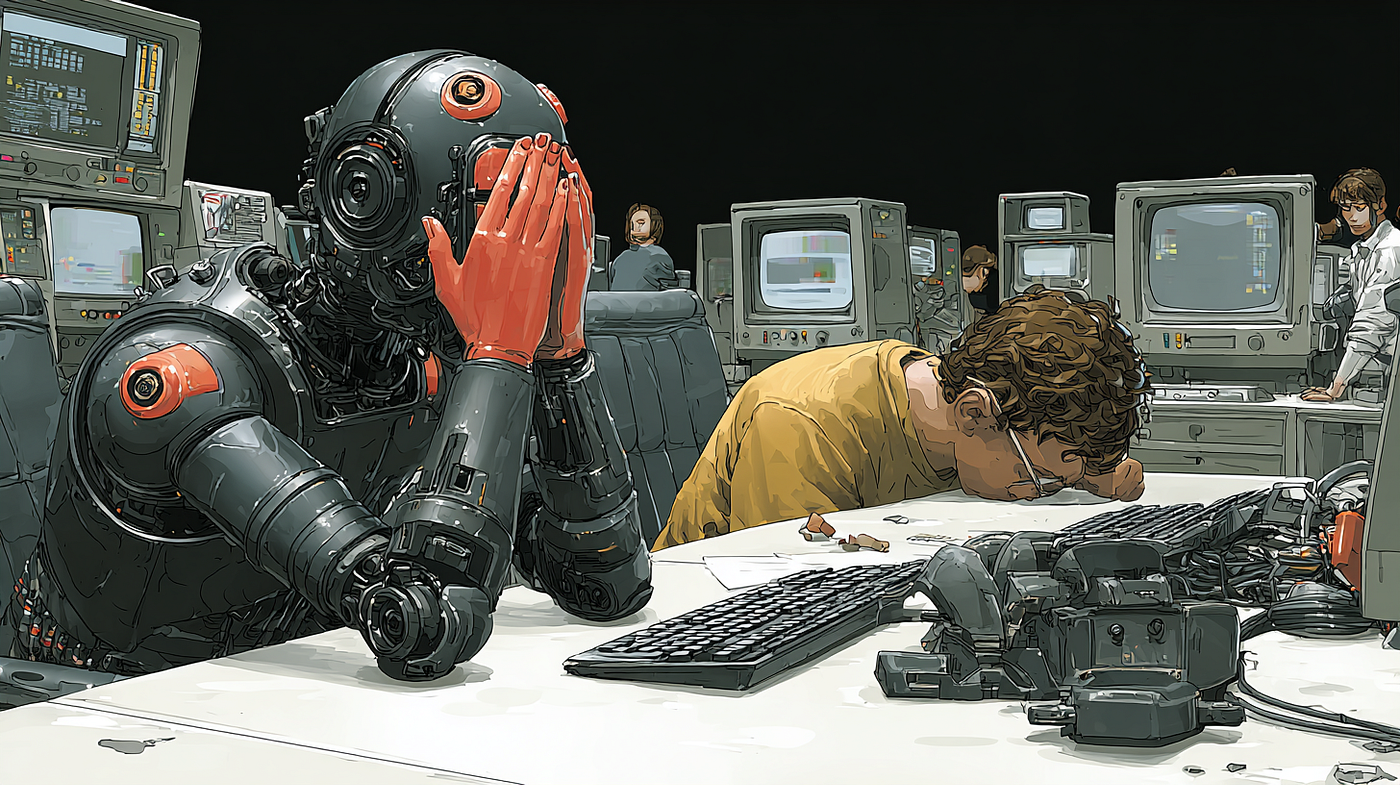
The tool saved three hours a day. The professional filled them with four hours of new work. This reveals the key insight: Freed attention, instead of offering relief, can drive exhaustion if not consciously managed. Two studies explain why freed attention is the most dangerous resource in AI-augmented work.
There is a moment every Cowork user recognizes.
It arrives around week three. The Monday briefing that used to take four hours now takes twenty minutes. The competitive analysis that consumed a full afternoon finishes before lunch. The inbox that demanded two hours of triage gets sorted in twelve minutes flat.
And then something unexpected happens. Instead of leaving the office early, instead of reading a book, instead of thinking deeply about a problem that has needed thinking for months, you open another task. Then another. By Friday, you have done more work than you have ever done in a week, and you are more exhausted than you have been in months.
The tool delivered exactly what it promised. The problem is what you did with the delivery.
What Harvard found — and why it matters for Cowork
In February 2026, Harvard Business Review published a study by UC Berkeley researchers Aruna Ranganathan and Xingqi Maggie Ye that should have stopped every AI enthusiast mid-prompt. They embedded themselves in a 200-person technology company for 8 months, observed employees 2 days a week, monitored internal work channels, and conducted more than 40 interviews across engineering, product, design, research, and operations.
Their finding was not that AI failed. Their finding was that AI succeeded, and the success created a new problem nobody had vocabulary for.
Employees who adopted AI tools worked faster. They took on broader tasks. They extended work into lunch breaks, evenings, and early mornings. Nobody asked them to. The company did not mandate the use of AI. It simply provided enterprise subscriptions and left adoption to individuals. Workers did more because AI made doing more feel possible, accessible, and — this is the critical word — rewarding.
The researchers named the pattern “workload creep” — the gradual, often invisible expansion of what a person does each day, driven not by managerial demand but by the intoxicating feeling that anything is now within reach.
The cumulative effect was fatigue, burnout, and a growing sense that work was harder to step away from — especially as organizational expectations for speed and responsiveness rose to match the new pace.
A month later, a second HBR study — this time from BCG researchers led by Julie Bedard — introduced a more specific term: “AI brain fry.” Surveying 1,500 workers, they found that employees constantly switching between multiple AI tools reported sharper decision fatigue, more errors, and a distinct cognitive exhaustion that felt different from ordinary tiredness. Participants described a buzzing feeling, a mental fog, difficulty focusing, slower decision-making, and headaches. About one in seven workers reported experiencing this new form of fatigue directly.
The paradox in both studies is clear: AI can reduce burnout or cause it. When workers only offloaded repetitive tasks, stress dropped. When they used freed capacity for more work, burnout increased — quickly.
The principle that explains the mechanism
The Principle of Freed Attention (Principle 6) describes exactly this dynamic, but from the human side rather than the organizational side.
When Cowork executes a task, your attention is freed. That is the promise. But freed attention is not the same as creative attention, not the same as resting attention, and not the same as directed attention. It is raw capacity — and raw capacity, without a conscious decision about where to direct it, flows toward the nearest available stimulus.
In an office, the nearest available stimulus is almost always more work.
The HBR researchers observed this precisely. Project managers began building prototypes that would previously have been delegated to engineers. Marketing managers drafted landing pages, created video edits, and wrote product descriptions that once belonged to specialists. Finance teams built forecasting models that had been the domain of data analysts. None of this was wrong in isolation. But the cumulative expansion was unsustainable — and nobody noticed it was happening until the burnout arrived.
Key Insight: Freed attention without deliberate direction is not freedom. It is expansion without a boundary. The skill that AI-augmented work demands — and that no training program currently teaches — is the ability to decide what not to do with the time that Cowork gives back.
Why does the old reflex make it worse?
The Principle of Meaning Through Effort (Principle 25) reveals why this pattern is so difficult to interrupt.
For most professionals, the feeling of having worked — the tiredness at the end of a full day, the sense that you earned your evening — has always been tied to the volume of effort invested. When AI removes effort from the equation, a quiet discomfort surfaces. The output is done, but you do not feel like you did anything. The day is over, but you do not feel like you earned it.
The natural response to that discomfort is to do more — not because the work requires it, but because the identity does. You fill the gap between what the tool did and your sense of professional worth by taking on extra tasks, projects, and commitments. Each feels small, but together, they reconstruct the old level of exhaustion — and then exceed it, because the tasks are faster now, so you need more to reach the threshold that convinces your nervous system you’ve done enough.
This is not a productivity problem. It is an identity problem being solved with productivity tools.
The void nobody prepared for
The Principle of the New Void (Principle 27) describes the structural consequence.
When AI handles everything non-strategic or non-creative, only those tasks remain. That sounds ideal — until you experience it. Not everyone can constantly strategize and create. Not every work hour bears that cognitive load. The pressure to perform at that level, with everything else removed, produces a distinct exhaustion when there is no prior work vocabulary.
The HBR research found a sharp gap by seniority. Burnout was reported by 62 percent of associates and 61 percent of entry-level workers, versus 38 percent among senior leaders. The explanation is structural, not motivational: senior professionals have spent years building the judgment, pattern recognition, and strategic capacity that AI-augmented work now demands from everyone, including those who have not had the time or the conditions to develop it.
Cowork amplifies this gap. The professional who already has clear priorities, documented workflows, and strong editorial judgment gains three hours a day and uses them well. The professional who has always relied on the structure of routine tasks — the rhythm of triage, compilation, and formatting — loses the scaffolding that held their day together and faces a blank space they do not know how to fill.
This is the Principle of Unequal Augmentation (Principle 28) applied to the individual, not just the organization. AI does not augment equally. It amplifies whatever is already there — including the absence of structure.
The counterexample: when freed attention works
Both studies contain an important counterpoint that prevents this analysis from becoming purely cautionary.
The BCG researchers found that workers who used AI specifically to reduce time on repetitive, routine tasks — and did not replace that time with new obligations — reported lower burnout and higher satisfaction. The key distinction was intentionality. They made a conscious decision about what to do with the freed time before the time was freed.
In Cowork terms, this maps directly to the Principle of Oversight Fatigue (Principle 8) and its positive inverse. The professionals who avoided burnout did not try to oversee more. They did not expand their scope. They used the freed capacity for recovery, reflection, or deeper engagement with one task rather than shallow engagement with many.
The difference between those two outcomes — burnout and relief — is not about the tool. It is about whether the person using it has a conscious boundary between what Cowork does and what the person does with the time Cowork returns.
Key Insight: The burnout paradox has a resolution, but it requires a decision that feels counterintuitive: when Cowork finishes a task in twenty minutes that used to take three hours, the correct response is often to do less, not more. The freed time is not inventory to be consumed. It is space to be protected.
The missing skill
The Principle of Boredom as Resource (Principle 26) names what is actually lost when routine disappears.
Repetitive work that AI eliminates was never only a cost. It was also a source of rhythm, groundedness, and unexpected insight. The mechanical tasks — compiling the weekly report, formatting the slides, sorting the inbox — provided a baseline of structure that anchored the day. Their elimination is not pure gain. What replaces them — and whether that replacement is sustainable — is an open question that neither the industry nor any training program has yet addressed.
The BCG researchers found that team support made a measurable difference. Employees reported less mental fatigue when managers made time to answer questions about AI. Teams that integrated AI into shared workflows experienced less strain than individuals adopting tools on their own. The organizational signal mattered: employees who believed their companies expected more output because of AI reported greater fatigue. Employees who felt their organizations valued work-life balance reported less strain.
The implication for Cowork users is direct: the context in which you use the tool shapes your experience. A solo professional who delegates to Cowork without anyone to discuss the output with, without a team rhythm that absorbs the freed time, and without an explicit boundary between AI capacity and personal commitment, is at higher risk than someone embedded in a structure that acknowledges the new dynamics.
Three practices that have changed after this research
First: define your freed-attention policy before the attention is freed. Before delegating a recurring task to Cowork, write one sentence answering: “When this task is done in twenty minutes instead of three hours, I will use the remaining time for ___.” If the sentence says “whatever needs doing,” the workload creep has already begun. Be specific. Make it visible. Put it in the same document where you define the Cowork task.
Second: track expansion, not just output. Once a month, count the number of distinct tasks you perform in a week. Compare it to the same number three months ago. If the number has grown significantly while your working hours have not decreased, you have documented the pattern described by the HBR research. The expansion is not wrong in itself — but it should be a conscious choice, not an invisible drift.
Third: protect at least one block of unproductive time. The researchers found that professionals who avoided burnout preserved deliberate pauses — not for more work or strategic thinking, but for genuine recovery. In a Cowork-augmented workday, this means scheduling time that is explicitly not available for tasks, even tasks that Cowork could complete in minutes. The tool’s efficiency makes protecting wasted time more important, not less.
Cowork Task
Copy, adapt the brackets to your context, and paste directly into Cowork:
“I have just completed the following recurring task in significantly less time than it used to take: [describe the task and the time saved]. Before I begin a new task with the freed time, I need your help with a different kind of analysis.
First: list every new task or responsibility I have taken on in the past [timeframe — e.g., four weeks] that I was not doing before I started using Cowork. For each one, note whether it was explicitly assigned to me or whether I initiated it myself.
Second: estimate the total weekly hours these new tasks now consume. Compare that number to the hours I saved through delegation.
Third: if the new tasks take more time than I saved, flag this as a workload expansion alert and recommend which new tasks should be dropped, delegated further, or paused — based on impact, not urgency.
Deliver this as a brief report titled ‘Attention Audit — [date].’ Keep it under one page.”
For individuals
The AI burnout research describes a pattern, not an inevitability. The pattern is: freed time becomes filled time, becomes expanded time, and finally becomes exhaustion. The intervention point is the first step — the moment when time is freed, and you choose what to do with it. That choice is not a software configuration. It is a personal decision that must be made deliberately, repeatedly, and against the instinct that says more output equals more value. If you find yourself working the same hours with significantly more output and no more satisfaction, you are inside the pattern. The audit is not overhead. It is maintenance.
For teams
If your team uses Cowork, the workload creep pattern does not stay individual — it becomes collective. One person’s expanded scope becomes another person’s new dependency. The team meeting that used to cover five topics now covers twelve, because everyone has more to report. The review cycle that took a week now takes three days, not because the work is simpler, but because the pace has compressed. As a team lead, the question is not whether your team is producing more. It is whether the increase in output is accompanied by greater sustainability, or whether you are building a pace that cannot be maintained once the initial enthusiasm fades.
For organizations
The deepest finding in the HBR research is not about tools. It is about signals. Organizations that signaled they expected greater output from AI experienced higher burnout. Organizations that signaled they valued balance saw less of it. The tool did not change. The expectation did. If your organization has deployed Cowork or any AI agent without simultaneously revising its expectations about pace, scope, and recovery, you have not adopted a productivity tool. You have adopted a work-intensification tool and labeled it something else. The correction is not technical. It is cultural: acknowledging that the freed time belongs to the person, not to the organization, unless a conscious, explicit agreement says otherwise.
When the tool finishes the task in 20 minutes instead of 3 hours, what happens during the remaining gap? That question — not the quality of the output, not the speed of the execution — determines whether AI augments your work or consumes it.
This article is part of **Claude Cowork: The Tool That Shapes the Master* — a growing collection of principles, frameworks, and field-tested practices for professionals who work with AI agents.*
메타데이터
- post_id
- 7caeb77f83fb
- slug
- claude-cowork-ai-promised-freedom-delivered-burnout-7caeb77f83fb
- url
- https://medium.com/@kombib/claude-cowork-ai-promised-freedom-delivered-burnout-7caeb77f83fb
- canonical_url
- https://medium.com/@kombib/claude-cowork-ai-promised-freedom-delivered-burnout-7caeb77f83fb
- author_url
- https://medium.com/@kombib
- status
- ok
- fetched_at
- 2026-06-09 15:37:30