Lightning McQueen: Creating Pixar’s Hotshot Rookie
The Cars Compendium | Article 09
Lightning McQueen: Creating Pixar’s Hotshot Rookie
The Cars Compendium | Article 09
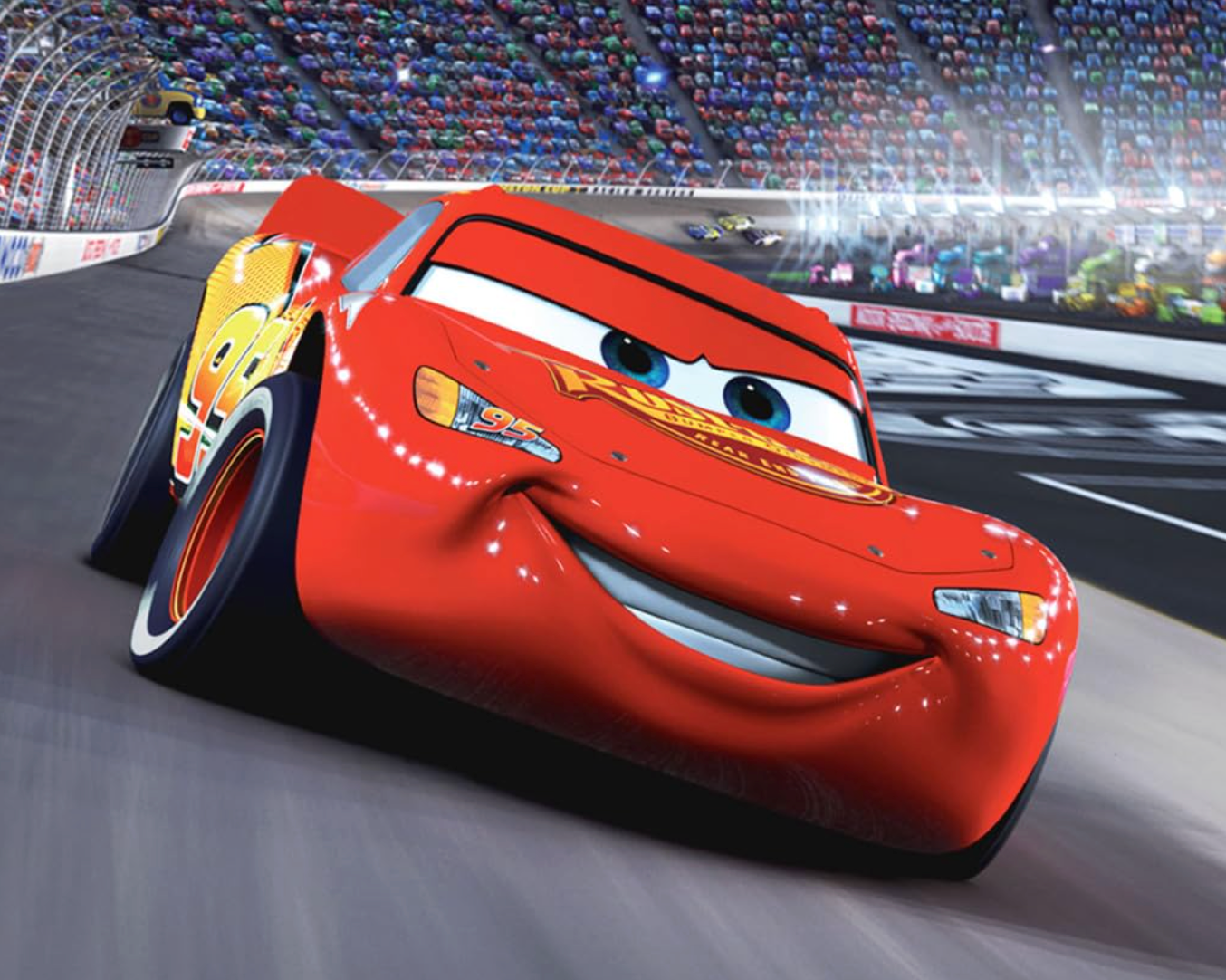
Lightning McQueen, Pixar’s first genuinely unlikable protagonist and the hardest trick the film had to pull: a cocky rookie the audience roots for anyway. Image: Disney/Pixar.
Pixar had built several films around flawed heroes, but rarely around one whose first impression was so openly alienating. Woody is capable of real ugliness, jealous enough of Buzz to knock him out a window, but the film frames that as a fall from a fundamentally decent character we already like. Marlin is anxious to the point of harm, but he is a devoted father. Mr. Incredible is proud, but he is a hero by trade and by instinct. Their flaws are the kind an audience forgives almost on contact, because the sympathy is established first. Lightning McQueen was something the studio had not tried before: a lead who is genuinely unlikable when the film begins, a self-absorbed rookie with no friends, no loyalty, and no interest in anyone but himself, and whose entire journey is the work of becoming a person worth rooting for. The gamble at the center of Cars is that an audience will follow a hero it does not yet like, on the promise that he is going to change. How the studio built that character, named him, cast him, and made him earn his ending is a story with more grief and more calculation in it than the finished film’s brightness lets on.
The design and animation of McQueen are covered elsewhere in this series. Article 06 traced how the windshield-eyes face and the shared character rig were designed, and Article 07 traced how animators made him perform, the cocky-but-likable body language, the athlete references, the borrowed mannerisms. What remains is the character himself: where his name came from and the loss it memorializes, how he was designed as a specific racing personality rather than a generic hero, why an unconventional casting choice gave him his voice, and how the film engineers his transformation from someone the audience tolerates into someone it loves.

The dedication that opens the story of the name. Glenn McQueen, a beloved Pixar supervising animator, died in 2002 during the making of Finding Nemo, which carries this tribute; his surname was given to the hero of Cars a few years later. Image: Disney Wiki.
A name that carries a death
The most important fact about Lightning McQueen’s name is one that most of the film’s audience never learns, and it has nothing to do with racing. Glenn McQueen was a Canadian animator, born in Toronto in 1960, who joined Pixar in 1994 after training at Sheridan College and a stint at Pacific Data Images. He was a supervising animator on the studio’s foundational run of features, Toy Story, A Bug’s Life, Toy Story 2, and Monsters, Inc., and one of the most gifted and beloved people in the building. John Lasseter called him the heart and soul of the animation department. In December 2001 McQueen was diagnosed with melanoma. He kept working. He died at his home in Berkeley on October 29, 2002, at the age of forty-one, during the production of Finding Nemo.
Pixar honored him twice. Finding Nemo, released the following year, carried a dedication to him that appears before the closing credits, and the film’s DVD includes a hidden tribute reel of his work and his colleagues’ memories. The second tribute was to give his name to the hero of Cars, a film whose development and production spanned the period around his death. The choice threads a quiet grief through a bright, funny film about a racecar. Pixar’s sunniest comedy carries the surname of a colleague the studio had just lost too young. It is the kind of memorial that hides in plain sight, meaningful to the people who made the film and invisible to almost everyone who watches it, and it connects Cars to the same instinct that runs through the whole compendium, a studio that keeps folding its private losses into its public work. Article 07 closed on the film’s dedication to Joe Ranft, the co-director who died during production; the hero’s own name is a second act of the same remembrance, so that the film memorializes two lost colleagues at once, one in its dedication and one in its protagonist.
There is a persistent belief that McQueen was named after Steve McQueen, the actor and racing enthusiast, a reading that gains surface plausibility because Steve McQueen co-starred with Paul Newman, who voices Doc Hudson, and because he genuinely loved fast cars. Pixar representatives have repeatedly clarified that this is not the case. Art department manager Jay Ward has stated directly that the character is named for Glenn McQueen, not the actor. The Steve McQueen version is a fan inference that fits so neatly it refuses to die, but the documented origin is the animator, and the difference matters, because the real story is not a cute Hollywood cross-reference but a memorial.
Not a generic hero
But the name was only one layer of the character’s individuality. Pixar also had to solve a less sentimental problem: how to make a racecar feel like an individual rather than a stock animated hero. He did not begin as Lightning McQueen. In the film’s earliest conception he was a broader racing type, and the long development of Cars was partly the work of sharpening that type into the particular young racer the finished film delivers. The idea of a film about cars reaches back to a 1993 conversation between Lasseter and character designer Bob Pauley during the carpool commute on Toy Story, and the story that eventually became Cars grew from a concept by Jorgen Klubien, whose early “Yellow Car” pitch Article 01 covered in detail. The protagonist was developed from that seed by Lasseter and co-director Joe Ranft over years of story work, with a screenplay eventually credited to Dan Fogelman, Kiel Murray, Phil Lorin, and Klubien. Across that development, the hero shifted from a broad racing archetype into a character with a precise personality, a precise look, and a precise flaw.
The car itself was designed as a deliberate hybrid rather than a copy of any single real vehicle. Lasseter described McQueen to the Los Angeles Times as a cross between a stock car and a more curvaceous Le Mans endurance racer, a combination that gives him the muscular proportions of NASCAR with a sleeker, more youthful line than a boxy Winston Cup stocker would carry. He is recognizably a racecar, but he is not any particular one, which is the point: he had to read as a hot young talent, not as a specific make and model.
Everything bolted onto that body was chosen to say something about who he is. His racing number, 95, is a Pixar in-joke, a reference to 1995, the year Toy Story launched the studio’s feature era; it had originally been 57, for Lasseter’s birth year, before the change. His tires are Lightyear, a pun that folds Goodyear together with Buzz Lightyear, so that even the rubber he rides on is a piece of Pixar self-reference. His sponsor is Rust-eze, a rust-treatment brand for aging cars, which plays as a joke at his expense: the brash young star of the racing circuit is bankrolled by a product for old beaters, and he is faintly embarrassed by it. His headlights are not functional; they are painted-on stickers, the implication being that a serious racecar has no need for them, and the film gets a gag out of it later when he buys night-vision goggles, a wink at the fact that his headlights were never real to begin with. Even the yellow on his rear reads as characterization: the rookie stripe, in the yellow-on-the-rear-bumper form NASCAR uses to mark a first-year driver, is a visual label that tells any fan in the stands exactly what he is, a talented newcomer who has not yet proven he can finish.
The accumulation of these details is what separates a character from a shape. McQueen is legible as a personality before he speaks, a young, cocky, self-made talent with something to prove and a chip on his shoulder about where he comes from, and all of it is encoded in the paint and the parts. That legibility is the design doing the storytelling, the same principle Article 08 traced in the environments, applied here to a single car.

Everything bolted onto McQueen is characterization. The number 95 nods to Toy Story’s 1995, the Rust-eze sponsorship is a joke at the young star’s expense, and the yellow rear stripe marks him, in racing tradition, as an unproven rookie. Image: Disney/Pixar.
The charm that keeps him human
Casting McQueen put unusual pressure on a single performance. Pixar had always used recognizable actors, Tom Hanks, Tim Allen, Billy Crystal, Albert Brooks, and more, but it had tended to sell its films on story and craft rather than on celebrity, keeping the voice talent relatively low in the marketing. Cars leaned more openly on its cast, Owen Wilson and Paul Newman, than Pixar usually had. That put real pressure on Wilson’s performance, because the film was, in part, being sold on it.
Wilson was not an obvious choice. In 2006 he was known for offbeat comedies and his collaborations with Wes Anderson, not for anchoring a family blockbuster, and he had never voiced a lead animated character. Lasseter’s route to him ran through Jackie Chan: Wilson had co-starred in Shanghai Noon and its sequel, and Lasseter, a fan of those films, met with him and told him as much. What Lasseter heard in Wilson was exactly what McQueen needed, a voice that was instantly recognizable, relaxed, and fundamentally human rather than cartoonish. McQueen could not sound like a cartoon villain or a broad comic type; he had to sound like a real young man who was cool, a little full of himself, and capable of growing up.
The direction Lasseter gave Wilson has often been paraphrased as a version of “don’t act, just be yourself.” Whatever the exact words, the intent was to keep McQueen grounded, to let Wilson’s own laid-back, slightly ironic delivery carry the character so that the arrogance never curdled into something an audience would reject. It worked because Wilson’s natural charm did the hardest part of the job, making cockiness sound likable, and the looseness of the approach left room for invention at the microphone. Wilson recorded many takes of individual lines, each tuned slightly differently, and some of the character’s most memorable moments came out of that freedom. McQueen’s signature exclamation, the self-satisfied “Ka-chow” he deploys with his sticker-headlight flash, is widely reported to have emerged from Wilson’s own read during recording rather than from the script. The catchphrase that became inseparable from the character was, fittingly for a role built on being yourself, an ad-lib.
The casting also quietly softens the film’s central risk. On the page, McQueen’s early behavior is genuinely ugly: he humiliates his crew, treats everyone around him as an instrument, and shows no capacity for caring about anyone else. In Wilson’s mouth, that ugliness comes out breezy, immature, almost socially oblivious rather than malicious, a young man who has never been made to consider other people rather than one who actively despises them. That softening is not a flaw in the performance so much as a necessary piece of calibration: it keeps the early McQueen this side of unwatchable, and it plants the suspicion, before the story has earned it, that there is a decent person under the swagger who has simply never been asked to be one. Everything the plot does to humble him works only because the voice has already made us believe he is worth humbling.

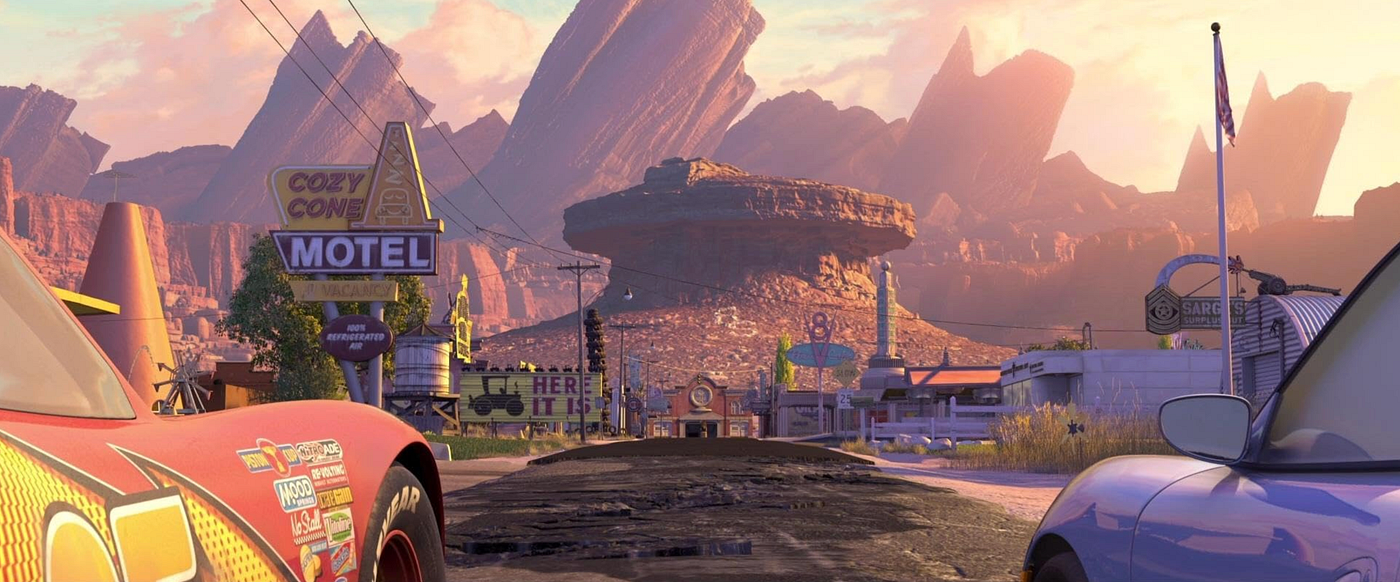
Stranded in a forgotten town he holds in contempt and sentenced to repair the road he tore up, McQueen is forced into the one situation his character was built to avoid: having to slow down and depend on others. Image: Disney/Pixar.
The engine of the whole film
Lightning McQueen is the rare Pixar protagonist whose growth is not a subplot but the entire plot. Art department manager Jay Ward has put the film’s theme squarely on the character: as a racecar, McQueen is completely self-centered, and his only goal at the start is to reach the finish line, but his time in Radiator Springs teaches him that life is about the journey, not the destination. Ward describes the racing world as the bookends of the story, the world McQueen starts in and the world he returns to, with the crucial difference that he comes back changed. The film is structured almost entirely around that change, and the precision of it is easy to miss under the comedy and the color.
McQueen begins the film with everything pointed inward. He refuses to name his pit crew, drives them away, alienates his sponsors, and treats his transport driver Mack as a convenience rather than a person, and it is that self-absorption, Mack exhausted and unsupported through a long night drive, that strands McQueen in Radiator Springs in the first place. His flaw causes his exile, which is the clean logic of a good redemption story: the trap he falls into is one he built himself. Stranded in a forgotten town he holds in contempt, sentenced to repair the road he tore up, he is forced into exactly the situation his character has been organized to avoid, having to slow down, having to depend on other cars, having to be somewhere that does not revolve around him.
What changes him is not a lecture but a place and the people in it. Doc Hudson, the town’s flinty doctor with a racing past of his own, becomes the mentor McQueen did not know he needed, and the relationship between the arrogant rookie and the veteran who has seen exactly this kind of talent before is the spine of McQueen’s growth. Sally, the town’s transplanted attorney, shows him what he has been racing past, and the drive she takes him on through Ornament Valley is the hinge of the film, the moment the world stops being an obstacle between him and the next race and starts being something worth slowing down for. The details of those relationships belong to Doc’s and Sally’s own stories, still to come in this series. What belongs to McQueen is the transformation they produce.

Doc Hudson, the town’s flinty doctor with a racing past of his own, becomes the mentor McQueen did not know he needed. The relationship between the arrogant rookie and the veteran is the spine of his growth. Image: Disney/Pixar.
Earning the ending
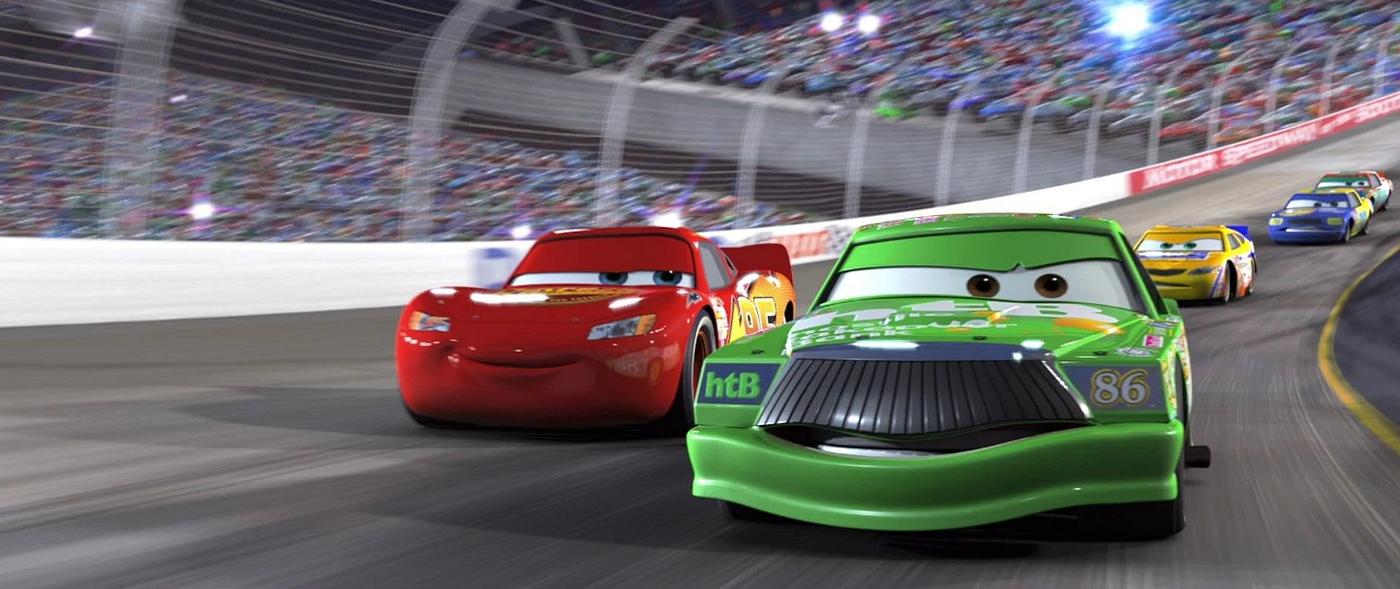
The proof of McQueen’s change is not that he says he has changed but that he acts against his old self when it costs him the thing he wanted most. The film’s climax is built as a direct test of the arc. Back in the racing world, at the Piston Cup tiebreaker he has spent the entire film chasing, McQueen is leading, with the championship in reach, when his rival Chick Hicks sends the veteran racer The King into a brutal crash. The old McQueen, the one the film opened on, would have driven through to the win without a second thought, because winning was the only thing he valued. The McQueen who returns from Radiator Springs brakes short of the finish line, gives up the championship, and drives back to push the wrecked King across the line so that the old champion can end his final race on his own terms rather than in the wall.

The whole film compressed into one decision. Leading the championship race, McQueen brakes short of the finish and drives back to push the wrecked King across the line, throwing away the trophy to let an old champion end his final race with dignity. Image: Disney/Pixar.
The choice is the whole film compressed into a single decision. Everything Radiator Springs taught him, that the race is not the point, that other cars are people, that how you win matters more than whether you win, is contained in the act of throwing away the trophy to help a competitor. It is a deliberate inversion of the opening: the rookie who would not even acknowledge his pit crew becomes the racer who sacrifices a championship for a rival. And the film is careful not to reward him too neatly for it. He loses the Piston Cup. What he gains is the crowd’s respect, Sally, the town, and a sense of who he wants to be, which the film argues is worth more than the trophy, and which is the thesis of the entire enterprise stated through action rather than dialogue.
That refusal to let winning be the reward is what makes McQueen more than a sports-movie hero. A conventional version of this story hands him the championship as the prize for becoming a better person. Cars specifically withholds it, and in doing so makes its actual point: the destination he spent the whole film obsessed with turns out not to matter, exactly as Doc’s and Sally’s town had been trying to teach him. The hero of a racing movie learns that the race was never the thing. He earns his ending precisely by being willing to lose.

The changed McQueen at the end of his arc. He loses the Piston Cup and gains the town, the crowd’s respect, and a sense of who he wants to be, which the film argues is worth more than the trophy he chased. Image: Disney/Pixar.
The character that carried a franchise
McQueen’s construction was successful enough that he became the durable center of one of the most commercially enormous properties in the studio’s history, anchoring two sequels, a raft of shorts, video games, and theme-park attractions, and driving merchandise sales that reportedly ran into the billions over the years after release. There is an added significance to that success: Cars was developed and largely produced while Pixar was still an independent studio, arriving in 2006 as the Disney acquisition closed, so McQueen sits at the hinge between Pixar’s independent era and its Disney one. The character was built to grow, which is part of why he sustained a franchise: because his defining feature is change, later films could put him through further transformations, the spy-comedy detour of Cars 2 and, more resonantly, the aging-veteran reckoning of Cars 3, where the cocky rookie of the first film has become the established champion facing his own obsolescence. Those later chapters are outside the scope of this article, which stays with the 2006 film, but they are evidence of how well the original character was made: a personality robust enough to be worth revisiting for two decades.
What Cars accomplished with Lightning McQueen was to prove that Pixar could build a film around a protagonist who is not good when we meet him, and make the audience stay anyway. Everything about him, the design that makes his arrogance legible, the casting that keeps it charming, the plot engineered to humble him, and the ending that rewards him with something other than the prize he chased, is in service of a single difficult trick: taking a hero nobody would like on first sight and making him, by the end, someone an audience is glad to have followed. He bears a lost animator’s name, a laid-back comedian’s charm, and the film’s central argument about what actually matters, all without ever looking like he is working. That ease is exactly what makes him a character rather than a car.
Sources
This article draws on the following primary and secondary materials.
Primary sources
Disney/Pixar’s official 2006 Cars production notes, for the character’s conception, the racing-number history (57 changed to 95), and the design intent behind McQueen as a young, cocky, self-made talent.
John Lasseter, interview with the Los Angeles Times (Dan Neil, “A grease geek will guide you: ‘Cars’ decoded,” June 2006), for Lasseter’s description of McQueen as a hybrid between a stock car and a more curvaceous Le Mans endurance racer.
Jay Ward (Pixar art department manager and franchise creative director), quoted in reporting on the franchise, for the clarification that the character is named for animator Glenn McQueen rather than Steve McQueen, and for the account that the film’s theme is expressed in McQueen’s development from a self-centered racer to one who learns that life is about the journey, with the racing world as the bookends of his arc. These statements are cited in Wikipedia’s entries on the character and are consistent with Ward’s public talks about the film.
Finding Nemo DVD bonus material (Disney/Pixar, 2003), for the Glenn McQueen tribute.
Secondary sources
Wikipedia’s biographical entry on Glenn McQueen, corroborated by the Pixar Times and other tribute accounts, for his career (Sheridan College, Pacific Data Images, Pixar from 1994, supervising animator on Toy Story through Monsters, Inc.), his melanoma diagnosis in December 2001, and his death on October 29, 2002, at age forty-one during the production of Finding Nemo, which was dedicated to him. Lasseter’s “heart and soul of the animation department” description is drawn from these tribute accounts.
Retrospective interviews and reporting on Owen Wilson’s casting, for Lasseter’s route to Wilson through the Shanghai Noon films, the naturalistic “be yourself” direction, Wilson’s recording of many takes per line, and the emergence of “Ka-chow” as an ad-lib during recording. These details appear across multiple secondary accounts of varying provenance rather than in a single authoritative primary source, and the “Ka-chow” ad-lib is also recounted by Jay Ward in public talks about the franchise.
The Hollywood Reporter reported in 2010 that an appellate court rejected a claim that Pixar had taken the Lightning McQueen concept from an outside creator; this is noted here as a matter of record and is not relied on in the article’s argument.
Wikipedia’s entry on the film Cars, corroborated by contemporary reporting, for the character’s development history (the 1993 Lasseter-Pauley carpool origin and the screenplay credits to Dan Fogelman, Kiel Murray, Phil Lorin, and Jorgen Klubien), the timing of Cars relative to the Disney acquisition, and the record-setting merchandise sales.
A note on uncertain claims
The Glenn McQueen naming is Tier 1 and unusually well-documented, stated by Jay Ward and corroborated across Pixar’s own tributes; the competing Steve McQueen attribution is a widely-circulated fan inference that the studio has explicitly corrected, and it is presented here as the misconception it is rather than as an alternative of equal standing. The character-arc framing (self-centered racer to changed character, “the journey not the destination,” the racing world as bookends) is Tier 1, drawn from Jay Ward’s own account of the film’s theme.
The Owen Wilson casting details sit at Tier 2. The broad facts, that Wilson was an unconventional choice, that Lasseter knew him through the Shanghai Noon films, that the direction was essentially “be yourself,” and that “Ka-chow” was an ad-lib, are consistent across multiple secondary accounts, but the exact wording of Lasseter’s direction and the specifics of the recording process come from interview and retrospective reporting rather than from the surviving production notes, and the article presents the “be yourself” line as the paraphrase it is. The design details bolted onto the character (the Lightyear tires, the Rust-eze sponsorship as a joke at his expense, the sticker headlights, the rookie stripe, the 95 number) are widely reported and visible on screen; the number history is documented, while some of the smaller readings, including the sticker-headlight and rookie-stripe interpretations, are inferences consistent with the film’s evident design logic rather than sourced production statements.
The reading of the climax as a deliberate inversion of the opening, and of the withheld championship as the film’s thesis, is interpretation rather than documentation, offered as a critical argument about how the film is constructed rather than as a sourced production claim. The deeper structural analysis of McQueen’s arc through classical story frameworks is reserved for a later thematic article in this series. Where a claim here is interpretation, I have tried to mark it as such. If you have access to a primary source that clarifies or corrects any of these, I welcome the correction.
Next in the compendium: Paul Newman’s Final Role.
메타데이터
- post_id
- 7cbd8b96e0fb
- slug
- lightning-mcqueen-creating-pixars-hotshot-rookie-7cbd8b96e0fb
- url
- https://medium.com/the-cars-compendium/lightning-mcqueen-creating-pixars-hotshot-rookie-7cbd8b96e0fb
- canonical_url
- https://medium.com/the-cars-compendium/lightning-mcqueen-creating-pixars-hotshot-rookie-7cbd8b96e0fb
- author_url
- https://medium.com/@anujshah7567
- status
- ok
- fetched_at
- 2026-07-14 12:02:10