Why Investing in AEO Now Is Like Investing in SEO in 2005 And What It Means for Your Business
The internet has been here before. A new discovery mechanism emerges, early movers build insurmountable leads, and the rest of the market…
Why Investing in AEO Now Is Like Investing in SEO in 2005 And What It Means for Your Business
The internet has been here before. A new discovery mechanism emerges, early movers build insurmountable leads, and the rest of the market pays a premium to catch up or never does.
ast your mind back to 2005. Google had been around for seven years. Most business owners had heard of “search engine optimisation” some had even hired someone to “do the keywords.” But the fraction of businesses treating SEO as a strategic infrastructure investment, rather than a curious side project, was vanishingly small. The companies that made that leap in 2005 building content architectures, earning backlinks, structuring their sites for crawl efficiency spent the following decade watching their competitors pay five times more to achieve half the results. Some competitors never caught up at all.
We are living through an exact structural replay of that moment. The discovery mechanism has changed from keyword-indexed search to AI-powered answer engines but the dynamics of first-mover advantage, compounding authority, and market consolidation are identical. Understanding the parallel is not merely academic. It is the clearest framework available for deciding how urgently and how heavily to invest in Answer Engine Optimisation right now.
The 2005 Moment: What Actually Happened
To appreciate the parallel, you need to remember what the SEO landscape actually looked like in 2005, stripped of the mythology that has accumulated around it.
Google had launched AdWords in 2000, and by 2005 it was already the dominant search engine. But the idea that a business should systematically invest in organic search presence that content strategy, technical site architecture, and link building were business-critical infrastructure was still a fringe view. Most marketing budgets were still dominated by print, radio, and direct mail. Digital was a line item, not a priority.
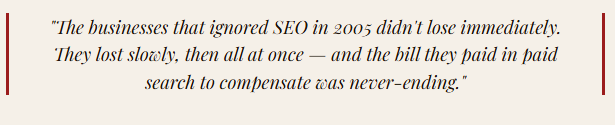
The businesses that broke from this consensus in 2005 the ones that hired dedicated SEO practitioners, built content programmes, and treated their website as a revenue asset rather than a digital brochure secured positions in Google’s index that proved extraordinarily durable. By 2010, the correlation between early SEO investment and category dominance in organic search was becoming undeniable. By 2015, the gap between first movers and late movers in most commercial categories was effectively insurmountable through organic means alone. Late movers were spending tens of thousands on PPC to buy the visibility that early movers had built for a fraction of the cost.
Why the Parallel to AEO Is Not a Metaphor It Is a Mechanism
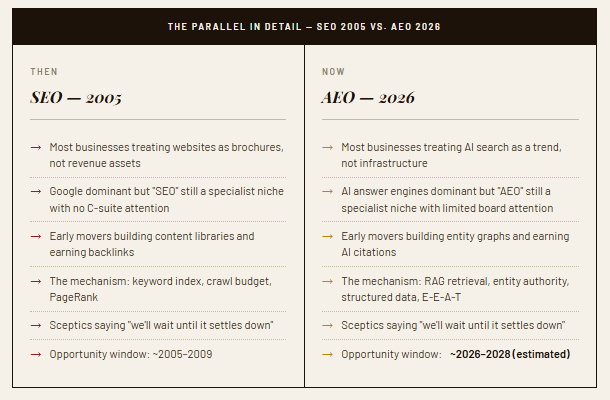
The SEO-AEO parallel is not simply a rhetorical device. The underlying mechanism driving first-mover advantage is identical in both cases, and understanding it makes the urgency concrete.
Authority Compounds Over Time
In SEO, domain authority was built through accumulated backlinks, indexed content, and dwell-time signals all of which compound over time. A domain with ten years of authority signals behind it is not merely incrementally better than a new one; it is categorically different in how search algorithms weight it.
In AEO, the equivalent is entity authority how well-defined, consistently referenced, and externally corroborated your brand entity is across the AI knowledge graph. This too compounds. The more your brand is cited in AI-generated answers, the more training data your name appears in with positive context, the more retrieval systems learn to treat you as a credible, authoritative source. Early citation begets more citation. The compounding curve is already bending.
The Index Doesn’t Forget Its Early Learnings
Google’s algorithm evolved enormously between 2005 and 2025, but the sites that built genuine authority in 2005 maintained structural advantages through every update because the updates were designed to reward exactly the kinds of signals they had legitimately built. AI retrieval systems will similarly evolve, but the foundational signals they reward entity clarity, content specificity, authorial credibility, structured data are not going to stop mattering. The businesses building these signals now are building on solid ground.
The First Mover Defines the Category in the AI’s World Model
This is perhaps the most powerful and least appreciated dynamic. When an AI answer engine is asked about a category “who are the leading providers of X in the UK?” it synthesises from its indexed knowledge and its retrieval results. The brand that appears most consistently, most authoritatively, and most specifically in both layers becomes the category default. Just as Google’s top organic result for a high-intent keyword captures a disproportionate share of clicks, the AI’s first-cited answer captures a disproportionate share of consideration and trust.
Once a brand occupies that position in the AI’s world model, displacing them requires not just better content it requires becoming more authoritative than a brand that has been compounding authority for years. It is the same challenge that faces anyone trying to dislodge a long-tenured number-one SEO result, but potentially even more entrenched because the AI’s knowledge graph is updated less frequently than a search index.
The Three Phases of Every Digital Discovery Shift And Where We Are Now
Every major shift in how people discover businesses online follows a consistent three-phase pattern. Understanding which phase we are in right now clarifies the investment calculus precisely.
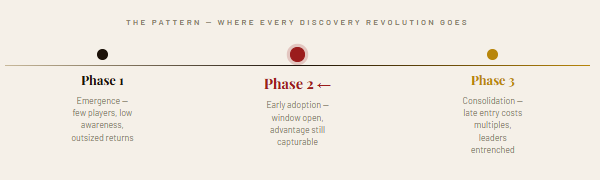
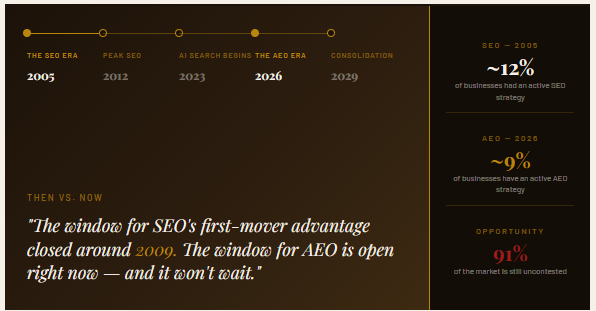
Phase 1 Emergence (2023–2025): AI answer engines launched and began handling real commercial queries. A tiny fraction of forward-looking businesses started experimenting with AEO. The returns were extraordinary for those who acted, but awareness was minimal.
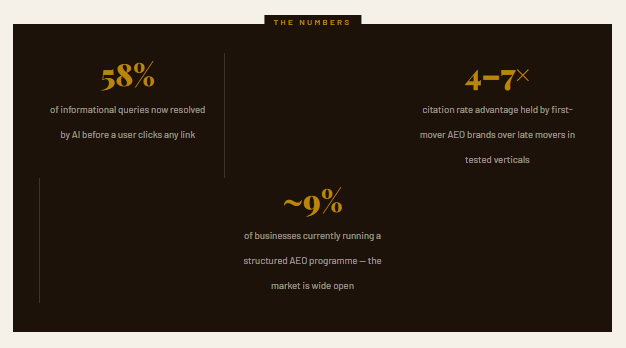
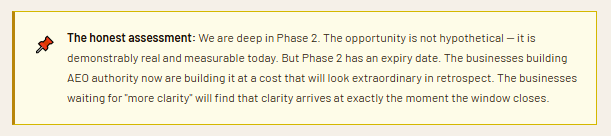
Phase 2 Early Adoption (now, 2026): AI answer engines now handle a majority of informational queries. Awareness of AEO is growing among marketing professionals but has not yet reached board-level strategic priority in most businesses. The opportunity to establish first-mover advantage is still real but the window is narrowing as more sophisticated players enter. This is the phase that 2005 SEO was in. The businesses that act now are the ones writing the case studies that will be cited in five years.
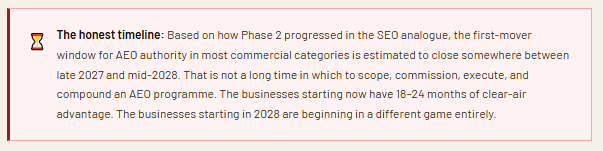
Phase 3 Consolidation (est. 2028–2029): Category leaders in AI citation will be established. Late movers will face the same choice that late-mover SEO brands faced from 2015 onwards: pay a significant and permanent premium for paid AI placement, or accept marginalised visibility. Neither option is attractive. Neither is avoidable once you reach Phase 3 without a foundation in place.
What the Late-Mover Tax Actually Looks Like
The business case for early AEO investment is sharpened considerably by understanding what late entry actually costs. The SEO precedent gives us a precise analogue.
A business that invested £2,000–£5,000 per month in SEO from 2005 to 2010 typically built an organic search position that, by 2015, was generating the equivalent of £15,000–£40,000 per month in traffic at no marginal cost. A competitor entering the same category in 2015 faced a choice: spend £8,000–£20,000 per month on paid search to buy equivalent visibility while waiting years for organic authority to build, or accept a permanently weaker digital position.
The same dynamic is already forming in AEO. Businesses building AI citation authority now are building an asset. Businesses that wait will pay to rent visibility through whatever paid AI placement products the major platforms develop in perpetuity, without building the underlying asset.
The ROI equation is not complicated. It is the same equation that made SEO-early-adopters wealthy and SEO-late-movers perpetually cash-poor on digital marketing. The only variable is the timeline.
The Sceptic’s Objection Addressed Directly
The most common objection to early AEO investment is a version of “we’ll wait until we know which AI platforms win and how they monetise.” This is a reasonable-sounding argument that is, on examination, a rationalisation of inertia rather than a strategic position.
Here is why: the foundational signals that drive AEO performance entity clarity, structured data, content specificity, authorial authority, E-E-A-T are not platform-specific. They translate across ChatGPT, Perplexity, Google AI Overviews, Microsoft Copilot, and every vertical AI assistant that will emerge over the next three years. Building these signals now is not a bet on one platform winning. It is building the infrastructure that wins regardless of which platforms dominate just as building genuine content authority in 2005 worked regardless of every subsequent algorithm update.
The same objection was made in 2005 by people who were waiting to see whether Google would maintain its dominance or whether Yahoo, MSN, or Ask would emerge as the primary search engine. The specific platform was secondary. The underlying behaviour people using search to find things was the signal worth investing around. Today, the underlying behaviour people using AI assistants to discover, evaluate, and choose is similarly durable regardless of which assistant they are using.
The businesses making the right decision right now are not waiting for certainty. They are recognising that the structural dynamics of AI-mediated discovery authority compounding, entity graph entrenchment, first-mover citation advantage are already in motion and accelerating. They are engaging specialists who understand AEO at both the strategic and technical level, auditing their current content and data architecture against AI legibility criteria, and beginning the process of building citation authority before their competitors do.
If you want to understand what a properly structured AEO programme looks like and what separates a genuine investment from a relabelled content marketing retainer the methodology being developed by specialist practices like Gorilla360’s AEO team is one of the clearer starting points: they approach it as a technical and strategic infrastructure project, not a content exercise, which is the distinction that actually determines whether an AEO investment compounds or stagnates.
What Action Actually Looks Like in Phase 2
The parallel with 2005 SEO is useful precisely because it tells us what “investing now” actually means in practice not as a vague aspiration, but as a concrete set of decisions that early-mover SEO businesses made and late movers did not.
In 2005, the early movers did not do everything at once. They prioritised ruthlessly: technical foundations first (crawlability, site architecture, page speed), then content strategy aligned to high-intent queries, then link acquisition through genuine value creation. They measured outputs that mattered rankings for commercial terms, organic traffic to revenue-generating pages not vanity metrics.
The AEO equivalent in 2026 follows the same logic. Technical foundations first: entity definition, schema mark-up infrastructure, structured data deployment across all content types. Then content strategy: building query-intent content that maps directly to the conversational questions your buyers are asking AI assistants. Then authority signals: third-party citations, expert authorship, credential mark-up, external entity corroboration. Measure what matters: AI citation rate for target queries, brand appearance in AI-generated category recommendations, entity disambiguation score.
The businesses that execute this sequence clearly and early will look, in five years, like the businesses that started SEO seriously in 2005 look today: categorically ahead of their competitors, benefiting from compounding authority returns, and genuinely confused about why anyone waited.
The Decision in Front of You
The case for early AEO investment is not built on hype or platform boosterism. It is built on a structural analysis of how digital discovery shifts work an analysis that we have seen play out in practice, in detail, over the past twenty years. The mechanism is not new. The asset being built is not new. Only the discovery layer has changed.
In 2005, the businesses that understood the mechanism invested. The businesses that waited for certainty found it at exactly the moment the advantage evaporated. The question in front of every business leader right now is whether this time, with the same mechanism clearly visible and the same window open, they will make the same mistake or a different one.
The answer engine era is not coming. It is here. The only open question is whether your brand will be one that the AI cites, or one that it overlooks and that question is being answered, actively, by the investment decisions being made in 2026.
메타데이터
- post_id
- 7cc2cdcbe0d0
- slug
- why-investing-in-aeo-now-is-like-investing-in-seo-in-2005-and-what-it-means-for-your-business-7cc2cdcbe0d0
- url
- https://medium.com/@fizza.q1399/why-investing-in-aeo-now-is-like-investing-in-seo-in-2005-and-what-it-means-for-your-business-7cc2cdcbe0d0
- canonical_url
- https://medium.com/@fizza.q1399/why-investing-in-aeo-now-is-like-investing-in-seo-in-2005-and-what-it-means-for-your-business-7cc2cdcbe0d0
- author_url
- https://medium.com/@fizza.q1399
- status
- ok
- fetched_at
- 2026-06-09 15:37:30