Do We Count in the Abundance Era?
Four schools of thought that shaped centuries of human life. One urgent question about our future. Their answers are more honest than…
Do We Count in the Abundance Era?
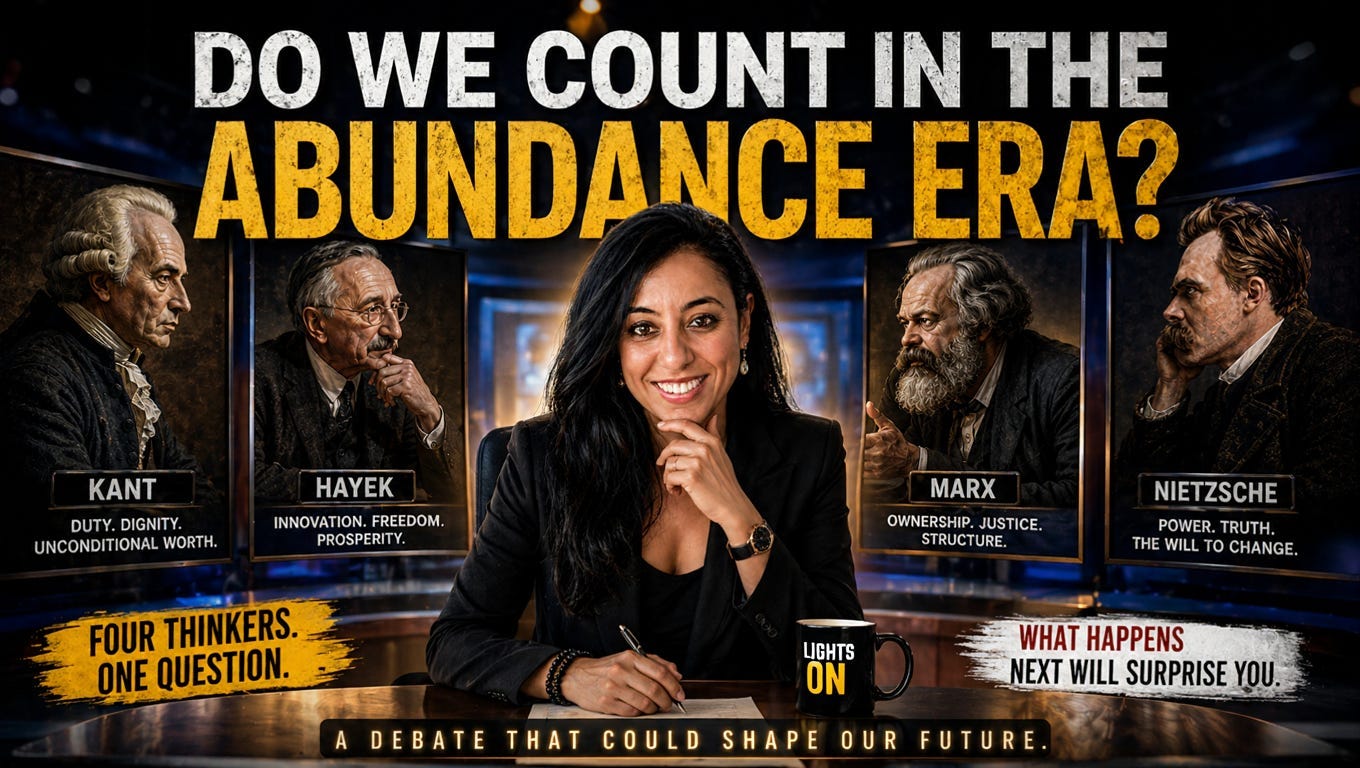
Four schools of thought that shaped centuries of human life. One urgent question about our future. Their answers are more honest than anything happening in any policy room today.

Do We Count in the Abundance Era? I took a trip back in time to ask our philosophers one question. What happened next I did not expect.
I did not go looking for comfort. I went looking for an answer.
So I did what I always do when the present becomes too loud to think inside: I stepped back. Into the rooms where the serious thinking happened. Built by people who had nothing to sell and no algorithm to please.
I summoned the four most prominent minds who designed how we think about work, meaning, and purpose, Kant, Hayek, Marx, and Nietzsche.
They did not agree when they were alive. They will not agree tonight. But they are the ones who gave us the language to even ask the question.
I summoned them to one table.
Kant at one end, precise and unbending. Hayek across from him, already preparing his counterargument. Marx with ink still on his fingers, leaning forward. Nietzsche standing slightly apart, watching the others with something between amusement and contempt.
I pulled up a chair.
I put the question on the table.
Do we count in the Abundance era?

The room goes quiet.
KANT: Define abundance first. Because if you mean a world of extraordinary productivity where the gains flow selectively, that is not abundance. That is surplus with a branding problem.
HAYEK: It is abundance. More goods, more services, more access than any previous generation in human history. AI is lowering the cost of things once reserved for the privileged, healthcare, education, legal advice, creative tools. Living standards rise when innovation compounds; the data is not ambiguous.
MARX: (Leans forward.) Living standards for whom, precisely? You measure the floor while ignoring the ceiling. Yes, the floor rises. But the ceiling rises faster, and the distance between them, that is the number no one reads at the boardroom presentation. That is the number that doesn’t make the quarterly report.
HAYEK: The distance is not the relevant metric. The absolute condition is. A poor person in 2025 has access to more than a middle-class person in 1975.
MARX: A poor person in 2025 also has no claim on the machine that replaced them. Access to cheaper goods does not replace income. Income is our modern prayer: how we eat, participate, and exist in the system you defend. You cannot hand someone a cheaper subscription and call it dignity. And before you tell me the market will create new categories of work, tell me who funds the worker during the transition. Worker shares? A public dividend? A national AI fund? Something structural. Because intention is not architecture, structure is.
HAYEK: The market will create new categories of work.
MARX: (Sharp.) When? After how much suffering in between? The people being displaced right now have mortgages. They have children in school. They live in an economy where three months without income means losing everything. You are asking them to fund the transition with their lives and calling it progress. And those deciding the transition will profit from it. Not one of them will ever be displaced by what they are building. They have no skin in the game. None.
Silence. Even Hayek doesn’t answer immediately.
NIETZSCHE: (Steps forward.) And there it is. The thing no one in any policy room will say out loud. Power writes the ledger. It always has. The people deciding the terms of this transition are the same people who will profit from it. They are not debating whether you count. They have already answered that question. What you are watching in parliaments and summits and AI safety conferences is not a debate. It is a performance of concern designed to delay accountability until the architecture is too entrenched to challenge.
KANT: (Quietly.) And do you know what the most revealing detail is? When policymakers do engage, they treat this as either the most important question in human history or a marginal disruption not worth serious attention. There is no middle ground. Do you know why?
HAYEK: (Carefully.) Because the middle ground requires actual answers.
KANT: Because the middle ground requires the people affected to be in the room. And they are not in the room. They are never in the room. If they’re not in the room, the answer is already decided for them. You cannot design a just transition for people whose voices are absent from the design. The absence of ordinary people from these conversations is itself the answer to your question. Do we count? Look at who is sitting at the table where the decisions are made. Then answer it yourself.
The room shifts. Something has been named that cannot be unnamed.
MARX: This is what I have been saying for two centuries in different registers. Power designs systems that reproduce power. AI is not an exception, it is the acceleration. Whose interests are encoded in its deployment? Whose labor trained it? Whose data fed it? Whose future is it being built to serve? Right now the answer to all four is the same group of people. And it is not us. If the machines are owned by four companies, and those companies are owned by a handful of funds, and those funds answer to no democratic institution, then redistribution is arithmetic, not justice.
HAYEK: (Frustrated but honest.) I do not dispute that the policy debate is inadequate. I dispute the conclusion you draw from it. The answer to a bad policy debate is a better policy debate, not the dismantling of the engine producing the wealth you want to redistribute. You cannot tax abundance you prevented from existing.
MARX: And you cannot share what is legally structured to be unshared. The problem is not the tax rate. It is the ownership architecture. Change who holds the keys, public dividends, worker equity, national AI funds, or the abundance era will be the most gilded cage in human history.
NIETZSCHE: (Cuts through.) Power writes the ledger, and the ledger will not be rewritten by better arguments alone. It will be rewritten when the cost of ignoring people exceeds the cost of including them. The policy debate is failing not because of bad ideas but because those with power over the outcome have no incentive to be honest. Who decides. Who benefits. Who absorbs the cost. These are not philosophical questions. They are political ones, and they will only be answered under pressure.
KANT: Then we make the alternative more expensive. That is what rights legislation is. That is what labor law was. Every structural protection people take for granted, someone made the cost of ignoring human dignity higher than the cost of acknowledging it.
NIETZSCHE: (Almost respectful.) Yes. And notice what that required. It did not require policymakers to have a fair debate. It required people outside the room to make enough noise that silence became untenable. The fair debate you are looking for will not come from inside the institutions. It will come from the pressure that forces them to change what they debate and how.
HAYEK: Which requires, and I say this reluctantly, that the pressure be directed at the right target. Not at innovation itself. At the architecture of its distribution. I will defend the engine until my last breath. But I will not defend a system that permanently privatizes the gains while permanently socializing the costs. That isn’t a market, it’s a subsidy for the already powerful, dressed in market language.
Marx looks at Hayek for a long moment.
MARX: Did you just agree with me?
HAYEK: (Drily.) I agreed with the diagnosis. I reserve the right to disagree violently with your prescription.
For the first time, something almost like laughter moves through the room.
NIETZSCHE: (Addressing me, directly.) You came here looking for an answer. Here is what none of us can give you, but all of us are pointing at: the debate you want, honest, fair, uncomfortable, is not happening in the rooms where it should be. Which means it has to happen everywhere else. Write it. Name it. Refuse the performance of concern as a substitute for accountability. That is not idealism. That is how every structural change in history actually started.
I did not get one answer. I got four true things that do not collapse into each other.

Human worth is unconditional, and must be structurally enforced, not charitably granted. No system earns the right to price it.
The engine of innovation is real and necessary. But an engine that runs on displaced lives while concentrating its output upward isn’t progress, it’s extraction with a press release.
Ownership is the question no one in power wants answered. Which means it is the most important question to keep asking, loudly, specifically, and without waiting for permission.
And meaning. Meaning cannot be inherited from a role the market no longer needs. It has to be rebuilt from something the market cannot touch, cannot optimize, cannot replace. That part is on us.
None of this came from one thinker. All of it came from letting them talk to each other, interrupt each other, challenge each other, refuse each other’s easy exits.
This is what I mean when I say truth has dimensions. Not that everything is relative. That reality is wide enough to hold four correct and insufficient answers simultaneously, and that the work of being human is to hold them all without flinching.

Do we count in the Abundance era?
We count exactly as much as we insist on counting. Not automatically. Not because the technology will be kind or the market will remember us or the institutions will hold without pressure.
We count because we refuse to be counted out.
That is not optimism. It is the only form of hope honest enough to have walked through every uncomfortable room, heard every true and insufficient answer, and chosen to act anyway.
The question was never really whether we count.
The question is what we are willing to do to make it true.

For the policymakers in the room and for everyone who wishes they were:
Three things that would make counting structural rather than aspirational.
A public dividend on AI productivity gains. Enforceable worker equity stakes in automated systems. Mandatory representation of displaced workers in the rooms where transition policy is designed.
Not charity. Architecture.
POLL
Which of these matters most to you? ( share your thoughts)
1- Public dividend on AI productivity
2- Worker equity stakes in automation
3- Displaced workers in policy rooms
4- All three. Yesterday.

“We count only if we refuse to be counted out, four philosophers debate AI, ownership, and what makes human worth non-negotiable.”
Originally published at https://fafi25.substack.com.
메타데이터
- post_id
- 7cc37c4d5f0f
- slug
- do-we-count-in-the-abundance-era-7cc37c4d5f0f
- url
- https://medium.com/@Fofa/do-we-count-in-the-abundance-era-7cc37c4d5f0f
- canonical_url
- https://medium.com/@Fofa/do-we-count-in-the-abundance-era-7cc37c4d5f0f
- author_url
- https://medium.com/@Fofa
- status
- ok
- fetched_at
- 2026-06-09 21:21:26