This Will Be The Never-Ending War
Nobody can locate the beginning of the circle anymore — and the circle doesn’t particularly want to be located
This Will Be The Never-Ending War
Nobody can locate the beginning of the circle anymore — and the circle doesn’t particularly want to be located
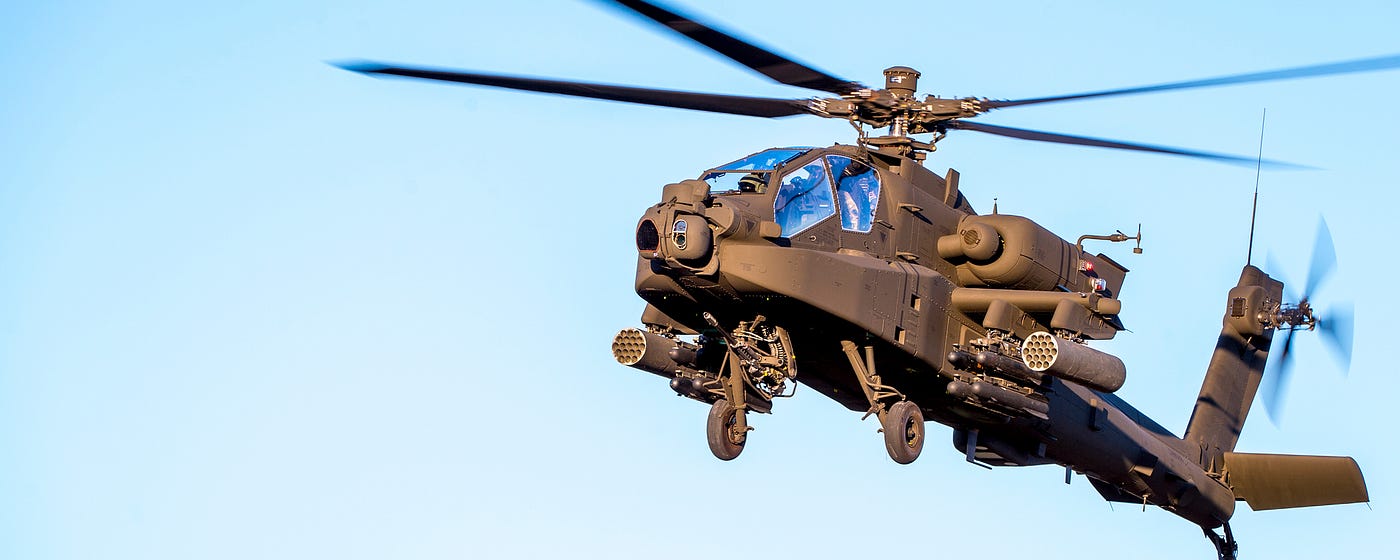
AH-64 Apache, The world’s most advanced, proven attack helicopter, and taken down by Iran (Source)
It is night over the Strait of Hormuz, June 9, and a US Army Apache helicopter is flying low over the water, escorting oil tankers through a waterway that has been closed since winter. The mission it belongs to does not officially exist. Fighter jets and helicopters have been shepherding commercial ships through the strait for weeks, defending them from Iranian drones and missiles, and the public knows none of this.
The public will learn about it for one reason only: the helicopter falls.
The two crew members are pulled from the water alive. By morning, Donald Trump has blamed Iran and promised Tehran will “pay the price.” By the next night, US fighter jets are hitting Sirik, Jask, Bandar Abbas and Qeshm Island. By the night after that, the strikes have widened to Karaj, west of Tehran, and a barracks outside the capital.
[embed]
Iran answers with missiles and drones against US bases in Kuwait, Bahrain, and Jordan, claiming 18 targets destroyed, then 12 ballistic missiles into a base in the Jordanian desert. Iran’s newly created strait bureaucracy, the Persian Gulf Strait Authority, announces the corridor is closed until further notice, and asks vessels holding transit permits to be patient. CENTCOM posts that commercial ships are still moving through the strait that very night. Iran’s foreign ministry declares the ceasefire, the one signed on April 8, now “practically meaningless.”
The helicopter was over the strait because the war exists. The helicopter falling became the reason for the war’s next week. The week’s strikes became the reason for the closure, the closure became the reason for the next escort mission, and the next escort mission is already in the air tonight, somewhere over the same water, waiting to become the reason for whatever comes after.
[embed]The war is an endless loop of these contradictions
The war has been running long enough to manufacture its own causes. Nobody can locate the beginning of the circle anymore — and the circle does not particularly want to be located.
A War at a Sustainable Temperature
The ceasefire is two months old. In those two months, the US has struck Iran repeatedly, Iran has struck back repeatedly, and both sides have accused the other of violating a truce that neither has stopped shooting through.
The diplomatic record calls these periodic flare-ups. The week of June 9 produced three rounds of them in five days.
What the ceasefire has actually been for, both sides have now said out loud. An Iranian official told Drop Site’s Jeremy Scahill, hours before the latest US strikes, that “we have taken advantage of the ceasefire to restore and strengthen our missile capabilities.” The same official said the framework of a deal had been in place until Trump disrupted it with new demands that fall outside anything Tehran can answer.
[embed]
On the US side, the president spent early June saying a deal could arrive within days, and then, forty-eight hours later, that Iran was “playing us for suckers” and would be hit hard again today. On Truth Social, he settled the matter of his own diplomacy: “The Bully of the Middle East is DEAD!!!”
The terms underneath have not moved since April. Iran wants sanctions lifted, billions in frozen assets released, and control over the strait. Trump wants the nuclear program ended, which Tehran says doesn’t exist as a weapons program. Between those two fixed positions, mediators rotate through Tehran like shifts at a plant: the Pakistanis shuttled in May, a Qatari delegation landed on Wednesday.
The plant produces almost-deals. It has never once produced a deal, and its output has been remarkably consistent for two months.
A ceasefire, in the dictionary, is the interval in which the firing stops. This one is something else: the war conducted at a temperature both sides can sustain. Cool enough that markets function and elections proceed. Warm enough that the re-arming, the blockade, the escort missions, and the leverage all stay alive.
Three Confessions in Five Days
The strangest feature of this war is that the people running it keep explaining it, accurately, in public, and nothing happens.
On June 10, Trump posted that the US would hit Iran “very hard tonight” and then kept typing. At some point in the near future, he wrote, the US will be taking Kharg Island and other oil infrastructure points, and will “assume total control of their Oil and Gas Markets, much like we have with Venezuela.” Kharg Island handles roughly nine of every ten barrels Iran exports. The war that was sold to the world as nuclear prevention now has, in the president’s own syntax, an acquisitions department. There was no walk-back, no clarification from the White House, no resignation.
[embed]
The day before, a second confession. “Did you know we’ve been taking out millions of barrels of oil?” Trump asked reporters at the White House. Nobody knows it, he added, correctly: no maritime traffic monitor on earth corroborates the claim. Kpler recorded eight transits through the strait between June 5 and 7, commercial and non-commercial combined, against roughly 135 ships a day before the war. The same week, Energy Secretary Chris Wright told Congress that strait traffic was rising “very meaningfully,” then acknowledged he could not put a number on the characterization. The phantom barrels, Trump explained, are why oil sits at $85 to $90 instead of $250.
The fleet exists only in the sentence that describes it, invented solely for market manipulation.
Then the third confession. New data showed US inflation at 4.2% in May, the highest in three years, more than double the rate from the week the war began, with energy driving over 60% of the monthly increase. A full year of inflation-adjusted wage growth has been erased in four months. Asked about it, the president told reporters: “I love the inflation.” He later said the remark was taken out of context.
[embed]
Here is what these confessions have in common: none of them changed anything.
The seizure announcement did not end the pretense of nuclear diplomacy; the talks resumed their stalling the same week. The phantom-barrel claim did not trigger any audit. The inflation remark cost one news cycle. A confession only matters if it changes someone’s incentives, and the in-between state has been engineered so that nobody’s do.
The mask falls off, on camera, in capital letters, and the war picks it up and hands it back.
A Clean Hole Through the Roof
Early Wednesday, US airstrikes destroyed a drinking water facility in Bemani, a village on Iran’s southern coast near the strait. The New York Times analyzed satellite imagery and verified footage: weapon fragments at the site matched a GBU-39 precision-guided glide bomb, and the strike had punched cleanly through the center of a roof. The two buildings stood alone outside the village, nothing else around them.
Researchers note that putting a precision munition through the middle of a roof, on an isolated structure, is an indicator of an intentional strike. More than 20,000 people lost their drinking water. Deliberately destroying civilian water infrastructure is a war crime under international law, and the analysis sits published while the next round of strikes is announced.
On the water, the blockade is producing its own parody. A US aircraft fired precision munitions into the engine room of the Settebello, a Palau-flagged tanker off Oman, after the crew, in CENTCOM’s words, failed to comply with instructions. Three Indian sailors died. Twenty-one were rescued. Within a day, the US had attacked a third vessel in a week, this one also Indian-crewed, and India’s foreign ministry was demanding that US operations against Gulf shipping cease. The sailors were not combatants in anyone’s definition. They were crew on tankers in a waterway that two governments have turned into a tollbooth and a target range simultaneously.
The war’s other fronts grind underneath the headlines. Lebanon’s health ministry counts 3,711 killed since Israel’s campaign began in March, with strikes this week hitting a residential building beside a hospital in Tyre and wounding ten nurses. Gaza’s own nine-month-old ceasefire has absorbed at least 981 killed since it began, with May the deadliest month of the year. And the war is arriving home in the country that started it: the State Department has opened an investigation of Trita Parsi, one of the most prominent US-based critics of the war, a green-card holder of twenty-five years, examining whether his commentary on Iran justifies deporting him. The same week, FBI agents raided the homes of college-aged activists over a divestment campaign.
[embed]
The in-between state has no front line. That is its design. Which means the front line is a tanker engine room, a water pump on a dry coast, a paycheck that buys 4.2% less than last year, and a visa file in a State Department drawer.
Nobody Can Afford the Ending
Trump needs the war. The midterms are approaching, his approval is sinking, inflation is eating his voters’ wages, and the war is the alibi for all of it: prices will come down like a rock, he says, once hostilities end, which makes the hostilities the explanation for every economic number until they do. He also needs the war contained.
The Pentagon’s stockpiles are a clock running down: a CSIS study found particular shortfalls in Tomahawks, Patriot interceptors, and THAAD missiles, the US has been draining its stocks in Europe and Asia to feed the campaign, and the administration has signed no new multiyear munitions contracts since taking office. This week, arms executives were summoned to the White House, and Trump demanded Congress pass $350 billion in additional Pentagon spending immediately. A war that ends does not justify the money. A war that escalates to its conclusion cannot be fought with the arsenal that remains.
The in-between is the only state the budget and the ballot both permit.
Iran’s math is the mirror image. A full war against the US, it loses, and its leadership knows the asymmetry to the decimal. A full peace costs it the strait, the single instrument that converts a sanctioned, blockaded economy into a power that can move global prices and summon mediators from two continents. So Tehran holds the corridor, absorbs the strikes, re-arms under the truce it accuses Washington of violating, and waits, having told Scahill’s source exactly what the waiting is for. Its foreign minister offered the doctrine in one sentence: foreign forces near Iran are at constant risk, and the safest course is for them to leave a region that will never host them hospitably.
[embed]
Neither government can afford the war to end. Neither can afford it to truly begin.
The US fought in Afghanistan for twenty years on inertia and sunk cost. This war has something stronger holding it in place: the thing it is fought over, the thing it burns, and the thing it inflates are all the same substance, and every actor at the table is being paid, in leverage or in budget or in alibi, by the price of it staying contested.
The Six-Day War lasted six days because somebody could win it. This one is built so that nobody has to.
The in-between is not the fragile state waiting to break. It is the finished structure, holding the weight of everyone who profits from it.
Tonight, over the strait, another helicopter is escorting another tanker through a waterway that is closed and open at the same time, depending on which government’s post you read. And whatever happens to it will be the reason for whatever happens next.
메타데이터
- post_id
- 7cda3a51f529
- slug
- this-will-be-the-never-ending-war-7cda3a51f529
- url
- https://medium.com/southern-winds/this-will-be-the-never-ending-war-7cda3a51f529
- canonical_url
- https://medium.com/southern-winds/this-will-be-the-never-ending-war-7cda3a51f529
- author_url
- https://medium.com/@jamal.ghadi08
- status
- ok
- fetched_at
- 2026-06-20 20:29:01