Write-Behind Cache in System Design: The Secret Behind High-Throughput Applications
Performance problems rarely appear when a system has a hundred users.
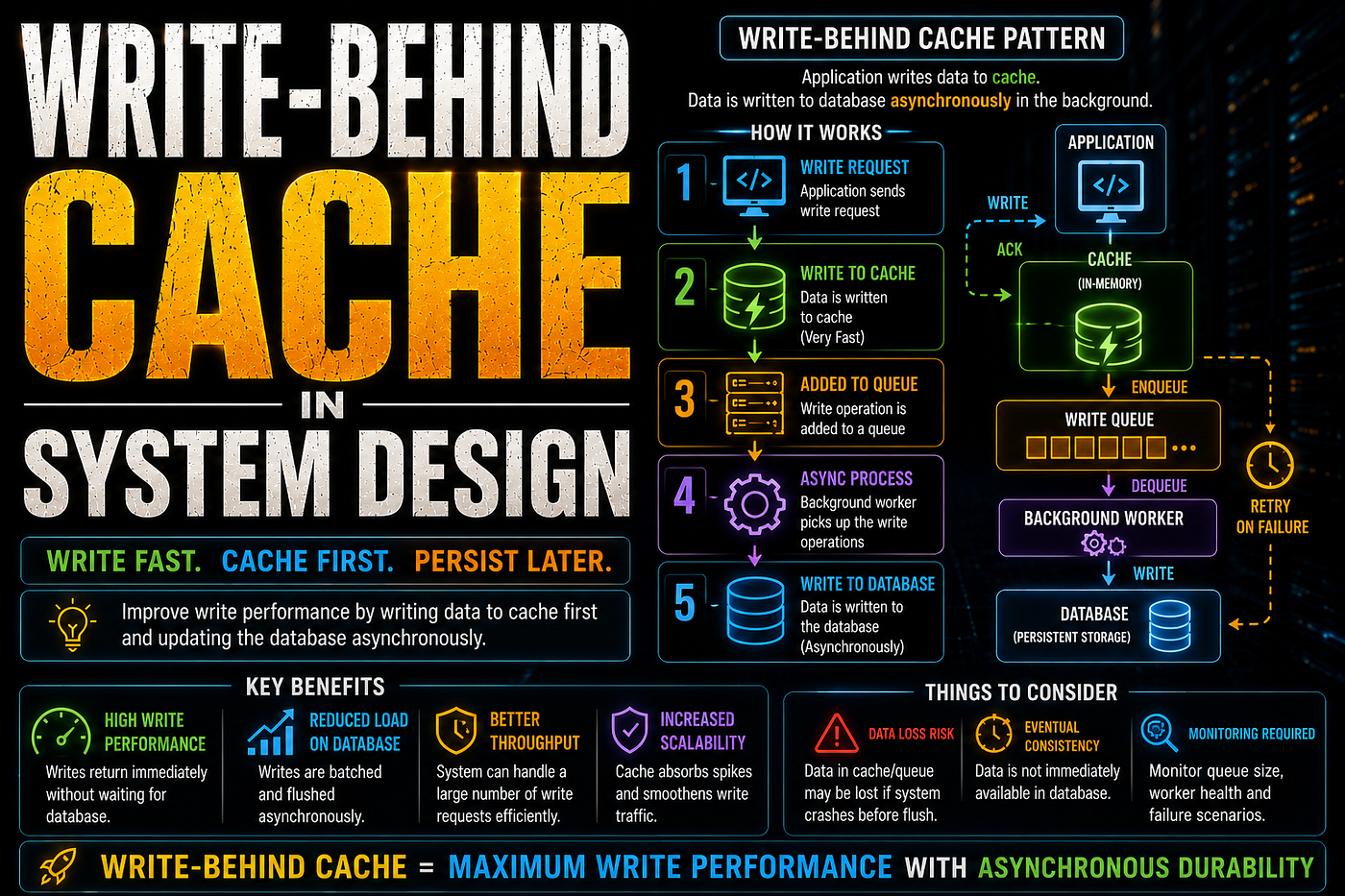
Blog Thumbnail
Write-Behind Cache in System Design: The Secret Behind High-Throughput Applications
Performance problems rarely appear when a system has a hundred users.
Things change when the same application starts serving millions of requests every day.
A database that looked perfectly healthy during development suddenly becomes the bottleneck. Write operations pile up. Response times increase. Infrastructure costs begin climbing faster than expected.
This is one of the reasons every backend engineer should understand caching strategies — not just for reads, but for writes as well.
Most engineers learn about cache-aside or write-through caching first. Those patterns solve many problems, but they still require the database to participate in every write operation. As traffic grows, that dependency becomes expensive.
Write-Behind Cache, sometimes called Write-Back Cache, takes a different approach.
Instead of writing data to the database immediately, the cache temporarily stores updates and acknowledges the request. The database is updated later, usually in batches.
This small architectural change can dramatically increase write throughput.
But it comes with trade-offs.
And those trade-offs matter.
What Is Write-Behind Cache?
Write-Behind Cache is a caching strategy where write operations are first stored in the cache, and the database update happens asynchronously at a later time.
The application receives a success response immediately after the cache accepts the write.
The database update is deferred.
Application
      |
      v
+-------------+
|    Cache    |
+-------------+
      |
      |
      |  (Async)
      v
+-------------+
|  Database   |
+-------------+
Unlike Write-Through Cache, the application does not wait for the database write to complete.
The request finishes much faster.
How Write-Behind Cache Works
Imagine an online gaming platform.
A player earns points during a game session.
The score changes continuously.
1000
1005
1010
1015
1020
If every score update were written directly to the database, thousands of unnecessary database operations would occur.
With Write-Behind Cache:
Player Score Update
        |
        v
Cache Updated
        |
        v
Immediate Success Response
        |
        |
        +---- Later ----+
                        |
                        v
                  Database Update
The cache records the latest value.
The database receives the final state later.
Instead of five database writes, perhaps only one occurs.
That reduction becomes significant at scale.
Why Write-Behind Cache Exists
Databases are often optimized for durability and consistency.
Not necessarily speed.
Even modern distributed databases have physical limitations.
Every write may involve:
- Disk operations
- Replication
- Transaction management
- Locking
- Index updates
- Network communication
These activities consume resources.
Write-Behind Cache removes the database from the critical path of user requests.
As a result:
- Lower write latency
- Higher throughput
- Reduced database load
- Better scalability
The benefits become more obvious as traffic increases.
Request Flow
Let’s examine the complete lifecycle.
Step 1: Client Sends Write Request
Update User BalanceThe application forwards the request to the cache.
Step 2: Cache Stores Data
Cache
-----
User123 = $500
The cache immediately stores the new value.
Step 3: Response Returned
The application receives success.
HTTP 200 OKAt this point, the database may not know about the update yet.
That distinction is important.
Step 4: Background Process Persists Data
A separate worker flushes changes.
Cache Queue
     |
     v
Background Worker
     |
     v
Database
This process runs independently from user requests.
Architecture Overview
A typical Write-Behind architecture looks like this:
+-------------+
                  | Application |
                  +-------------+
                         |
                         v
                  +-------------+
                  |    Cache    |
                  +-------------+
                         |
                         v
                +------------------+
                | Write Queue      |
                +------------------+
                         |
                         v
                +------------------+
                | Background Worker|
                +------------------+
                         |
                         v
                  +-------------+
                  | Database    |
                  +-------------+
The queue acts as a buffer between the cache and persistent storage.
Without that buffer, reliability becomes difficult.
Advantages of Write-Behind Cache
Extremely Fast Writes
The most obvious benefit.
The application no longer waits for database acknowledgment.
Response times decrease substantially.
Application -> Cache -> SuccessOnly one operation exists in the request path.
Reduced Database Load
Instead of processing every update individually, the database receives fewer operations.
Consider this scenario:
10,000 User UpdatesWithout batching:
10,000 Database WritesWith Write-Behind:
500 Batched Database WritesThe difference is considerable.
Better Throughput
Systems handling large volumes of updates benefit significantly.
Examples include:
- Gaming platforms
- Analytics systems
- IoT applications
- Logging systems
- Telemetry platforms
These workloads generate massive write traffic.
Write-Behind Cache helps absorb it.
Efficient Batch Processing
Updates can be grouped together.
INSERT INTO events (...)
VALUES (...), (...), (...);
Batch operations are typically more efficient than individual transactions.
The database performs less work overall.
Disadvantages of Write-Behind Cache
The performance gains are attractive.
The risks are equally important.
Potential Data Loss
This is the biggest concern.
Suppose the cache crashes before pending writes reach the database.
Cache Failure
      |
      v
Unflushed Data Lost
Data may disappear permanently.
For financial systems, this risk is often unacceptable.
Eventual Consistency
Database state may lag behind cache state.
For a short period:
Cache     = New Value
Database  = Old Value
Both systems are inconsistent.
Eventually they synchronize.
But not instantly.
Increased Complexity
Background workers, retry mechanisms, queues, and recovery processes introduce operational overhead.
The architecture becomes harder to maintain.
Failure Handling Challenges
Questions start appearing:
- What if the worker crashes?
- What if the queue becomes full?
- What if the database is unavailable?
- What if updates arrive out of order?
Each scenario requires careful handling.
Write-Behind vs Write-Through Cache
These two strategies are often compared.

Write Through vs Write ThroughCache
The decision depends on business requirements.
Neither approach is universally better.
Real-World Use Cases
Analytics Platforms
Analytics systems collect enormous numbers of events.
Writing every event directly to the database can become expensive.
Write-Behind allows efficient batching.
IoT Systems
Sensors may generate millions of updates every minute.
Persisting every update immediately often makes little sense.
Gaming Applications
Player statistics change constantly.
High-frequency writes benefit from asynchronous persistence.
Monitoring Systems
Metrics, logs, and telemetry data are excellent candidates.
Small delays are generally acceptable.
Recommendation Engines
User interactions can be accumulated and flushed periodically instead of updating storage for every action.
When Not to Use Write-Behind Cache
Not every system should adopt this pattern.
Avoid it when:
- Strong consistency is mandatory
- Data loss is unacceptable
- Regulatory requirements demand immediate persistence
- Financial transactions are involved
- Audit trails must be recorded instantly
Banking systems, payment gateways, and trading platforms typically avoid pure Write-Behind strategies.
The risk profile is simply too high.
Common Reliability Improvements
Production systems rarely rely on cache memory alone.
Several mechanisms are commonly introduced.
Persistent Queues
Cache
   |
   v
Durable Queue
   |
   v
Database
Messages survive service restarts.
Retry Mechanisms
Failed writes are retried automatically.
Write Failed
      |
      v
Retry
      |
      v
Retry Again
Temporary database outages become less problematic.
Dead Letter Queues
Problematic updates can be isolated for investigation.
This prevents one bad record from blocking the entire pipeline.
Periodic Checkpointing
Pending writes are stored persistently.
Recovery becomes easier after failures.
Interview Perspective
A common system design interview question is:
“How would you scale a system receiving millions of writes per second?”
Write-Behind Cache is frequently part of the discussion.
Interviewers typically expect candidates to cover:
- Throughput improvements
- Eventual consistency
- Failure recovery
- Data durability
- Queue design
- Batch processing strategies
Simply naming the pattern is not enough.
The trade-offs matter more than the terminology.
Final Thoughts
Write-Behind Cache exists because databases are expensive resources. Fast systems often emerge not by making databases faster, but by reducing how frequently they are asked to work.
By moving database writes out of the request path, applications can achieve remarkable throughput improvements. The trade-off is straightforward: lower latency and higher performance in exchange for additional complexity and weaker consistency guarantees.
That balance makes Write-Behind Cache one of the most powerful patterns in system design.
Used in the right place, it can transform a struggling architecture into one capable of handling enormous scale.
Used in the wrong place, it can create data integrity problems that are difficult to recover from.
Understanding where that line exists is what separates implementation knowledge from system design expertise.
메타데이터
- post_id
- 7ce150d897ca
- slug
- write-behind-cache-in-system-design-the-secret-behind-high-throughput-applications-7ce150d897ca
- url
- https://medium.com/algomart/write-behind-cache-in-system-design-the-secret-behind-high-throughput-applications-7ce150d897ca
- canonical_url
- https://medium.com/algomart/write-behind-cache-in-system-design-the-secret-behind-high-throughput-applications-7ce150d897ca
- author_url
- https://medium.com/@yashjainio
- status
- ok
- fetched_at
- 2026-06-25 07:00:49