Harnessing Murray-Darling Basin (MDB) 450 GL buyback for environmental sustainability
As one of Australia’s most significant freshwater resources, the MDB is currently facing a crisis due to overexploitation of irrigation…
Harnessing Murray-Darling Basin (MDB) 450 GL buyback for environmental sustainability
As one of Australia’s most significant freshwater resources, the MDB is currently facing a crisis due to overexploitation of irrigation over the past hundred years, including the risk of freshwater scarcity from climate change, increasing water demand, affecting water quality and quantity, as well as the ecosystem within it (Conservancy, 2017; Sengupta A, 2018). The MDB is a perennial system that supports one third of Australia’s food supply and more than 3 million people, and the surrounding water-dependent ecosystem could be at risk because of declining freshwater per capita (McMahon et al., 2007; WWAP, 2015). As its natural resources, the government need to engage more directly and intensively about how much water can be consumed in short and long term (Owens, 2022).
Currently, under the Water Act 2023, the government is focusing on water management, aiming to achieve 450 GL through a buyback mechanism for return to the environment (DCCEEW, 2023). The entitlements trade represents permanent transfer or water right access each year with higher or lower value uses (DAFF, 2019). By the end of 2027, the government will engage stakeholders to focus on returning 450 GL of water to restore and maintain environmental health, thereby positively impacting social and economic well-being amid the uncertainty of climate change and annual extreme weather events (DCCEEW, 2026b). This essay aims to summarise the social-economic, and environmental impacts of the Water Amendment 2023 policy in Murray-Darling Basin (MDB) from the government’s perspective.
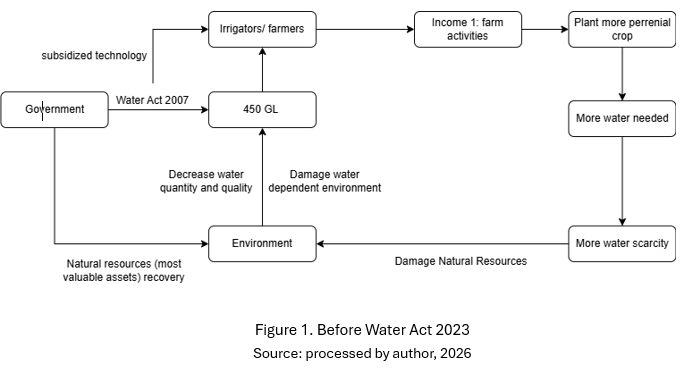
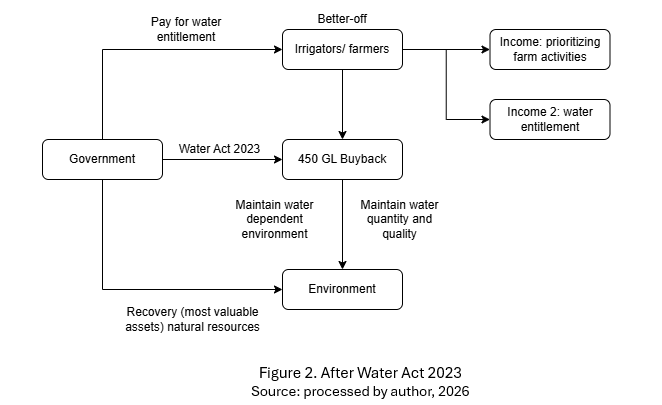
In accordance with the 2007 Water Act, the water recovery policy, which was initially focused on subsidising irrigation infrastructure, was feared to be unable to meet the 450 GL target by the end of 2026. In 2023, the government, through the 2023 Water Act, shifted course to a buyback, which was deemed more effective than technology subsidies. The government carried out the buyback by repurchasing water-use permits directly from willing sellers (irrigators/farmers) at prevailing market prices. The following are some of the socio-economic welfare impacts that emerged from the policy adjustment:
- The environment will recover water more easily and at a lower cost than with subsidies (Grafton & Wheeler, 2018). This is related to more efficient, higher-quality groundwater return flows compared to subsidies (Grafton & Wheeler, 2018; Wheeler et al., 2024). Besides, by reducing anthropogenic activities, water quality issue such as high salinity, nutrient pollution across MDB could be managed (Beavis et al., 2023; Korbel et al., 2022).
- Farmers will gain financial freedom and convenience from the money paid by the government(Grafton & Wheeler, 2018). This freedom can be used to pay off debt, find an exit strategy from irrigation farming, or start new businesses and increase agricultural resilience (Wheeler et al., 2018). Along with the repurchase of water rights, it is estimated that irrigated land area will also decrease, thereby reducing the negative impacts of agricultural water use, such as increased water salinity ((MDBA), 2025)
- In terms of water cost/ML, buybacks will be much more effective (Wheeler, 2024). The cost of returning water per ML is around $2,109, while irrigation programs range up to $6,557 per ML, which is three times the cost of buybacks (Wheeler, 2024).
Numerous studies have shown that buyback programs are far more effective and cost-efficient in returning water to the environment than subsidised irrigation technology, benefiting farmers, environmental managers, and surrounding communities (Wheeler, 2024) (Adamson & Loch, 2017). Furthermore, research indicates that the majority of the public (60%) supports the government restoring more water for the environment and culture, particularly through market mechanisms such as buybacks (Zuo & Wheeler, 2024).
Several economic principles applied in these policy adjustments include:
- A trade-off occurs between environmental sustainability and irrigator output through the Water Act 2023 policy, which focuses on meeting the 2027 target of 450 GL of environmental health, the government minimize it using voluntary water purchase from irrigators (Water, 2025). The trade-off should be viewed across seasons: in dry years, agricultural losses might exceed the acceptable range, but in wet years, the environment can store more water to meet more targets (Pang et al., 2018). Achieving 450 GL buyback is explained by three mechanisms: the Resilient Rivers Program, voluntary water purchases, and the Sustainable Community Program (DCCEEW, 2026b). Choosing environmental health over irrigators’ activities also supports the natural resources ecosystem and the biotic life around the river especially in refugial wetland, where species recover from severe droughts (Bennett et al., 2025). This trade seems fair in the long term for both environmental and social-economic welfare, given the increasing scarcity of freshwater in the future due to extreme droughts (Pang et al., 2018).
- The climate crisis also prompted the government to choose the opportunity cost of reduced water for farmers, whilst nowadays the financial losses have not been scientifically quantified (Aghapour Sabbaghi et al., 2020). We conclude that the government incurs an opportunity cost in terms of profits from on-farm agricultural activities. However, we argue that the government gains compensation by protecting the most important national asset, the natural resources of the MDB. Natural resources such as significant Ramsar wetlands, keeping rivers and floodplains connected, maintaining habitat for waterbirds, supporting native fish spawning, and maintaining clean water quality by flushing algae or salt from rivers, decreasing salinity levels, and supporting water quality and social impacts (Sengupta A, 2018).
- People respond to the incentives (Mankiw, 2015). By implementing voluntary buybacks, water supplies to farmers will decrease, while water demand will increase, ensuring water prices will rise and benefiting farmers by generating higher profits over time(Downham R, 2024). This incentive can be used to reduce debt or fund structural changes, thereby increasing farm resilience (Wheeler et al., 2018).
- By implementing the voluntary 450 GL buyback, the government has directly utilised the principle that markets are usually a good way to organise economic activity (DCCEEW, 2026c; Mankiw, 2015). The government, as a stakeholder, through market mechanisms, allows water trade decisions in MDBs to interact with the market, driven by interest and prices, which Adam Smith called the invisible hand ((MDBA), n.d.; Mankiw, 2015). This creates a natural guideline: the market will produce what people want and need at the prices they are willing to pay (Mankiw, 2015).
- In accordance with the principle that the government can sometimes improve market outcomes by intervening through adjustments to the Water Act 2023, it is not only predicted that the government will achieve the 450 GL target of allocating water for environmental sustainability by the end of 2027 (DCCEEW, 2026b; Mankiw, 2015). Other approaches, such as continuing to subsidise technology and enhancing sustainable community development, will increase public trust in the government’s water market management efforts. Through the MDB Authority, state governments are also asked to support the MDB Plan by monitoring and developing water trade policies and procedures to identify potential risk and benefit from the policy to guide society towards effective and acceptable solutions ((MDBA), 2026)
Summary
Therefore from the government’s perspective, MDB areas represent natural resources that are a strategic pillar of life and long-term socio-economic activity (DCCEEW, 2026a). Considering the increasing risk of water scarcity, the strategic shift from subsidised technology-focused to voluntary 450 GL buyback directly supports the market in regulating water supply and demand for environmental sustainability while supporting socio-economic welfare at the same time (DCCEEW, 2026b).
Bibliography
(MDBA), M.-D. B. A. (n.d.). Water markets. Retrieved 29 March from https://www.mdba.gov.au/water-use/water-markets
(MDBA), M. D. B. A. (2025). Salinity. Australian Government. Retrieved 28 March from https://www.mdba.gov.au/water-management/managing-water-quality/water-quality-threats/salinity
(MDBA), M. D. B. A. (2026). 2026 Basin Plan Review: Have Your Say. Retrieved 29 March from https://getinvolved.mdba.gov.au/2026basinplanreview
Adamson, D., & Loch, A. (2017). Achieving environmental flows where buyback is constrained. Australian Journal of Agricultural and Resource Economics, 62(1), 83–102. https://doi.org/10.1111/1467-8489.12231
Aghapour Sabbaghi, M., Nazari, M., Araghinejad, S., & Soufizadeh, S. (2020). Economic impacts of climate change on water resources and agriculture in Zayandehroud river basin in Iran. Agricultural Water Management, 241, 106323. https://doi.org/https://doi.org/10.1016/j.agwat.2020.106323
Beavis, S. G., Wong, V. N. L., Mosley, L. M., Baldwin, D. S., Latimer, J. O., Lane, P., & Lal, A. (2023). Water quality risks in the Murray-Darling basin. Australasian Journal of Water Resources, 27(1), 85–102. https://doi.org/10.1080/13241583.2022.2163475
Bennett, J. M., Linke, S., Brooks, S., Bush, A., Hitchcock, J., Pollino, C., & Thompson, R. M. (2025). Conservation planning for environmental water to climate refugia in the manageable Murray-Darling Basin. J Environ Manage, 393, 127184. https://doi.org/10.1016/j.jenvman.2025.127184
Conservancy, T. N. (2017). Creating a Sustainable Murray-Darling. Retrieved 28 March 2026 from https://www.natureaustralia.org.au/what-we-do/our-priorities/land-and-freshwater/land-freshwater-stories/creating-a-sustainable-murray-darling/
DAFF, A. (2019). Snapshot of Australian Water Markets. Australia: Australian Government Retrieved from https://www.agriculture.gov.au/sites/default/files/abares/documents/SnapshotOfAustralianWaterMarkets_v1.0.0.pdf
DCCEEW. (2023). Water amendment (Restoring Our Rivers) Bill 2023 Fact Sheet. Australia: Australian Government Retrieved from https://www.dcceew.gov.au/water/publications/restoring-our-rivers-bill-factsheet
DCCEEW. (2026a). Murray–Darling Basin. Department of Climate Change, Energy, the Environment and Water. Australian Government. Retrieved 28 March from https://www.dcceew.gov.au/water/policy/mdb#:~:text=Water%20from%20the%20Basin%20helps,over%20$15%20billion%20a%20year%20.
DCCEEW. (2026b). Restoring Our Rivers: Framework for delivering the 450 GL of additional environmental water. Canberra: Australian Government Retrieved from https://www.dcceew.gov.au/water/policy/implementing-the-plan/450-framework
DCCEEW. (2026c). Voluntary Water Purchase Program for the 450 GL (Restoring our Rivers). Department of Climate Change, Energy, the Environment and Water. Retrieved 28 March from https://www.dcceew.gov.au/water/policy/water-recovery/government-water-purchasing/voluntary-restoring-our-rivers#:~:text=There%20is%20no%20fixed%20volume,Commonwealth%20Environmental%20Water%20Holder's%20portfolio.
Downham R, J. W., Mihir Gupta, David Galeano, dan Simon Hone. (2024). The impacts of further water recovery in the southern Murray–Darling Basin. ABARES (Australian Bureau of Agricultural and Resource Economics and Sciences) — Department of Agriculture, Fisheries and Forestry (DAFF). Retrieved 29 Maret from https://www.agriculture.gov.au/abares/research-topics/water/the-impacts-of-further-water-recovery
Grafton, R. Q., & Wheeler, S. A. (2018). Economics of Water Recovery in the Murray-Darling Basin, Australia. Annual Review of Resource Economics, 10(1), 487–510. https://doi.org/10.1146/annurev-resource-100517-023039
Korbel, K. L., Greenfield, P., & Hose, G. C. (2022). Agricultural practices linked to shifts in groundwater microbial structure and denitrifying bacteria. Science of The Total Environment, 807, 150870. https://doi.org/https://doi.org/10.1016/j.scitotenv.2021.150870
Mankiw, N. G. (2015). Principles of economics (Seventh edition ed.). Cengage Learning.
McMahon, T. A., Vogel, R. M., Peel, M. C., & Pegram, G. G. S. (2007). Global streamflows — Part 1: Characteristics of annual streamflows. Journal of Hydrology, 347(3), 243–259. https://doi.org/https://doi.org/10.1016/j.jhydrol.2007.09.002
Owens, K. (2022). Governing Climate-Related Systemic Risks in the Murray-Darling Basin in Australia. Utrecht Law Review, 18(2), 12–29. https://doi.org/10.36633/ulr.826
Pang, A., Li, C., Sun, T., Yang, W., & Yang, Z. (2018). Trade-Off Analysis to Determine Environmental Flows in a Highly Regulated Watershed. Sci Rep, 8(1), 14130. https://doi.org/10.1038/s41598-018-32126-6
Sengupta A, T. D., dan Carmel Pollino. (2018). Understanding ecosystem response to water management in the Murray-Darling Basin. CSIRO Retrieved from https://www.csiro.au/en/news/All/Articles/2018/April/murray-darling-basin
Water, D. f. E. a. (2025). Basin Plan. Government of South Australia Retrieved from https://www.environment.sa.gov.au/topics/water-and-river-murray/projects-plans-security-and-legislation/legislation-and-policies/basin-plan
Wheeler, S. A. (2024). Comparing the success and failure of the Murray–Darling Basin Plan’s water recovery programs. Australian Journal of Public Administration. https://doi.org/10.1111/1467-8500.12672
Wheeler, S. A., Xu, Y., & Zuo, A. (2024). Developing an economic quality assessment framework and applying it to water economic studies in the Murray-Darling Basin. Environmental Science & Policy, 152. https://doi.org/10.1016/j.envsci.2023.103654
Wheeler, S. A., Zuo, A., & Loch, A. (2018). Water torture: Unravelling the psychological distress of irrigators in Australia. Journal of Rural Studies, 62, 183–194. https://doi.org/https://doi.org/10.1016/j.jrurstud.2018.08.006
WWAP, W. W. A. P. (2015). Water for a sustainable world. Paris: UN World Water Dev. Rep.,
UNESCO Retrieved from https://unesdoc.unesco.org/ark:/48223/pf0000232272
메타데이터
- post_id
- 7cea01be59b1
- slug
- harnessing-murray-darling-basin-mdb-450-gl-buyback-for-environmental-sustainability-7cea01be59b1
- url
- https://medium.com/@itsdibah/harnessing-murray-darling-basin-mdb-450-gl-buyback-for-environmental-sustainability-7cea01be59b1
- canonical_url
- https://medium.com/@itsdibah/harnessing-murray-darling-basin-mdb-450-gl-buyback-for-environmental-sustainability-7cea01be59b1
- author_url
- https://medium.com/@itsdibah
- status
- ok
- fetched_at
- 2026-06-09 15:37:30