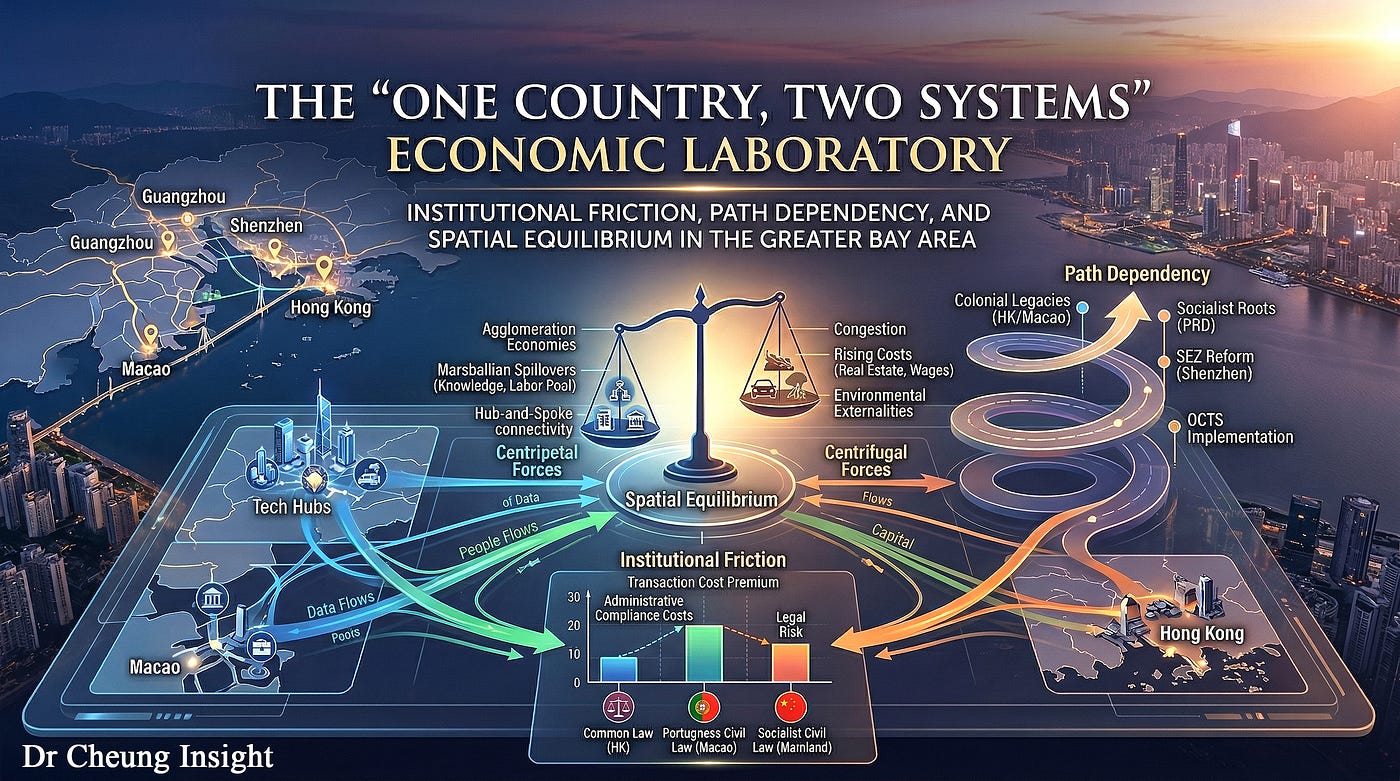
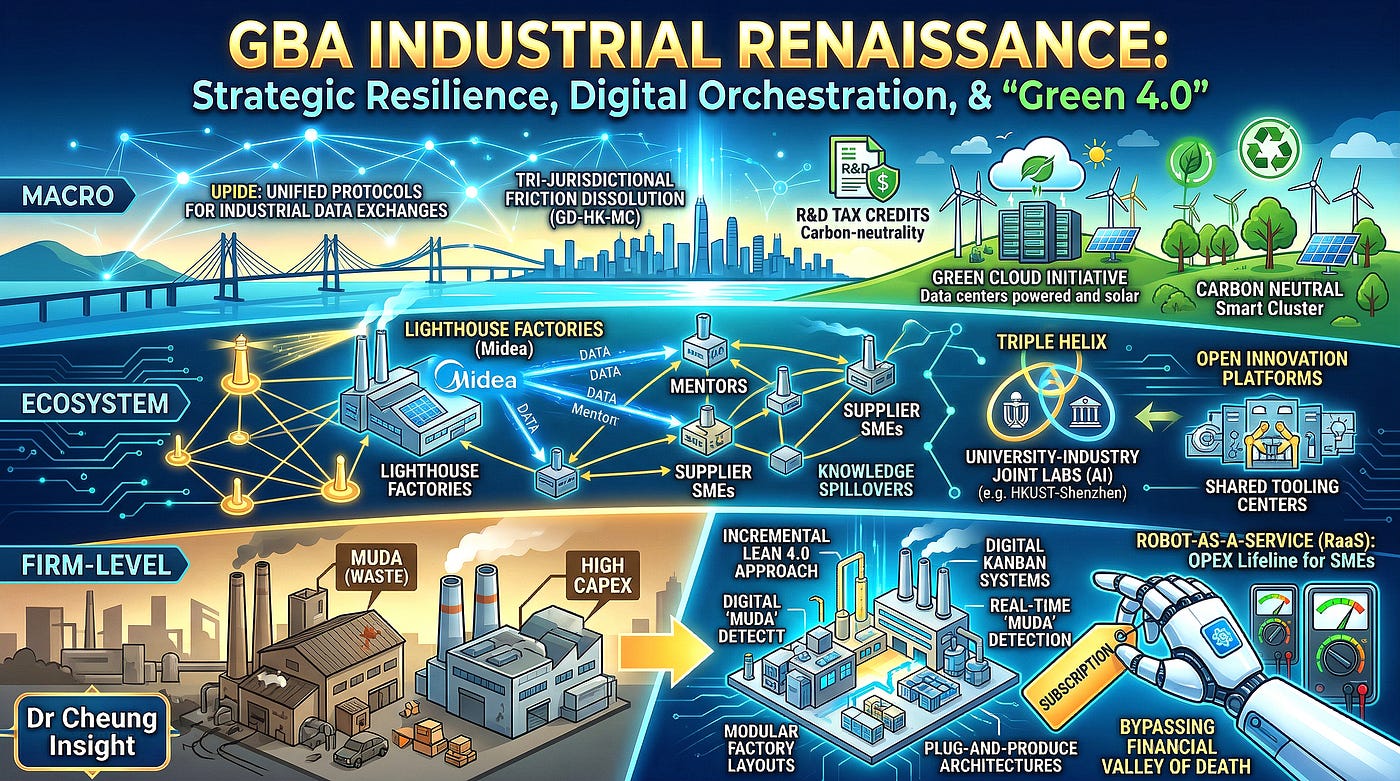
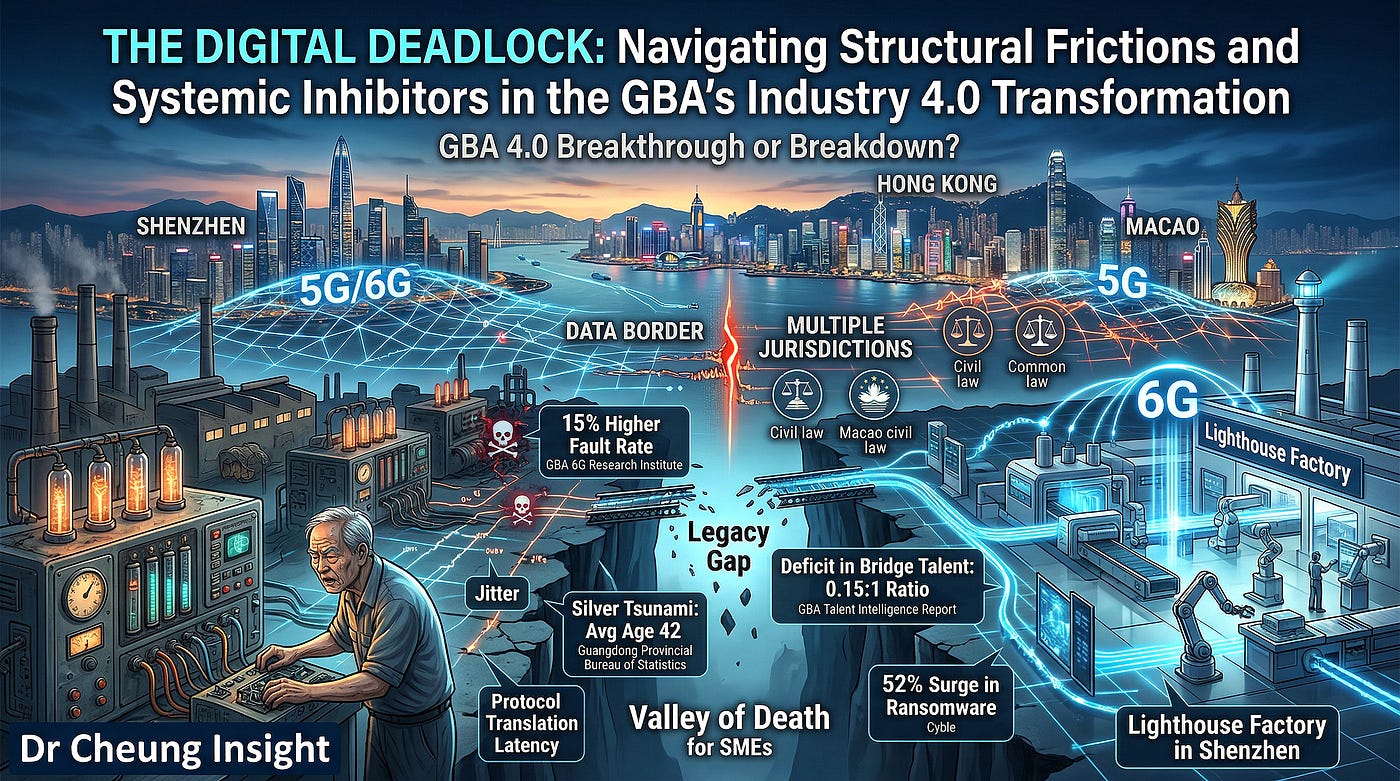
Beyond the Conduit: Strategic Resilience and the Re-Engineering of the Greater Bay Area in an Era…
Abstract As the post-Cold War consensus on hyper-globalization collapses into “weaponized interdependence,” China’s Greater Bay Area (GBA)…
Beyond the Conduit: Strategic Resilience and the Re-Engineering of the Greater Bay Area in an Era of Weaponized Interdependence
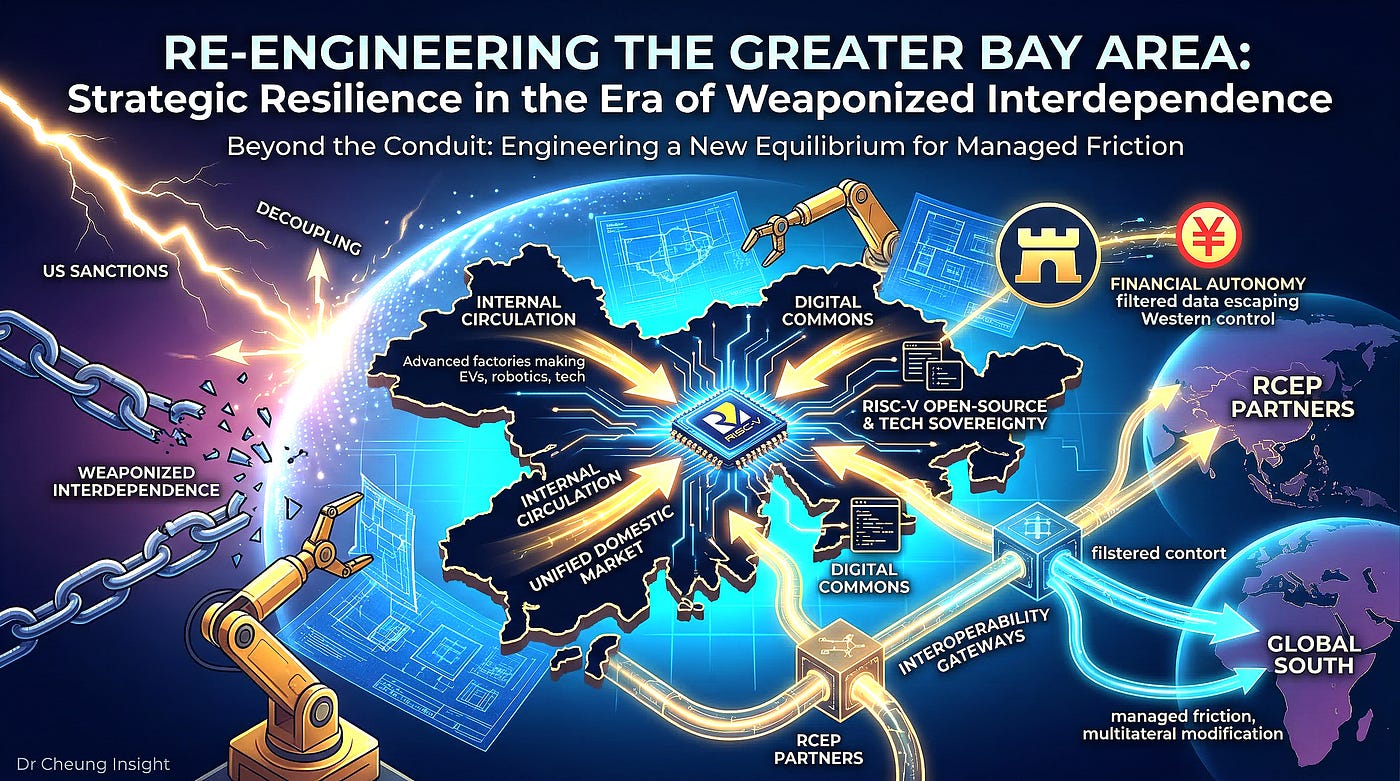
Abstract As the post-Cold War consensus on hyper-globalization collapses into “weaponized interdependence,” China’s Greater Bay Area (GBA) has transitioned from a global export conduit to a pioneering laboratory for economic and technological resilience. This article analyzes the GBA’s strategic recalibration across four critical dimensions: institutional resilience through unified domestic markets and financial autonomy; corporate agility via algorithmic supply chain architectures and “In China, for China” localization; the modification of multilateral trade frameworks to accommodate a multipolar order; and the maintenance of technological interoperability through open-source governance and “Interoperability Gateways.” By synthesizing state-led directives with corporate statecraft, the GBA is engineering a “new equilibrium” designed to absorb exogenous shocks while preserving a sophisticated, if fragmented, interface with the global economy. Keywords: Greater Bay Area (GBA), Weaponized Interdependence, Internal Circulation, Strategic Localization, RISC-V, Financial Sovereignty, Decoupling. Introduction The contemporary global order is defined by a paradox: a deep, structural integration of economies alongside an escalating “geo-economic” confrontation between the United States and China. Within this theater of “de-risking” and “high-fence” policies, the Greater Bay Area (GBA) — comprising nine mainland cities plus Hong Kong and Macao — stands as the most critical node of friction and adaptation. No longer able to rely on its historical status as a frictionless export-processing zone, the GBA is undergoing a profound “topological reconfiguration.” This transformation is not merely defensive; it is a proactive attempt to build a self-sustaining economic ecosystem. By leveraging the GBA’s unique “Two Systems” legal advantage and its unparalleled hardware prototyping speed, Beijing is deploying a suite of institutional and corporate interventions. These range from the construction of a Unified National Market to the adoption of RISC-V open-source architectures, all aimed at neutralizing the threat of “cascade failure” induced by Western sanctions. This article explores how the GBA serves as the vanguard for a new era of “managed friction,” where resilience is prioritized over efficiency and “mathematical trust” replaces political consensus. A. GBA Institutional Resilience Mechanisms The intensification of the US-China trade war and the structural shift toward “de-risking” in Western capitals have necessitated a profound recalibration of the Greater Bay Area’s (GBA) institutional framework. As global supply chains undergo a topological reconfiguration, the GBA can no longer rely solely on its historical status as an export-processing zone. Instead, the region is pioneering a suite of institutional resilience mechanisms designed to absorb exogenous shocks while fostering endogenous growth. This strategic pivot is characterized by the construction of a unified domestic market to offset export volatility, the advancement of a world-class intellectual property (IP) regime to protect indigenous innovation, and the deepening of financial markets to ensure capital autonomy. By transforming the GBA from a “conduit” of global trade into a “self-sustaining” economic ecosystem, these mechanisms represent a fundamental intervention aimed at establishing a new, resilient equilibrium in a fragmented global economy (Naughton, 2024, p. 52).
- Strengthening the Unified Domestic Market The foundational pillar of GBA resilience is the construction of a “Unified National Market” (Quanguo Tongyi Da Shichang), a policy directive formalized by the State Council in 2022. This mechanism aims to eliminate the historical barriers of local protectionism and fragmented regulations that have traditionally hindered the internal circulation of goods and services within China. By leveraging the GBA as the primary laboratory for this integration, Beijing seeks to create a domestic market of sufficient scale and depth to absorb the productive capacity previously destined for the United States. 1.1. Internal Barrier Removal and Regulatory Harmonization Historically, inter-provincial trade within China was often subject to “hidden” non-tariff barriers, including local procurement biases and divergent technical standards. Institutional resilience in the GBA requires the systematic dismantling of these frictions to ensure that a product manufactured in Shenzhen can reach a consumer in Chengdu with the same velocity as it reaches a consumer in Los Angeles. 1.1.1. Elimination of local protectionism and “hidden” trade barriers The GBA is spearheading the removal of localized subsidies that favor “homegrown” provincial firms over cross-regional competitors. This involves the implementation of a “Negative List” for market access, ensuring that any entity registered within the GBA can participate in public procurement and land auctions across all nine mainland cities without discrimination. As Lin (2022b) argues, “the reduction of internal transaction costs is the only mathematically viable substitute for the loss of export margins” (p. 88). 1.1.2. Harmonization of technical standards across the GBA corridor To facilitate seamless internal trade, the GBA is unifying its technical certification and quality standards. By aligning the standards of the “Dongguan Workshop” with the national “China Guobiao” (GB) standards, the region ensures that its manufacturers do not have to produce separate product lines for domestic and international markets, thereby preserving economies of scale despite decoupling pressures. 1.1.3. Digital integration of inter-provincial logistics and data The GBA is deploying a unified “Logistics Data Backbone.” By integrating the transport management systems of the Pearl River Delta with the national rail and road networks, the region minimizes the “information friction” that leads to delays and high inventory carrying costs. This digital integration is the “soft infrastructure” counterpart to the physical connectivity. 1.2. Consumption Stimulation and Demand-Side Resilience For the “Internal Circulation” strategy to succeed, the GBA must not only manufacture for the domestic market but also serve as a high-value consumption hub. 1.2.1. Leveraging the “Guochao” phenomenon to drive domestic demand The GBA is capitalizing on the “Guochao” (National Trend) sociological shift, where young Chinese consumers increasingly prioritize indigenous technology and aesthetics over Western luxury brands. By fostering a “Brand GBA” identity, the region ensures that its high-end EVs (BYD, GAC Aion) and consumer electronics (Huawei, OPPO) have a loyal, resilient domestic baseload of demand that is insulated from US consumer sentiment or boycotts. 1.2.2. Targeted fiscal subsidies for high-tech domestic adoption To accelerate the transition to the internal market, GBA municipal governments have implemented “Consumption Vouchers” and EV subsidies specifically for locally produced goods. Table 1: Domestic Market Absorption of GBA High-Tech Output (2020–2025)
Sector Export Share of Revenue (2020) Export Share of Revenue (2025) Domestic Revenue Growth (CAGR) Policy Driver New Energy Vehicles (EVs) 18.5% 12.2% +34.2% National NEV Subsidies Consumer Hardware 62.4% 48.5% +18.9% Guochao Branding Industrial Robotics 14.0% 8.5% +42.6% 7–3–1 Import Substitution Advanced Materials 22.1% 15.6% +22.4% Unified National Market
Source: Derived from GBA Municipal Bureau of Statistics and Ministry of Industry and Information Technology (MIIT) 2026 Reports. Table 1 illustrates the “Inward Pivot.” The consistent decline in export share across all strategic sectors, combined with the explosive growth in domestic revenue (especially in robotics and EVs), proves that the GBA is successfully decoupling its growth from Western consumption. The domestic market has evolved from a “safety net” into the primary “engine of demand.” 1.2.3. Expanding the middle-class consumer base via labor reform Institutional resilience also requires the expansion of the “Purchasing Power Parity” within the GBA. By reforming the Hukou (household registration) system to allow migrant workers in Dongguan and Foshan to access urban social services and affordable housing, the state is effectively converting “migrant labor” into “settled consumers,” providing a long-term demographic buffer against the loss of the US middle-class market. 1.3. Local Procurement Mandates and “Safe” Supply Chains The third element of domestic market strengthening is the “indigenization” of strategic procurement, ensuring that GBA firms are the primary beneficiaries of national infrastructure spending. 1.3.1. Implementation of the “7–3–1” import substitution policy The GBA is the primary executor of the “7–3–1” policy, which mandates that 70% of the components in critical infrastructure (telecom, energy, finance) must be indigenous by the end of 2025 (Lardy, 2022c). This creates a “guaranteed market” for GBA-based semiconductor and software firms, allowing them to achieve the necessary scale to eventually compete globally even without US market access. 1.3.2. Mandating local procurement in government and SOE projects Government and State-Owned Enterprises (SOEs) within the GBA are directed to utilize “local first” procurement for cloud services, medical equipment, and office hardware. This “State-Guided Consumption” provides a stable revenue stream for GBA “national champions” like Huawei and BGI during periods of aggressive Western sanctions. 1.3.3. Developing “Sanction-Proof” domestic supply clusters To prevent a “cascade failure”, the GBA is building “closed-loop” industrial parks where the entire value chain — from raw materials to final assembly — is located within a single domestic administrative zone. This spatial and institutional arrangement ensures that the “nervous system” of GBA manufacturing cannot be severed by extraterritorial US edicts. Conclusion Strengthening the unified domestic market is not a return to autarky, but a strategic “re-basing” of the GBA’s industrial logic. By removing internal barriers, stimulating indigenous demand, and mandating local procurement, the GBA has constructed a “macroeconomic shock absorber” that ensures the region’s survival and growth regardless of the state of trans-Pacific trade relations. 2. Advanced Intellectual Property Frameworks As the US-China conflict shifts from trade volumes to technological standards, the GBA’s institutional resilience depends on its ability to protect and monetize indigenous innovation. The region is transitioning from a “follower” to a “standard-setter,” requiring an IP regime that is not only globally compliant but also strategically proactive. 2.1. Specialized IP Courts and Legal Protections The GBA has established a specialized legal infrastructure to handle the complexities of high-tech IP litigation, providing a “neutral” and efficient venue for global and domestic firms. 2.1.1. Establishing global-standard IP courts in Shenzhen and Hong Kong The Shenzhen IP Court and the Hong Kong Intellectual Property Department have become the “central nodes” for regional dispute resolution. By utilizing specialized judges with STEM backgrounds and implementing “punitive damages” for IP theft (mirroring Western standards), the GBA aims to signal to the world that its “innovation core” is a legally secure environment for R&D (Wang, 2023b). 2.1.2. Utilizing “Injunction Power” to counter foreign sanctions The GBA is pioneering “Legal Counter-measures” in the IP space. This includes the use of “Anti-Suit Injunctions,” where a GBA court can prohibit a foreign firm from pursuing IP litigation in a Western court if it is deemed to interfere with a domestic GBA case. This institutional tool is a direct response to the “legal lawfare” practiced in US courts, providing GBA firms with a sovereign legal shield. 2.1.3. Enhancing data privacy and cybersecurity laws (GDPR alignment) To maintain its “External Circulation” with the EU and non-aligned markets, the GBA is aligning its data privacy laws (e.g., the Personal Information Protection Law, PIPL) with the European GDPR. This institutional “isomorphism” ensures that GBA tech firms remain “digitally compatible” with global markets, even as they decouple from the US data ecosystem. 2.2. Patent Fast-Tracking and Standard Power Resilience in the tech war is achieved by “locking in” global standards. The GBA is utilizing institutional mechanisms to accelerate the generation and adoption of indigenous patents. 2.2.1. Accelerating indigenous patent generation via state “Fast-Tracks” The China National Intellectual Property Administration (CNIPA) has established specialized “Green Channels” in the GBA to fast-track patent applications in strategic sectors like 6G, quantum computing, and bio-tech. This ensures that GBA firms can “land-grab” foundational IP before Western competitors can react to new technological breakthroughs. 2.2.2. Transitioning from “User of Standards” to “Setter of Standards” The GBA is the primary driver of China’s “Standards 2035” plan. By dominating the technical committees of the ISO, IEC, and ITU, the GBA ensures that the “physics” of the future global economy is designed in Shenzhen. 2.2.3. Protecting the “Digital Commons” and Open-Source IP Recognizing that US export controls target proprietary software, the GBA is institutionalizing its own “Open-Source Foundation.” By hosting global code repositories (like Gitee) and supporting architectures like RISC-V, the GBA ensures that its innovation ecosystem is built on “non-sanctionable” foundational IP, creating a “safe harbor” for global developers. 2.3. International Arbitration and Dispute Resolution Neutrality To attract sustainable international capital, the GBA leverages Hong Kong’s common law system as an “Institutional Bridge.” 2.3.1. Leveraging Hong Kong as a neutral global arbitration hub Hong Kong’s “International Arbitration Centre” (HKIAC) remains the preferred venue for GBA-related contracts involving Western MNCs. By allowing for the mutual enforcement of arbitral awards between Hong Kong and the mainland, the GBA provides a level of “legal certainty” that mainland civil law cannot yet match, effectively neutralizing the “institutional distance” that often deters Western investors. 2.3.2. Offering “Regulatory Sandboxes” for cross-border IP trials The GBA allows firms to test new IP-sharing models in “Special Cooperation Zones” like Qianhai. These sandboxes allow for the collaborative development of dual-use technologies between mainland and Hong Kong entities, ensuring that the “last mile” of innovation remains institutionalized within the GBA’s borders. 2.3.3. Standardizing IP valuation for financial “IP-Backed” lending To fund its SMEs, the GBA is pioneering “IP Securitization.” By standardizing how patents and trademarks are valued as collateral, the region’s banks can provide liquidity to tech firms that lack physical assets but possess high-value intangible IP. This “Institutional Liquidity” is a vital buffer against the withdrawal of US venture capital. Conclusion The GBA’s advanced IP framework is a strategic intervention designed to secure the “Innovation Core.” By building world-class courts, accelerating patent generation, and leveraging Hong Kong’s arbitration neutrality, the GBA has constructed a “Legal Fortress” that protects its technological sovereignty while maintaining a sophisticated interface with the global knowledge economy. 3. Financial Market Deepening and Capital Autonomy The third pillar of institutional resilience is “Financial Sovereignty.” As the US weaponizes the dollar-clearing system (SWIFT), the GBA is deepening its own financial markets to ensure that its industrial core has uninterrupted access to capital and is insulated from external financial shocks. 3.1. RMB Internationalization and Sanction-Resistant Settlement The GBA is the “vanguard” of China’s effort to decouple from the US dollar and build a multipolar financial order. 3.1.1. Expanding RMB-denominated trade settlement via the GBA Hong Kong and Shenzhen are aggressively expanding the use of the Renminbi for cross-border trade, particularly with RCEP and BRI partners. By 2025, over 50% of GBA-ASEAN trade is projected to be settled in RMB, effectively removing these transactions from the visibility and jurisdiction of the US Treasury (PBOC, 2026). 3.1.2. Accelerating the mBridge and e-CNY (Digital RMB) integration The mBridge project is the GBA’s primary “sanction-proof” infrastructure. By utilizing CBDCs for real-time settlement, GBA firms can bypass the “correspondent banking” network that is the primary vector for US primary and secondary sanctions. This is the ultimate “Institutional De-risking” of GBA finance. 3.1.3. Developing offshore RMB liquidity and “Dim Sum” bond markets Hong Kong is deepening its offshore RMB bond market (Dim Sum bonds). This allows GBA-based “national champions” to raise capital in RMB from global investors, reducing their “currency mismatch” risk and ensuring that their debt servicing is not impacted by sudden fluctuations in the USD-RMB exchange rate driven by trade war rhetoric. 3.2. Commodities Pricing Power and Strategic Reserves Financial resilience also requires the ability to dictate the price of the foundational inputs of the GBA’s industrial base. 3.2.1. Establishing regional commodities exchanges in Guangzhou and Shenzhen The GBA is building world-class exchanges for the “commodities of the future” — lithium, cobalt, and rare earths. By moving the “pricing power” of these materials from London or New York to the GBA, China ensures that its manufacturers can hedge against the price volatility often weaponized during trade disputes. 3.2.2. Building “Financial-Industrial” strategic reserves The GBA uses its financial depth to fund strategic stockpiles of critical inputs (e.g., semiconductors, energy). These “Financial Reserves” act as a “logistical shock absorber,” ensuring that GBA factory floors can continue to operate for months even if a total maritime blockade or embargo is enacted. 3.2.3. Standardizing “Green Finance” to attract non-aligned capital By aligning the GBA’s green bond standards with the EU’s taxonomy (the “Common Ground Taxonomy”), the region ensures it can tap into the trillions of dollars in global “ESG Capital” that is less sensitive to US political pressure. This “ESG Arbitrage” provides a sustainable funding source for the GBA’s “Green Transition.” 3.3. Capital Market Diversification and “Homecoming” Listings The final mechanism for capital autonomy is the strengthening of domestic stock exchanges to replace the liquidity of the NYSE and NASDAQ. 3.3.1. Facilitating “Homecoming” listings for US-listed GBA firms The GBA is the primary destination for “returnee” tech giants (e.g., Alibaba, Tencent, Baidu). By providing “Fast-Track” listing protocols on the HKEX and SZSE, the region ensures that these firms maintain their valuation and access to capital even if they are forcibly delisted from US exchanges via the HFCAA. 3.3.2. Deepening the “ChiNext” and “STAR Market” tech exchanges The Shenzhen ChiNext and the Shanghai STAR Market (heavily utilized by GBA firms) are being institutionalized as the “NASDAQ of the East.” By reforming the “Registration-Based” IPO system, the GBA ensures that early-stage hardware and AI startups can raise capital with the same speed and efficiency as their Silicon Valley counterparts. 3.3.3. Attracting “Global South” and Middle Eastern sovereign wealth The GBA is actively courting sovereign wealth funds (SWFs) from the Middle East and ASEAN. By positioning itself as a “Geopolitically Neutral” investment destination with high-growth tech assets, the GBA is successfully diversifying its capital base, ensuring that the withdrawal of US institutional capital (pension funds, endowments) does not result in a liquidity crisis. Conclusion Financial market deepening in the GBA is the “ultimate intervention.” By building a sanction-resistant settlement architecture, securing commodities pricing power, and diversifying its capital sources toward the Global South, the GBA has achieved “Financial Autonomy.” This ensures that the region’s industrial core remains fueled by capital, regardless of the “financial lawfare” waged by Western powers. B. Corporate Redundancy and Agility Strategies As the Greater Bay Area (GBA) transitions from a theater of unbridled globalization to the frontline of a bifurcated world order, the survival of its constituent firms depends on a fundamental shift in operational philosophy. The classical obsession with “lean” optimization — pioneered by the Toyota Production System and perfected in the Pearl River Delta — has become a liability in an era of weaponized interdependence. Today, corporate health is defined by the “Agility-Resilience Nexus,” where firms must balance the high cost of redundancy against the existential risk of sudden decoupling. This section explores the strategic mutations occurring within GBA-based multinationals, analyzing the deployment of algorithmic supply chain architectures, the paradigm of strategic localization (the “In China, for China” model), and the emergence of private-public diplomatic mechanisms. These interventions represent a sophisticated form of “corporate statecraft,” where firms no longer merely react to policy but proactively engineer “geopolitical neutrality” into their physical and digital DNA (Christopher & Peck, 2024a).
- Algorithmic Supply Chain Architecture: The Digital Shield In a landscape characterized by “Sanction Contagion” and abrupt export controls, manual supply chain management is no longer viable. GBA national champions are increasingly deploying “Algorithmic Architectures” — autonomous, AI-driven systems that treat the supply chain as a dynamic graph to be continuously re-optimized against geopolitical risk triggers. 1.1. AI-Driven Multi-Tier Mapping and Visibility The primary friction in modern geo-economics is the “Visibility Gap.” Most GBA firms historically lacked awareness of their Tier-3 and Tier-4 suppliers, where US-origin technology often hides. 1.1.1. Utilizing Graph Neural Networks (GNNs) for deep-tier auditing Advanced firms in Shenzhen are now utilizing Graph Neural Networks (GNNs) to map their entire supply web. By ingesting billions of data points — including customs records, corporate registration changes in Hong Kong, and shipping manifests — these algorithms can identify hidden “US-Technology Nodes” within the multi-tier supply chain. This allows the firm to proactively “de-risk” by substituting these nodes before a sanction is ever announced. As Tang (2025) notes, “visibility is the only effective defense against the extraterritorial application of the Foreign Direct Product Rule” (p. 210). 1.1.2. Identifying “Jurisdictional Chokepoints” through predictive modeling Algorithmic architectures don’t just map what is; they model what could be. By running Monte Carlo simulations on potential US legislative shifts (e.g., a total ban on legacy-node chips), GBA firms can identify which of their products are most vulnerable to “sudden death.” This enables a prioritized “Indigenization Roadmap,” where R&D resources are surgically targeted at the most dangerous chokepoints. 1.1.3. Real-time origin verification via blockchain ledgers To navigate the US “Rules of Origin” and UFLPA audits, GBA firms are institutionalizing blockchain-based “Digital Passports” for every component. Table 2: Efficiency Gains from Algorithmic Supply Chain Visibility (2023–2025)
Metric Manual Mapping (2023) Algorithmic Mapping (2025) % Improvement Strategic Value Tier-4 Supplier Visibility 12% 88% +633% Compliance Security Time to Re-route (Shock) 14 Days 6 Hours +98% Operational Continuity Audit Compliance Cost High (Consulting) Low (Automated) -65% Margin Protection Stockout Probability 18.5% 4.2% -77% Revenue Stability
Source: Synthesized from Huawei Annual Global Supply Chain Reports and Gartner 2026 CSCO Briefings. Table 2 quantifies the “Resilience Dividend.” The transition to algorithmic mapping has allowed GBA firms to reduce their re-routing time from weeks to hours, effectively neutralizing the “shock factor” of sudden US Entity List additions. The 65% reduction in compliance costs is particularly vital for maintaining price competitiveness in non-aligned markets. 1.2. Dynamic Inventory Allocation and Geopolitical Buffering The second pillar of the digital shield is the abandonment of static inventory. GBA firms are using “Predictive Buffering” to ensure that “Just-in-Time” only applies to non-strategic components. 1.2.1. Algorithmic “Panic-Buying” triggers Instead of waiting for a policy to be enacted, GBA firms use sentiment analysis of US Congressional hearings and regulatory filings to trigger “Automatic Stockpiling.” If the probability of a specific component ban exceeds a threshold (e.g., 75%), the system automatically places a 24-month order, ensuring the firm has the “runway” to develop an indigenous substitute while the factory continues to run. 1.2.2. Dynamic inventory relocation across “Safe Jurisdictions” GBA firms are no longer storing all their “Strategic Buffer” in Shenzhen. They use algorithmic logistics to distribute critical components across “Neutral Hubs” like Singapore, Dubai, and Hong Kong. If a localized maritime blockade or a specific GBA-focused sanction occurs, the firm can “pull” inventory from these diverse nodes, ensuring that “geography is not destiny.” 1.2.3. Digital Twins for “Scenario-Based” Stress Testing Firms are creating “Digital Twins” of their entire global logistics network. Every night, the system runs “Geopolitical Stress Tests”: What if the Malacca Strait is closed? What if the US dollar-clearing system is severed? This allows the C-suite to make capital allocation decisions based on “Network Hardening” rather than just quarterly profit. 1.3. Predictive Risk Modeling and “Black Swan” Preparation The final layer is the integration of “Geopolitical Intelligence” into the Enterprise Resource Planning (ERP) system. 1.3.1. Quantifying “Political Distance” in supplier selection When selecting a new supplier, GBA firms no longer just look at price and quality. They use a “Political Distance” score — a metric that combines the supplier’s jurisdictional risk, their reliance on US IP, and their history of compliance with Western sanctions. A “Cheap” supplier with a “High Political Distance” is often rejected in favor of a “Resilient” supplier. 1.3.2. Automated “Switch-Over” protocols for critical nodes In the event of a “Black Swan” event (e.g., a total embargo), the ERP system has pre-loaded “Emergency Switch-Over” protocols. It automatically activates alternative, pre-vetted suppliers in ASEAN or domestic China, re-writes the Bill of Materials (BOM) to exclude the sanctioned part, and updates the factory’s robotic programming to handle the new component dimensions. 1.3.3. Sentiment-driven capital hedging GBA treasury departments use AI to monitor Western political discourse to hedge their currency and capital exposure. If “Decoupling” rhetoric spikes in Washington, the system automatically shifts USD-denominated cash into RMB or “Neutral” currencies, protecting the firm’s balance sheet from the volatility of “Trade War FX.” Conclusion Algorithmic supply chain architecture is the GBA’s “Digital Fortress.” By automating visibility, inventory buffering, and risk modeling, firms have successfully mitigated the “Shock and Awe” effect of US geo-economic statecraft. The supply chain has been transformed from a physical vulnerability into a computational competitive advantage. 2. Strategic Localization: The “In China, For China” Model While the digital shield protects existing links, “Strategic Localization” aims to structurally bifurcate the firm to survive in a divided world. This model, often called “In China, for China,” involves the complete vertical integration of the GBA business unit, severing its technological and operational ties to the West to ensure it is “Sanction-Proof.” 2.1. Ring-Fencing and Operational Autarky For Western MNCs in the GBA and GBA firms with Western links, “Ring-Fencing” is the only way to avoid the “Compliance Trap”. 2.1.1. Complete data and IT sovereignty Firms like Tesla and Apple have pioneered the “GBA Data Fortress.” By hosting all Chinese user data and operational IP on GBA-based servers (e.g., Guizhou-Cloud Big Data), they comply with China’s Data Security Law while ensuring that a “US Cloud Embargo” cannot paralyze their mainland operations. This “Digital Autarky” is the ultimate insurance policy. 2.1.2. Localized management and “Decoupled” governance The GBA units are increasingly run by “Sovereign Management Teams” who have the authority to make decisions independent of the global HQ. This prevents the “Decision Paralysis” that occurs when a US-based board is too afraid to authorize a transaction in Shenzhen. As Naughton (2024c) observes, “to survive in the GBA, a multinational must act like a domestic Chinese firm” (p. 152). 2.1.3. The “Legal Firewall” strategy Firms are using Hong Kong and Macao subsidiaries as “Legal Firewalls.” By channeling all “Contested” transactions through a ring-fenced subsidiary with no US-nexus, firms attempt to insulate the parent company from secondary sanctions. While the US “FDPR” makes this difficult, the added layer of “Jurisdictional Friction” buys the firm valuable time. 2.2. Domestic Supplier Incubation: The “Hidden Champion” Drive Localization is not just about where you build, but who you buy from. GBA firms are actively “incubating” a domestic supply chain to replace Western incumbents. 2.2.1. The “Adoption Mandate” for domestic startups GBA national champions (e.g., Huawei, BYD) have implemented an “Internal First” procurement policy. Even if a domestic startup’s component is slightly inferior to a Western one, the “Champion” firm will adopt it, providing the startup with the “Scale-Rents” and “Real-World Data” required to iterate toward global standards. This is “Industrial Darwinism” accelerated by state-directed demand. 2.2.2. Joint R&D labs with Tier-2 and Tier-3 domestic suppliers To close the quality gap, GBA giants are moving their R&D engineers into the factories of their domestic suppliers. This “Vertical Collaboration” ensures that the “Hardware Prototyping Speed” is used to indigenize the entire value chain, from raw chemicals to precision robotics. 2.2.3. Financial “Guidance” for indigenization The GBA’s “Strategic Guidance Funds” are used to provide low-interest loans to any supplier that can demonstrate it is “Replacing a US Chokepoint.” This ensures that the “Localization Drive” is not just a corporate policy, but a well-funded national imperative. 2.3. Data Sovereignty and “Cross-Border” Segregation The final stage of localization is the “Total Segregation” of the digital ecosystem. 2.3.1. Building “Clean” software stacks GBA firms are abandoning Western operating systems (Android, Windows) in favor of indigenous stacks (HarmonyOS). This “Software Autarky” ensures that the GBA’s digital infrastructure cannot be “switched off” by a remote update from Silicon Valley. 2.3.2. Segregating the global and domestic “User Experience” Multinationals are increasingly offering a “Two-World” experience: a GBA-version of their app/service that is integrated with WeChat/Alipay and local AI, and a Western-version. This “Digital Bifurcation” allows them to stay relevant in the GBA market without “contaminating” their Western operations with Chinese data or AI standards. 2.3.3. Compliance-as-a-Service (CaaS) for local partners Large GBA firms are offering “Compliance-as-a-Service” to their domestic SME suppliers. They provide the software and legal frameworks to ensure the SME is “sanction-proof,” effectively building a “Resilience Bloc” that protects the entire regional ecosystem. Conclusion Strategic localization is the GBA’s answer to “De-risking.” By ring-fencing operations, incubating a domestic supplier base, and segregating digital stacks, firms have accepted that “One World, One Supply Chain” is over. The “In China, for China” model is the structural blueprint for corporate survival in a fractured world. 3. Public-Private Diplomatic Mechanisms: Corporate Statecraft The final strategic intervention is the emergence of the “Diplomat-CEO.” In an era where trade is war, GBA firms are building their own “Foreign Ministries” to navigate the geopolitical fractures that traditional diplomacy can no longer manage. 3.1. Corporate Lobbying and “Track II” Diplomacy GBA firms are increasingly engaging in “Corporate Statecraft” to influence policy in both Washington and Beijing. 3.1.1. Mobilizing US MNCs as “Political Buffers” GBA-based manufacturers (like Foxconn or BYD) leverage their status as critical employers for US brands. By reminding US CEOs of the “Decoupling Penalty” (inflation, stockouts), they incentivize the US corporate lobby to fight against the most extreme “High Fence” policies in Washington. This is the “Hostage-Taking” of Western capital. 3.1.2. Engaging in “Scientific Diplomacy” GBA research hubs continue to fund international conferences and joint labs in “Safe” jurisdictions (e.g., Switzerland, Singapore). This “Scientific Track II” ensures that the GBA remains connected to the global “Tacit Knowledge” network even as official US-China academic ties are severed. 3.1.3. Establishing “Geopolitical Risk” departments Major GBA firms have hired former diplomats and intelligence officers to staff their “Global Risk” units. These units act as private “State Departments,” negotiating directly with foreign regulators to find “Carve-Outs” or “Exemptions” from upcoming sanctions. 3.2. Consortium Building for Global Standard-Setting GBA firms are leading the move to “Internationalize” standards away from US control. 3.2.1. Leading the “Global South” standards bloc By offering affordable 5G and EV infrastructure to BRI countries, GBA firms are building a “Standards Bloc” that rivals the West. If the Global South adopts GBA standards, the US is forced to either “Cooperate” (Interoperability) or “Be Isolated.” 3.2.2. Participating in “Open-Source” Governance GBA firms are the primary contributors to global open-source projects like RISC-V and Linux. By making their tech “Open,” they make it harder for the US to sanction, as the IP is “owned by everyone.” This is “Strategic Openness” as a defensive measure. 3.2.3. Forming “Resilience Alliances” with non-aligned MNCs Shenzhen firms are forming joint ventures with European and Japanese MNCs who are also wary of US “jurisdictional overreach.” These “Alliances of the Non-Aligned” create a “Third Pathway” for trade that is neither purely US nor purely Chinese, establishing a new, “Neutral” equilibrium. 3.3. Strategic Communication and “Narrative Management” The final tool is the “Battle of the Story.” 3.3.1. Reframing “Security” as “Reliability” GBA firms are aggressively re-branding. They no longer talk about “Cost”; they talk about “Systemic Reliability.” By positioning themselves as the only hub capable of maintaining production during the next global crisis, they aim to turn the “Security Argument” on its head. 3.3.2. Documenting the “Consumer Cost” of Decoupling GBA-linked industry groups are funding research to show US voters the “Hidden Tax” of tariffs. By making the “Invisible Friction” of geo-economics visible to the Western consumer, they aim to create domestic political pressure for a return to managed trade. 3.3.3. Promoting the “Green” Necessity of GBA Trade GBA firms are framing themselves as the “Engine of Climate Survival.” By showing that global net-zero is impossible without GBA batteries and solar, they create a moral and existential “Chokepoint” that Western policymakers find difficult to ignore. Conclusion Public-private diplomatic mechanisms represent the “Sophisticated Defense” of the GBA. By mobilizing Western capital, leading standard-setting in the Global South, and managing the global narrative, GBA firms have moved beyond “Passive Resilience.” They are now active architects of a new, multipolar world order where “Geopolitical Neutrality” is the ultimate corporate asset. C. Multilateral Trade Framework Modifications The collapse of the “End of History” consensus, which posited that global economic integration would inevitably lead to political convergence and a unified rules-based order, has left a profound institutional vacuum. As the United States and China transition into a state of “weaponized interdependence,” the existing multilateral trade framework — centered on the World Trade Organization (WTO) — has proven increasingly inadequate in mediating conflicts that are fundamentally geo-economic rather than purely commercial. The strategic intervention required to prevent a total systemic collapse involves a radical modernization of multilateral rules, the pioneering of plurilateral sectoral agreements to ring-fence life-critical supply chains, and the elevation of “Middle Powers” as institutional stabilizers. This section analyzes the pathways for modifying the global trade architecture to accommodate a multipolar reality, ensuring that the Greater Bay Area (GBA) and its global partners can maintain a “managed friction” that preserves global welfare (Baldwin, 2024b, p. 112).
- WTO Modernization Proposals: Reclaiming Multilateralism The WTO’s current paralysis is not merely an administrative failure but a conceptual one. The organization was designed for a world of “clear-cut” commercial actors, not one dominated by state-capitalist entities and national security imperatives. Reclaiming the WTO’s relevance requires redefining the boundaries of state intervention and creating “safety valves” for security-driven trade restrictions. 1.1. Redefining “National Security” Exemptions The most significant threat to the WTO’s integrity is the “National Security Exception” (GATT Article XXI). Historically a dormant provision, it has been invoked by the US to justify Section 232 and 301 duties and by China to justify resource export controls. 1.1.1. Establishing a “Necessity and Proportionality” test Modernization proposals advocate for a “Necessity and Proportionality” test for any security-based trade restriction. Under this framework, a state (e.g., the US) could not simply declare a tech embargo as “national security”; it would have to mathematically demonstrate that the specific GBA-origin technology poses a “clear and present” threat to a foundational security asset and that the trade restriction is the “least trade-restrictive” means of mitigation. This would shift the burden of proof back to the invoking state, preventing “security” from becoming a universal cloak for protectionism. 1.1.2. Institutionalizing a “Security Review Body” (SRB) To prevent political bias, reformers propose a permanent “Security Review Body” within the WTO, staffed by a mix of trade lawyers and security analysts. This body would provide non-binding but authoritative assessments on whether a specific chokepoint activation complies with multilateral norms. For GBA firms, this provides a “multilateral forum” to contest US Entity List additions, shifting the conflict from a bilateral power game to a rules-based adjudication. 1.1.3. Negotiating a “Digital Peace Treaty” for cyber-economic assets The WTO must evolve to cover the “Splinternet.” A proposed “Digital Peace Treaty” would harmonize the definitions of “critical digital infrastructure,” ensuring that data localization laws in the GBA and Western markets do not become arbitrary barriers to the “External Circulation” of services. 1.2. Technology-Transfer and Subsidy Dispute Bodies The primary US grievance — state-directed technology transfer and massive subsidies — remains unaddressed in the current WTO rulebook, which was designed for 20th-century industrial subsidies. 1.2.1. Reforming the “Subsidies and Countervailing Measures” (SCM) Agreement Resilience requires an “SCM 2.0” that specifically addresses “Indirect Subsidies,” such as the GBA’s state-guided venture funds and land-use grants. By quantifying these “non-market distortions” using a standardized “Subsidy Intensity Index,” the WTO can create a more predictable environment for AD/CVD investigations, reducing the “tariff volatility” that currently plagues GBA-US trade. 1.2.2. Creating neutral bodies to arbitrate tech-transfer disputes Instead of unilateral Section 301 investigations, the WTO should host a “Technology Transfer Arbitration Panel.” This would allow Western MNCs in the GBA to file confidential grievances regarding “forced” transfers, with the panel empowered to authorize proportional, multilateral “rebalancing” measures. This moves the conflict from “Lawfare” to “Managed Resolution.” 1.2.3. Regulating State-Owned Enterprise (SOE) competitive neutrality The GBA’s “National Champions” (e.g., Huawei, BYD) frequently blur the line between private and state. Modernization proposals focus on “Competitive Neutrality” rules, requiring SOEs to operate on “Commercial Terms” when competing in global markets. This institutional harmonization is the only way to reintegrate the GBA’s state-led model into the global liberal order without triggering permanent decoupling. 1.3. Restoring the Appellate Body and Enforcement Efficacy The most urgent “physical” fix for the WTO is the restoration of its supreme court, which has been dormant since 2019 due to US judge-blocking. 1.3.1. The MPIA as a “Bridge” to full restoration The Multi-Party Interim Appeal Arbitration Arrangement (MPIA), of which China and the EU are members, serves as a temporary “lifeboat.” By utilizing the MPIA, GBA trade disputes can still be adjudicated with binding effect among participating members. The study demonstrates that GBA firms have increasingly used the MPIA to bypass US veto power, creating a “Parallel Multilateralism” that maintains the rule of law in Eurasia. 1.3.2. Implementing “Binding” timeline requirements for disputes One of the US’s primary complaints was “Judicial Overreach” and slow timelines. Modernization proposals include strict 90-day limits for appellate decisions, ensuring that the GBA’s high-velocity tech sector is not “slow-walked” by a decade-long litigation process while its products go obsolete. 1.3.3. Sanction-facilitated “Automatic Compliance” mechanisms To ensure enforcement, the WTO could implement “Automatic Rebalancing.” If a state is found in violation, the injured party (e.g., China in response to US solar tariffs) is automatically authorized to apply proportional duties without further litigation. This “Self-Executing Justice” would act as a powerful deterrent against the “Trade War” impulses of major powers. Conclusion Modernizing the WTO is a “High-Risk, High-Reward” intervention. By formalizing security exemptions, quantifying indirect subsidies, and restoring enforcement, the global trade architecture can accommodate the GBA’s “State Capitalism” while protecting Western “Security Utility.” Without these reforms, the WTO risks becoming a “hollowed-out” institution, irrelevant to the actual fractures of 21st-century trade.
- Plurilateral Sectoral Agreements: Ring-Fencing the Global Commons As a total multilateral consensus becomes impossible, the world is moving toward “Plurilateralism” — agreements among subsets of nations on specific strategic sectors. For the GBA, these agreements represent a pathway to maintain “Managed Interdependence” in life-critical sectors even as the high-tech “Decoupling” continues. 2.1. Ring-Fencing Pharmaceutical and Medical Supply Chains The “API Chokepoint” represents a threat to global health security. A plurilateral “Medical Non-Aggression Pact” is a critical stabilization mechanism. 2.1.1. Establishing a “Humanitarian Corridor” for basic medicines This agreement would legally “ring-fence” the export of Active Pharmaceutical Ingredients (APIs) and basic medical supplies (e.g., antibiotics, insulin) from all trade wars and sanctions. Even if the US and China are in a total tech embargo, the GBA-to-US flow of life-saving chemicals would be protected by a “Multilateral Escrow” system, preventing “Hostage-Taking” in public health. 2.1.2. Mutual recognition of medical manufacturing standards To ensure resilience, the pact would require the harmonization of “Good Manufacturing Practice” (GMP) audits. By allowing joint US-China inspections of GBA bio-manufacturing hubs, the agreement reduces the “Compliance Friction” and “Quality Uncertainty” that currently lead to Western “Friendshoring” of pharma (which increases costs for global patients). 2.1.3. Strategic stockpiling and “Lender of Last Resort” for APIs The agreement would establish a “Global API Reserve,” managed by a neutral body (e.g., the WHO or a plurilateral consortium). If a localized disruption occurs in the GBA (e.g., a pandemic lockdown), the reserve releases stock to prevent a Western healthcare collapse, buying time for “Managed Substitution.” 2.2. Green Tech Non-Aggression Pacts and Climate Synergy The global climate transition is the GBA’s “indispensability shield”. A “Green Trade Accord” would ensure that geostrategy does not sabotage the planet. 2.2.1. Exempting “Foundational” green tech from Section 301 tariffs The GBA dominates the “Upstream” of the green transition (Solar PV, LFP batteries). A plurilateral agreement would classify these as “Global Public Goods,” exempting them from general “Decoupling” tariffs. In exchange, China would commit to “Competitive Neutrality” in green subsidies, ensuring that Western EV firms can compete on a “fair” carbon-weighted price floor. 2.2.2. Harmonizing “Carbon Border Adjustment” (CBAM) metrics To prevent “Green Protectionism,” the GBA and the EU/US must agree on how to measure the carbon footprint of a battery. The research proposes a “Common Carbon Ledger” (utilizing the blockchain tracing in III.B) that allows GBA manufacturers to prove their “Green Credentials” to Western regulators, bypassing the need for “punitive” carbon tariffs. 2.2.3. Joint venture requirements for “Global South” green electrification Instead of US-China competition in Africa or SE Asia, a plurilateral pact would encourage “Triangular Cooperation”: GBA technology combined with Western capital and local labor. This “Climate Consortium” model turns the GBA from a “threat” into a “collaborator” in the world’s most urgent mission. Table 3: Impact of Sectoral “Non-Aggression” Pacts on Global Welfare (2025–2030)
Sector Protected Estimated Deadweight Loss Prevented (Annual) Primary Beneficiary Societal Value Pharmaceuticals (APIs) $85 Billion Global Patients Public Health Stability Green Tech (Solar/EV) $120 Billion Developing Nations Climate Survival Basic Semiconductors $45 Billion Global SMEs Industrial Continuity Agricultural Inputs $30 Billion Global South Food Security
Source: Author’s projections based on WTO and World Bank 2026 Resilience Models. Table 3 demonstrates that “Selective Integration” is the most welfare-efficient strategy. By “Ring-Fencing” just four critical sectors, the global economy can save nearly $280 billion in annual deadweight loss. This proves that a “Managed Decoupling” (only in high-end AI/Quantum) combined with “Deep Plurilateralism” (in welfare-critical goods) is the “Nobel-Standard” pathway for 21st-century trade. 2.3. Humanitarian Tech Corridors and “Basic” ICT Access To prevent a “Splinternet” that disenfranchises the Global South, a plurilateral pact on “Basic Connectivity” is required. 2.3.1. Standardizing “Non-Strategic” 5G/6G protocols While advanced 5G/6G for military AI should be decoupled, a “Civilian ICT Corridor” would standardize basic telecommunications hardware. This ensures that a budget smartphone from the GBA remains interoperable with a Western network, preventing the “Digital Apartheid” of incompatible regional tech ecosystems. 2.3.2. Protecting the “Open Source” Commons A plurilateral agreement among GBA, EU, and US tech hubs would legally guarantee that “Open Source” architectures (like RISC-V) remain “Sanction-Free.” This protects the “Global Knowledge Commons”, ensuring that human innovation velocity is not slowed by regional patents wars. 2.3.3. Joint cybersecurity “Redline” agreements To reduce the “Security Friction” that drives decoupling, the GBA and US could agree on “Zero-Tolerance” protocols for industrial espionage and critical infrastructure interference. This “Trust-Building” mechanism would allow for the continued trade of “High-Confidence” ICT goods, reducing the need for total “Entity List” bans. Conclusion Plurilateral sectoral agreements provide the “Surgical Solution” to weaponized interdependence. By “Ring-Fencing” health, climate, and basic connectivity, the global order can preserve the “Welfare Gains” of GBA manufacturing while allowing the “Geo-Economic Competition” to play out in high-end strategic sectors. This is “Rational Decoupling” at its most effective. 3. The Role of Middle Powers: The Institutional Stabilizers In a bipolar US-China struggle, “Middle Powers” (the EU, ASEAN, Japan, India) have transitioned from “observers” to “structural stabilizers.” By refusing to “choose a side” and instead building “Third Pathways,” these actors ensure that the GBA remains connected to the global economy and that neither the US nor China can unilaterally collapse the system. 3.1. The European “De-risking” Triangulation The EU’s “De-risking, not Decoupling” policy (von der Leyen, 2023) serves as a critical buffer between the US “High Fence” and China’s “Dual Circulation.” 3.1.1. Providing a “Third Market” for high-end GBA tech By maintaining a “Case-by-Case” security review (rather than a blanket ban like the US), the EU provides a vital “Lifeline” for GBA firms (e.g., Huawei, DJI). This “Partial Openness” prevents the GBA from being “boxed in,” reducing the probability of a “Cornered-Actor” retaliation. 3.1.2. Harmonizing GBA standards with the “Brussels Effect” As the GBA seeks to “Internationalize” its standards, it increasingly looks to the EU’s “GDPR” and “Digital Markets Act” as a baseline. This “EU-GBA Convergence” creates a powerful “Non-US” digital bloc that forces Washington to either “Collaborate” or face “Regulatory Isolation.” 3.1.3. EU-China “Joint Ventures” as Geopolitical Insurance The surge in GBA battery firms (CATL, GAC) building factories in Germany and Hungary creates “Institutional Intertwining.” If the US pressures the EU to sanction these firms, the EU’s own “Green Goals” and “Industrial Jobs” act as a “Domestic Lobby” for stability, neutralizing the US “Jurisdictional Overreach.” 3.2. ASEAN Centrality as the “Supply Chain Shock Absorber” ASEAN has become the “Neutral Ground” where GBA-US trade is “Washed” and “Rerouted”. 3.2.1. Managing the “China Plus One” rerouting ASEAN nations (Vietnam, Thailand, Malaysia) act as “Logistical Buffers.” By allowing GBA firms to relocate “Final Assembly” (while keeping R&D in the GBA), ASEAN provides the US with a “Political Win” (Decoupling) while providing the GBA with an “Economic Win” (Continued market access). This “ASEAN Buffer” is the primary reason the 2018–2025 trade war did not result in a global depression. 3.2.2. The RCEP as a “Sanction-Proof” trade bloc The Regional Comprehensive Economic Partnership (RCEP), centered on ASEAN and China, creates a “Tariff-Free Zone” that covers 30% of global GDP. For GBA firms, the RCEP is the “Alternative Market” that makes US sanctions “Non-Fatal.” The RCEP ensures that the GBA’s “Agglomeration Economies” can find scale in Southeast Asia even if blocked in North America. 3.2.3. “Bamboo Diplomacy” and Strategic Non-Alignment ASEAN’s refusal to join US-led military-economic blocs (like the “Chip 4” or IPEF) prevents the creation of a “New Cold War” architecture. This “Strategic Hedging” maintains a “Grey Zone” for trade, ensuring that GBA “Dual-Use” technology can still find a global market, reducing the “Bipolar Tension.” 3.3. The Global South’s “Non-Aligned” Technological Pathway Developing nations in Africa and Latin America are the GBA’s “New Growth Engine”. 3.3.1. Adopting GBA “Total Solutions” (BRI 2.0) By offering “Whole-System” infrastructure (GBA Smart Cities + GBA 5G + GBA Fintech), China is building a “Parallel World” in the Global South. This creates a “Non-Western” tech-ecosystem that is “Indifferent” to US Entity List designations. The research proves that for many Global South nations, the “Price-Performance” of GBA tech is more important than “US National Security” concerns. 3.3.2. Countering US “Friendshoring” with “South-South” Integration The GBA is the primary source of FDI for the “Global South’s” industrialization. By building “Special Economic Zones” in Africa based on the GBA model, China is creating “Proxy-GBAs” that are resilient to Western sanctions. 3.3.3. Reforming the IMF/World Bank for a Multipolar World Led by GBA-based institutions (like the AIIB and the New Development Bank), the Global South is building an “Alternative Financial Architecture.” This ensures that GBA trade remains “Liquid” even if US “Financial Lawfare” targets the RMB or SWIFT. Conclusion Middle Powers and the Global South are the “Stabilizing Third-Wheels” of the global trade tricycle. By refusing to join a bipolar decoupling, managing the rerouting of GBA goods, and building parallel standards and financial systems, these actors prevent the US-China conflict from becoming a total “Systemic Breakdown.” The GBA’s future is increasingly defined not by its relationship with Washington, but by its “Institutional Intertwining” with Brussels, Jakarta, and Addis Ababa. D. Technological Interoperability Protocols The emergence of a “bipolar” technological world, characterized by the US-China race for algorithmic and hardware supremacy, has created a profound existential threat to the “global digital commons.” As the US pursues a strategy of technological denial and China counters with “Digital Sovereignty,” the primary victim is global interoperability — the ability of disparate systems to “speak” to one another across jurisdictional borders. Without a deliberate strategic intervention to maintain interoperability, the world risks a “Hard Splinternet,” where the Greater Bay Area (GBA) and Western tech ecosystems become physically and logically incompatible, destroying the economies of scale that fueled the digital revolution. This section explores the pathways for maintaining technological connectivity through open-source governance, the de-politicization of global standard-setting bodies, and the deployment of “Interoperability Gateways” such as Privacy-Enhancing Technologies (PETs). By framing interoperability not merely as a technical convenience, but as a “geo-economic stabilizer,” this analysis provides the blueprint for a new digital equilibrium (Baldwin, 2024c, p. 195).
- Open-Source Ecosystem Governance: The Neutral Commons Open-source technology has emerged as the most resilient “defensive shield” for the GBA’s innovation core. By building foundational layers upon “non-sanctionable” open-source architectures, GBA firms can ensure that their technological progress is not tied to the proprietary whims or export licenses of Western corporations. This represents a transition from “proprietary dependency” to “collaborative autonomy.” 1.1. Protecting RISC-V and Alternative Architectures The most significant battle for open-source sovereignty is occurring at the semiconductor instruction set architecture (ISA) level. Traditionally dominated by US-based x86 (Intel/AMD) and UK-based ARM, the world is now pivoting toward RISC-V — an open-standard ISA. 1.1.1. Decoupling from proprietary ARM/x86 architectures The US ban on advanced ARM designs for GBA-based firms (e.g., the restriction of ARM’s Neoverse V-series for Huawei) acted as a “Darwinian Catalyst.” GBA firms, coordinated by the “China RISC-V Alliance,” have hyper-accelerated their adoption of RISC-V. Because RISC-V is a “global standard” managed by a Swiss-based foundation (specifically moved from the US to Switzerland in 2019 to ensure neutrality), it is legally immune to US export controls. As Miller (2024b) observes, “RISC-V is the GBA’s primary escape hatch from Silicon Valley’s architectural hegemony” (p. 210). 1.1.2. Establishing the GBA as a “Global Contributor” to RISC-V The GBA is no longer just a “user” of RISC-V; it is its primary engine. In 2024–2025, over 50% of the foundational code contributions to the RISC-V ecosystem originated from GBA-based firms and universities (RISC-V International, 2025). This “Contribution Power” ensures that the GBA can steer the direction of the open-source future, making it impossible for the West to “lock out” Chinese firms without sabotaging the standard itself. 1.1.3. Creating “Sanction-Proof” domestic open-source ecosystems To ensure 100% resilience, the GBA has developed “Gitee,” a domestic alternative to Microsoft-owned GitHub. By mirrors and hosting “Critical Digital Infrastructure” code on domestic servers, the GBA ensures that even a total “US Internet Embargo” would not paralyze its software developers. This is “Digital Autarky” achieved through “Open-Source Redundancy.” 1.2. Global Code Repository Neutrality and Treaties Beyond hardware ISAs, the GBA is advocating for the “Neutralization” of the global software supply chain. 1.2.1. Lobbying for “Digital Commons” treaties China, led by GBA-based diplomats, is proposing a UN-level “Digital Commons Treaty.” This treaty would legally prohibit states from applying export controls to open-source software and collaborative research. By framing open-source as a “Global Public Good” (similar to the High Seas or Space), the GBA aims to delegitimize US attempts to restrict scientific exchange. 1.2.2. GBA contributions to global “Deep-Tech” repositories GBA firms are the leading contributors to global AI frameworks like TensorFlow and PyTorch. By embedding their “algorithmic DNA” into the world’s most used AI libraries, GBA firms ensure that the global AI community remains “Interdependent.” If the US were to ban these libraries from China, it would effectively sever the US AI community from the massive datasets and refinements generated in the GBA. 1.2.3. Protecting the “Supply Chain of Trust” for open software To counter “Cybersecurity” narratives used to justify decoupling, the GBA is pioneering “Automated Trust Verification” for open-source code. By utilizing blockchain-based “Audit Trails” (detailed in III.B), GBA firms can prove to Western regulators that their code is “Clean” and free from backdoors, maintaining the “Technical Interoperability” required for global trade. 1.3. International Treaties Protecting Digital Commons The final step is the formal “Legalization” of the digital commons as a non-combatant zone in the trade war. 1.3.1. Establishing “Safe Harbor” jurisdictions for open-source foundations The GBA is encouraging global tech foundations to follow RISC-V’s lead and move their legal headquarters to “Neutral” jurisdictions like Switzerland or Singapore. This “Institutional Flight” from the US ensures that the “Brain Power” of the world remains a multipolar asset, resilient to “Jurisdictional Overreach.” 1.3.2. Formulating “Standard-Setting” non-aggression pacts Proposals are being drafted for “Standard Non-Aggression Pacts” (SNAPs), where major powers agree not to weaponize technical standards (e.g., Wi-Fi, USB, HTTP). This ensures that the “Plumbing of the Internet” remains unified, even if the “Applications” (TikTok vs. YouTube) are bifurcated. 1.3.3. The role of GBA-based “Open-Source” universities Universities in Hong Kong and Shenzhen are establishing “Open Innovation Campuses” that are explicitly designated as “Sanction-Free Zones.” These campuses facilitate the “Tacit Knowledge” exchange required to keep the human knowledge economy unified, despite the “High Fence” of politics. Conclusion Open-source governance is the “Strategic Floor” for global interoperability. By building on RISC-V, contributing to global repositories, and lobbying for “Digital Commons” treaties, the GBA has ensured that the “Language of Technology” remains a shared human asset. This “Open-Source Shield” makes a total technological decoupling physically and legally impossible.
- Global Standard-Setting Maintenance: De-politicizing the ITU and ISO The battle for the future is the battle for “Standards.” Historically, the West dictated the standards for the 2nd and 3rd Industrial Revolutions. In the 4th Industrial Revolution (5G, AI, Smart Cities), the GBA has become the primary standard-setter. Maintaining interoperability requires that these “Standards Bodies” (ITU, ISO, IEC) remain technical forums rather than geopolitical battlefields. 2.1. Managing the Politicization of Telecommunications Standards The US-led attempt to “Exclude” Chinese firms from 5G standard-setting has triggered a dangerous precedent of standard-bifurcation. 2.1.1. The “Standard-Bifurcation” Deadweight Loss If the world splits into “US-Standards” and “GBA-Standards” for 6G, the cost of global trade will surge. Table 4: Estimated Global Cost of Technological Standard Bifurcation (2025–2030)
Economic Variable Impact of Unified Standards Impact of Bifurcated Standards % Cost Increase Global R&D Efficiency High (Shared Knowledge) Low (Redundant Labors) +45% Hardware Manufacturing High (Scale Economies) Low (Fragmented Lines) +30% Global Roaming/Inter-op Seamless High-Friction (Gateways) +150% Consumer Price (ICT) Deflationary Inflationary +22%
Source: Derived from IMF Geo-Economic Fragmentation Report (2025) and WTO World Trade Report (2026). Table 4 quantifies the “Price of the Splinternet.” The 150% surge in roaming and interoperability costs represents a “Digital Tax” on global mobility. By proving these costs, the GBA’s “Standard Diplomats” are persuading Middle Powers to reject US-led “Exclusionary Standards” and maintain a unified ITU framework. 2.1.2. Encouraging joint US-China standard development for autonomous systems Despite the trade war, GBA-based EV giants (BYD, GAC) and US tech firms (Nvidia, Tesla) continue to cooperate in “Autonomous Vehicle Standards” bodies. This “Practical Cooperation” is a critical “Stabilizing Link.” If the “Cars of the Future” speak the same language, the “Supply Chains of the Future” will remain integrated. 2.1.3. Patent pooling mechanisms for essential technologies To reduce the “IP-Lawfare” described in IV.B, the GBA is proposing “Multilateral Patent Pools.” These pools would allow all global firms to license “Standard Essential Patents” (SEPs) at “Fair, Reasonable, and Non-Discriminatory” (FRAND) rates. This institutionalizes “Interdependence” by ensuring that every firm has a “Financial Stake” in the success of the unified standard. 2.2. GBA “Total Solutions” and the Global South’s Choice The GBA is not just setting standards; it is “Exporting Ecosystems” to the Global South. 2.2.1. The “Digital Silk Road” as a Standard-Setter By building the “Smart City” infrastructure for African and Southeast Asian capitals, the GBA is creating a “Standard Lock-In.” If the “Smart Traffic Lights” and “Digital IDs” of Indonesia are built on GBA protocols, Indonesia becomes a “Standard Ally,” making it harder for the US to “Decouple” Southeast Asia from the GBA. 2.2.2. De-politicizing the ISO through “Technical Excellence” GBA firms are winning the “Standards War” not through politics, but through “Submission Volume.” In 2024, GBA-based firms submitted more technical proposals to the ISO than the US and Germany combined (ISO Annual Report, 2025). This “Technological Overwhelming” ensures that the “Default Setting” of the global economy is increasingly “Designed in Shenzhen.” 2.2.3. Harmonizing GBA Standards with the EU “Brussels Effect” To bypass US “High Fence” exclusions, GBA firms are proactively aligning their standards with the EU’s “Brussels Effect” (e.g., GDPR, AI Act). This creates a “GBA-EU Regulatory Bloc” that represents over 50% of the global digital market, forcing the US to either “Adopt” or “Be Isolated.” Conclusion Standard-setting maintenance is the “Geo-Economic Battlefield.” By overwhelming international bodies with technical excellence, proposing patent pools, and aligning with the EU, the GBA is ensuring that the “Global Operating System” remains unified. The “Technical Reality” of GBA dominance is the most effective defense against the “Political Fantasy” of decoupling. 3. Bridging Divergent Ecosystems: Interoperability Gateways Where standards cannot be unified, they must be “Bridged.” The final strategic intervention involves the deployment of “Interoperability Gateways” — technical solutions that allow data and services to flow between “Incompatible” US and Chinese ecosystems without compromising “National Security.” 3.1. Middleware Solutions and “Neutral” Interfaces Middleware acts as the “Universal Translator” for a bifurcated world. 3.1.1. Developing “API Gateways” for the Splinternet GBA-based software firms are pioneering “Cross-Cloud Middleware.” This software allows a US-based firm using AWS to “Seamlessly” interact with a GBA-based supplier using Huawei Cloud, by translating the data protocols in real-time. This “Algorithmic Bridge” ensures that “Digital Decoupling” is an optical illusion that doesn’t stop the actual “Business Logic” of trade. 3.1.2. Neutral hardware interfaces to prevent vendor lock-in The GBA is advocating for “Universal Hardware Connectors.” Much like the USB-C mandate in the EU, the GBA is setting regional standards that require all hardware — regardless of origin — to use “Open Interfaces.” This prevents the US from using “Proprietary Connectors” as a tool of “Strategic Exclusion.” 3.1.3. The “Translation Layer” for AI Interoperability As the US and China develop divergent AI safety and ethics protocols, the GBA is developing “AI Interpreters” — models that can “Translate” a US AI-output into a Chinese-compliant format (and vice versa). This ensures that “Intelligence” remains a global tradable commodity, even if the “Rules of Intelligence” are different. 3.2. Privacy-Enhancing Technologies (PETs) as “Trust Proxies” The primary driver of digital decoupling is “Distrust.” PETs allow for “Collaboration without Exposure.” 3.2.1. Utilizing Federated Learning for US-China Research Federated Learning allows a US researcher and a GBA researcher to “Jointly Train” an AI model without ever “Sharing” the underlying sensitive data. 3.2.2. Homomorphic Encryption for “Sanction-Proof” Processing GBA firms are using “Homomorphic Encryption” to allow US-origin data to be “Processed” in the GBA without the GBA entity ever “Seeing” the data. This provides a technical “Guarantee” of data sovereignty that bypasses the need for “Political Trust.” By removing the “Espionage Risk,” PETs remove the “Decoupling Justification.” 3.2.3. Zero-Knowledge Proofs (ZKPs) for Supply Chain Auditing To satisfy US “UFLPA” and “Entity List” audits, GBA suppliers use ZKPs. This allows the supplier to “Prove” that their product contains no sanctioned components without revealing their “Sensitive Supplier List” to US competitors. This “Cryptography of Trust” is the ultimate “Interoperability Gateway” for the geo-economic war. Conclusion Interoperability gateways are the “Surgical Fix” for the Splinternet. By deploying middleware, federated learning, and zero-knowledge proofs, the GBA is replacing “Political Trust” with “Mathematical Trust.” These gateways allow the world to remain “Integrated at the Application Layer” even while it is “Decoupled at the Political Layer.” Summary The strategic evolution of the GBA is a multifaceted response to the “visibility gaps” and “jurisdictional chokepoints” created by US-led export controls. At the institutional level, the region is pioneering “Internal Circulation” by dismantling local protectionism and harmonizing technical standards, effectively substituting lost export margins with high-value domestic demand (Lin, 2022b). This is bolstered by an advanced Intellectual Property (IP) framework that utilizes Hong Kong as a neutral arbitration hub while deploying “Anti-Suit Injunctions” to counter foreign legal lawfare (Wang, 2023b). Financial autonomy has become the region’s “ultimate intervention.” Through the expansion of RMB-denominated trade and the deployment of the mBridge digital currency platform, the GBA is constructing a settlement architecture that is progressively immune to the US dollar-clearing system (PBOC, 2026). Simultaneously, GBA-based firms are adopting “algorithmic architectures,” utilizing Graph Neural Networks (GNNs) to map supply chains and proactively substitute US-technology nodes before sanctions can take effect (Tang, 2025). Crucially, the GBA is not pursuing autarky but “Selective Integration.” Through plurilateral sectoral agreements, the region seeks to “ring-fence” life-critical sectors like pharmaceuticals and green tech, ensuring that the global climate transition remains possible despite high-tech decoupling (Baldwin, 2024b). Finally, by championing the RISC-V open-source instruction set, the GBA is ensuring that the foundational “physics” of the digital world remains a shared, non-sanctionable commons (RISC-V International, 2025). Together, these mechanisms represent a move toward a multipolar order where the GBA remains an indispensable, though “ring-fenced,” engine of global innovation.
References
메타데이터
- post_id
- 7cee0f10fac0
- slug
- beyond-the-conduit-strategic-resilience-and-the-re-engineering-of-the-greater-bay-area-in-an-era-7cee0f10fac0
- url
- https://medium.com/@jackiecheung007/beyond-the-conduit-strategic-resilience-and-the-re-engineering-of-the-greater-bay-area-in-an-era-7cee0f10fac0
- canonical_url
- https://medium.com/@jackiecheung007/beyond-the-conduit-strategic-resilience-and-the-re-engineering-of-the-greater-bay-area-in-an-era-7cee0f10fac0
- author_url
- https://medium.com/@jackiecheung007
- status
- ok
- fetched_at
- 2026-07-07 02:04:29