Brahma and the Fear of Getting Started
There is a canvas in a studio that has remained blank for eight months.
Brahma and the Fear of Getting Started
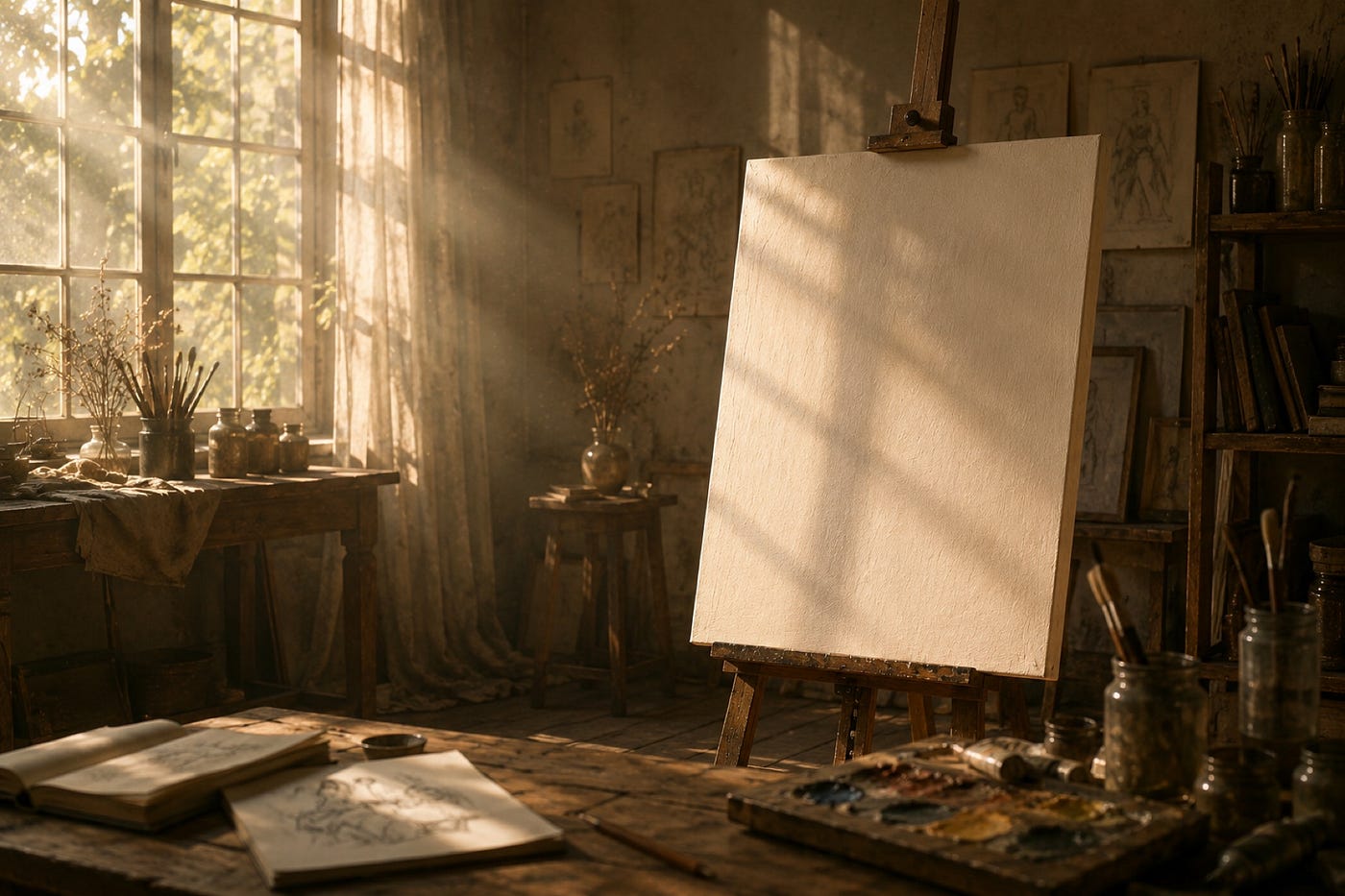
image created by author using AI
There is a canvas in a studio that has remained blank for eight months.
The painter knows what she wants to create. She has filled notebooks with sketches, researched techniques, bought the right materials, imagined the finished work a hundred different ways. She has prepared herself carefully for the moment she begins.
And yet each time she enters the studio, she looks at the empty canvas and turns toward something else.
When friends ask about the painting, she says she is almost ready.
She is not lying.
In every sense except the one that matters, she is almost ready.
The canvas is not waiting for her to become ready.
It is waiting for her to begin.
Most people recognise some version of this moment.
Not always in something dramatic or artistic. More often it appears quietly – in a conversation postponed for months, a book unwritten, a project endlessly researched, a life direction sensed but never fully entered.
We often interpret this hesitation as caution, intelligence, or discernment. There is, after all, something reasonable about wanting clarity before action. We want to begin well. We want certainty that what emerges will match what we imagined.
But creation rarely works this way.
Readiness is not what comes before the beginning.
Readiness is what the beginning creates.
This is one of the deepest insights hidden within the figure of Brahma. Not merely as a distant creator god from mythology, but as a psychological principle alive within human experience – the force that initiates movement where there was previously only possibility.
And initiation is rarely comfortable.
Something new rarely arrives feeling fully supported or complete. More often it appears as a fragile impulse, slightly premature, slightly exposed, asking for participation before confidence has arrived.
This is why beginnings feel so vulnerable.
The difficulty is usually not that we do not know what to do. The difficulty is that we are waiting for a future version of ourselves – someone wiser, calmer, more talented, more certain – to appear first.
But that version of the self is not discovered before the act.
It is formed through the act itself.
The first mark on the canvas is rarely elegant. The first draft rarely says exactly what we meant. The first attempt often feels embarrassingly small compared to the vision that inspired it.
And yet something irreversible happens in that first movement.
We shift from observer to participant.
From imagination to embodiment.
From endless possibility into living process.
Once that threshold is crossed, reality begins to answer back. What was abstract becomes tangible. What was distant becomes immediate. The work begins shaping the person creating it.
This is the real threshold of creation.
Not the moment when fear disappears, but the moment when movement becomes more important than certainty.
In this sense, Brahma is not only the god of creation.
He is the force that appears at the edge of every unwritten page, every unspoken truth, every life waiting to begin, asking the same difficult question:
Will you start?
메타데이터
- post_id
- 7d0bf89a44a1
- slug
- brahma-and-the-fear-of-getting-started-7d0bf89a44a1
- url
- https://medium.com/illumination/brahma-and-the-fear-of-getting-started-7d0bf89a44a1
- canonical_url
- https://medium.com/illumination/brahma-and-the-fear-of-getting-started-7d0bf89a44a1
- author_url
- https://medium.com/@suebushell
- status
- ok
- fetched_at
- 2026-06-09 15:37:30