PRICE TO PAY: The Commodification of Fitness in the Social Media Age
By: Myrrh Flores
PRICE TO PAY: The Commodification of Fitness in the Social Media Age
By: Myrrh Flores
MIAGAO, ILOILO — Every day, millions of people lace up their running shoes, sign up for gym memberships, and scroll through fitness influencers promising transformation. From gyms and boutique fitness studios to Instagram stories filled with smoothies and squats, the message seems clear: fitness is the path to a better you.
But what happens when this pursuit of “better” becomes a never-ending loop of dissatisfaction? Behind the motivational quotes, chiseled abs, and clean aesthetics lies a billion-dollar industry built on a quieter, more dangerous message: who you are now is not enough.
The fitness boom
The fitness industry has seen exponential growth over the past two decades. What was once a niche market–dominated by bodybuilding competitions and aerobics classes–has exploded into a sprawling economy. According to Statista (2025), the global fitness and health club industry in the Philippines is worth over PHP 477 million, with thousands of people paying for gym memberships, home workout subscriptions, supplements, and activewear.
The digital era only intensified this growth. The pandemic may have temporarily closed gyms, but it opened a new era of online fitness influencers, remote coaching programs, and app-based tracking tools. Movement, once personal and spontaneous, became content.
“The fitness industry thrives on creating a sense of urgency,” explains an anonymous marketing consultant who has worked with a fitness brand for a while. “We’re taught to tap into people’s insecurities and their desire to belong. The messaging is rarely ‘you’re fine as you are.’ It’s always ‘here’s what you could be.’”
When pressed about specific tactics, they become more candid about the psychological manipulation at work.
“Every campaign starts with identifying pain points,” they continue. “Are they unhappy with their appearance? Do they feel left behind? We create content that amplifies those feelings, then position our product as the solution. It’s Marketing 101, but in fitness, it’s particularly effective because health and appearance are so deeply personal,” they reveal.
Fitness was supposed to be primarily about health, now, it is increasingly synonymous with aesthetic goals: abs, glutes, waistlines, and weight loss.
Lendunn Nava, a personal coach, markets personal training as a must, or else you won’t achieve your goals, “Workouts that are self-aided or accompanied by YouTube also risk the chance of incorrect form, which can lead to misguided results”.
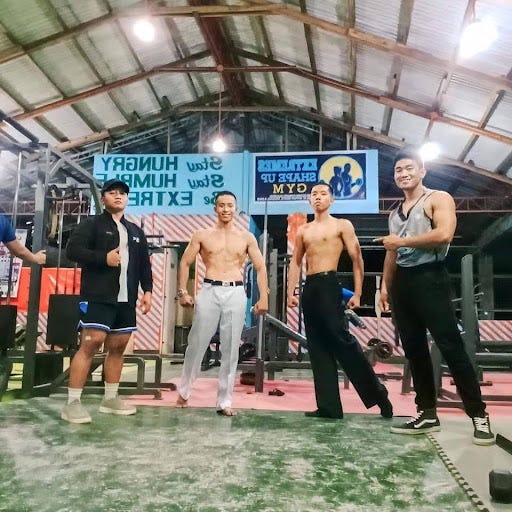
POSING FOR POSTING. Lendunn with gym regulars and some of his clients for personal coaching, flexing for the camera. Photo by Lendunn Nava.
Sometimes gyms bundle packages with supplements, or recommend gear. That’s part of the business too…every improvement needs a product to match.
Gyms as Temples
To understand how the average person experiences this industry, you only need to step inside a gym. For some, it’s a space of strength and stress relief. For others, it’s a pressure cooker of expectations and comparison.
“Going to the gym used to be my escape,” says Jessica Jaen, who identifies as a gym regular. “But it became an obsession. Missing a workout felt like failing myself. Even when I made progress, it was never enough. I was constantly buying more sessions, more supplements, better shoes, thinking that would finally make me feel satisfied…It didn’t.”
Jessica’s experience isn’t unique. Gym culture often thrives on continuous progress and that expectation can bleed into everyday life, influencing how we see ourselves and others.
Another gym-goer, Eusef Blancada, reflects a similar long-term entanglement between self-worth and fitness: “I’ve always been interested in fitness, starting with home workouts and having the goal of having visible abs ever since 8th grade.”
This early fixation with aesthetics, what bodies should look like rather than what they should feel like, can shape one’s relationship with fitness before it even begins. For Eusef, physical insecurity was a motivating factor, but the line between self-improvement and obsession blurred quickly.
He added, “At first it was just because I was super skinny and unhealthy–malnourished–due to the pandemic and my own lifestyle choices. [I] wanted to change for the better but eventually it evolved into a hobby and [a part of my lifestyle].”
Even what begins as a routine can quickly become a data-driven spiral for Eusef too, “I enjoy the numbers aspect of the gym. Tracking workout progressions, macronutrients, weight changes, basically the data. Seeing empirical data about what I do is also part of the motivation as it tells me that there’s opportunity to be better during the next session.”
In the commodified fitness landscape, progress is often quantified, not just in physical strength but in measurable stats. The body becomes a project to manage. Numbers are empowering, until they aren’t.
When goals aren’t met or the body resists control, anxiety, shame, and frustration often follow.
“There were so many things I did wrong just because I had a different and wrong mindset about fitness, I got fat because I wanted to be as jacked as possible in the shortest time possible, I lost my gains trying to get as lean as possible because I got fat…As a result I wasted substantial time and money in the process all because I wanted to be something ASAP,“ he added.
The hidden costs
Fitness is often sold as self-care, but for many, the experience brings emotional and financial strain. Gym memberships can be expensive, especially when tied to long-term contracts. Supplements and gear add up. Then there’s the mental toll, constant comparison, dissatisfaction, and the guilt of skipping a day.
“People don’t talk enough about the shame spiral,” says Jessica. “You skip one session, you feel bad. You look in the mirror and feel like all your progress is gone. It’s not healthy, but the culture makes you believe that the only way to be worthy is to keep pushing.”
And while fitness is often framed as a personal journey, it’s rarely free from the gaze of others.
“Some people can’t avoid ang mag-comment just because they think they’ve reached farther than you or achieved a certain level na. I actually experienced that some really look down on starters or beginners,” Lanelle Garces, an endurance athlete shared.
This cycle of shame and striving doesn’t only affect self-worth, it creates an ideal consumer. Someone always reaching, always needing more, and always not quite enough.
The marketing machine
Social media has amplified these dynamics. Platforms like Instagram and TikTok are flooded with fitness influencers offering tips, routines, and a curated glimpse into their disciplined lifestyles.
As these influencers grow their following, they often become the face of an industry that profits off insecurities. What was once seen as a personal pursuit of health now carries an added layer of marketability. Fitness is now a carefully crafted brand.
“Fitness became a lifestyle for me because of my husband. He really helped me a lot. Exercise is really important for our body, especially for muscles and blood circulation,” says Johanna Flores, a local fitness influencer, emphasizing a message that fitness is not just an individual pursuit but something to be shared, marketed, and modeled for others.
These influencers promote products, supplements, and services, turning their personal journeys into a profit-driven endeavor.

CHECK IT OUT. Johanna, a local influencer promoting supplement, workout equipment, and activewear on Facebook. Screenshot by Myrrh Flores.
“Someone approached me at church and told me how much they liked my posts. They encouraged me to promote fitness because it motivates people to exercise through fitness content,” she added. While these motivations seem genuine on the surface, the deeper truth is that their content is part of a broader marketing machine that thrives on engagement.
Johanna reiterates, “What I do in front of the screen online, I also do in reality. Even if there’s a yellow basket [or affiliate link] for the product used, it still encourages people [to exercise].”
The influencer’s fitness content becomes a vehicle for driving sales of the products they use, from gear to supplements, becoming a subtle promotion of consumerism
“Influencer marketing in fitness is incredibly lucrative because of the aspirational element,” shares the marketing consultant. “People buy into lifestyles. When an influencer with a perfect body promotes a supplement or workout program, followers believe they’re purchasing that transformation.”
The consultant reveals how these conversions are carefully orchestrated, exploiting moments of emotional vulnerability.
“The yellow basket links, the discount codes, the ‘swipe up’ features, they’re all strategically placed at moments of maximum vulnerability,” they add. “Right after showing a before-and-after photo, or during a motivational speech about change. It’s designed to convert inspiration into immediate purchase decisions.”
What’s most revealing is the data-driven approach to emotional manipulation.
“We track everything like engagement rates, conversion metrics, and even the emotional language that drives sales. Words like ‘transform,’ ‘unlock,’ and ‘unleash’ consistently outperform health-focused messaging. That tells you everything about what really moves this market,” they exclaim.
Different bodies, different stories
The polished surface of the fitness industry hides a more complex reality — where empowerment is often shadowed by insecurity. Jessica’s story is not unique, and others in the fitness space echo the same.
Endurance athlete Lanelle Garces shares how even practical choices (like buying shoes!) can be influenced by a deeper, more emotional pull.
“Sometimes, there’s this aspect or moment where I should get the new shoes because it would make me want to run even more… that I’ll be more motivated to run because I have these new shoes or gym set,” she says, pointing to how consumerism and motivation often become entangled.

RUNNER’S HIGH. Some endurance athletes fall prey to trends, rationalizing new products are necessities. Photo by Pavel1964.
Even within performance-driven spaces, aesthetic pressures linger.
“The endurance athlete community is affected by the same marketing tactics that focus on appearance rather than performance or well-being, definitely,” she adds, saying how there’s still athletes that get won over by aesthetics more than purpose.
Even trying out a new sport can spark a desire to visually ‘belong’. Lanelle shared when she was trying to get into golf, she fell into the rabbit hole of eyeing polo shirts, skirts, or golf clubs.
“When you’re starting to get into something new, you would want to look the part,” she explained.
She continues on how these pressures manifest in subtle yet persistent ways: “To me, the [industry] appeals to people’s insecurities or the urge of people to naturally look good while doing something even if they’re not that proficient in that aspect.”
Lanelle recounts experiences of seeing fellow runners obsess over gear and aesthetics, often prioritizing how they looked running over how they actually ran.
Ultimately, at the heart of it all is her question of value: “If you really want to spend so much on something, can you justify it? With the amount of interest, the amount of time, effort you put into it, will it be worth it?”
But what happens when people start asking this question more critically and they begin to challenge not just the price tags, but the entire system that made them feel inadequate in the first place?
Reclaiming fitness
But something’s changing. The pushback has been slow but noticeable. Movements like anti-diet culture and body-positive fitness are gaining traction. More people are questioning the hyper-commercialization of wellness, how products, programs, and platforms constantly sell the idea that fitness must be bought.
“While I did feel pressured in the past, [and] now really, I learned that rushing things won’t do you any good and that time is really one of the biggest factors in all of this,” says Eusef, who has spent years navigating the ups and downs of gym routines and personal goals.
But this realization often comes at a cost: financial, emotional, even physical. For some, it takes years of overtraining, overspending, or chasing unattainable bodies to finally let go of the hustle.
“Plateaus and regressions are normal because progress isn’t linear, it’s part of the journey and the key is to bounce back even stronger,” he adds. “Social media has a huge impact on my body dysmorphia. The best thing that I learned is that you shouldn’t compare yourself with anyone else. Nobody has the same circumstances. The only comparison you should make is you today and you in the past.”
Some choose to step away entirely from the pressures of the gym and refocus on movement for health, not appearance. It’s also about refusing to be treated as a customer first and a person second.
“I quit the gym more than a year ago,” says Aleona Gardose, someone who wanted to try the gym once but grew tired of the constant pressure. “Every time I walked in, I felt like I was being measured by the people inside and even by myself. It stopped being about trying to feel good and became this exhausting performance.”
For her, what replaced the gym was something simpler and more sustainable, movement on her own terms. No performances nor purchases.

GOOD FOR THE HEART. Aleona breaks away from the routine of gyms and embraces a less-pressuring form of exercise. Photo by Myrrh Flores.
“These days, I just walk. No tracking apps, no membership fees, nor step counters. Just me, the occasional stray dogs accompaniment, and the trees within my university. I’d walk for ten minutes, sometimes an hour. I stop when I want to stop,” Aleona adds.
There’s something quiet but powerful in that choice; to move without metrics and step outside for no reason other than the joy of it.
For a long time, fitness was framed as a war to be won, against fat, laziness, cravings, or even your own body; a war fueled by a market that profits from your self-doubt. As more people unlearn the noise of comparison and consumerism, fitness is starting to look less like a battleground and more like a playground.
There is no single right way to move. Exercise is turning into outlets for creativity, curiosity, or care. It can be dance tutorials from YouTube, yoga in pajamas, rave spin classes, or even just walking home after a long day at school.
For Aleona, Eusef, and many others, fitness doesn’t mean subscriptions or pushing through punishing routines anymore but about reclaiming movement as something freeing and intuitive.
Not something to buy into, but something to come home to. Something done not to earn your body, but to honor it.
In a culture that often equates worth with appearance, resisting the endless cycle of fitness consumerism can be a radical act of self-trust.
How do you think you could redefine fitness on your own terms?
#
메타데이터
- post_id
- 7d0d34ba002a
- slug
- price-to-pay-the-commodification-of-fitness-in-the-social-media-age-7d0d34ba002a
- url
- https://medium.com/@iwriteupv/price-to-pay-the-commodification-of-fitness-in-the-social-media-age-7d0d34ba002a
- canonical_url
- https://medium.com/@iwriteupv/price-to-pay-the-commodification-of-fitness-in-the-social-media-age-7d0d34ba002a
- author_url
- https://medium.com/@iwriteupv
- status
- ok
- fetched_at
- 2026-06-23 17:05:31