Interview Cheating Detection: How AI Ensures Fair Hiring
Remote hiring has increased the possibility of cheating more than ever before. Candidates can submit answers generated by artificial…
Interview Cheating Detection: How AI Ensures Fair Hiring
Remote hiring has increased the possibility of cheating more than ever before. Candidates can submit answers generated by artificial intelligence, get help from someone else, and even replace themselves in some instances. Gartner estimates that in the next five years, one out of four candidate profiles worldwide will be fabricated.
However, most hiring teams remain obsessed with protecting the assessment and take-home test stages while ignoring the interview stage, which becomes the weakest link of all.
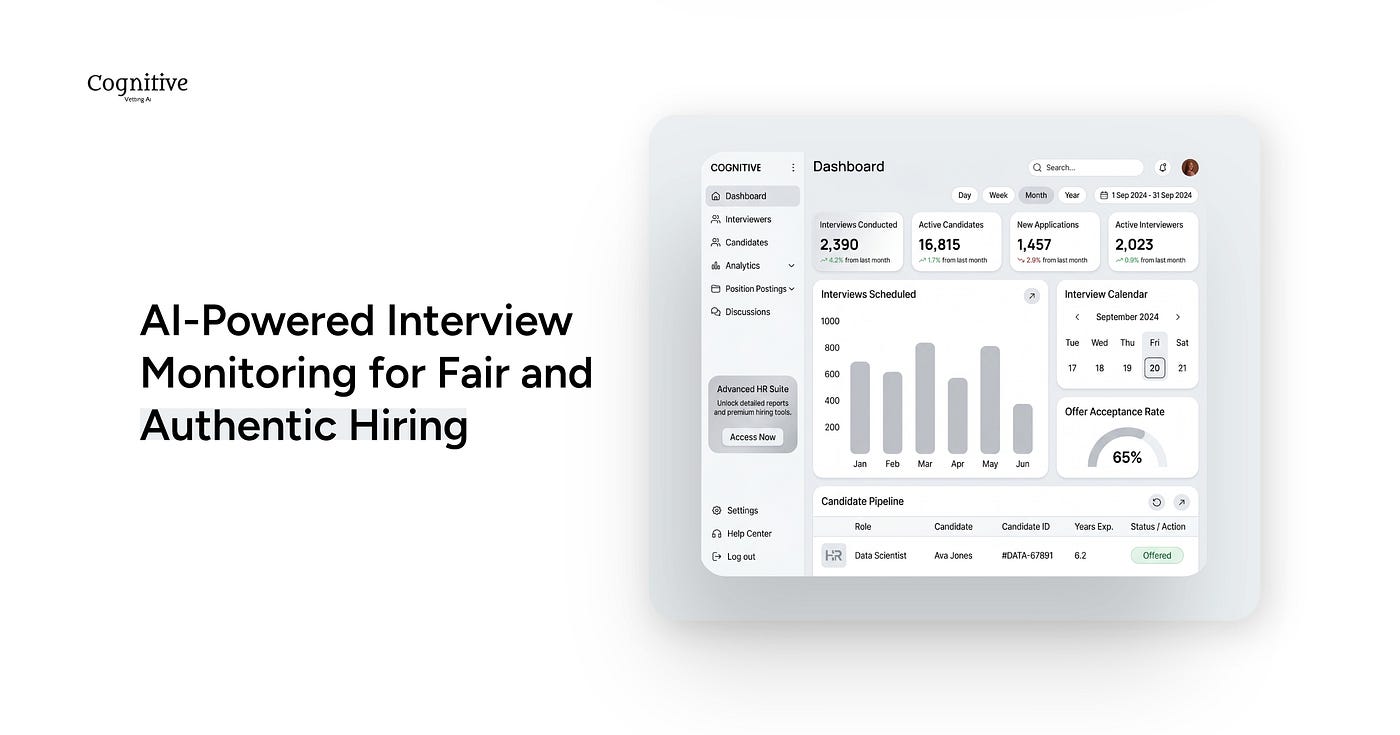
Modern interview cheating detection changes this. AI-powered conversational recruiting software now monitors behavioural signals in real time, flags integrity violations with timestamped evidence, and gives hiring teams a clear, auditable record of every session.
How Candidates Actually Cheat in AI Video Interviews
These are not exceptional examples. Dedicated apps for cheating in AI interviews have hundreds of thousands of users.
- Tab switching — Minimizing the AI interview window to open ChatGPT or pre-written answers. Takes a second and leaves no traces unless the activity is being monitored.
- Camera-off tricks — Turning off the camera to look into notes or consult the person on the other side of the table who presents it as a problem with internet connection.
- Earpieces — using an earpiece to provide an answer generated by the AI in real time. Interviewer sees a fluent, structured response that the candidate is just repeating.
- Scripted AI answers — pre-written answers that are sent quickly, sound professional, and can easily be proven wrong by a follow-up question that was not pre-written.
- Identity proxies — some other person is completing the test instead of the candidate, either physically present or doing it via video trickery.
- Browser extensions — browser add-on providing instant answers or hidden notes in the interview window.
The pattern linking all of these: a gap between performance in the interview and performance on the job. Interview cheating detection matters because that gap is invisible without it — until it’s too late.
What Interview Cheating Detection Actually Looks Like in 2026
Detection is not about monitoring the candidate. Detection is about making sure that all the relevant and factual information about what happened is available for the reviewers. Human is always in charge of the decision-making process. Not the data.
Below are examples of data monitored via active monitoring process:
- Tab switch detection — Each tab switch is documented along with the timestamp and then added as a clip for review.
- Camera off detection — Considered integrity signal and thus documented together with the exact moment when it occurred in the interview.
- Gaze and facial movements — Extended look away moments that are likely to indicate a behavior when a candidate looks at something else on another device are tracked and recorded.
- Response pattern analysis — Answers that stand out as too polished, too fast or too well-prepared are highlighted for the reviewer’s attention. Answers generated by AI have a particular texture that is different from live responses.
All flags become clips in the candidate’s scorecard along with the timestamps.
Anti-Fraud Built Into the Interview, Not Layered On Top
In most cases, the tools for monitoring interviews consider fraud detection as an additional stage that has been incorporated into the workflow. The right way is to have a structural solution, which means implementing integrity during the interview.
Conversational recruiting software does this in four ways:
- Timestamped integrity flags — Any tab switching, turning off the camera and looking away from it will be recorded and cut into the video candidate report automatically. No need to go through recordings in order to find anything.
- An AI that pushes back — In case of the lack of clarity in answers, AI asks follow-up questions. In case of scripted responses, it goes even further. Such responses can hardly survive during live discussion when the flow is adjusted based on the candidate’s words.
- Live, two-way conversation — Unlike the asynchronous video interviews in which the candidates are able to make several tries or take a break, the conversation with AI is live, which means the impossibility of consulting external sources.
- Scorecards tied to actual moments — Each score has its timestamp in the video. The fake fluency will be exposed due to lack of evidence in transcript.
Is Your Interview Process Actually Fraud-Proof?
Here are some queries you could pose about your current system:
- Are all tab switches and instances of camera-off being time-stamped and clipped, rather than simply counted?
- Does the AI generate follow-up questions based on answers, and therefore adaptively so that these cannot be anticipated beforehand?
- Is interviewing carried out live, two-way and not in asynchronous, submitted video?
- Are scorecards tied directly to video clips?
- Do flags for issues of integrity reach the reviewer for consideration, while the decision remains in the hands of the person?
- Is the process of anti-fraud monitoring built into the interview process, rather than superimposed onto it?
If your current process fails to do most of these things, then it is not catching cheating. It is simply hoping it’s not taking place.
The Bottom Line
Cheating detection in interviews is not a matter of mistrust but rather the integrity of a process that your recruitment decision hinges upon. In the event that you allow cheating during an interview to go unnoticed, everybody loses; from the team that requires the appropriate talent to the very same talented individual who missed out.
The most successful **conversational recruiting software** does not consider its fraud detection capabilities as something secondary. It makes honesty integral to every question, follow-up, and scorecard — hence every candidate gets the same treatment according to the same criteria with supporting evidence for every suggestion.
An interview that generates a poor signal too quickly is even worse than no interview at all.
메타데이터
- post_id
- 7d0df124c2bd
- slug
- interview-cheating-detection-how-ai-ensures-fair-hiring-7d0df124c2bd
- url
- https://medium.com/@growth_86840/interview-cheating-detection-how-ai-ensures-fair-hiring-7d0df124c2bd
- canonical_url
- https://medium.com/@growth_86840/interview-cheating-detection-how-ai-ensures-fair-hiring-7d0df124c2bd
- author_url
- https://medium.com/@growth_86840
- status
- ok
- fetched_at
- 2026-07-16 16:23:14