Why I Refuse Buying a New Car
I may have an old car that probably needs replacing but at least it doesn’t tell me what to do!
Why I Refuse Buying a New Car
Shôn Ellerton, July 26, 2026 I may have an old car that probably needs replacing but at least it doesn’t tell me what to do!
I grew up in the 80s, a time when, during your high school years, you could take a class in auto shop and fully understand how to take apart your car. From changing your carburettor to replacing the heater core under your dashboard. Our high school auto shop teacher first told us that real American muscle cars from the 1960s and the 70s were the best. Dodge Chargers, Ford Mustangs, Chevrolet Camaros, Plymouth Road Runners, Mercury Cougars, and so on. He hated anything to do with 1980s cars made in the Far East, calling them ‘rice grinders’. However, it so happened that many of these so-called ‘rice grinders’ turned out to be classics which lived forever and ever. Like Toyota Corollas surviving in the middle of the Saharan desert along with equally indestructible 1980s Mercedes-Benz 230Es, a car that I once owned while living in the United Kingdom during the 90s.
But something happened in the 80s. Cars turned out to be wimpy, boxy and boring. In fact, I would say, hands down, that the 80s spawned a new generation of the most hideous looking cars to date. Sure, they were functional, but my goodness, were they boring and ugly. The Ford Mustang was exciting during the 60s and 70s, but when my mum bought a 1980s Ford Mustang, it was the most uninspiring vehicle I set my eyes on from a manufacturer that once made iconic muscle cars. It was, as if it was designed for the 80s yuppie Nautilus gym-going big hair vegan Aquanet hairspray aerobics-going and Jane Fonda crowd. But saying that, some of these cars lasted for ages. Hundreds of thousands of miles on the clock and they still plod on. Like the aforementioned Toyota Corolla and the devastatingly ugly Volvo 200 series, a car so uninspiring that even the Swedish tradition of not wanting to brag, or what they call *Jantelagen*, has to be questioned in earnest.
From the 90s onwards, cars tended to become a little more elegant and pleasing to the eye. Not all, of course, but there was a general tendency to round off those boxy edges and streamline the body shape. This continued, somewhat, through the early 2000s to the mid-2010s, but something changed afterwards. Cars were forced to adopt a large number of safety features, warning systems, and sneaky in-built systems that drivers weren’t able to switch off or disable.
Enter the age of today’s new cars. A world of throw-away pieces of junk fitted out with an endless array of high-tech electronics which, if any part fails, sometimes renders the whole car absolutely useless.
I hate the world of modern cars of today with a passion.
The first thing that blows my mind is how anyone could find it financially viable to pay between $50k to $100k for a brand new, frankly ordinary, car.
I find this utterly insane.
Let’s take this in perspective.
I’ve had a number of used vehicles since I started driving at the age of sixteen.
A Volkswagen Rabbit, similar to a Golf. An old Mini Clubman. Two old Ford Granadas. A Citroen of a model I can’t remember. A Rover V8 SD1 which the UK police used to use. And a Mercedes Benz 230E, a car consisting of parts that could be found in your ordinary DIY store. Which explains their seemingly lifelong presence trundling around developing countries.
I give you an example.
I once needed to fix my headlight assembly and it came apart easily because it consisted of parts which were put together with screws and bolts that I could easily find in any hardware shop. The whole headlight unit was tightened with a couple of simple wingnuts. How good is that?
These days, if you have to fix any part of a headlight, you often have to throw away the whole unit and get a new one for a hefty price from the manufacturer because it comes as one whole piece which is hermitically sealed and unbreachable.
Some of my cars were hand-me-downs, while others were bought for less than a thousand quid. In any case, they worked until they either died of rust poisoning or I crashed them on the road.
The point is this. They were cheap and they did the job from getting me from A to B.
And this is the thing, touch wood. I have never broken down from some failure of the car apart from the occasional flat tyre. Mind you, I do keep a careful eye on oil and other fluid levels and have some inbuilt intuition that the car doesn’t seem quite right and needs a look into.
But returning to the subject of new cars. $50k to $100k for a car? You have got to be joking! I was playing around with ChatGPT the other day and searched for a reasonably thriving American city to live in with property at reasonable prices. Pittsburgh, a place I wouldn’t have thought of, came up high in the list. There, you can buy decent houses for around $150k, a vast sum of money some idiotic person living in Pittsburgh would get themselves into car debt purchasing a car at over half that price.
The instant that key is turned in a car, you’re on the steep downwards slippery slope of depreciation. I’ve amused myself watching YouTube videos of people getting themselves into car debt because they want to keep up with the Joneses by getting bigger and fancier cars they cannot afford.
I’ll place a caveat on those taking up new cars who might benefit from taking out a financially beneficial novated lease through a company or under a favourable lease package. It works for some but, of course, you don’t own the car.
Currently, I have a fading orange Holden Commodore SV6 of 2006 vintage which I purchased second-hand around 2009 or so. I love it to bits. It drives nice and with its 3.5 litre V6 engine, it can move pretty quick and effortlessly, unlike many of today’s wimpy new cars. Yes, it’s an old car but, considering its age, it just got to the 200,000 kilometre mark on the odometer. It’s had a few things replaced from time to time, but it’s still a very good car. My wife and mother want me to get rid of it suggesting that I deserve to get a new car.
Being open to new technologies, I thought I might try out some electric hybrid cars like those made by BYD and Great Wall Motors. My curiosity was piqued with the PHEV cars, those electric hybrid cars you can plug in, giving you a shorter range of travel running on battery before the petrol engine kicks in.
I booked an appointment to drive a BYD Sealion 6 and a Shark Ute. These are both PHEV, or plug-in electric vehicles.
On arrival at the dealership, a young man attended to me and he asked me what I was looking for. I explained my situation and was interested to know a bit more about plug-in electric hybrid cars. However, I also explained to him that I’m a bit ‘old school’ and want to disassociate myself with some of the ‘smarts’ embedded in the car.
The young man seemed to be old-school himself, judging from the computer mouse he was using which was in the shape of an old 1970s Holden classic car. He explained to me that the Australian government had placed a myriad of mandatory safety features on cars since 2025, some of them, utterly bewildering.
For example, with new cars in Australia these days, the manufacturer is required to implement Lane Keeping Assist which makes it possible for the car to detect lane markings and keep the car centred. Now let me say this. I do not want this feature. I tried it out in another vehicle and, on several occasions, it got ‘confused’ and tried to take me off the highway down an off-ramp. I asked the man there, can’t you just switch it off, to which he replied that you have to push a few buttons on the touch screen every time the car is started.
So, that did not wash well with me!
Here’s another gripe.
I want normal cruise control. In other words, the car just maintains the speed you select regardless of what’s around it. Adaptive cruise control can be handy for travelling on freeways with a moderate amount of traffic. For example, it will keep the selected speed of your car but if it comes towards a slower car in front of you, it will ‘back off’ until the car in front has either shifted to another lane or you move to a new one. But try using adaptive cruise control on a country road with soft curves overshadowed by trees on either side. I guarantee that at some point, the car’s sensors will freak out and suddenly cause the car to slow down because it confused the shadows and the curves. It happened to me several times and it really freaked me out. I’m sure sensors are getting better but I want the option to disable them.
Another thing which really irritates me about new cars is the feature set by manufacturers to disable cruise control if towing anything, even if it’s a small box trailer with a half-ton capacity. There are workarounds by fiddling around with the electric connection between the car and the trailer, but I shouldn’t have to do this. And the reason is this. Using adaptive cruise control with a trailer is certainly not advised but unfortunately, most new cars only have adaptive cruise control.
Cruise control is especially important for lessening the workload of driving for long-haul driving because, not only is it more relaxing, you don’t have to worry about keeping an eye on the speedometer to prevent enterprising cops looking for additional revenue. While towing, I use normal cruise control combined with using the manual option of the gearbox because I want full control of how the gears change on ascents and descents. Continuous automatic gear changes are not good on the overall life of the car’s transmission. In essence, while towing a trailer on long-haul drives, I tend to drive more like a truck driver or light-aircraft pilot sensing the revs of the engine and maintaining the gear changes myself. Without a trailer, I’m more than happy with full auto!
Before I continue, I have to mention a very funny book written in the 80s called Real Men Don’t Eat Quiche by Bruce Feirstein. This book contains a variety of phrases like ‘real men don’t ask directions’, ‘real men fix everything with duct tape and WD40’, and that sort of thing. But the funny one was ‘real men don’t drive stick shifts’.
Why?
Because real men are perfectly at ease with their car changing their gears for them!
And this is true. A lot of men, myself included, don’t like the inconvenience of manual shifting, but when it comes to pulling loads, four-wheel driving on tricky terrain, or some other requirement that requires careful handling of gear changes, we need manual control. But for most urbanites, this is unnecessary.
OK. It’s time to talk about the camera crap they put inside the car looking at you.
One of the most irksome experiences I had while renting one of today’s new cars was that I was constantly reminded to look ahead while using the lane assist feature. At first, the lane assist feature was useful to some extent on busier freeways; however, for some reason or another, the car’s computer kept reminding me to look at the road, which I was. At the same time, it shook the steering wheel to alert me. I kept shouting out loud, ‘Yes, I’m looking at the road!’ while flailing my hands for the camera to see me.
Thankfully, I had the option to turn that shit off.
Back to the salesman at BYD, I was curious to know what it felt like sitting inside one of their Sealion 6 cars. I had no intention of buying one, and the guy serving me knew as well. Hopefully he didn’t say it too loud but he said to me, ‘Yeah, these new and modern cars are not meant to be driven by real men.’
I wholeheartedly agreed. Modern cars are meant for those who don’t like driving anymore and, in a way, I don’t blame them. One minor infraction of the rules like accidentally being spotted moving your mobile phone, or eating in the car with one hand on the steering wheel and a Big Mac in the other, or being flashed by one of many thousands of speed cameras. There’s always a constant state of being paranoid of breaching one of these rules which seem to be made up on a daily basis.
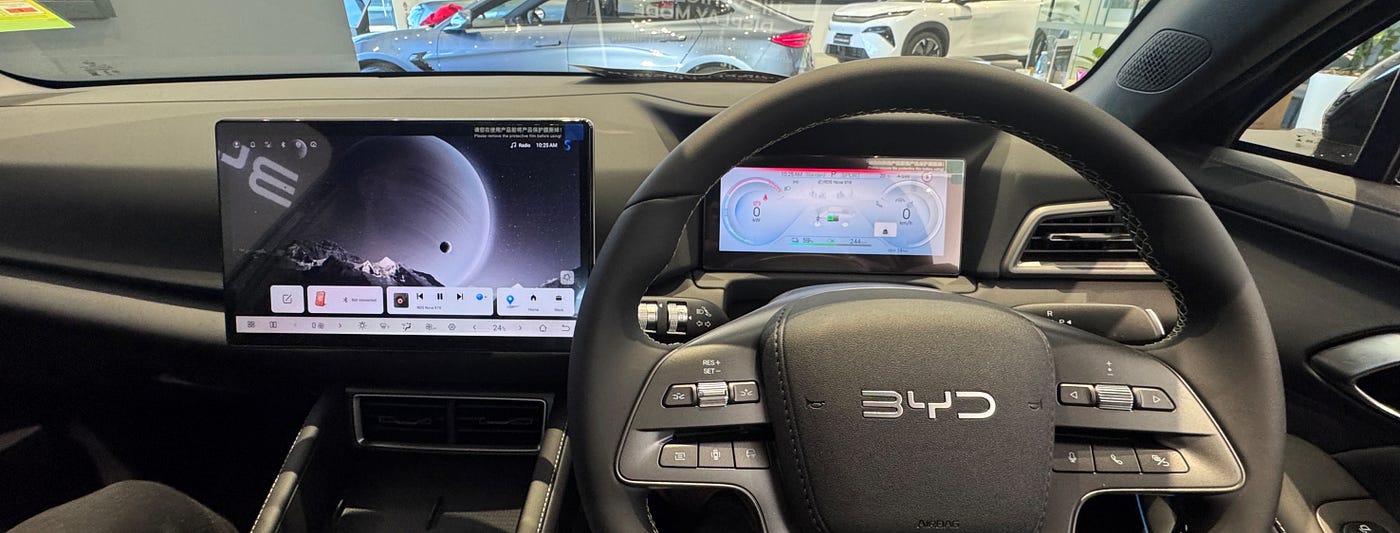
I sat in this car, and the first thing that struck me as being dead cert ugly and awful was being presented with a massive touchscreen right in the middle of the dash. As if someone stuck a giant iPad there.
I want none of this. I want buttons and knobs and stuff I can feel while my eyes are on the goddamned road! Seriously, the morons who thought it would be space age and cool to use touchscreen apps on a car to control basic shit like A/C and the radio have their heads utterly unscrewed. Safety in using touchscreen icons on a glued iPad to your dash? Insane.
Another thing.
I do not like being tracked. I want none of the bullshit technology that gathers data about what you are doing. If I ever had the misfortune of getting a car which has all this crap, the first thing I’d do is jailbreak and disarm it. I suppose that would invalidate the warranty which, in any case, the first day after expiration, the car would be designed to fail anyway necessitating the need to buy a new car all over again.
Seat belt warnings piss me off as well. My Commodore does warn you if anyone in the front seats is not wearing a belt, but only for a short time. For example, I could be slowly trundling up a private farm road stopping from time to time to, I don’t know, take photos, or do something that requires stopping all the time. Try doing that in a new car of today. You’d get your car in a state of hysteria by not putting on your seat belts. I wouldn’t be surprised if some cars had it programmed in them to punish you by not being able to start your car again without your seat belt on.
Modern cars also warn you incessantly if the rear seat passengers are not wearing their seatbelts. And yet, for some inexplicable reason, I can walk around inside a public bus travelling at 80 km/h on a freeway. Someone, please give me the logic behind this one.
What I like about my ‘ancient’ Commodore SV6 is this. It has none of these awful safety features which the Australian government insists we have built in. It’s just a car that is nice to drive, has basic cruise control, has a good gearbox that I can switch to manual if needed. It has traction control which I switch off and it has safety air bags which I could choose not to be activated if I really wanted to. It’s got proper knobs and buttons and I can feel my way around them without looking. For long drives in the country, someone can lie down across the rear seats without being constantly reminded by the Seat Belt Nazi Machine to sit down properly in your seat and buckle up.
I come from the generation that was raised where you can sit in the back of a pick-up truck. Not have your seat belts on, although we all thought it wise to do so, especially in the front seats. We had control over our own car. I guess this sort of car is what I consider a real man’s car!
To cap this off, there is a very funny story about Chinese cars locking their drivers inside their cars if they broke the law and then self-driving them to the police station.
Funny as hell in a Terry Gilliam’s film sort of way, but ultimately urban myth.
As you may deduce, I won’t be out shopping for a new car. I’m past it. I’m old school. I don’t need all the tech. I don’t need to be told what to do by my car. I refuse to be tracked by Big Brother.
So, for those car dealers trying to push their new cars struggling for sales, your best bet is to team up together and challenge the government’s strict rulings on what must be built into a today’s new car.
Because, these days, only ignorant muppets, later to regret buying a new car, will be your customers.
메타데이터
- post_id
- 7d1b64ea04e3
- slug
- why-i-refuse-buying-a-new-car-7d1b64ea04e3
- url
- https://medium.com/ironkeel/why-i-refuse-buying-a-new-car-7d1b64ea04e3
- canonical_url
- https://medium.com/ironkeel/why-i-refuse-buying-a-new-car-7d1b64ea04e3
- author_url
- https://medium.com/@shonellerton
- status
- ok
- fetched_at
- 2026-08-08 13:46:47