End of the Republic Part II: Collapse of Empire
INTRODUCTION:
End of the Republic Part II: Collapse of Empire
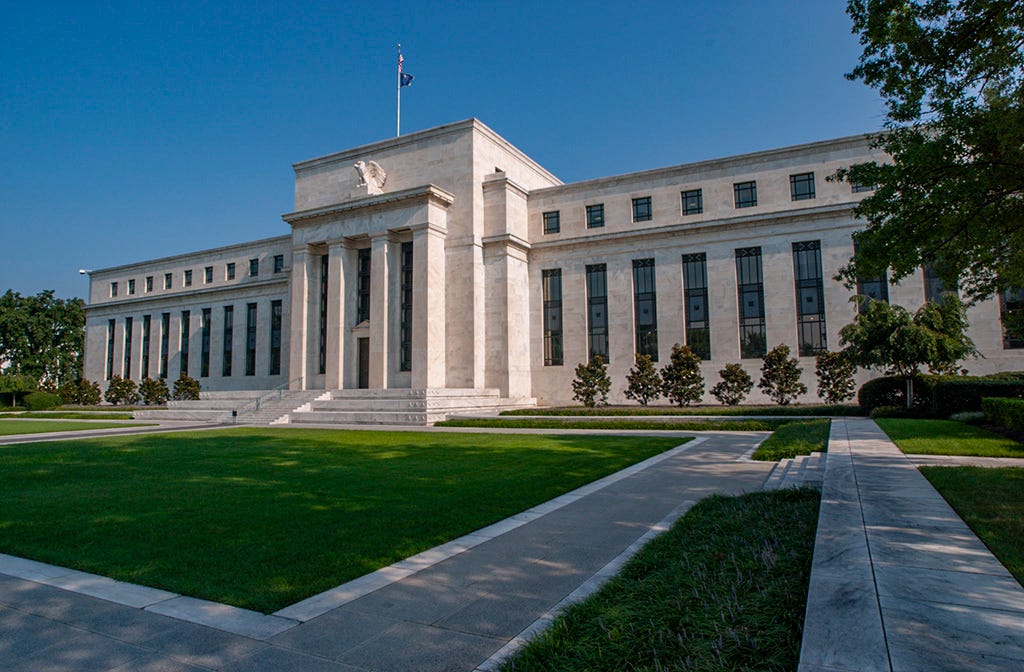
Marriner S. Eccles Federal Reserve Board Building
INTRODUCTION:
The United States has a staggering national debt that exceeds $36 trillion and is projected to increase by an additional $20 trillion over the next decade. This figure does not account for unfunded liabilities — particularly Medicare and Social Security — which are expected to total approximately $78 trillion over the next 75 years. Furthermore, the US debt-to-GDP ratio has reached 123% and continues to rise. A clear signal of growing fiscal instability.
In response to these economic challenges, President Donald J. Trump has adopted a confrontational stance on international trade, frequently and erroneously attributing America’s economic decline to foreign actors — most notably China — whom he accused of exploiting US markets. His administration’s tariffs on key global trade partners are framed as a corrective measure to address trade imbalances, revitalize domestic manufacturing, generate employment, and preserve the dollar’s role as the world’s reserve currency.
However, a closer examination of the post-World War II global monetary architecture reveals that many of the nation’s economic difficulties are largely self-inflicted. While the US dollar’s role as the global reserve currency confers certain advantages, it also imposes significant structural burdens on the domestic economy. Moreover, over the past four decades, American political and economic elites have embraced a neoliberal policy framework that has systematically undermined labor, weakened the working class, and contributed to deindustrialization. In parallel, the strategic use — or “weaponization” — of the dollar and international trade mechanisms has further exacerbated global tensions and accelerated the decline of American hegemony.
Whether the United States can endure these economic and political pressures without compromising the integrity of its democratic institutions remains an open and pressing question.
BRETTON WOODS
Nestled away in the White Mountains of New Hampshire lies Bretton Woods, a quiet area in the town of Caroll. In July 1944, as the Axis powers’ defeat in World War II was imminent, forty-four nations met at the Mount Washington Hotel to restructure the international monetary order.
It is instructive to note that the United States was the undisputed global economic superpower by the end of the Second World War. The destruction of the infrastructure of both Europe and Asia gave the US manufacturing supremacy. The US accounted for approximately half of the world’s industrial output, producing vast quantities of goods, machinery, vehicles, and weaponry. The US also held about two-thirds of the world’s gold reserves, reinforcing the dollar’s strength and suitability as a global anchor.
Key features of what is now known as the Bretton Woods Conference were the creation of international institutions — the International Monetary Fund (IMF) to ensure global monetary cooperation and provide financial support to countries facing balance-of-payment issues and the World Bank (then International Bank for Reconstruction and Development — IBRD) — to fund post-war reconstruction and development projects in poorer countries.
It should be noted, the International Monetary Fund (IMF) and the World Bank are frequently perceived as instruments of the neoliberal agenda. One can argue that these institutions function as extensions of US geopolitical influence, in alignment with broader strategic and economic interests. Consequently, they are often regarded as mechanisms of structural oppression rather than agents of global development and equity.
Additionally, a fixed exchange rate system was created where member currencies were pegged to the US dollar, which in turn was convertible to gold at $35 per ounce. And most prominently, the US Dollar became the world’s primary reserve currency, effectively replacing the British pound. There was push-back.
Prominent economist John Maynard Keynes, representing the UK, proposed an alternative to the dollar-based system. He proposed a global reserve currency called the “Bancor”, managed by an international clearing union. The main idea was to avoid imbalances by penalizing both creditor and debtor nations. Surplus countries like the US would have to spend or lend their surpluses and deficit countries would be given time and support to balance their trade. This idea was flatly rejected by the US.
Years later, economist Robert Triffin would remind the world of a fundamental flaw in the Bretton Woods system. He basically stated that for the dollar to serve as the global reserve currency, the US had to run trade deficits to supply dollars to the world. However, persistent deficits would eventually undermine confidence in the dollar’s value and its convertibility to gold. This paradox became known as the Triffin Dilemma.
Over time, the United States began running large trade deficits and printing more dollars to fund programs like the Vietnam War and the Great Society initiatives. This led to a surplus of dollars globally, raising doubts about the US’s ability to maintain the gold peg. As mentioned previously, under the Bretton Woods system, countries could exchange their US dollar reserves for gold from the US Treasury.
Countries, especially France under President Charles de Gaulle, began viewing the dollar’s privileged status as a form of American monetary imperialism. One French official referred to it as an “exorbitant privilege.” De Gaulle also began to doubt the dollar’s value and started demanding gold in exchange for their dollar reserves. In early August 1971, a French warship was sent to New York Harbor to retrieve French gold stored at the New York Federal Reserve Bank. By the late 1960s and early 1970s, the US gold reserves were dwindling as more countries requested redemptions.
THE NIXON SHOCK
To stop the depletion of US gold reserves and prevent a run on the dollar, President Nixon, on August 15, 1971, “temporarily” suspended the convertibility of the US dollar into gold, meaning foreign governments could no longer convert dollars into gold. Nixon’s actions, known as the “Nixon Shock,” meant the US reneged on the Bretton Woods agreement. His actions effectively marked the end of the Bretton Woods system and ushered in the current fiat global monetary system, where money is backed only by government decree and not by a physical commodity like gold.
Nixon’s decision to decouple the dollar from gold gave the Federal Reserve (America’s central bank) more control over monetary policy. The Federal Reserve could now print money without being constrained by gold reserves. Gold, in effect, served as a chaperone for the global monetary system. While removing this critical guardrail allowed for more flexible responses to economic crises, it also introduced a greater risk of inflation, since there was no hard limit on how much money could be created.
THE POWELL MEMO:
Officially titled “Attack on American Free Enterprise System,” the “Powell Memo” was a confidential memorandum written in 1971 by Lewis F. Powell Jr., a corporate lawyer and future Supreme Court Justice. It was addressed to the US Chamber of Commerce and laid out a blueprint for how American business should respond to what Powell perceived as growing threats from liberal intellectuals, media, and government regulation.
The memo’s key points were that the American free enterprise system was under siege — not by foreign enemies, but from within, especially from colleges, the media, and consumer/environmental advocacy groups, and therefore it urged the corporate community to organize politically, intellectually, and culturally to defend capitalism. This included funding pro-business think tanks, media, academic work, and influencing education and judicial appointments. The memo also encouraged investing in lobbying and political action to influence regulation and legislation. As a long-term strategy, the memo stressed a sustained, well-funded, and coordinated effort to shift public opinion and policy in favor of business interests.
NEOLIBERALISM:
Neoliberalism is an economic philosophy that emphasizes free markets, deregulation, limited government, tax cuts, and individual responsibility. The Powell Memo helped set the ideological and institutional groundwork for this shift by reframing capitalism as under threat and needing defense and promoting market solutions over government intervention. This led to the deregulation and privatization during the Reagan and Thatcher eras of the 1980s and early 1990s.
Corporate political influence also grew dramatically, helping to roll back environmental and labor regulations. Conservative legal organizations like the Federalist Society grew, aiming to place pro-business judges in the courts. In effect, the Powell Memo bridged the post–New Deal consensus — where government played a central economic role — to a new era dominated by corporate power and market-oriented governance.
DEINDUSTRIALIZATION AND NEOLIBERALISM
Under neoliberal policies, deindustrialization — the decline of manufacturing industries in advanced economies — accelerated rapidly. Those governments, influenced by neoliberal ideology, favored services and finance over heavy industry. The opening of markets, tax incentives for outsourcing, and weakening of labor protections made it easier and more profitable for corporations to offshore manufacturing jobs to lower-wage countries.
The impact was predictable. The US, UK, and other Western nations saw the shuttering of factories, especially in traditional manufacturing regions like the US Midwest and Northern England. Job losses hit working-class communities, especially those in steel, auto, and textiles. Economic inequality widened as unionized, well-paid jobs disappeared and were replaced with lower-wage service jobs.
Neoliberalism also contributed to the decline of private-sector union membership, which had been a cornerstone of the mid-20th-century working class. Union-busting became common practice in the private sector. Legislation and court rulings often favored employers and weakened collective bargaining rights. The share of unionized workers in the private sector in the US dropped from about 35% in the 1950s to less than 7% today. With weaker unions, wages stagnated, workplace protections eroded, and the political influence of labor declined.
TRADE AGREEMENTS AND GLOBALIZATION
Several trade agreements, rooted in neoliberal ideals, facilitated the globalization of production and trade including North American Free Trade Agreement (NAFTA). This agreement came about in 1994. It was an agreement between the US, Mexico, and Canada. It eliminated most tariffs between the countries. It encouraged US companies to relocate manufacturing to Mexico, where labor was cheaper. This resulted in major job losses in US manufacturing, while agriculture and industry in Mexico also saw disruptions, fueling migration.
The World Trade Organization, created in 1995, replaced the General Agreement on Tariffs and Trade (GATT) and provided a rules-based global trade system. It also strengthened corporate rights to sue governments over regulations seen as “trade barriers,” and it facilitated the massive expansion of global trade, particularly in manufactured goods from developing nations.
The Trans-Pacific Partnership (TPP) was a proposed trade deal among 12 Pacific Rim countries. It was aimed at countering China’s growing influence. While it was signed but never ratified by the US, it supported outsourcing jobs and favoring multinational corporations.
DEINDUSTRIALIZATION AND THE RISE OF CHINA:
US-sponsored neoliberal trade policies directly contributed to the rapid industrialization of China. After joining the WTO in 2001, China became the “world’s factory”, attracting massive foreign investment and becoming a global export powerhouse. US and European firms offshored production to China to exploit lower labor costs and loose regulations. China used this influx of capital and technology to build domestic manufacturing capacity and lift hundreds of millions out of poverty. At the same time, Western economies experienced wage stagnation, especially for blue-collar workers, and rising inequality, as capital gains and high-end service sectors flourished while manufacturing declined.
FROM MAOISM TO MARKET SOCIALISM:
After the death of Mao Zedong, China’s economy was stagnant, centrally planned, and largely isolated. In 1978, under the leadership of Deng Xiaoping, China shifted to a new model: “socialism with Chinese characteristics.” Key reforms included decollectivizing agriculture and allowing farmers to sell surplus crops, opening up to foreign investment, creating Special Economic Zones (SEZs) that allowed free-market experimentation, and permitting private enterprise alongside state-owned firms.
This model preserved state control in strategic sectors (like banking, energy, and infrastructure) while allowing the market to allocate resources to others. The result was an explosion of economic activity. China’s GDP grew at an average of 9–10% annually for decades. It became the world’s second-largest economy and the global manufacturing hub. This growth fueled urbanization, infrastructure development, and job creation.
China’s economic transformation lifted over 800 million people out of extreme poverty, according to the World Bank. Rural reforms increased farm productivity and incomes. Industrialization absorbed surplus rural labor, offering higher-paying urban jobs. Targeted poverty alleviation programs in the 2010s focused on remote, disadvantaged regions. Infrastructure investment connected rural areas to economic centers. By 2020, China officially declared it had eradicated extreme poverty (defined domestically), though income inequality and relative poverty remain concerns.
Unlike in fully liberalized economies, China’s government maintained tight control over macroeconomic policy. State-owned banks directed investment into infrastructure and priority industries. The government coordinated long-term development goals. Education, healthcare, and housing subsidies helped stabilize the population during rapid change. This state-guided capitalism ensured that growth translated, at least in part, into broad-based development.
China’s approach contrasts with neoliberal development models, which emphasize full privatization, minimal state intervention, and rapid deregulation and liberalization. It is important to note that many developing countries that followed neoliberal prescriptions saw slower growth, greater inequality, and less poverty alleviation than China. China’s success suggests that a mixed model — market incentives within a strong state framework — can be more effective at improving mass living standards.
NEOLIBERALISM AND US FISCAL POLICY:
Neoliberalism has played a significant role in shaping US fiscal policy, including contributing to the massive increase in national debt. Though neoliberalism emphasizes limited government, deregulation, free markets, and reduced public spending, its real-world implementation — particularly in the US — often contradicted these ideals, especially when it came to military spending and tax policy.
Under neoliberal influence, US policymakers pursued significant tax cuts, particularly for corporations and the wealthy, under the theory of supply-side economics (trickle-down theory). Key examples include the Reagan tax cuts (1981, 1986). These dramatically reduced top-income tax rates while federal spending (especially on defense) increased. The Bush tax cuts (2001, 2003) further reduced tax burdens, especially on capital gains, dividends, and high-income earners. And the Trump tax cuts (2017), which cut the corporate tax rate from 35% to 21%, led to increased deficits despite promises of growth.
These tax policies, while aligned with neoliberal goals of stimulating investment, reduced federal revenue and significantly increased the national debt, particularly when not offset by spending cuts.
Neoliberal policies also contributed to financial deregulation, which played a major role in the 2008 financial collapse. In response, the government spent trillions in bailouts and stimulus packages — funded by debt — to stabilize the economy. These interventions were necessary but contradicted neoliberal ideas of limited government, showing the inconsistency between ideology and practice.
Although neoliberalism emphasizes free trade and economic integration, in practice, it has often been associated with military interventions that supported US global economic dominance. Wars and interventions aimed at securing global markets and geopolitical power contributed heavily to debt. For example, the Iraq War (2003) — often linked to strategic interests in oil and the Middle East- cost over $2 trillion. The Afghanistan War (2001–2021) — justified by security concerns but also part of broader US efforts to stabilize regions key to global markets. And of course, Libya (2011) and Syria (post-2011) — though more multilateral, these interventions reflect a broader neoliberal foreign policy strategy of opening markets and securing strategic influence. The total cost of US post-9/11 wars is estimated at over $8 trillion, with much of it financed through borrowing.
CONTRADICTIONS OF NEOLIBERALISM AND DEBT GROWTH:
While neoliberalism advocates fiscal restraint, in practice it led to tax cuts without spending cuts; rising military expenditures; bailouts of large financial institutions and privatization schemes that sometimes increased public liabilities. These policies shifted public wealth to private hands and required increased borrowing to maintain federal obligations — contributing to the national debt, which now exceeds $36 trillion.
Neoliberalism has played a central role in the rise of student and household debt in the United States, reshaping education, housing, and consumer finance through deregulation, privatization, and a shift in responsibility from the state to the individual. As a result, individuals were increasingly expected to finance their education, homes, and lifestyles through debt, rather than through public support.
Under neoliberalism, the cost of college shifted from the state to the student. Starting in the 1980s and accelerating in the 1990s and 2000s, state and federal governments cut funding to public universities. Colleges responded by raising tuition, transferring the burden to students. In place of grants and subsidies, the federal government expanded student loan programs. Today, over 45 million Americans owe more than $1.7 trillion in student debt.
Colleges adopted corporate models, emphasizing revenue generation, branding, and expansion. Degrees were marketed as private goods for career advancement, rather than public goods for civic life. This, of course, aligns with neoliberal logic: education is an individual investment in human capital, and the risks (debt) are borne by the individual, not the state.
Neoliberal deregulation also encouraged the financialization of everyday life, making credit central to maintaining a middle-class lifestyle even as wages stagnated. While real wages for most Americans have stagnated since the 1970s, the cost of healthcare, housing, and education rose. Households turned to credit cards, mortgages, and personal loans to fill the gap.
The 1980s and 1990s saw major deregulation of the banking and credit sectors. Subprime lending, payday loans, and risky mortgage products proliferated. This culminated in the 2008 financial crisis, which was rooted in unsustainable household debt, especially in housing. Total US household debt now exceeds $17 trillion, with rising burdens in credit cards, auto loans, and student loans.
A key feature of neoliberalism is the privatization of risk. Under earlier economic models, the state provided public safety nets (free or low-cost education, affordable housing, and healthcare). Neoliberalism offloaded these responsibilities, leaving individuals to self-finance through debt. This model disproportionately impacts young people (burdened by student loans), low-income households (targeted by predatory lenders), and communities of color, who often face structural barriers to wealth accumulation and are more likely to rely on debt.
THE ILLUSION OF REINDUSTRIALIZATION IN THE UNITED STATES:
Reindustrializing the United States — bringing back robust domestic manufacturing — faces major structural, political, economic, and cultural challenges despite renewed interest driven by supply chain concerns, national security, and economic inequality. The key difficulties rest with globalized supply chains. Over the decades, US manufacturers have offshore production to countries with cheaper labor, especially China, Mexico, and Southeast Asia. Many critical products — such as semiconductors, electronics, and pharmaceuticals — now rely on complex global supply chains that cannot be easily or quickly reshored. Even if final assembly returns to the US, components and raw materials are often sourced abroad.
Additionally, deindustrialization hollowed out entire industrial regions (e.g., the Rust Belt). The skilled labor force that once powered US manufacturing — toolmakers, machinists, welders — has declined significantly. Vocational training and apprenticeships were dismantled or deprioritized in favor of college-prep education. Once disrupted, industrial ecosystems (including suppliers, logistics, and R&D hubs) are very difficult to rebuild.
The cost of labor and capital also serves as an impediment to reshoring. US labor is much more expensive than in many manufacturing-heavy countries. Environmental regulations, worker protections, and union wages, though socially beneficial, raise production costs. Many companies are reluctant to invest in US plants without subsidies or major tax incentives.
Further, US corporations operate under a profit-maximization model driven by quarterly earnings and shareholder returns. Offshoring and financial engineering (e.g., stock buybacks) often yield higher returns than long-term investments in domestic factories. Without structural change to corporate governance or trade policy, firms have little reason to choose US production over cheaper alternatives abroad.
And speaking of trade policy, for decades, US trade policy was shaped by neoliberal free trade ideology, which facilitated offshoring but failed to protect domestic industries from unfair competition (e.g., state-subsidized production in China). NAFTA, WTO membership for China, and similar policies opened US markets while failing to secure labor or environmental protections abroad.
Other barriers include inadequate infrastructure and investment, cultural and political divides, and environmental and climate considerations. The US suffers from underinvestment in infrastructure, including ports, rail, power grids, and broadband, which are critical for industrial efficiency. Public investment in R&D, training, and industrial policy has lagged far behind countries like China, Germany, or South Korea.
US politics is deeply divided over the role of government in the economy. Many associate industrial policy or large-scale public investment with “big government”, leading to resistance to subsidies, mandates, or state planning. There is also a generational and cultural shift toward digital, service-oriented careers, with manufacturing often seen as “dirty” or outdated.
Modern reindustrialization must be green and sustainable, requiring advanced technology, regulation, and investment in clean energy and emissions controls.
A FALSE NARRATIVE:
The belief that “China has been ripping off the U.S.” is a politically charged claim that misrepresents the nature of global trade, economics, and the U.S.-China relationship. While there are legitimate concerns about trade imbalances and intellectual property (IP), the idea that China’s success is due to theft or manipulation — rather than US policy choices and global capitalism — is factually misleading. Furthermore, tariffs are not a meaningful tool for reducing the US national debt and often create economic harm at home.
The US runs a trade deficit with China (it imports more than it exports), but this is not theft. It reflects US consumer demand for cheaper goods and the offshoring of manufacturing. The US chooses to buy from China because it’s cost-effective, not because China is “stealing.” As for trade deficits — they are not inherently bad — they’re the result of macroeconomic choices, including low US savings rates and the strong dollar, which makes imports cheaper.
We must also keep in mind under the neoliberal model many American firms voluntarily outsourced jobs and supply chains to China to cut costs and increase profits — not because China forced them. This offshoring was a result of corporate decisions and US free trade policies, not Chinese exploitation.
And yes, while Intellectual Property (IP) Issues exist, they are overstated. While IP theft and forced tech transfer have been legitimate concerns in the past, China has improved protections in recent years under pressure from the US and the WTO. Many US companies willingly shared technology in exchange for market access — a business choice, not coercion. China is now producing significant homegrown innovation, reducing its dependence on foreign IP.
In the final analysis China became a major exporter by playing the long game. China invested heavily in education, infrastructure, manufacturing, and technology, and used state-led capitalism to support its industries. The US, meanwhile, deindustrialized and prioritized finance, consumption, and shareholder profits. China’s rise reflects strategic planning more than exploitation.
TARIFFS WON’T FIX THE DEBT:
Tariffs on Chinese goods are paid by US importers and consumers, not China. Tariffs are taxes on the American consumer. They increase the price of goods in the US, hurting households and businesses, especially in industries reliant on global supply chains. Even at their peak during Trump’s first term, tariffs generated about $70–80 billion per year — a tiny fraction of the multi-trillion national debt. Finally, tariffs slow economic growth by increasing costs and disrupting trade. Slower growth leads to lower tax revenues, which can actually worsen the debt-to-GDP ratio over time.
END OF EMPIRE:
The end of American hegemony is no longer a fringe theory but a serious topic among economists, historians, and geopolitical analysts. While the US remains a global power, several converging forces — including the fragility of the US bond market, rising interest payments on the national debt, de-dollarization, and the rise of BRICS and other multipolar institutions — are eroding the core pillars of US dominance.
The US bond market, particularly Treasury securities, has long been the backbone of the global financial system. It allows the US to borrow cheaply and run deficits without immediate consequences. It underpins global central bank reserves, foreign exchange markets, and international trade.
But today, this system is under pressure. The US national debt is now over $36 trillion. Debt-to-GDP ratio is above 120%, levels typically associated with economic distress. Investors are growing wary of the US fiscal path, especially with rising entitlement costs, political gridlock, and tax cuts.
The interest payment on the national debt surpassed $1 trillion in 2024, exceeding defense spending, which is around $850 billion. This means the US government now spends more on servicing past debt than on maintaining global military supremacy. This trend is unsustainable and crowds out future investments in infrastructure, education, and security.
Foreign holdings of US Treasuries are declining, particularly among China, Japan, and oil-rich Gulf states. While China can very easily dump US Treasuries, it has to take a measured approach. A reckless dumping of Treasuries can upend the global economy and cause yields to rise, which will directly impact Treasuries still held by China. However, the fact remains that China is de-dollarizing. Nonetheless, as global diversification continues, the US may be forced to raise interest rates further to attract buyers, worsening debt service costs.
The US dollar’s role as the world’s reserve currency gave America unparalleled economic leverage — but it’s now being challenged. Nations simply do not trust the US. The US has increasingly used the dollar system as a geopolitical weapon (e.g., freezing approximately 300 billion in Russian sovereign assets, including $67 billion in US dollar reserves held by the Central Bank of Russia). Sanctions against Russia (a nuclear power), Iran and Venezuela have alarmed other countries, encouraging them to seek alternative currencies and payment systems.
Nations are trading in local currencies (e.g., China-Russia in yuan/rubles; India-Iran in rupees). China’s CIPS (Cross-Border Interbank Payment System) offers a non-SWIFT mechanism for yuan-based trade. Central banks globally are reducing dollar holdings and stockpiling gold. Oil and commodities are increasingly priced in other currencies (e.g., yuan-based oil contracts between China and Gulf nations).
The Rise of the BRICS bloc (Brazil, Russia, India, China, South Africa), recently expanded to include new members like Iran, Egypt, and Saudi Arabia, aims to: challenge Western financial institutions like the IMF and World Bank; create new currency arrangements and alternatives to the dollar (e.g., a BRICS currency backed by commodities) and coordinate on trade, investment, and development without US oversight. Though still fragmented, BRICS represents a growing consensus among the Global South — the desire for a less U.S.-centric global order.
America’s hegemony isn’t collapsing overnight — but it’s deteriorating by attrition. In the US a tiny elite (billionaires, large shareholders, corporate executives) controls a disproportionate share of wealth. Wages for workers have stagnated, while CEO pay, and asset values (stocks, real estate) have soared. Social mobility declines, and intergenerational wealth gaps widen.
The economy has shifted from productive industry (making goods) to finance, speculation, and debt. Corporations make more profit through stock buybacks, rent-seeking, and asset bubbles than through innovation or labor. Markets have become separated from real economic needs, creating instability and frequent crashes.
A few multinational corporations dominate key industries, including tech, healthcare, media, agriculture, and energy. These firms wield more influence than many governments, in shaping laws, regulations, and even public discourse. Small businesses and independent producers struggle to survive.
Stable, long-term jobs with benefits are replaced by gig work, contract labor, and part-time jobs. Workers have little job security, no collective bargaining power, and are treated as disposable. Union membership continues to decline in the private sector.
Health, education, housing, water, and even personal data are turned into profit-generating commodities. Human needs are secondary to market logic — if you can’t pay, you go without. This drives up student debt, medical bankruptcies, and housing crises.
Capitalism’s drive for endless growth leads to ecological devastation — climate change, resource depletion and species extinction. Environmental costs are externalized pollution and climate risks are borne by the public, especially the poor.
The government increasingly serves corporate and elite interests, not the public. Lobbying, campaign donations, and revolving doors between business and politics undermine democracy. Social services are cut, while defense and corporate subsidies rise.
CONCLUSION:
In the aftermath of World War II, the United States emerged as the preeminent global power. It possessed unmatched military capabilities, including near exclusive access to nuclear weaponry, and held the world’s largest reserves of gold. American industry was dominant, and the US dollar was established as the world’s reserve currency under the Bretton Woods system.
However, the subsequent erosion of US economic dominance cannot be solely attributed to external forces. America’s intervention in Southeast Asia — framed as a campaign to contain communism — was, in large measure, driven by a desire to secure access to vital raw materials such as tin, rubber, and oil. This prolonged military engagement contributed significantly to ballooning federal expenditures and, ultimately, unsustainable levels of national debt. The financial strain compelled President Nixon to sever the dollar’s link to gold in 1971, effectively ending the Bretton Woods agreement and marking a pivotal shift in global economic policy.
Domestically, the release of the Powell Memo in 1971 signaled a strategic pivot among American business elites. Rather than pursuing broad-based economic prosperity, these leaders mobilized to dismantle organized labor and suppress leftist political movements, actions motivated by the preservation of corporate power rather than national well-being. This ideological shift laid the groundwork for the rise of neoliberalism.
Neoliberal economic policies, subsequently embraced by policymakers across party lines, prioritized privatization, deregulation, and tax reductions. These measures were not designed to uplift the working class or strengthen the middle class but rather to concentrate wealth and influence among a small economic elite.
Since the Reagan administration, successive presidents have presided over a steady weakening of labor protections, the erosion of the middle class, and growing socioeconomic inequality. Today, with a national debt surpassing $36 trillion and no comprehensive strategy to address it, the United States faces a profound fiscal and social crisis. Yet the oligarchic interests that dominate political and economic institutions appear largely indifferent to these challenges. Their focus remains on preserving their own wealth and influence in the face of a potentially destabilizing collapse of the monetary system.
As the nation grapples with the consequences of four decades of neoliberal policy, those most affected by economic dislocation face a critical juncture. They can either continue to engage with a political system increasingly shaped by the interests of the wealthy, or they can demand a transformative reorientation of governance — one committed to the collective welfare of the broader citizenry rather than a privileged few.
메타데이터
- post_id
- 7d295495e8da
- slug
- end-of-the-republic-collapse-of-empire-7d295495e8da
- url
- https://medium.com/@mjefferson.esq/end-of-the-republic-collapse-of-empire-7d295495e8da
- canonical_url
- https://medium.com/@mjefferson.esq/end-of-the-republic-collapse-of-empire-7d295495e8da
- author_url
- https://medium.com/@mjefferson.esq
- status
- ok
- fetched_at
- 2026-07-19 17:17:15




