Should You Invest in a New Project in Times Like These?
One of the most common questions business owners and investors are asking today, particularly across the Middle East, is deceptively…
Should You Invest in a New Project in Times Like These?
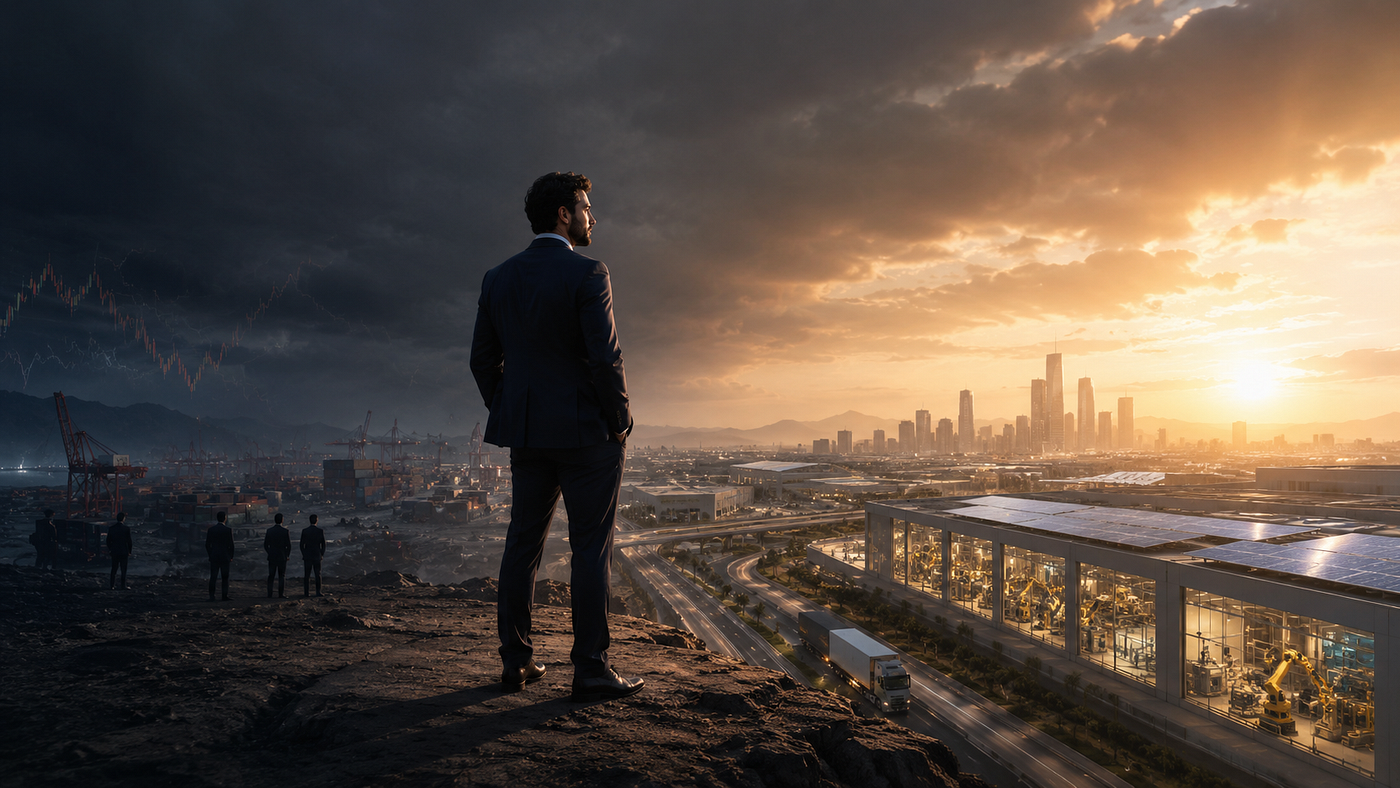
One of the most common questions business owners and investors are asking today, particularly across the Middle East, is deceptively simple: Is this really the right time to invest? It is an understandable question. The world feels uncertain. Political tensions rise quickly, wars disrupt markets, financing costs fluctuate, supply chains remain vulnerable, technology is transforming entire industries, and economic headlines often seem to offer more reasons for caution than confidence. For many investors, the instinctive response is to wait. Wait for stability. Wait for interest rates to improve. Wait for conflicts to end. Wait for markets to become clearer. Wait for the world to calm down.
But there is one serious problem with that strategy: the world may never become as calm as you are waiting for it to be.
History does not move from crisis to stability and then remain there. It moves from one transformation to another. The global financial crisis shook confidence and destroyed businesses, yet investment did not disappear. New companies were created, industries were reshaped, and investors who understood what was changing discovered opportunities that were invisible during the years of easy growth. Then came the COVID-19 pandemic. Borders closed, aircraft were grounded, factories stopped, offices emptied, consumer behavior changed almost overnight, and for a moment it appeared that large parts of the global economy had simply frozen. Yet investment did not stop. It moved. Capital flowed toward technology, logistics, healthcare, e-commerce, digital services, automation, local manufacturing and new supply-chain solutions.
Before the world had fully absorbed the lessons of the pandemic, the Russia-Ukraine war created another shock. Energy markets changed, food security became a strategic issue, logistics routes were reconsidered, inflation accelerated, and governments and companies began thinking differently about where products should be manufactured and how dependent they should be on distant suppliers. More recently, continuing geopolitical tensions across the Middle East have once again reminded investors that uncertainty is not an exceptional event. It has become part of the environment in which investment decisions are made.
And yet factories are still being built. Companies are still expanding. Governments are still competing for investment. New technologies are still attracting billions in capital. Supply chains are still being redesigned. New markets are still being entered. Entrepreneurs are still launching businesses, and established companies are still acquiring competitors, adding production lines and entering new countries.
The world did not stop.
It simply changed direction.
That distinction is critical because a crisis rarely eliminates economic opportunity completely. More often, it moves opportunity from one place to another. When international transportation becomes expensive, local manufacturing may become more attractive. When a country becomes concerned about the security of its supply chains, import substitution can become a national priority. When customers reduce spending in one category, demand may accelerate in another. When labor becomes expensive, automation becomes more attractive. When geopolitical uncertainty makes reliance on a single supplier dangerous, companies begin searching for regional alternatives.
For investors, therefore, the real question should not always be, “Is the economy good or bad?” A far more useful question is: What has changed, and which businesses benefit from that change?
Fear is a natural element of investment. In fact, an investor who feels no fear at all may be more dangerous to his capital than an investor who is cautious. The problem begins when fear stops being a tool for analysis and becomes a reason for permanent inaction. Healthy fear forces you to test assumptions, study scenarios, protect liquidity, examine suppliers, challenge sales forecasts and understand risks. Unhealthy fear simply says, “Not now.”
And “not now” can quietly become five years.
Imagine an investor who decided during the pandemic to wait until COVID disappeared. Then he waited for global shipping to normalize. Then he waited for inflation to fall. Then he waited for interest rates to decline. Then he waited for the war in Ukraine to end. Then he waited for the Middle East to become completely stable. Then he decided to wait until the impact of artificial intelligence on his industry became clearer.
At what point does waiting stop being prudence and become a strategy of doing nothing?
There is a risk that appears in almost every feasibility study: the risk of investing. But there is another risk that business owners often underestimate: the risk of not investing.
Not investing has a cost. Delaying a factory can mean losing market share. Delaying a new production line can allow imported products to strengthen their position. Delaying digital transformation can leave a company structurally weaker than its competitors. Delaying expansion can allow another company to take the best location, sign the strongest distributor, secure the most experienced employees or establish relationships with the most important customers. A company may successfully protect its cash for several years and still discover that it has lost something much more difficult to recover: its position in the market.
This does not mean investors should rush into projects simply because conditions are uncertain. That would not be courage. It would be speculation.
Periods of uncertainty actually make professional feasibility analysis more important. The investor should not build a financial model that assumes everything will go right. The project should be tested against difficult scenarios. What happens if construction is delayed? What happens if raw-material prices increase? What happens if the first year reaches only half of the expected sales? What happens if financing becomes more expensive? What happens if a major supplier becomes unavailable? What happens if the currency changes? What happens if transportation costs rise? Can the company survive the downside scenario without exhausting its cash?
The strongest investment opportunity is not necessarily the project with the highest theoretical return. Sometimes it is the project that continues to make economic sense even when some assumptions go wrong.
This is particularly important in industrial investment. A manufacturing project should not be evaluated only according to today’s selling price or today’s import volume. The investor needs to understand the supply chain, local raw materials, technology, production efficiency, energy requirements, logistics, competitors, replacement products, government incentives, export potential and the strategic importance of the product. In many cases, the disruption that frightens investors is precisely what creates the industrial opportunity.
A product that was comfortably imported for twenty years may suddenly become expensive, delayed or strategically sensitive. That can create room for a local manufacturer. A foreign supplier may decide that the Middle East is too complicated to serve directly, creating an opportunity for regional manufacturing. A government may decide that a particular industry must be localized. A large industrial customer may begin searching for a second supplier. None of these opportunities necessarily exist during periods of perfect stability. They are often born from disruption.
There is another uncomfortable truth about investment: when everybody feels safe, opportunities can become expensive. Assets rise in price. Competition increases. Suppliers become busy. Skilled employees become harder to attract. Attractive projects receive attention from many investors at once. By the time the opportunity feels completely obvious, much of its advantage may already have disappeared.
Uncertainty, on the other hand, can reduce competition. Some investors retreat. Others postpone decisions. Markets become less crowded. Assets may be repriced. Suppliers become more flexible. Governments may increase incentives. Customers become more willing to consider new alternatives.
This does not make every crisis a buying opportunity. But it does mean that fear itself should never be the final investment criterion.
At Googan Business Services, our experience in feasibility studies, market analysis, industrial projects and investment advisory has taught us a simple lesson: do not stop investing because the environment is uncertain. Change the way you invest because the environment is uncertain.
Study more deeply. Challenge your assumptions. Build conservative scenarios. Protect liquidity. Reduce unnecessary fixed costs. Avoid dependence on one supplier. Understand exactly who will buy your product before purchasing the machinery. Examine the possibility of local sourcing. Study export markets. Structure financing carefully. Enter in stages when appropriate. Most importantly, understand whether the project solves a real problem that will still exist even if the economic environment becomes more difficult.
A strong investor does not wait for risk to disappear. Risk never disappears.
A strong investor learns which risks can be managed, which risks can be transferred, which risks can be priced into the investment and which risks are serious enough to make the project unacceptable.
That is the difference between investment and gambling.
The Middle East itself provides perhaps the clearest lesson. The region has experienced wars, oil shocks, financial crises, political changes, pandemics and geopolitical disruptions. At the same time, it has built airports, industrial cities, logistics hubs, technology companies, hospitals, factories, tourism destinations, energy projects and some of the largest infrastructure developments in the world.
Economic development did not wait for the news cycle to become peaceful.
Neither should serious investors.
So, should you invest in a new project under today’s conditions?
The professional answer is neither an automatic yes nor an automatic no.
The answer is to study the project as though uncertainty will continue rather than assuming everything will return to normal next month. If the project can survive conservative assumptions, solve a genuine market need, maintain adequate liquidity and generate acceptable returns under realistic stress scenarios, then today’s uncertainty may not be a reason to avoid the investment.
It may actually be part of the opportunity.
Do not allow daily headlines to make a long-term investment decision for you. Markets change. Governments change. Interest rates change. Wars eventually change direction. Technologies disrupt industries. Supply chains move. New competitors emerge.
But there is one asset that cannot be recovered once it is lost:
time.
The investor who spends years waiting for absolute certainty may eventually discover that the project he was afraid to start has already been built by someone else.
The objective is not to become fearless.
The objective is to become prepared enough to act despite fear.
Because perhaps the greatest investment opportunities are not created when everybody feels confident.
Perhaps they are created precisely when most people are still waiting.
Googan Business Services Feasibility Studies | Market Research | Industrial Investment | Investment Advisory googan.co
메타데이터
- post_id
- 7d3be7b874a7
- slug
- should-you-invest-in-a-new-project-in-times-like-these-7d3be7b874a7
- url
- https://medium.com/@info_45600/should-you-invest-in-a-new-project-in-times-like-these-7d3be7b874a7
- canonical_url
- https://medium.com/@info_45600/should-you-invest-in-a-new-project-in-times-like-these-7d3be7b874a7
- author_url
- https://medium.com/@info_45600
- status
- ok
- fetched_at
- 2026-08-09 07:23:33