DevOps + Agents: Building a Safe Auto-Merge System (Human-in-the-Loop)
In 2024, DevOps teams started experimenting with fully autonomous pipelines, where AI agents not only test and lint code but also merge it…
DevOps + Agents: Building a Safe Auto-Merge System (Human-in-the-Loop)
In 2024, DevOps teams started experimenting with fully autonomous pipelines, where AI agents not only test and lint code but also merge it into production. The dream? Continuous delivery that truly never sleeps. But the nightmare? An unreviewed PR gone rogue at 2 a.m. breaking production for millions.
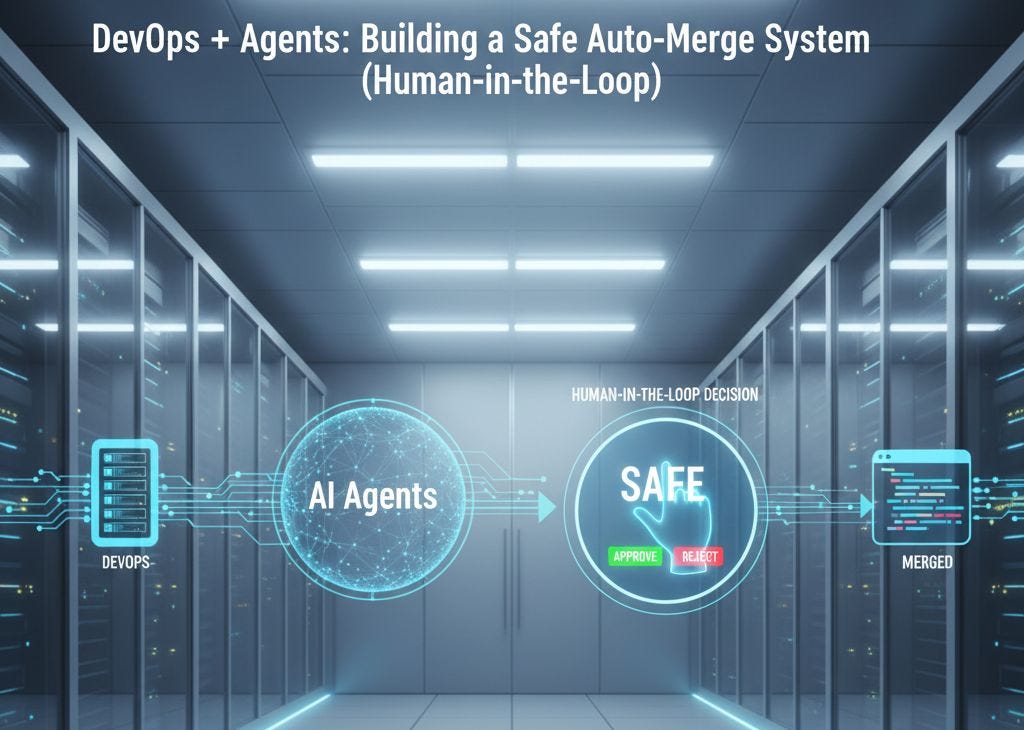
This is where Human-in-the-Loop Auto-Merge Systems come in, a hybrid model where agentic AI handles routine merges, approvals, and CI/CD handshakes, while humans still oversee and authorize critical changes.
If you’ve read our last guide, **From Prompt to PR: Using Claude Opus for End-to-End Feature Scaffolding, this is the natural next step: moving from feature generation to safe automation in deployment.**
The Evolution of DevOps + Agents
Traditional DevOps tools like Jenkins, GitHub Actions, and CircleCI were automation powerhouses, but static. They required predefined triggers and linear workflows. Agentic DevOps flips this paradigm. Instead of waiting for triggers, AI agents act autonomously based on context, recent commits, and pipeline health.
Example: An agent identifies a flaky test, retries the job, detects the pattern of previous failures, and decides whether to block the merge or pass it forward for human approval.
The Core Idea: Human-in-the-Loop Governance
The challenge with automation in DevOps isn’t capability, it’s trust. We don’t want AI to merge blindly. We want it to understand intent, impact, and accountability.
The modern pattern looks like this:
- Agent scans incoming PRs for metadata, tests, and code quality.
- Static analysis + dynamic checks run autonomously.
- Risk score is generated using model inference.
- Human gate: If score < threshold (safe), AI merges; else routes to a senior reviewer.
Example:
- A doc update PR gets merged instantly.
- A dependency upgrade triggers human approval.
- A logic change waits for a senior sign-off.
Architecture Overview
A practical hybrid system could look like:
- LangChain Agent: Orchestrates PR inspection and linting.
- GitHub API Hooks: For comment-based approvals (“@bot merge when green”).
- CrewAI or AgentKit: To manage multi-agent tasks (testing, validation, docs).
- CI Runner (GitHub Actions, Jenkins): Executes tests, logs metrics.
- Human Review Portal: Dashboard showing which merges need manual intervention.
Commit → Test → Agent Review → Risk Assessment → (Auto Merge / Human Review)Benefits
- Reduced latency between merge and deploy.
- Elimination of trivial human bottlenecks.
- Consistent compliance enforcement (no missed checks).
- Auditable decision trail via logs.
- Safe automation culture (confidence in AI decisions).
Risks & Guardrails
- False Positives: AI might over-approve low-risk but incorrect PRs.
- Security Leakage: Prompt injection or unsafe API access to secrets.
- Lack of Context: Agents may not understand business-critical logic.
- Model Drift: Rules and patterns must update with repo evolution.
Mitigation Strategies:
- Implement “no-merge without human fingerprint” on sensitive branches.
- Maintain audit logs for every AI-triggered merge.
- Rotate tokens and restrict repository permissions.
- Run all AI decisions through sandbox staging environments first.
Example Setup (Code Snapshot)
Here’s a minimalistic implementation skeleton using GitHub + LangChain AgentKit:
from agentkit import GitHubAgent, RiskEvaluatoragent = GitHubAgent(repo="yourorg/yourrepo")@agent.on_pull_request
def auto_merge_check(pr):
score = RiskEvaluator(pr).calculate()
if score < 0.3:
agent.comment(pr, "✅ Auto-approved by DevOpsAgent.")
agent.merge(pr)
else:
agent.comment(pr, "⚠️ High risk detected — awaiting human review.")Frequently Asked Questions (FAQs)
1. What does “Human-in-the-Loop” mean in DevOps?
It means automation handles repetitive tasks, but humans approve or override when necessary, keeping safety and accountability in place.
2. Can AI really merge PRs safely?
Yes, with strict guardrails, auto-merging trivial or low-risk changes (like doc edits or config updates) while routing logic-heavy PRs to humans.
3. What models are used for decision scoring?
Models like GPT-4o, Claude 3.5 Sonnet, or Llama 3 fine-tuned with code semantics are common.
4. What’s the biggest risk?
Trusting the AI too early. Always keep approval thresholds and clear audit trails.
5. Can this be extended to release management?
Absolutely. The same agentic framework can manage version bumps, changelogs, and production rollout triggers.
Conclusion
AI-driven auto-merge systems signal the next phase of DevOps, one that is not just automated, but intelligent and self-regulating. With human-in-the-loop oversight, teams can accelerate safely, letting agents own repetitive workflows while people focus on innovation and governance.
Next Up is Practical Prompt Engineering for Developers: Templates That Produce Reliable Code.
Listen On Spotify:
Catch the full discussion here on our podcast:
Resources Mentioned
메타데이터
- post_id
- 7d76cdf7fe6f
- slug
- devops-agents-building-a-safe-auto-merge-system-human-in-the-loop-7d76cdf7fe6f
- url
- https://medium.com/ai-code-journal/devops-agents-building-a-safe-auto-merge-system-human-in-the-loop-7d76cdf7fe6f
- canonical_url
- https://medium.com/ai-code-journal/devops-agents-building-a-safe-auto-merge-system-human-in-the-loop-7d76cdf7fe6f
- author_url
- https://medium.com/@semanticedonline
- status
- ok
- fetched_at
- 2026-06-12 22:02:08