Modern Web App Architecture Features and Cost to Build
Explore key features, architecture types, and cost factors in modern web app development to build scalable, secure, and cost-efficient…
Modern Web App Architecture Features and Cost to Build
Modern businesses rely on web applications that deliver speed, reliability, and security at scale. The strength of a web app depends on its architecture — the structural design that defines how its frontend, backend, databases, and cloud services work together to serve users seamlessly.
As digital operations grow, architecture becomes a business priority rather than just a technical detail. It determines how efficiently your application handles traffic, how securely it manages data, and how smoothly it scales to meet new demands, while keeping infrastructure and maintenance costs predictable.
This article explains the key features of modern web app architecture and the factors that influence its development cost.
It explains how thoughtful design choices improve performance, scalability, and long-term sustainability, helping businesses make smarter technical and financial decisions when building or upgrading their applications.
Modern Web Application Architecture
Modern web application architecture focuses on flexibility, scalability, and continuous delivery. Unlike older monolithic systems, it uses modular components — such as APIs, microservices, and containers — that can be developed, deployed, and scaled independently. This separation ensures faster updates and reduced downtime.
Business uses applications are often cloud-native, using services that automatically scale based on traffic and performance needs. Containerization tools like Docker and orchestration systems like Kubernetes allow consistent deployments across environments.
Modern architecture also emphasizes API-driven communication, where each service interacts via secure, standardized interfaces, ensuring seamless integration and maintainability. Together, these practices create applications that are more resilient, cost-efficient, and easier to evolve as business requirements change.
Layers of Modern Web App Architecture
Modern web applications are structured across three main layers — the Frontend (Client-Side Layer), the Backend (Server-Side Layer), and the Database layer. Each layer plays a specific role in how data flows, how logic executes, and how users interact with the application.
Frontend (Client-Side Layer)
The client-side layer is responsible for managing everything users see and interact with in their browsers. It focuses on design, usability, and user experience. This layer is built using HTML, CSS, and JavaScript, often enhanced with modern frameworks such as React, Angular, or Vue.js to create dynamic, responsive web interfaces.
Key Components of the Frontend (Client-Side Layer):
- User Interface (UI): Includes all visible elements such as text, buttons, forms, and images that make up the visual layout.
- User Process Components: Manage user interactions, run in-browser logic, and ensure smooth transitions without reloading the entire page. Frameworks like React or Vue.js make this possible by handling dynamic rendering.
Backend (Server-Side Layer)
This Web App Architecture layer processes requests from the frontend, applies business rules, and manages communication with the database and external APIs. This layer is developed using technologies such as Node.js, Python, Java, or .NET
Key Components of the Server-Side:
- Web Server: Handles HTTP/HTTPS requests, routing, and responses (e.g., Nginx, Apache, IIS).
- Application Server: Executes the application’s business logic, processes data, and interacts with other services or APIs.
- Security and Middleware: Manage authentication, authorization, and data validation before requests reach application logic
Database Layer
The database layer stores, organizes, and retrieves all application data. It can use relational (SQL) databases such as MySQL, PostgreSQL, or Oracle for structured data, or NoSQL databases such as MongoDB or Cassandra for flexible, large-scale data handling.
Key Components of the Database Layer:
- Database Management System (DBMS): Controls how data is created, updated, and deleted.
- Optimization Tools: Caching, indexing, and replication improve query performance and data reliability.
- Backup and Recovery: Ensure data availability and protection against failures.
Types of Modern Web App Architecture
Web application architecture defines how the frontend, backend, and data layers communicate to deliver a cohesive digital experience.
Selecting the right architecture is essential as it affects performance, scalability, cost, and long-term maintenance.
Depending on your product’s goals and complexity, modern web apps are generally built using client-side, server-side, or hosting-based architectures.
1. Client-Side Architectures
Client-side architecture runs most of the application logic inside the user’s browser, minimizing server requests. It handles rendering, data updates, and interactivity using modern JavaScript frameworks, ensuring fast performance and a smooth user experience.
Single-Page Application (SPA) Architecture
A Single-Page Application loads a single HTML page and dynamically updates only specific sections via APIs, rather than reloading entire pages. It executes most of the logic on the client side, enabling faster transitions and real-time updates. SPAs are widely used in applications that require continuous user interaction and dynamic content updates.
Advantages of Single-Page Application (SPA) Architecture
- Delivers a seamless, app-like user experience.
- Reduces network load by fetching only required data.
- Enables reusable code and easier maintenance.
Disadvantages of Single-Page Application (SPA) Architecture
- Longer initial loading time due to large scripts.
- SEO optimization can be complicated.
- Needs strict client-side security and caching management.
Use Cases of Single-Page Application (SPA) Architecture
Ideal for dashboards, SaaS platforms, analytics tools, and social media apps with high interactivity.
Key Technologies Used in Single-Page Application (SPA) Architecture
React, Angular, Vue.js, REST APIs, GraphQL, React Router.
Examples of Single-Page Application (SPA) Architecture
Gmail, Google Maps, GitHub, Pinterest, and PayPal.
Progressive Web App (PWA) Architecture
Progressive Web Apps bridge the gap between web and native applications. They work in browsers yet can be installed on devices, offer offline support, and send push notifications. Using service workers and web app manifests, PWAs deliver consistent speed and reliability, even on unstable networks.
Advantages of Progressive Web App (PWA) Architecture
- Offline accessibility and background sync.
- Installable without app-store dependence.
- High engagement via push notifications and responsive design.
Disadvantages of Progressive Web App (PWA) Architecture
- Limited access to device-specific APIs.
- Inconsistent browser support for older versions.
- Requires careful handling of offline data security.
Use Cases of Progressive Web App (PWA) Architecture
Best for eCommerce stores, news apps, and travel portals targeting both web and mobile audiences.
Key Technologies Used in Progressive Web App (PWA) Architecture
Service Workers, Web App Manifest, HTTPS, Background Sync, Workbox, IndexedDB, framework PWA plugins (React, Angular, Vue).
Examples of Progressive Web App (PWA) Architecture
Microsoft Office, Twitter Lite, Starbucks, Flipkart, Pinterest, Uber.
2. Server-Side Architectures
Server-side architecture manages the operations that occur behind the scenes of a web application. It handles user requests, business logic, database communication, authentication, and security. By processing data on the server rather than the client, it ensures stable performance, better control over sensitive information, and improved SEO through server-side rendering. Two of the most widely used patterns today are Microservices Architecture and Modular Monoliths.
Microservices Architecture
Microservices architecture divides the application’s backend into a collection of small, self-contained services. Each service is responsible for a specific business capability and can be built, deployed, and scaled independently. They communicate via APIs, ensuring agility, fault isolation, and more effortless scalability across distributed environments.
Advantages of Microservices Architecture
- Independent scaling and deployment of services.
- Strong fault isolation and high availability.
- Flexibility to use different technologies per service.
Disadvantages of Microservices Architecture
- Complex orchestration and inter-service communication.
- Increased operational and monitoring overhead.
- Requires mature DevOps practices and automation.
Use Cases of Microservices Architecture
Enterprise-level systems, streaming platforms, and eCommerce applications that need scalability and continuous delivery.
Key Technologies of Microservices Architecture
Docker, Kubernetes, API Gateway, REST/GraphQL, service mesh, and message queues.
Examples of Microservices Architecture
Netflix, Amazon, Uber, Spotify, Airbnb.
Modular Monoliths
A modular monolith is a single deployable application composed of well-structured, independent modules. It keeps everything in a single codebase while maintaining clear component boundaries. This balance between simplicity and modularity makes it an excellent choice for early-stage or growing projects that are transitioning to microservices later.
Advantages of Modular Monoliths
- Simplified deployment and reduced operational complexity.
- Faster development and testing cycles.
- Easier refactoring into microservices when scaling demands grow.
Disadvantages of Modular Monoliths
- Scaling must happen as a whole, not per module.
- Tight coupling risks if boundaries aren’t enforced.
- Slower updates once the system becomes very large.
Use Cases of Modular Monoliths
Startups, mid-sized SaaS products, and applications that require quick development but a predictable structure.
Key Technologies Used in Modular Monoliths
Domain-Driven Design (DDD), modular frameworks (.NET, Spring Boot), internal APIs, and monorepos.
Examples of Modular Monoliths
Shopify, GitHub, and Zendesk.
3. Hosting Approaches
Hosting architecture defines how web applications are deployed, managed, and scaled in production environments. Modern hosting focuses on flexibility, automation, and efficiency by leveraging cloud platforms and containerization. The two leading hosting models today are Serverless Architecture and Containerized Environments, each offering unique scalability and cost benefits.
Serverless Architecture
In a serverless model, developers focus on writing and deploying code while the cloud provider manages infrastructure, scaling, and resource allocation. Applications run in stateless compute containers that automatically spin up on demand and shut down when not in use, reducing operational costs and maintenance overhead.
Advantages of Serverless Architecture
- No need for server provisioning or maintenance.
- Auto-scaling ensures performance under variable traffic.
- Pay-as-you-go pricing minimizes waste.
Disadvantages of Serverless Architecture
- Cold-start delays may impact response time.
- Vendor lock-in due to proprietary cloud services.
- Limited execution time for long-running processes.
Use Cases of Serverless Architecture
APIs, automation scripts, chatbots, and event-driven applications with unpredictable workloads.
Key Technologies of Serverless Architecture
AWS Lambda, Google Cloud Functions, Azure Functions, and Firebase Cloud Functions.
Examples of Serverless Architecture
Slack workflows, Trello automations, Zapier integrations, and other event-driven systems.
Containerized Environments
Containerization packages applications with all their dependencies into lightweight, isolated units called containers. These containers ensure consistent operation across development, staging, and production. When managed through orchestration platforms like Kubernetes, they enable scalable, portable, and self-healing deployments.
Advantages of Containerized Environments
- Consistent environment across multiple stages.
- Efficient resource utilization and rapid scaling.
- Simplifies CI/CD pipelines and version control.
Disadvantages of Containerized Environments
- Requires orchestration and cluster management expertise.
- Networking and storage configuration can be complex.
- Slight performance overhead if not optimized.
Use Cases of Containerized Environments
Microservice-based systems, enterprise platforms, and hybrid cloud solutions require continuous deployment.
Key Technologies Used in Containerized Environments
Docker, Kubernetes, Helm, OpenShift, Jenkins, and Terraform.
Examples of Containerized Environments
Spotify’s backend, Shopify’s production environment, and Bloomberg’s engineering systems.
Essential Features of Modern Web App Architecture
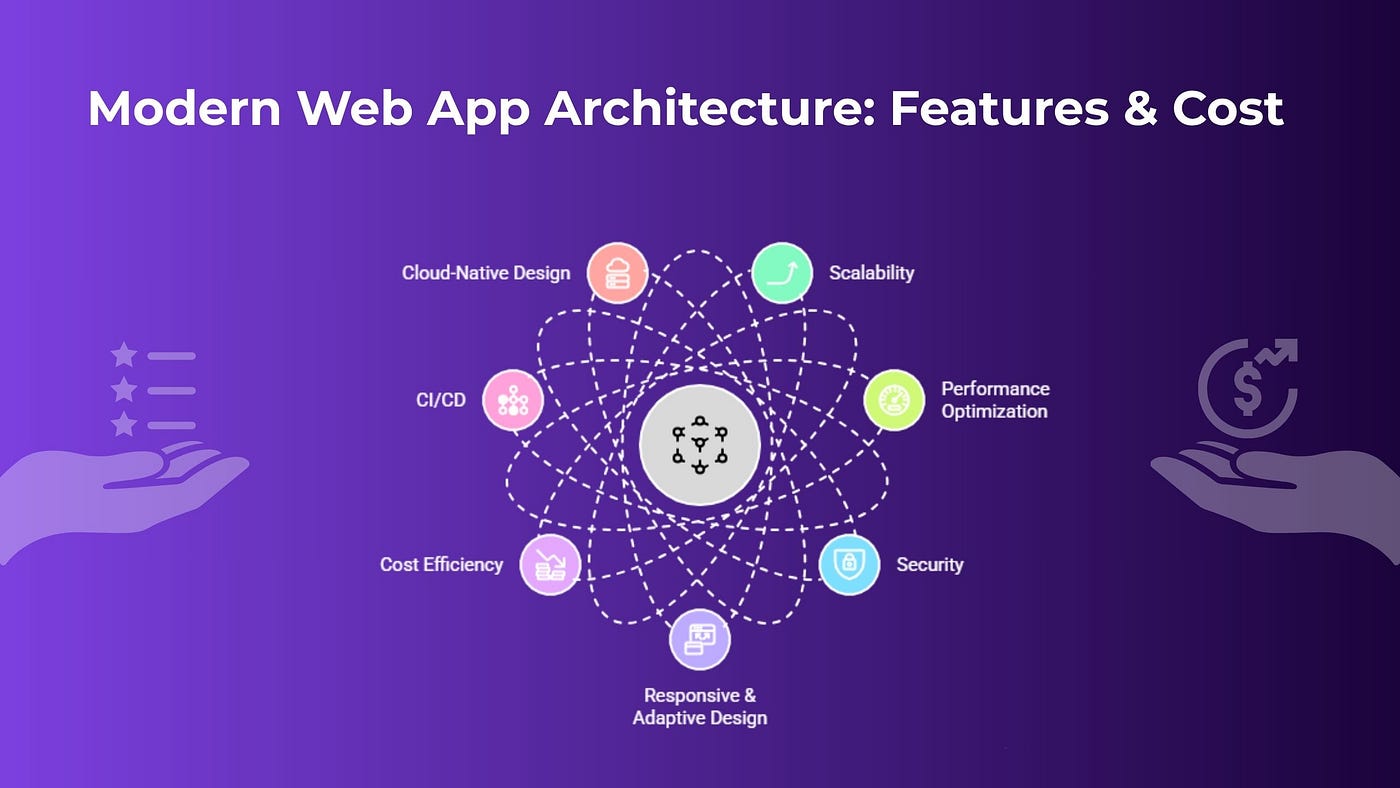
Modern web app architecture delivers fast, secure, and scalable experiences while keeping operations efficient. All layers — from frontend to backend — must align to ensure reliability, high availability, and cost control.
Scalability
Handle growth in users, data, and transactions without slowdown. Use horizontal/vertical scaling, autoscaling, and load balancers to stay responsive.
Example: Netflix scales microservices with Kubernetes and AWS Auto Scaling.
Performance Optimization
Reduce latency with caching, CDNs, lean payloads, and async processing. Optimize queries and minimize round-trip.
Example: Pinterest reduced load time by ~40% using CDN caching and code splitting.
Security
Embed SSL/TLS, strong auth (OAuth 2.0, JWT), input validation, and encrypted storage. Run regular security tests and meet standards such as ISO 27001 and GDPR.
Example: Stripe enforces encryption, strict key management, and PCI DSS.
Responsive & Adaptive Design
Ensure consistent performance and visual quality across different devices, resolutions, and orientations. Responsive layouts adapt fluidly to screen sizes, while adaptive design fine-tunes specific breakpoints for optimal usability.
Example: Airbnb and LinkedIn use responsive grids and adaptive components to maintain seamless functionality from desktop to mobile.
Cost Efficiency
Adopt pay-as-you-go, serverless, where fit, and autoscaling. Right-size resources and track usage to cut waste.
Example: Teams on AWS Lambda or Cloud Functions pay only for execution time.
Continuous Integration and Deployment (CI/CD)
CI/CD automates testing, validation, and production rollout, reducing manual effort and ensuring consistent build quality. Using canary and blue-green strategies lowers deployment risk while keeping services available.
Example: Spotify delivers frequent microservice updates through automated pipelines, sustaining rapid releases without disrupting active user sessions.
Cloud-Native Design
Cloud-native architecture organizes applications as independent, containerized services that can scale, deploy, and recover automatically. Using managed cloud services reduces operational overhead, boosts resilience, and enables global reach while each component evolves independently.
Example: Airbnb’s Kubernetes platform accelerated deployments, improved scalability, and lowered maintenance effort.
Suggested Read: Modern Web Application Architecture Development Guide
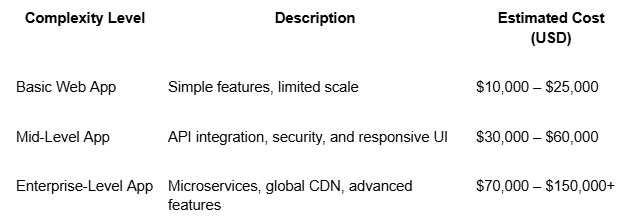
Cost to Build a Modern Web App Architecture
Budgets hinge on scope, risk tolerance, and traffic shape — plan discovery first, then size teams and infrastructure to real usage, security, and compliance needs.
The following are the primary factors that influence the cost of designing and implementing a modern web app architecture.
Application complexity and required features
Increasing the number of workflows, roles, and compliance rules can lead to longer design times, deeper testing, and greater integration effort. Complex domains also demand stronger observability and rollback plans.
Choice of technology stack (frontend, backend, database)
Frameworks with rich ecosystems speed delivery, while specialized stacks raise hiring and maintenance costs. Database selection affects licensing, expertise, and scaling patterns.
Infrastructure models (IaaS, PaaS, serverless)
IaaS gives control but adds ops overhead. PaaS simplifies deployment for a platform fee, while serverless computing shifts to consumption-based billing and reduces idle costs.
Performance and optimization expectations
Budgets rise when you target low latency globally. Caching, CDNs, and performance tooling add line items but cut origin load and bandwidth.
Third-party service integrations
Payments, auth, analytics, and marketing platforms add per-use or per-seat costs. Contract terms and regional data transfer fees must be modeled.
Maintenance and operational overhead
Expect ongoing spend for monitoring, logging, backups, and security updates. FinOps practices, tagging, and budgets keep usage accountable.
Estimated Cost Ranges
Best Practices for Scalable and Cost-Efficient Modern Web App Architecture
A modern web app must be flexible enough to scale, secure enough to protect data, and efficient enough to run cost-effectively. These best practices help you build a foundation that can evolve without constant rewrites or heavy operational costs.
Adopt Modular and API-First Designs
Define clear module boundaries and versioned APIs so teams ship independently without breaking consumers — document contracts and deprecations to keep integrations stable across releases.
Prioritize Scalability from the Start
Model peak traffic, data growth, and regional access early to avoid costly retrofits. Design for horizontal scale with stateless services, read replicas, and partitioned workloads.
Use Microservices Strategically
Split only along firm domain boundaries to prevent a distributed monolith. Standardize contracts, telemetry, and deployment patterns so services scale predictably.
Optimize Queries and Caching Mechanisms
Profile slow paths, add targeted indexes, and trim payloads to reduce compute time. Layer caching at client, edge, and data tiers to cut latency and control spend.
Integrate Monitoring and Logging Tools
Centralize metrics, logs, and traces with SLOs (Service Level Objectives) and alerting to reduce mean time to resolution. Feed observability data into capacity plans and performance budgets.
Ensure Strong Security and Compliance
Enforce encryption, least-privilege access, and secret rotation across environments. Automate audits and drift detection against required standards to maintain posture.
Leverage Cloud and Serverless Technologies
Prefer managed services for undifferentiated ops, aligning cost with real demand. Use event-driven functions for bursty work and reserved capacity for steady loads.
Implement automation with CI/CD Pipelines.
Automate tests, releases, and safe rollbacks using canary or blue-green strategies. Track change failure rate and lead time to production as core delivery metrics.
Choosing the Right Web Application Development Services
Partner with a team that approaches architecture strategically, turning business goals into measurable results in speed, reliability, and cost efficiency.
Select developers with proven expertise in Web Application Development Services and cloud platforms like AWS, Azure, or Google Cloud, along with experience in CI/CD, microservices, and security optimization. Ask for an initial architecture assessment that outlines the system design, potential risks, and data flow. Ensure transparent pricing, clear performance expectations, and well-documented handover and support processes for long-term scalability and stability.
With Quokka Labs, you get a product-first team with cloud-native expertise across AWS, Azure, and GCP, disciplined CI/CD practices, security by design, and transparent pricing — delivering scalable architectures, predictable timelines, and documentation that eases handover and long-term maintenance.
Conclusion
Modern web app architecture enables sustainable growth by balancing performance and cost, protecting data, meeting compliance requirements, and maintaining predictable delivery as traffic and features expand. A deliberate structure clarifies boundaries, streamlines deployments, and adds telemetry and alerting, turning guesswork into measurable reliability and capacity planning.
With the right development partner, product goals become concrete choices for APIs, data models, scaling strategies, budgets, and risk controls. Early investment in modular design, automation, and observability reduces rework, shortens incident resolution times, and controls total ownership costs, while users enjoy a faster and safer experience.
메타데이터
- post_id
- 7d8d952f7c4e
- slug
- modern-web-app-architecture-features-and-cost-to-build-7d8d952f7c4e
- url
- https://medium.com/@quokkalabs135/modern-web-app-architecture-features-and-cost-to-build-7d8d952f7c4e
- canonical_url
- https://medium.com/@quokkalabs135/modern-web-app-architecture-features-and-cost-to-build-7d8d952f7c4e
- author_url
- https://medium.com/@quokkalabs135
- status
- ok
- fetched_at
- 2026-06-26 12:24:55