Inverse Probability Treatment Weighting (IPTW) Using Python Package Causal Inference
Causality analysis of treatment effects using Inverse Probability Treatment Weighting (IPTW) in Python
Inverse Probability Treatment Weighting (IPTW) Using Python Package Causal Inference
Causality analysis of treatment effects using Inverse Probability Treatment Weighting (IPTW) in Python
Photo by Diana Polekhina on Unsplash
Inverse Probability Treatment Weighting (IPTW) is a statistical method for causal analysis.
In this tutorial, we will talk about how to do Inverse Probability Treatment Weighting (IPTW) using the Python CausalInference package.
Resources for this post:
- Video tutorial for this post on YouTube
- Click here for the Colab notebook.
- More video tutorials on Causal Inference
- More blog posts on Causal Inference
Let’s get started!
Step 1: Install and Import Libraries
In step 1, we will install and import libraries.
Firstly, let’s install dowhy for dataset creation and causalinference for Inverse Probability Treatment Weighting (IPTW).
# Install dowhy
!pip install dowhy
# Install causal inference
!pip install causalinferenceAfter the installation is completed, we can import the libraries.
- The
datasetsis imported fromdowhyfor dataset creation. pandasandnumpyare imported for data processing.CausalModelis imported from thecausalinferencepackage for Inverse Probability Treatment Weighting (IPTW).
# Package to create synthetic data for causal inference
from dowhy import datasets
# Data processing
import pandas as pd
import numpy as np# Causal inference
from causalinference import CausalModelStep 2:Create Dataset
In step 2, we will create a synthetic dataset for the causal inference.
- Firstly, we set a random seed using
np.random.seedto make the dataset reproducible. - Then a dataset with the true causal impact of 10, four confounders, 10,000 samples, a binary treatment variable, and a continuous outcome variable is created.
- After that, we created a dataframe for the data. In the dataframe, the columns W0, W1, W2, and W3 are the four confounders, v0 is the treatment indicator, and y is the outcome.
# Set random seed
np.random.seed(42)
# Create a synthetic dataset
data = datasets.linear_dataset(
beta=10,
num_common_causes=4,
num_samples=10000,
treatment_is_binary=True,
outcome_is_binary=False)# Create Dataframe
df = data['df']# Take a look at the data
df.head()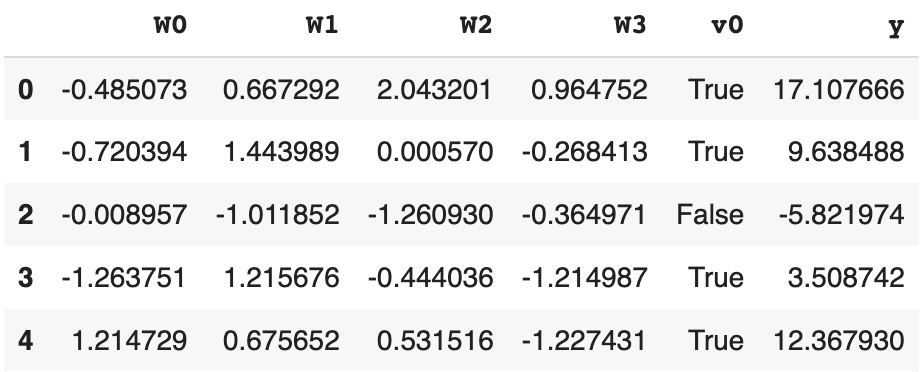
Causal Inference Data — GrabNGoInfo.com
Next, let’s rename v0 to treatment, rename y to outcome, and convert the boolean values to 0 and 1.
# Rename columns
df = df.rename({'v0': 'treatment', 'y': 'outcome'}, axis=1)
# Create the treatment variable, and change boolean values to 1 and 0
df['treatment'] = df['treatment'].apply(lambda x: 1 if x == True else 0)# Take a look at the data
df.head()
Causal Inference Data — GrabNGoInfo.com
Step 3: Raw Difference
In step 3, we will initiate CausalModel and print the raw data summary statistics. CausalModel takes three arguments:
Yis the observed outcome.Dis the treatment indicator.Xis the covariates matrix.
CausalModel takes arrays as inputs, so .values are used when reading the data.
# Run causal model
causal = CausalModel(Y = df['outcome'].values, D = df['treatment'].values, X = df[['W0', 'W1', 'W2', 'W3']].values)
# Print summary statistics
print(causal.summary_stats)
Python CausalInference raw balance and difference — GrabNGoInfo.com
causal.summary_stats prints out the raw summary statistics. The output shows that:
- There are 2,269 units in the control group and 7,731 units in the treatment group.
- The average outcome for the treatment group is 13.94, and the average outcome for the control group is -2.191. So the raw difference between the treatment and the control group is 16.132, which is much higher than the actual treatment effect of 10.
Nor-diffis the standardized mean difference (SMD) for covariates between the treatment group and the control group. Standardized Mean Differences(SMD) greater than 0.1 means that the data is imbalanced between the treatment and the control group. We can see that most of the covariates have SMD greater than 0.1.
Step 4: Propensity Score Estimation
In step 4, we will get the propensity score estimation. A propensity score is the predicted probability of getting treatment. It is calculated by running a logistic regression with the treatment variable as the target, and the covariates as the features.
There are two methods for propensity score estimation, est_propensity_s and est_propensity.
est_propensityallows users to add interaction or quadratic features.est_propensity_sautomatically choose the features based on a sequence of likelihood ratio tests.
In this step, we will use est_propensity_s to run the propensity score estimation.
# Automated propensity score estimation
causal.est_propensity_s()
# Propensity model results
print(causal.propensity)
Propensity Score Estimation — GrabNGoInfo.com
From the model results, we can see that the feature selection algorithm decided to include only the raw features, and not include interaction or quadratic terms.
To get the propensity score, use causal.propensity['fitted'].
# Propensity scores
causal.propensity['fitted']
Output
array([0.99295272, 0.99217314, 0.00156753, ..., 0.69143426, 0.99983862,
       0.99943713])
Step 5: Inverse Probability Treatment Weighting (IPTW)
In step 5, we will talk about Inverse Probability Treatment Weighting (IPTW).
Generally speaking, the algorithms of Inverse Probability Treatment Weighting (IPTW) can be divided into the following steps:
Step 1 is propensity score estimation.
Step 2 is to calculate weights for each unit.
- For the unit that received treatment, the weight is the reciprocal of the propensity score.
- For the unit that did not receive treatment, the weight is the reciprocal of 1 minus the propensity score.
Step 3 is to run a weighted least squares model with the weights calculated in the previous step.
The Python CausalInference package has a function called est_via_weighting to implement these steps. Note that the propensity score needs to be estimated using the Python CausalInference package before calling the est_via_weighting function.
We can use causal.estimates to check the estimation results.
# Inverse Probability Treatment Weighting (IPTW)
causal.est_via_weighting()
# Print out the testimation results
print(causal.estimates)
Inverse Probability Treatment Weighting (IPTW)
From the treatment effect estimation results, we can see that the average treatment effect (ATE) is the same as the true causal impact of 10, which is a much more accurate estimation than the raw difference of 16.
To learn more about the average treatment effect (ATE) and how to calculate it, please check out my previous tutorial ATE vs CATE vs ATT vs ATC for Causal Inference.
More tutorials are available on GrabNGoInfo YouTube Channel and GrabNGoInfo.com.
[embed]Inverse Probability Treatment Weighting (IPTW) — GrabNGoInfo.com
Recommended Tutorials
- GrabNGoInfo Machine Learning Tutorials Inventory
- Multivariate Time Series Forecasting with Seasonality and Holiday Effect Using Prophet in Python
- Four Oversampling And Under-Sampling Methods For Imbalanced Classification Using Python
- 3 Ways for Multiple Time Series Forecasting Using Prophet in Python
- Databricks Mount To AWS S3 And Import Data
- Hyperparameter Tuning For XGBoost
- One-Class SVM For Anomaly Detection
- Time Series Anomaly Detection Using Prophet in Python
- Sentiment Analysis Without Modeling: TextBlob vs. VADER vs. Flair
- Recommendation System: User-Based Collaborative Filtering
- How to detect outliers | Data Science Interview Questions and Answers
- Causal Inference One-to-one Matching on Confounders Using R for Python Users
- Gaussian Mixture Model (GMM) for Anomaly Detection
- Time Series Anomaly Detection Using Prophet in Python
- How to Use R with Google Colab Notebook
References
메타데이터
- post_id
- 7d8f454eb8f3
- slug
- inverse-probability-treatment-weighting-iptw-using-python-package-causal-inference-7d8f454eb8f3
- url
- https://medium.com/grabngoinfo/inverse-probability-treatment-weighting-iptw-using-python-package-causal-inference-7d8f454eb8f3
- canonical_url
- https://medium.com/grabngoinfo/inverse-probability-treatment-weighting-iptw-using-python-package-causal-inference-7d8f454eb8f3
- author_url
- https://medium.com/@AmyGrabNGoInfo
- status
- ok
- fetched_at
- 2026-06-17 12:55:42