MOFs That Turns Desert Air Into Drinking Water
Nobel Prize‑winning metal‑organic frameworks (MOFs) promise to help communities harvest water from low‑humidity air using adsorption
MOFS That Turns Desert Air Into Drinking Water
Nobel Prize‑winning metal‑organic frameworks (MOFs) promise to help communities harvest water from low‑humidity air using adsorption
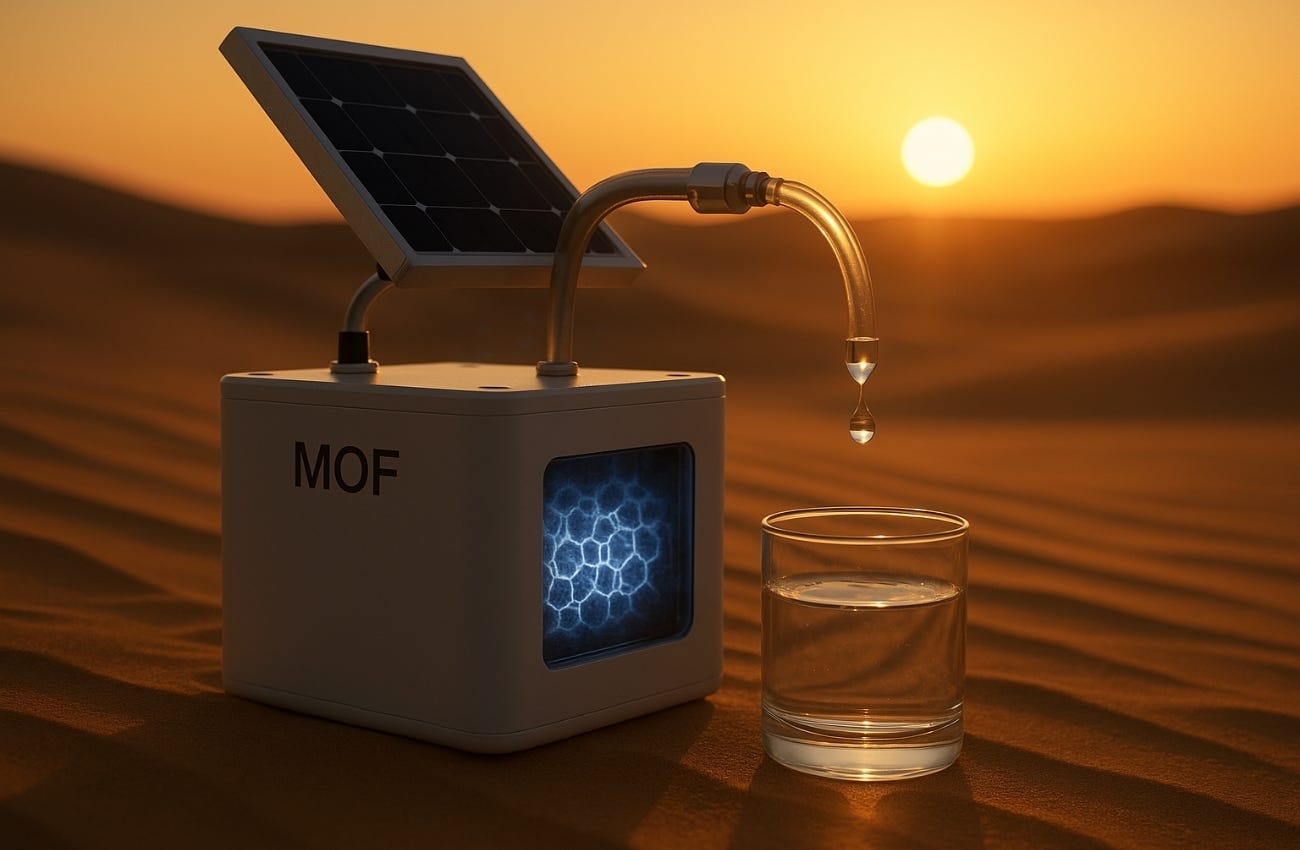
illustration for MOFs device for water harvesting
Water scarcity is a global crisis. Only 0.4 % of the world’s freshwater is easily accessible, and by 2050 billions may face shortages. Meanwhile, our atmosphere holds an enormous pool of moisture. Metal-organic frameworks (MOF)‑based systems promise to harvest water even when humidity is as low as 20 %, offering hope for arid communities.
Non-members can read this story free with this Friend Link → **Here**
What makes MOFs unique?
In 2025, Susumu Kitagawa, Richard Robson and Omar Yaghi won the **Nobel Prize in Chemistry** for inventing metal‑organic frameworks. MOFs are crystalline materials built from metal ions and organic linkers. Their modular structure means scientists can tune pore size, shape and chemistry like building blocks. One gram of MOF can have a surface area of 7,000 m², equivalent to 1.3 football fields, giving them incredible capacity to hold gases and water.

Metal-organic frameworks (MOFs)
Unlike silica gels or zeolites, MOFs work at low humidity and release water with gentle heating. For example, MOF‑801 can adsorb 0.25–0.37 kilograms of water per kilogram of material at 20–30 % relative humidity. Some materials, such as Ni₂F₂BTDD, can hold more than their own weight in water at 32 % RH.
What Does a MOF Actually Look Like?

Real MOF Products on Amazon
Most MOFs appear as fine, dry crystalline powders — often in different colors — similar to flour or chalk dust. There are no visible pores, no gel-like texture, and nothing that looks “high-tech” at first glance — even though small quantities are now commercially available online, including on Amazon.
The power of an MOF is hidden inside. Each tiny particle contains a precisely ordered network of nanoscale pores, giving the material an enormous internal surface area. This is what allows MOFs to pull water vapor directly from dry air, molecule by molecule.
In real devices and commercial products, MOFs are typically pressed into pellets or embedded in solid blocks so air can flow through them efficiently. What you’re holding may look simple — but internally, it functions like a molecular sponge engineered at the nanoscale.
How does a MOF water harvesting system work?
MOF devices harvest water using adsorption, not condensation. Here’s the basic cycle:
- Capture: At night, when the air is cool, the MOF’s pores grab water molecules from the air. The material’s structure encourages cluster adsorption, meaning water uptake happens in a narrow humidity range.
- Release: During the day, sunlight or waste heat warms the MOF material. Unlike conventional desiccants, MOFs release water at modest temperatures (around 65 °C), so solar energy is enough.
- Collect: The released vapour is directed to a condenser. Because the humidity inside the device is now high, the water condenses without expensive refrigeration. Tests show that the water contains no metals or contaminants, making it safe to drink.

Image created by AI
A 2017 prototype using MOF‑801 and natural sunlight produced **2.8 liters of water per kilogram of MOF per day at 20 % RH, with no external power. Newer adaptive devices sense changes in humidity and temperature to optimize cycle times, producing [3.5 Liters per kg of MOF per day](https://www.nature.com/articles/s41467-022-32642-0)** in desert conditions.
Why humidity and adsorption matter
Most people associate humidity with sticky summer air, but in desert regions, it can drop below 20 %. Traditional condensation systems struggle under these conditions because the dew point is too low. MOFs thrive in low humidity because of their ability to adsorb water in a step‑shaped isotherm. This means they store large amounts of water once the RH crosses a threshold and release it when heated.
Adsorption allows MOF systems to operate without cooling the air to the dew point. As a result, they require less energy than refrigeration‑based harvesters and can be powered by sunlight. That makes them ideal for remote communities, off‑grid homes, and humanitarian relief efforts.
Conclusion: Drinking the sky is now science, not fiction
What once sounded like a science‑fiction idea is becoming reality. By harnessing the adsorption power of metal-organic frameworks, scientists have created water harvesting systems that extract clean water from desert air. As climate change intensifies droughts and stresses water supplies, MOF technology offers a decentralized, sustainable solution. Imagine a future where homes, farms, and refugees drink from the sky.
If you find this information inspiring, please clap, comment, or share with someone who cares about water scarcity. Want to read more? Check out related stories on sustainability and climate tech in Substack.
메타데이터
- post_id
- 7d9bec4a600b
- slug
- water-harvesting-system-that-turns-desert-air-into-drinking-water-7d9bec4a600b
- url
- https://medium.com/@water-filter/water-harvesting-system-that-turns-desert-air-into-drinking-water-7d9bec4a600b
- canonical_url
- https://medium.com/@water-filter/water-harvesting-system-that-turns-desert-air-into-drinking-water-7d9bec4a600b
- author_url
- https://medium.com/@water-filter
- status
- ok
- fetched_at
- 2026-06-26 03:39:16