Four Score and Seven Word Salads Ago
Donald Trump, the Gettysburg Address, and the Ongoing War on Knowing Things
When leaders can’t explain democracy’s founding documents
Four Score and Seven Word Salads Ago
Donald Trump, the Gettysburg Address, and the Ongoing War on Knowing Things
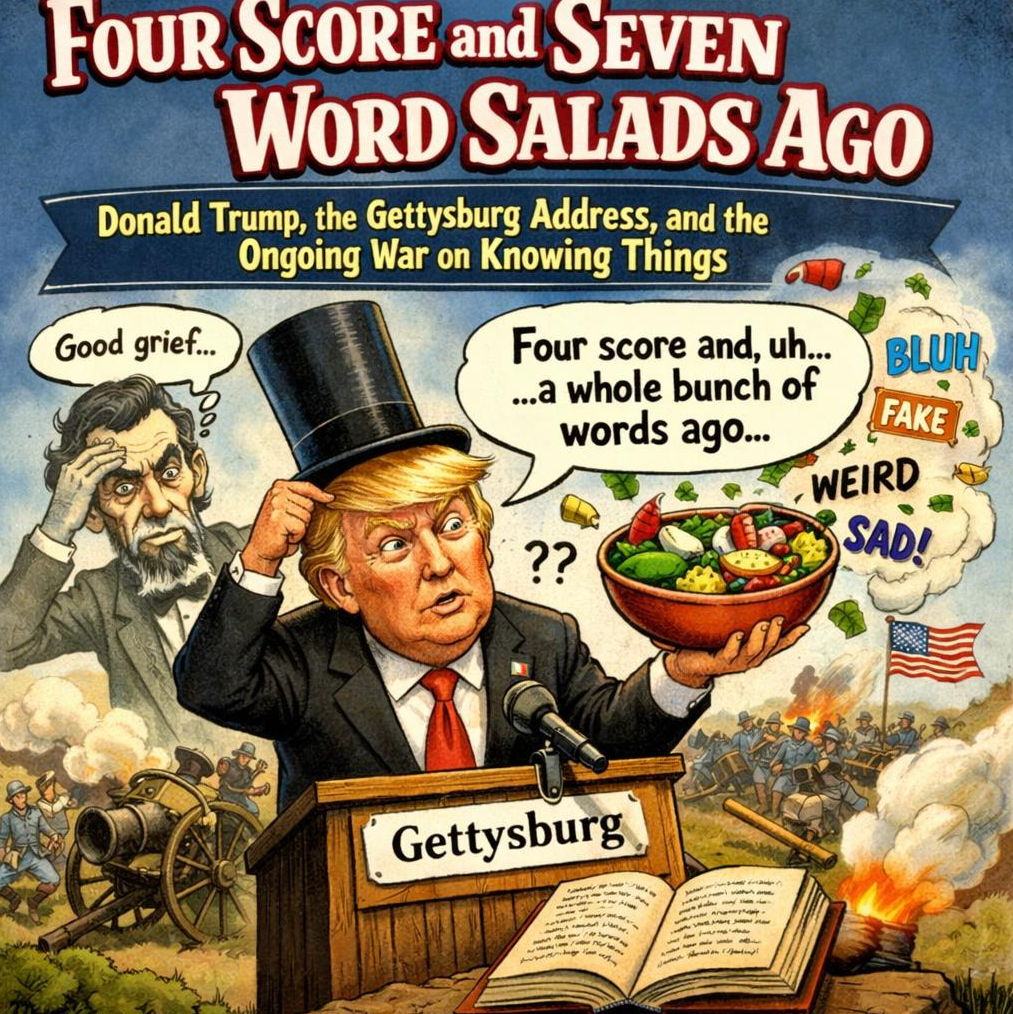
Image created by Dr. Janine Bouey using OpenArt AI (2026).
There are moments in American political life when time seems to fold in on itself — when the past reaches forward, taps the present on the shoulder, and whispers, “You seeing this shit?”
One of those moments occurred when Donald J. Trump was asked about the Gettysburg Address.
Not Abraham Lincoln.
Not the Civil War.
Not slavery.
Not democracy.
Just… the Gettysburg Address.
A 272-word speech.
Two minutes long.
Shorter than most Trump tangents about shower water pressure.
And yet.
What followed was not an answer so much as a conceptual evacuation — a response that wandered off like a Roomba that found an open door and decided to discover itself.
At a 2024 rally in Schnecksville, Pennsylvania, Trump said: “Gettysburg, what an unbelievable battle that was. It was so much, and so interesting, and so vicious and horrible, and so beautiful in so many different ways — it represented such a big portion of the success of this country. Gettysburg, wow — I go to Gettysburg, Pennsylvania, to look and to watch" (https://www.newsweek.com/donald-trump-gettysburg-civil-war-historian-1890325).
Now, to be clear: no one expected a Lincolnian exegesis. No one needed footnotes. No one was asking for a recitation, or context, or even basic historical literacy. The bar was subterranean. The bar was “Do you know what this is?”
Reader, the bar was not cleared.
The bar was not approached.
The bar was not acknowledged as existing.
Instead, Trump responded the way a man responds when he’s been asked to discuss a book he has never opened, seen, or emotionally acknowledged as real.
He did not answer the question.
He orbited it.
He waved at it from a distance.
He spoke around it the way people speak around death at Thanksgiving.
And in doing so, he unintentionally delivered the most perfect anti-Gettysburg Address imaginable.
What Lincoln Did (Briefly, Since Apparently That’s Hard)
Let’s reset for a moment.
The Gettysburg Address is not famous because it is long.
It is famous because it is dense.
It is a surgical strike of moral clarity:
• The nation was founded on an idea.
• That idea was equality.
• The Civil War was a test of whether a nation built on that idea could survive.
• The dead mattered.
• The living had responsibilities.
• Democracy is fragile.
• The people are sovereign.
• Government exists by consent.
• And we must finish the work.
That’s it.
That’s the speech.
No merch table. No grievance list. No enemies named. No self-praise. No crowd size comparisons.
Just purpose.
What Trump Did Instead
Trump, when asked about the Gettysburg Address, did not engage with:
• equality
• democracy
• sacrifice
• the Civil War
• Lincoln
• slavery
• the Constitution
• the dead
• the living
• the unfinished work
Instead, he did what Trump always does when confronted with history:
He changed the subject to vibes.
He spoke in the abstract.
He praised “great things.”
He gestured toward “important moments.”
He implied reverence without demonstrating comprehension.
He performed respect the way someone performs CPR having only seen it in a movie.
There was no thesis.
There was no reference point.
There was no indication that the words meant anything beyond being a famous thing Americans are told to like.
It was the rhetorical equivalent of nodding solemnly while your brain screams, “Do not ask a follow-up question.”
This Is Not a Memory Problem
This Is a Values Problem
Here’s the thing people keep getting wrong when they say, “Oh, he just doesn’t know history.”
No.
That’s not it.
Trump doesn’t forget the Gettysburg Address.
He rejects it.
Because the Gettysburg Address is fundamentally incompatible with Trumpism.
Lincoln said:
the nation is founded on equality
Trump’s political career is built on hierarchy.
Lincoln said:
the people decide
Trump believes:
the people decide unless I lose
Lincoln said:
sacrifice binds us to moral obligation
Trump believes:
sacrifice is for suckers
Lincoln said:
democracy requires unfinished work
Trump believes:
democracy is fine as long as it flatters him personally
So when Trump is asked about the Gettysburg Address, he’s not confused.
He’s ideologically allergic.
That speech is a problem for him.
It is inconvenient.
It contradicts the entire operating system.
The Gettysburg Address Is an Anti-Trump Document
Let’s be blunt.
The Gettysburg Address:
• centers humility
• elevates collective responsibility
• honors the dead without exploiting them
• insists that power flows upward from the people
• frames leadership as service, not domination
Trump’s worldview:
• centers grievance
• elevates personal loyalty
• uses the dead as props
• treats power as personal entitlement
• frames leadership as revenge with better branding
Lincoln used 272 words to argue for democracy.
Trump has used millions to argue for himself.
Why This Moment Matters (Yes, It Actually Does)
Some people will say, “Who cares? It’s just history.”
No.
It’s not.
The Gettysburg Address is not just a speech.
It is the moral firmware of the country.
It answers the question:
Why does America exist at all?
And Trump’s inability — or refusal — to engage with it tells you everything you need to know about how he views the country.
Not as a shared project.
Not as a fragile experiment.
Not as an idea worth protecting.
But as a brand.
A territory.
A stage.
A thing to be won.
Lincoln saw the presidency as a burden.
Trump sees it as a throne with bad acoustics.
Imagine Lincoln Answering Like Trump
Just for fun.
Imagine Lincoln at Gettysburg saying:
“We’re here today, it’s a great place, many people say one of the greatest places, tremendous history, really tremendous, people talk about it all the time, very important, very special, nobody’s ever seen anything like it…”
There would be no United States.
There would be a plaque that reads:
“We meant well.”
This Is Why the Right Is Uncomfortable with Lincoln Now
Notice something interesting:
Modern MAGA politics rarely quotes Lincoln.
They prefer the Founders — abstract, distant, pliable.
Lincoln is dangerous.
Lincoln is specific.
Lincoln names slavery.
Lincoln centers equality.
Lincoln frames democracy as an obligation, not a vibe.
Trump can’t use Lincoln because Lincoln would not recognize Trump as legitimate authority.
Lincoln believed in law.
Trump believes in loyalty.
Lincoln believed loss demanded reflection.
Trump believes loss demands retaliation.
The Punchline (Because Satire Requires One)
So when Trump responds to the Gettysburg Address with word salad, abstraction, and patriotic noise, understand:
That wasn’t confusion.
That was avoidance.
Because the Gettysburg Address asks a question Trump can never answer:
Can a nation dedicated to equality survive leaders who do not believe in equality?
Lincoln answered yes — with sacrifice.
Trump answers no — with merch.
Final Thought
Four score and seven years ago, America was tested.
Today, the test is simpler:
Do we remember what the test was about?
Because if the Gettysburg Address becomes just another “important thing people say is important,” then the war Lincoln warned us about — the war over whether democracy means anything at all — never actually ended.
It just changed uniforms. The battlefield moved from Gettysburg to ballot boxes, from muskets to misinformation, from physical secession to constitutional subversion.
And some people, apparently, still don’t know what the speech was saying.
Or worse:
They know exactly what it was saying —
and they don’t like it.
When the president-elect refuses to commit to a peaceful transfer of power, when election results are dismissed as fraudulent without evidence, when democratic processes become negotiable based on personal preference — Lincoln’s unfinished work remains catastrophically unfinished.
Lincoln asked whether a nation conceived in liberty could long endure.
That question now sits in the hands of a man who cannot legally possess a firearm, but who currently holds the presidency again.
History has a dark sense of humor.
If you caught yourself agreeing along the way — you’re not limited to a single clap!
메타데이터
- post_id
- 7d9d88bb8b59
- slug
- four-score-and-seven-word-salads-ago-7d9d88bb8b59
- url
- https://medium.com/@jusbouey/four-score-and-seven-word-salads-ago-7d9d88bb8b59
- canonical_url
- https://medium.com/@jusbouey/four-score-and-seven-word-salads-ago-7d9d88bb8b59
- author_url
- https://medium.com/@jusbouey
- status
- ok
- fetched_at
- 2026-07-09 08:02:55