NetSuite to Power BI connector: from data silos to real-time analytics
Build a clean NetSuite-to-Power BI pipeline, replace manual exports, and ship live dashboards with scheduled refresh
ServiceNow vs Salesforce: A Detailed Comparison
SourceIn the fast-shifting world of enterprise software, ServiceNow vs Salesforce remain two of the most visible platforms. Each brings distinct strengths for different goals. ServiceNow is celebrated for IT Service Management (ITSM), while Salesforce leads the field in Customer Relationship Management (CRM). This in-depth look compares their features, advantages, and differences to help organizations choose the best fit.

What is Salesforce?
Salesforce is a leading cloud-based CRM platform. It serves as a comprehensive system to manage and optimize workflows for companies of every size. From startups like Twilio to giants like Google, teams across industries rely on Salesforce to coordinate and streamline customer-facing processes.
At its foundation, Salesforce strengthens relationships between enterprises and customers. It supports mobile and web use cases and focuses on lead, opportunity, marketing, and sales management. Its adaptability and scale make it a top option for teams aiming to improve engagement and drive revenue. Adding a salesforce servicenow connector can boost efficiency by enabling smooth data exchange, reducing manual effort, and creating a unified view across customer service and sales.
What is ServiceNow?
ServiceNow is a rising ITSM platform recognized for robust control of IT operations and back-office services. Its reach extends beyond IT into HR and customer-facing workflows as well.
ServiceNow uses machine learning to automate routine tasks, cutting manual steps and lifting efficiency. It is built to map and manage structured IT services, making it central to IT operations. Many organizations report up to a 60% lift in ITSM efficiency, which makes ServiceNow a strong choice for optimizing IT processes.
Features of Salesforce vs ServiceNow
A feature-led view highlights the standout capabilities of ServiceNow vs Salesforce and how each supports business outcomes.
Features of Salesforce
Salesforce provides a rich, flexible toolkit well suited to modern teams:
- Opportunity Management: Track deals through every stage of the sales cycle. Record details like close date, stage, amount, expected revenue, and probability to guide execution.
- Sales Forecasting: Analyze customer behavior and pipeline to shape sales strategy. Use methods such as product, territory, opportunity revenue, and overlay split for more precise planning.
- Contact and Account Management: Centralize customer data, including names, addresses, phones, email, and interaction history. Keep communication consistent and contextual.
- Email Integration: Send, receive, and track messages directly inside Salesforce so every interaction stays on record and accessible.
- Lead Management: Capture, qualify, and convert leads with automated workflows. Prioritize based on business rules to improve handoffs and win rates.
Features of ServiceNow
ServiceNow focuses on intelligent operations and streamlined service delivery:
- IT Service Management (ITSM): Manage requests, incidents, and changes with assignment, tracking, and SLA-driven resolution.
- Workflow Automation: Automate repeatable processes from onboarding to payroll, reducing manual work and errors while improving consistency.
- Analytical Reporting: Visualize operations and trends with dynamic charts and dashboards for faster, data-driven decisions.
- IT Operations Management (ITOM): Coordinate incidents, problems, changes, and configuration items to stabilize services and reduce downtime.
- Customer Service Management: Accelerate resolution with structured case handling and integrated processes that raise satisfaction.
Similarities Between ServiceNow vs Salesforce
Before looking at differences, note where ServiceNow vs Salesforce align:
- CRM Focus: Both can support customer interactions and hybrid work environments.
- Workflow Automation: Each platform automates processes to raise efficiency and consistency.
- User-Friendly Interfaces: Both feature approachable UIs with mobile access.
- Integration Capabilities: Salesforce offers broader third-party integrations, while ServiceNow provides options that are more selective.
- Customization: Both allow tailoring through configuration and development to meet specific needs.
Comparison Table: ServiceNow vs Salesforce Differences: ServiceNow vs Salesforce

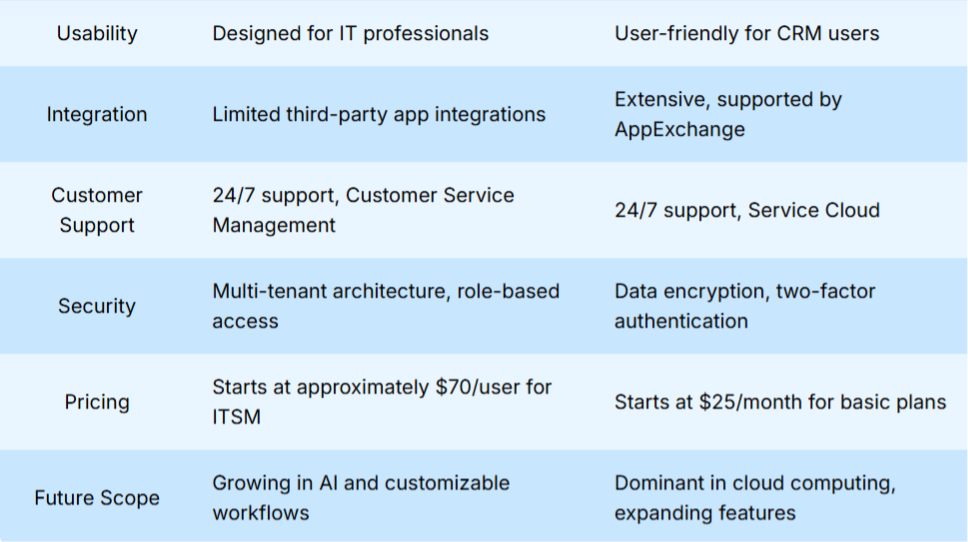
Although both deliver value, they target different priorities and excel in separate areas:
Performance
- ServiceNow: Strong in ITSM and automation, with about 1.5-second average page load and 99.9% uptime.
- Salesforce: Renowned for CRM, with roughly 2.5-second average page load and 99.9% uptime.
Implementation
- ServiceNow: Focused on ITSM, offered as a cloud-based implementation service and solution.
- Salesforce: Broad CRM platform deployable in the cloud and with options supporting on-premises integrations.
Usability
- ServiceNow: Best aligned to IT teams and technical operations.
- Salesforce: Geared toward CRM users in sales, marketing, and adjacent functions.
Integration
- ServiceNow: Provides narrower third-party integrations and may need supplemental tools for end-to-end use cases.
- Salesforce: Offers extensive integrations through AppExchange. For example, Salesforce WhatsApp messaging becomes a two-way, on-record channel alongside email and chat for unified service. With Salesforce third-party integration, companies connect ERP, marketing, and collaboration tools for a single source of truth. Organizations adopting Salesforce DevOps can streamline development, automate deployments, and harden security within their environment.
Customer Support
- ServiceNow: 24/7 assistance via phone, chat, email, and FAQs.
- Salesforce: Multi-channel support through Service Cloud, including live chat, email, social, and 24/7 phone help.
Security
- ServiceNow: Multi-tenant model with role-based access and ongoing vulnerability scanning.
- Salesforce: Encryption, two-factor authentication, and real-time activity monitoring.
Pricing
- ServiceNow: ITSM starts around 70 dollars per user, with higher tiers at additional cost.
- Salesforce: Entry plans begin near 25 dollars per month, with more advanced editions priced higher.
Future Scope
- ServiceNow: Expanding in AI and machine learning with a projected market value of 12.2 billion dollars by 2025.
- Salesforce: Expected to lead CRM as the market approaches 57 billion dollars by 2025.
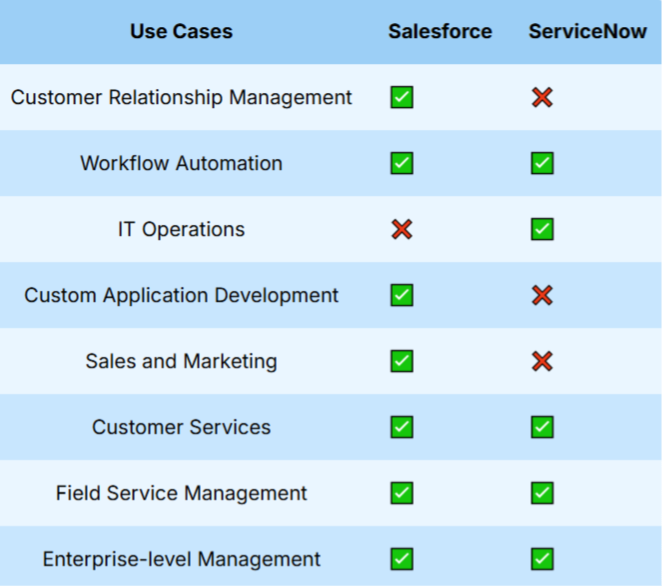
When to Use Salesforce vs ServiceNow
Match the platform to your objectives and consider alternatives where appropriate.
Conclusion: ServiceNow vs Salesforce
Choosing between ServiceNow vs Salesforce is like picking the right instrument from a well-stocked toolkit — each excels in different jobs. If your priority is optimizing IT operations and technical workflows, ServiceNow fits best. If elevating customer relationships and accelerating sales is the goal, Salesforce provides a comprehensive CRM suite.
In the end, let your specific requirements guide the decision. Whether you select ServiceNow vs Salesforce, both deliver mature capabilities with strong roadmaps. Teams seeking a tailored approach can partner with a Salesforce or ServiceNow development company to customize the platform around unique needs and achieve better results.
메타데이터
- post_id
- 7d9dab2efd42
- slug
- servicenow-vs-salesforce-detailed-comparison-7d9dab2efd42
- url
- https://medium.com/@nataliiaboikivska/servicenow-vs-salesforce-detailed-comparison-7d9dab2efd42
- canonical_url
- https://medium.com/@nataliiaboikivska/servicenow-vs-salesforce-detailed-comparison-7d9dab2efd42
- author_url
- https://medium.com/@nataliiaboikivska
- status
- ok
- fetched_at
- 2026-07-21 16:10:44