To Make the Stone Stony
There’s Still Tomorrow (2023, dir. Paola Cortellesi)
FILM CRITICISM
To Make the Stone Stony
‘There’s Still Tomorrow’ (2023, dir. Paola Cortellesi)
0.
The point is not to make political films, but to make films politically. — Jean-Luc Godard
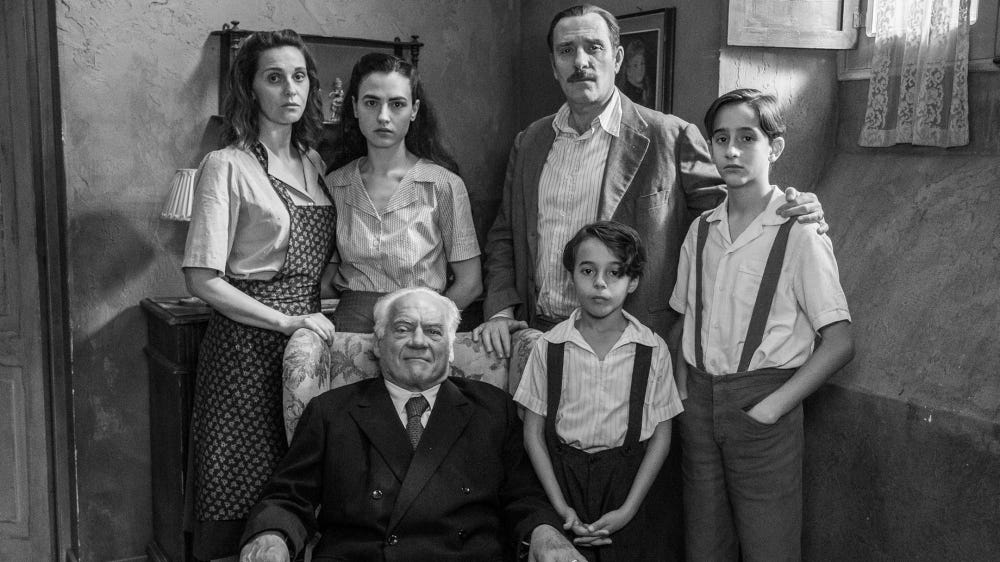
Still from There’s Still Tomorrow (2023) © Vision Distribution
1.
My immediate impression is one of tension between things that do not align.
Most viewers probably notice right away the gap between violence and its representation. What is actually taking place is horrific domestic abuse, yet the film presents it with the comic rhythm of something like a musical number. Some have criticized the film for aestheticizing violence, while others have argued that it translates naturalized violence into form. Either way, one thing is clear: the film deliberately refuses to make the event and its representation coincide.
While monopolizing legal rights and social authority, men shift much of the economic burden onto women. Delia keeps the family afloat not only through housework but also by taking on multiple odd jobs, yet every important decision always belongs to her husband, Ivano. Even when women perform the same work — or perform it with greater skill — they are paid less simply because they are women, making it difficult to escape male dominance in the first place. Ivano beats his wife while firmly believing that he loves his family. Giulio, too, first appears as a gentle and cultivated young man, but as the story unfolds, he gradually reveals the same patriarchal attitudes that define Ivano.
It remains tragic from beginning to end, yet continually reaches for comedy. It begins like a melodrama, only to conclude as a political drama. It is rooted in a specific historical moment, yet its lingering resonance compels us to reflect on the present. The world of the film is in constant conflict with the ethical assumptions its audience takes for granted, and that discomfort itself becomes another form of tension the film deliberately creates.
As Cortellesi herself has explained in multiple interviews, the past and the present also exist in a clear state of tension. The film is rigorously set in postwar Rome, around 1946. It openly pays homage to Italian Neorealism, yet at the same time incorporates contemporary music and edits scenes with the rhythm of a musical, constantly addressing today’s audience. It refuses to grant viewers the comfortable distance of dismissing everything as a story from long ago. One of the film’s greatest charms lies in the way it feels like the present while remaining the past, and like the past while remaining the present.

Still from There’s Still Tomorrow (2023) © Vision Distribution
2.
Love cannot coexist with violence. Responsibility must be accompanied by rights. Form must relate to reality in one way or another. Yet in the world of this film, every one of these pairs has been severed. More importantly, those separations remain concealed, much as Delia’s family lives in a basement. A husband beating his wife is concealed under the label of a private family matter. Women being paid next to nothing is dressed up as devotion. Women’s inability to vote is justified as tradition, while Marcella’s future is presumed to be secure simply because she is expected to marry a wealthy husband.
The film is not merely depicting a world where A and B have drifted apart. Rather, it points to a society in which everyone continues to accept this misalignment as perfectly normal. It is easy to grow frustrated with Delia for passively accepting all these injustices, but what truly matters is that her neighbors, the police, and even her own family all accept them as natural. This is much closer to the way ideology — or what Gramsci calls hegemony — actually operates. Although the film is set at the historical crossroads between the abolition of the monarchy and the birth of the republic, the problem it identifies reaches far beyond any particular political system.
Cortellesi does not expose this unjust order through direct denunciation or speeches. Instead, she chooses to create simultaneous fractures throughout the film. Ivano sees himself as the head of the household, yet what we actually see is that Delia alone keeps the household running. Even so, the film never introduces some extraordinary incident merely to expose or condemn Ivano’s incompetence. It simply shows us the reality as it is, allowing the audience to discover the fracture for themselves, just as Delia must discover it for herself.
The decision to replace scenes of domestic violence with dance rather than portraying them as solemn or harrowing makes this intention unmistakable. The sense of estrangement and discomfort created by the mismatch between reality and representation prevents us from simply becoming emotionally consumed with outrage. Instead, it makes us ask why the film chose to depict it this way. Its subversive homage to Neorealism functions as the central device that encourages us to step back from reality and question its fractures. Because reality itself is already connected in the wrong way, the film deliberately adopts a form that is likewise connected in the wrong way.

Still from There’s Still Tomorrow (2023) © Vision Distribution
3.
If we understand the film primarily as Delia’s personal drama, the final voting scene feels somewhat abrupt. Winning the right to vote does not immediately transform her reality. Nor does the ending amount to some sweeping revolution or complete liberation. Even if suffrage is somehow secured, we all know countless obstacles still lie ahead. Certainly, the sight of the gathered crowd carries an instinctively moving emotional force that any citizen can recognize. Even so, it is nothing like the soaring emotional exaltation of Les Misérables. The film stops at the possibility that what has been fractured might once again be reconnected.
Viewed through the lens of concealment and fracture, however, the ending becomes much easier to understand. Having recognized the fracture running through the ideology that concealed injustice, Delia becomes like a shard of broken pottery. The people filling the polling station are other shards, each having arrived at the awareness of the same fracture through different circumstances. Seen this way, the panorama of the polling station resembles the finely fractured surface of an unjust society. It is the moment when reality is finally named for what it truly is.
It is easy to read the film as a story of women’s liberation, and I would not say that reading is wrong. Personally, however, I believe it reaches somewhere even deeper. Through its countless conflicts, concealments, and fractures, the audience is invited to reflect on far more than a women’s narrative: on a form that compels us to see reality properly; on the difference between love and domination; on the restoration of human equality; on citizenship, where responsibility and rights must exist together; and on the historical consciousness that binds the past to the present.
To borrow Viktor Shklovsky’s famous phrase, the essence of art lies in “making the stone stony.” Through this realism that is deliberately unreal, Cortellesi makes it impossible for us to continue seeing a social order we have accepted for far too long as something natural. That, above all else, is her most fundamental ambition. The point is not to make political films, but to make films politically.

Still from There’s Still Tomorrow (2023) © Vision Distribution
Appreciate you reading.
If this analysis offered a meaningful perspective, feel free to clap, comment, or follow for more cinematic insights.
Note: Originally written in Korean. The English translation was assisted by AI to share these cinematic thoughts with global readers.
메타데이터
- post_id
- 7d9e1957e2cf
- slug
- to-make-the-stone-stony-7d9e1957e2cf
- url
- https://medium.com/counterarts/to-make-the-stone-stony-7d9e1957e2cf
- canonical_url
- https://medium.com/counterarts/to-make-the-stone-stony-7d9e1957e2cf
- author_url
- https://medium.com/@realpierr
- status
- ok
- fetched_at
- 2026-07-10 22:46:24