Building Shared Understanding
Continuing the Conversation
Building Shared Understanding
Continuing the Conversation
In the first article of this series, we explored a simple leadership discipline that is often overlooked in strategic planning. Before leadership teams can decide where they are going, they must first develop a shared understanding of where they are today. Shared understanding must precede shared direction.
Most leaders instinctively agree with this idea, yet it is surprisingly difficult to practice. Leadership teams rarely begin strategic conversations with a common view of reality. Each person enters the room carrying different experiences, different information, and different assumptions about what matters most. Those differences are not a weakness — they are one of the greatest strengths of leadership teams. The challenge is transforming those individual perspectives into a shared understanding that everyone can use as the foundation for meaningful strategic decisions.
That raises the next question in our journey together.
If shared understanding is essential to good strategy, how do leadership teams intentionally create it?
That question marks the beginning of the next leadership practice.
Seeing the Same Organization
Almost every leadership team has experienced a meeting where an important strategic issue quickly turns into a debate. Ideas are proposed, opinions are exchanged, and before long intelligent, experienced leaders find themselves advocating very different courses of action. It is easy to conclude the disagreement is about strategy. Often, it isn’t.
More often than not, the disagreement began long before anyone suggested a solution. Each leader is looking at the organization through a different window. One is thinking about customers, another about operational capacity, another about financial performance, while someone else is focused on changing market conditions or emerging opportunities. Every perspective is legitimate because each reveals something important about the organization. Yet no single perspective captures the whole picture.
Without realizing it, the leadership team begins discussing direction before it has developed a common understanding of reality. What appears to be disagreement about strategy is often something much simpler. People are responding to different versions of the organization they believe they are leading.
This is why so many strategic conversations become longer and more frustrating than they need to be. The problem is rarely a lack of intelligence or commitment. It is that the team has never intentionally paused long enough to see the same organization together before deciding what to do next.
Shared understanding rarely appears simply because capable people gather around a boardroom table. It is the outcome of disciplined leadership. The strongest leadership teams recognize that every individual brings valuable observations, but they also understand that strategy cannot emerge from disconnected perspectives. Before direction can be chosen, those individual observations must be woven into a common picture of reality.
That is the purpose of disciplined analysis. Its value is not found in collecting more information or producing longer reports. Its value lies in helping leaders develop a shared understanding of the organization they are trying to lead. Analysis, when practiced well, becomes a leadership discipline rather than an administrative exercise.
The Ten Box Analysis was designed with that purpose in mind. It provides leadership teams with a disciplined way of examining their organization from multiple perspectives, allowing individual observations to become collective understanding before strategic choices are made. The framework is valuable not because it provides answers, but because it improves the quality of the conversations that lead to better questions, deeper insight, and wiser decisions.
Over many years of facilitating strategic conversations with leadership teams, I noticed that the quality of strategy was rarely limited by a lack of ideas. More often, it was limited by the quality of the conversations leaders had before they began choosing direction. Certain questions consistently uncovered insight, while others led teams quickly toward premature conclusions. Over time, those observations evolved into what I now call the Ten Box Analysis — not as another planning methodology, but as a supporting conversation tool that helps guide the Analysis component of the Campana Continuous Strategic Planning Model.
The Ten Box Analysis explores ten complementary perspectives on organizational reality. Together they encourage leadership teams to slow down just long enough to see more completely before deciding more confidently. Each perspective brings a different dimension of reality into the conversation, helping leaders build a richer and more balanced understanding of the organization they are trying to lead.
Some perspectives highlight the capabilities that give the organization confidence and the competitive advantages that distinguish it. Others surface the challenges, obstacles, recurring pain points, and critical issues demanding leadership attention. Still others draw the conversation outward to the changes, innovations, and opportunities shaping the organization’s future. Finally, the framework intentionally leaves room for important observations that may not fit neatly into any category but still deserve to be part of the strategic conversation.
None of these perspectives is intended to produce immediate answers. Their purpose is to help leadership teams see more completely before deciding more confidently. As each perspective is explored, observations begin to connect. Patterns emerge. Assumptions are tested. Conversations become more thoughtful, and what initially appeared to be isolated problems often reveal themselves as symptoms of a deeper strategic reality.
This is where disciplined observation becomes disciplined conversation. As leaders begin building on one another’s observations instead of defending individual perspectives, they create something that none of them could have developed alone: a shared understanding of reality. Only then are they truly ready to begin making strategic choices.
I have come to believe analysis is more than the first component of strategy. It is the first leadership discipline in the continuous practice of strategy. When leaders intentionally practice disciplined observation and conversation, they create a shared understanding from which meaningful aspirations, focused action, and effective execution can naturally emerge.
Reflection
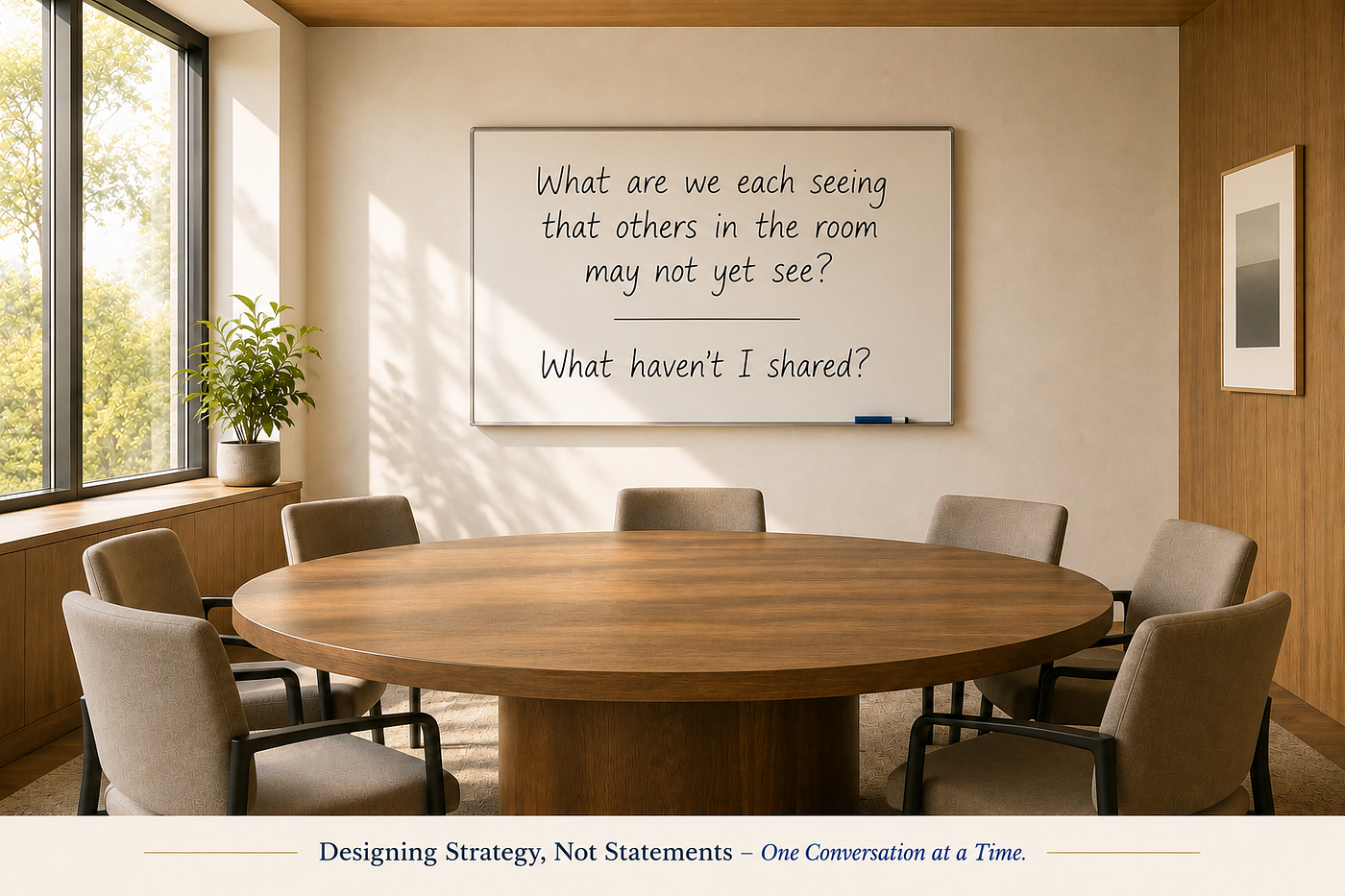
Shared understanding does not happen by accident. It is a product of disciplined leadership.
Before leaders ask, “Where do we want to go?”, they should first ask:
“What are we each seeing that others in the room may not yet see?”
That simple question changes the conversation.
And often, it changes the strategy design.
Practitioner’s Reference — A Practical Resource for Strategic Leaders
Ten Box Analysis©
The Ten Leadership Questions of the Ten Box Analysis
The Ten Box Analysis is a supporting conversation tool for the Analysis component of the Campana Continuous Strategic Planning Model. It helps leadership teams build shared understanding through disciplined observation and conversation before making strategic choices. The table below provides a concise reference to the ten leadership questions that guide those conversations. Use these perspectives to guide observation and conversation before making strategic choices. Their purpose is not to produce immediate answers, but to help leadership teams build the shared understanding from which good strategy emerges.

Tools do not design or create strategy. Leaders do. Tools simply support the disciplined strategic conversations through which strategy emerges.
© Steve Campana | The Practice of Strategy Series | Ten Box Analysis
메타데이터
- post_id
- 7da2a048e126
- slug
- building-shared-understanding-7da2a048e126
- url
- https://medium.com/@swcleadership/building-shared-understanding-7da2a048e126
- canonical_url
- https://medium.com/@swcleadership/building-shared-understanding-7da2a048e126
- author_url
- https://medium.com/@swcleadership
- status
- ok
- fetched_at
- 2026-08-21 11:58:18




