Multi-Layer Perceptron (MLP) Explained for Beginners: The Brain Behind Deep Learning
Have you ever wondered how computers can recognize your face, understand your voice, or even beat humans at chess? The secret lies in a…
Multi-Layer Perceptron (MLP) Explained for Beginners: The Brain Behind Deep Learning
Have you ever wondered how computers can recognize your face, understand your voice, or even beat humans at chess? The secret lies in a fascinating concept inspired by the human brain — the Multi-Layer Perceptron, or MLP.
In this article, we will break down the MLP from scratch using simple language and real-life examples. No prior experience in machine learning is needed. Let’s dive in!
🧠 What is a Neuron? (The Building Block)
Before we understand MLP, we need to understand what a single neuron is — because MLP is just a network of many neurons connected together!
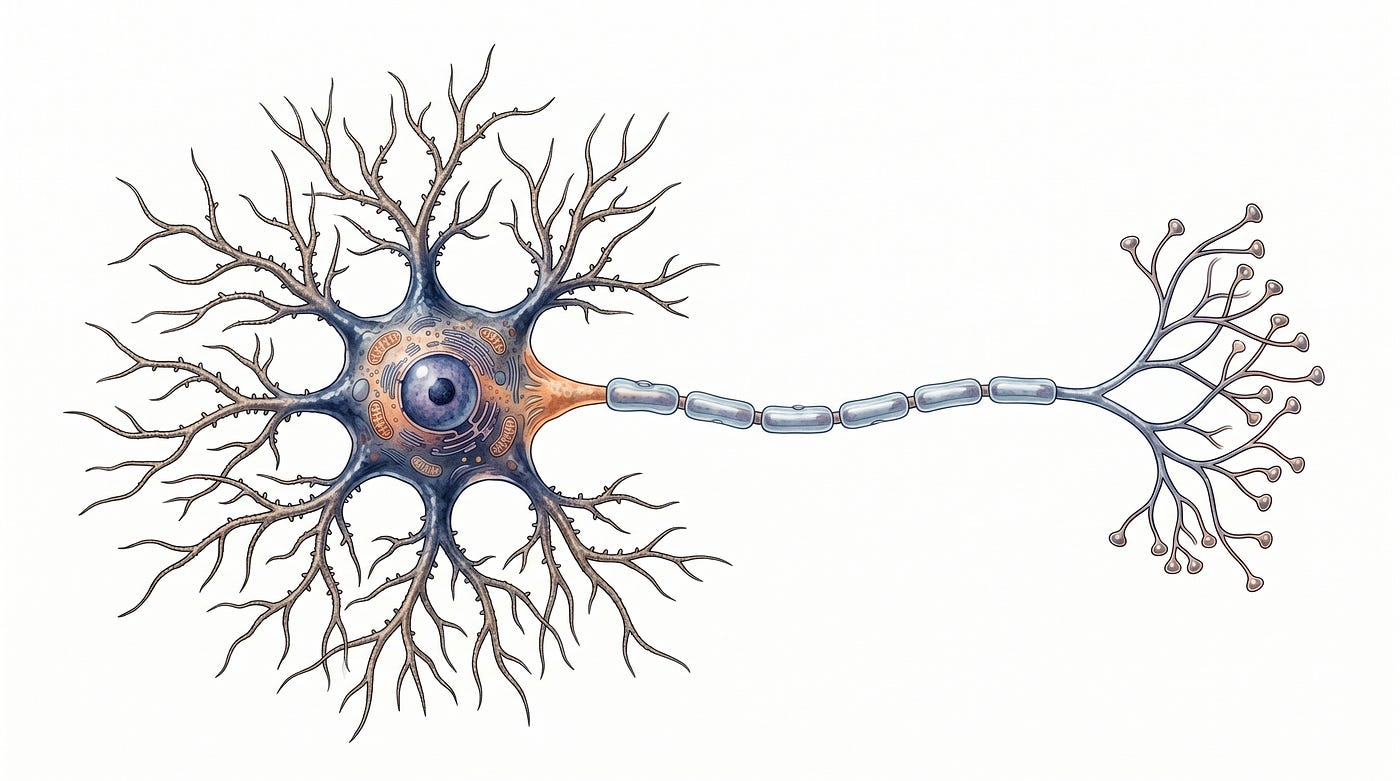
Think of a neuron like a tiny decision-maker. It receives some information, does a quick calculation, and passes the result forward.
Real-life analogy: Imagine you touch a hot cup of tea. Your nerve cells (neurons) sense the heat, send a signal to the brain, and the brain tells your hand to pull back. This is exactly how artificial neurons work in a computer!
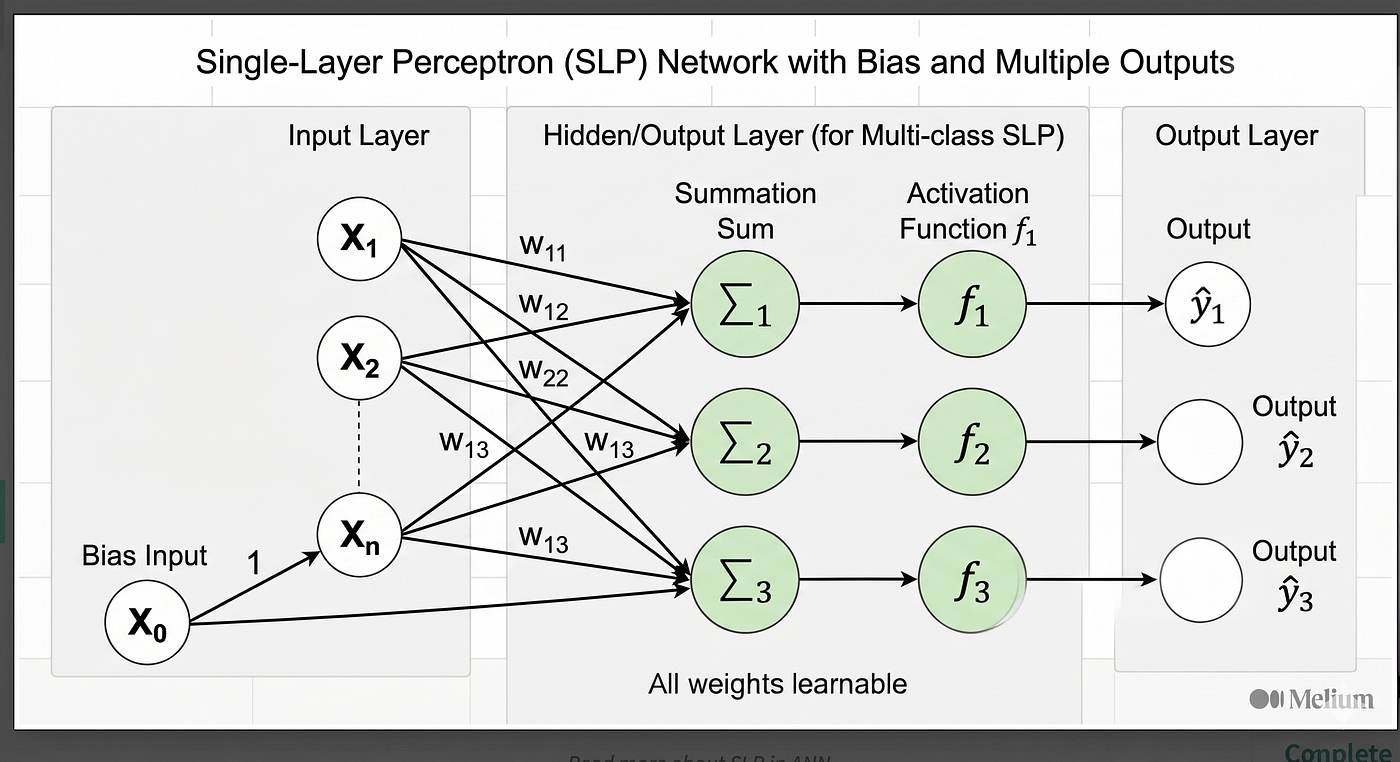
An artificial neuron has three main parts:
Inputs (x): These are the data or information coming in. For example, pixel values of an image.
Weights (w): These are like the importance level given to each input. The neuron learns which inputs are more important.
Bias (b): A small extra value that helps the neuron make better decisions.
Activation Function: This decides whether the neuron should “fire” (pass info forward) or stay quiet.
🔗 From a Single Neuron to a Perceptron
A Perceptron is the simplest form of a neural network — it’s just ONE neuron. It takes multiple inputs, multiplies each by a weight, adds them up, and passes through an activation function to produce an output.
Example: Let’s say you want to decide if you should carry an umbrella tomorrow.
Input 1: Is it cloudy? (1 = Yes, 0 = No)
Input 2: Is it the rainy season? (1 = Yes, 0 = No)
Input 3: Did it rain yesterday? (1 = Yes, 0 = No)
The perceptron would look at these inputs with their weights (importance), add them up, and give an output: “Yes, carry umbrella” or “No, don’t bother.”
🏛️ So What is a Multi-Layer Perceptron (MLP)?
A Multi-Layer Perceptron is like having MANY layers of these decision-making neurons stacked together. Instead of just one neuron making a single decision, hundreds or thousands of neurons work together across multiple layers to solve complex problems.
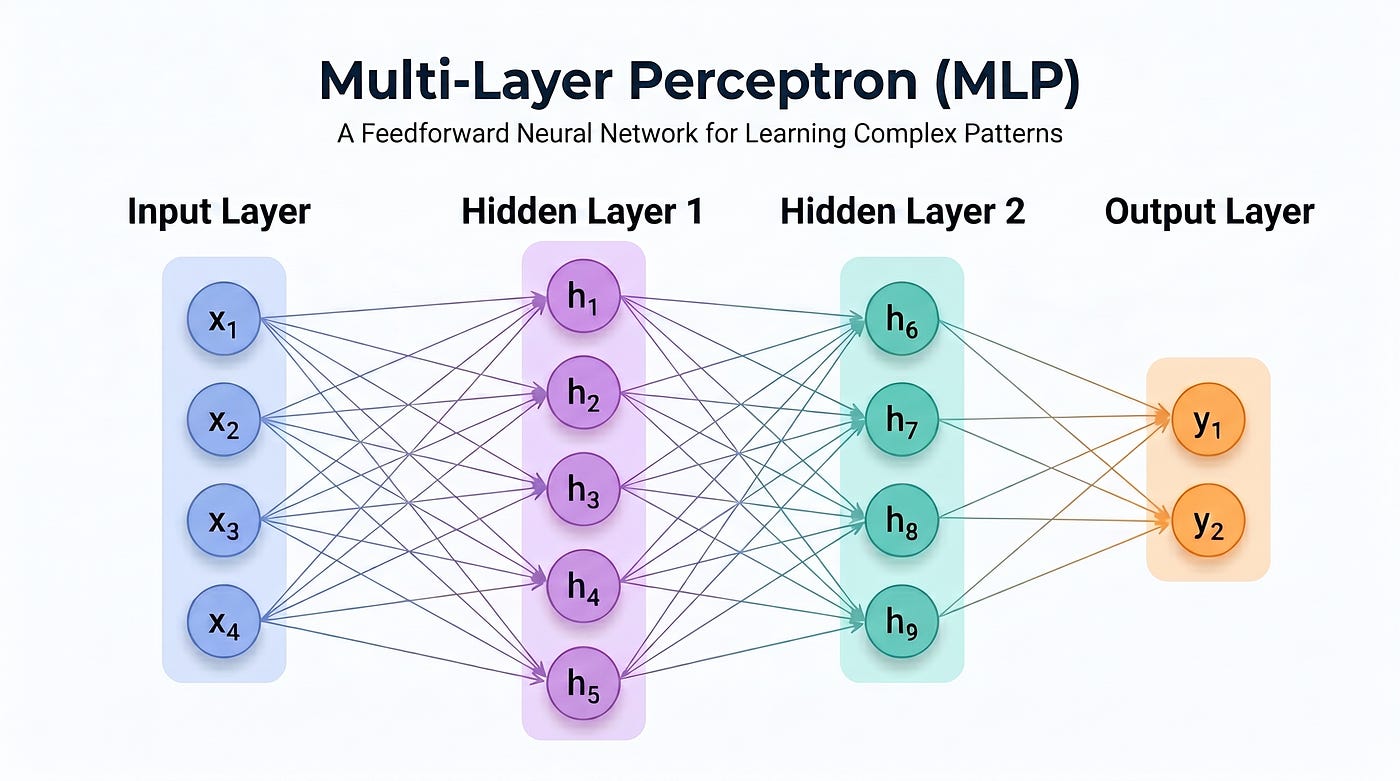
MLP has three types of layers:
-
Input Layer — This is where your data enters. Each node in this layer represents one feature of your data. For example, if you have a photo of 28x28 pixels, the input layer has 784 neurons (one per pixel).
-
Hidden Layer(s) — These are the “secret workers” in the middle. They transform the input data through calculations to find patterns. You can have one or many hidden layers. More hidden layers = more powerful the network!
-
Output Layer — This gives the final answer. For example, if you’re classifying if an email is spam or not, the output layer might have 2 neurons (spam / not spam).
⚡ How Does Information Flow Through an MLP?
The process of information flowing through an MLP is called Forward Propagation. Here’s how it works step by step:
Step 1: You feed the data into the Input Layer.
Step 2: Each neuron in the hidden layer receives inputs, multiplies them by weights, adds a bias, and passes the result through an activation function.
Step 3: The output of one layer becomes the input of the next layer.
Step 4: Finally, the Output Layer gives the prediction.
Think of it like a factory assembly line. The raw material (your data) enters one end, gets processed by many workers (neurons) in different stations (layers), and a finished product (the prediction) comes out the other end!
🔥 What are Activation Functions?
An activation function is a mathematical gate that decides what output a neuron produces. Without activation functions, an MLP would just be a very complicated addition machine and couldn’t learn complex patterns.
Here are the most common activation functions explained simply:
- Sigmoid Function
This squishes any number into a value between 0 and 1. It’s great for binary decisions like yes/no or true/false. Think of it like a light dimmer: output can be 0% (off) to 100% (fully on).
- ReLU (Rectified Linear Unit)
This is the most popular activation function today. It’s super simple: if the value is negative, output 0. If positive, output that same value. It’s like saying: “If the news is good, pass it along. If it’s bad (negative), ignore it!”
- Softmax
Used in the output layer when you have multiple classes (e.g., cat, dog, bird). It converts all outputs into probabilities that add up to 100%. “30% cat, 60% dog, 10% bird” — the model picks the highest one!
🔄 How Does the MLP Actually Learn?
This is the most magical part! The MLP learns by making mistakes and correcting them — just like how you learn to ride a bike by falling and adjusting.
Here’s how learning happens:
-
Make a Prediction: The MLP processes input data and outputs a prediction.
-
Measure the Error (Loss): We compare the prediction to the correct answer. The difference is called the loss or error.
-
Backpropagation: The error is sent backward through the network. Each neuron gets told how much it contributed to the mistake.
-
Update Weights: The weights are adjusted slightly so that next time, the prediction is a little bit better. This process is called Gradient Descent.
-
Repeat: This process repeats thousands of times until the network becomes accurate.
Analogy: Imagine practicing free throws in basketball. Every missed shot gives you feedback. You adjust your angle, force, and technique slightly each time. After hundreds of practice shots, your accuracy improves dramatically!
🌟 A Real-World Example: Recognizing Handwritten Digits
Let’s look at a classic example that beginners use to understand neural networks: recognizing handwritten digits (like the numbers 0 through 9).
Imagine the problem: You take a photo of someone’s handwritten number “7”. The computer needs to figure out that this is the digit 7.
How MLP solves this:
Input Layer: The image is 28x28 pixels = 784 pixels total. Each pixel’s brightness value (0 to 255) is fed as an input. So we have 784 input neurons.
Hidden Layers: Let’s say 2 hidden layers with 128 neurons each. They detect patterns like edges, curves, and intersections in the image.
Output Layer: 10 neurons (one for each digit 0–9). The neuron with the highest activation wins!
If the MLP sees an image, it might output: [0.01, 0.02, 0.01, 0.01, 0.01, 0.01, 0.01, 0.90, 0.01, 0.01]. The 8th value (index 7) is highest at 0.90, so the answer is: “This is the digit 7!” ✨
🚀 Where is MLP Used in Real Life?
MLPs are used in many exciting real-world applications:
📞 Spam Detection: Your email app uses an MLP (or similar network) to decide if an email is spam or not.
🏦 Fraud Detection: Banks use MLPs to detect suspicious transactions in real time.
🎤 Voice Recognition: When you talk to Siri or Google Assistant, an MLP helps convert your voice to text.
🏥 Medical Diagnosis: Doctors use ML models to predict diseases from patient data like blood reports and X-rays.
🎵 Music Recommendation: Spotify’s recommendation system uses neural networks to understand your music taste.
🚗 Self-Driving Cars: Neural networks process sensor data to help cars make driving decisions.
📝 Quick Summary: Key Takeaways
Here’s a quick cheat-sheet of everything we learned:
✅ A Neuron is a tiny decision-making unit inspired by biology.
✅ A Perceptron is a single neuron with inputs, weights, bias, and an activation function.
✅ MLP (Multi-Layer Perceptron) = Multiple layers of neurons: Input Layer → Hidden Layer(s) → Output Layer.
✅ Forward Propagation = Data flows from input to output through layers.
✅ Backpropagation = Errors flow backward to update weights and improve the model.
✅ Activation Functions like Sigmoid, ReLU, and Softmax add non-linearity and help solve complex problems.
✅ MLPs are used everywhere: spam filters, voice assistants, medical diagnosis, and more!
🏁 What’s Next?
Now that you understand the basics of Multi-Layer Perceptrons, here are some exciting topics to explore next:
➡️ Convolutional Neural Networks (CNNs) — Great for image recognition
➡️ Recurrent Neural Networks (RNNs) — Great for sequence data like text and speech
➡️ Transformers — The technology behind ChatGPT and modern AI
Remember: Every expert was once a beginner. The fact that you’re reading this means you’ve already taken the first step toward understanding one of the most powerful technologies of our time.
Keep learning, keep building, and don’t be afraid to experiment. The world of deep learning is exciting, rewarding, and full of possibilities for curious minds like yours! 🚀
메타데이터
- post_id
- 7da4ce91f339
- slug
- multi-layer-perceptron-mlp-explained-for-beginners-the-brain-behind-deep-learning-7da4ce91f339
- url
- https://medium.com/@surisettikrishna17/multi-layer-perceptron-mlp-explained-for-beginners-the-brain-behind-deep-learning-7da4ce91f339
- canonical_url
- https://medium.com/@surisettikrishna17/multi-layer-perceptron-mlp-explained-for-beginners-the-brain-behind-deep-learning-7da4ce91f339
- author_url
- https://medium.com/@surisettikrishna17
- status
- ok
- fetched_at
- 2026-06-20 20:29:01