The Shepherd’s Crown: Why Terry Pratchett’s Final Work is a Masterclass in the Continuity of the…
To speak of The Shepherd’s Crown is to speak of a goodbye that is as practical as it is profound. This final novel, completed in the…
The Shepherd’s Crown: Why Terry Pratchett’s Final Work is a Masterclass in the Continuity of the Soul
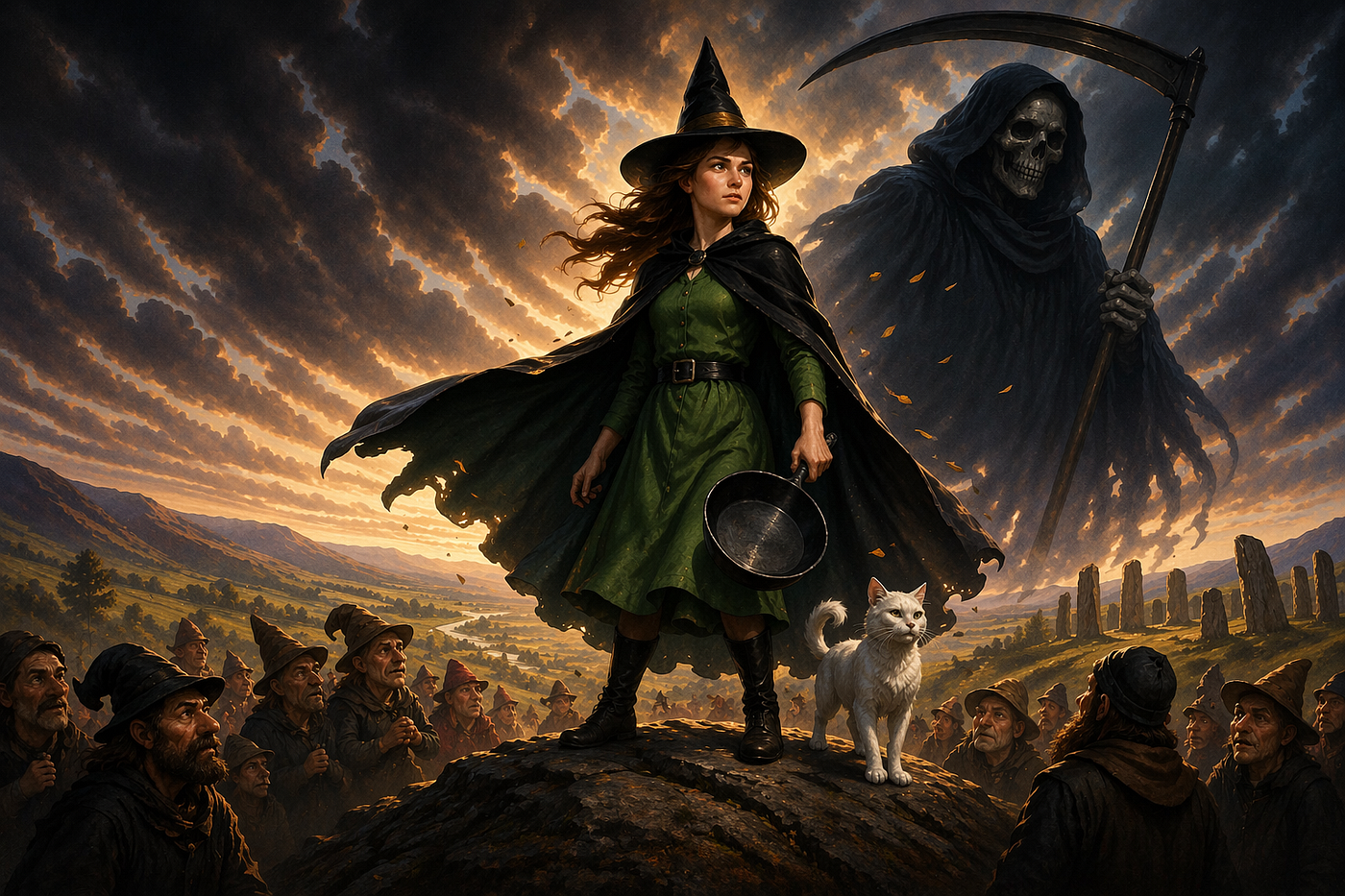
Tiffany Aching stands firm at the edge of myth and memory in The Shepherd’s Crown by Terry Pratchett — a powerful visual of legacy, identity, and the enduring continuity of the soul that defines the final Discworld novel.
To speak of The Shepherd’s Crown is to speak of a goodbye that is as practical as it is profound. This final novel, completed in the twilight of Terry Pratchett’s life, is not a grand, explosive finale filled with magic and fire. Instead, it is a quiet, “Muscular” study of the one thing that connects every living being on the Disc: the necessity of moving on. It is the story of Tiffany Aching coming into her full power, but more importantly, it is a story about how the world continues when the giants we rely on finally step away from the hearth.
At its core, this is a book about the “Continuity of the Soul.” It explores how a legacy is not something left behind like a dusty relic, but something that must be actively carried, polished, and put to use by those who remain.
The Passing of the Hat
The novel begins with a moment that shifted the foundation of the Discworld for every reader: the death of Granny Weatherwax. For decades, Esme Weatherwax was the immovable object of the series — the ultimate authority on right, wrong, and the “hard” truth. Her passing is handled with the trademark Pratchett dignity. She doesn’t vanish in a puff of smoke; she simply finishes her work, tidies her cottage, and waits for Death with her back straight.
This event serves as the catalyst for Tiffany’s final transformation. Suddenly, the “safety net” is gone. Tiffany is no longer the “young” witch; she is the witch. She is the one the others look to. Pratchett uses this transition to explore the weight of leadership. It’s one thing to do the work when you know a master is watching; it’s quite another to do it when you are the final word.
Tiffany’s struggle in this book is “Internal” and relentless. She has to manage two different steadings, negotiate the petty jealousies of the other witches, and face a renewed threat from the Fairyland — all while grieving. Pratchett shows us that grief isn’t a distraction from the work; for a witch, grief is part of the work. You acknowledge it, you give it its due, and then you pick up the broom because the floor still needs sweeping.
The Return of the Elves: The Hunger of the Fairyland
The primary “External” threat comes from the Elves, who sense the vacuum left by Granny Weatherwax’s departure. Pratchett’s Elves have always been terrifying — not because they are “evil” in the traditional sense, but because they are “Thin.” They have no empathy; they only have glamour, cruelty, and a desperate hunger for the “Solid” reality of the human world.
They see the Chalk as vulnerable. They believe that without the “Old Guard,” the land is ripe for the taking. This conflict allows Pratchett to pit two different philosophies against each other. The Elves represent the “Fiction” of glamour and the desire for power without responsibility. Tiffany and her allies represent the “Reality” of the soil, the sheep, and the hard-earned wisdom of the hearth.
The battle for the Chalk is not just a physical fight; it’s a defense of the “Common Man.” It’s about protecting the ordinary, messy, beautiful lives of shepherds and villagers from those who would turn them into playthings. Pratchett’s writing here is sharp and urgent, reminding us that the “Fairyland” is always waiting at the edge of our perception, looking for a moment of weakness.
The Integration of the “New”
One of the most surprising and delightful elements of The Shepherd’s Crown is the introduction of Geoffrey, a young man who wants to be a witch. In a world where gender roles are traditionally rigid — wizards are men, witches are women — Geoffrey is a quiet revolutionary. He doesn’t want to cast fireballs; he wants to help. He has “the touch” for animals and a calm, “Muscular” approach to care.
Through Geoffrey, Pratchett suggests that “Witchcraft” is not a gendered trait, but a temperament. It is a choice to stand between the victim and the bully. Geoffrey’s inclusion is a final nod to the theme of progress that defined the later Discworld books. It shows that even the most ancient traditions can grow and change without losing their essence. He represents the “future” of the work — a version that is more inclusive but just as dedicated to the “Logic” of the hearth.
The Gathering of the Witches
As the threat of the Elves grows, the witches of the Disc gather. We see Nanny Ogg, Magrat Garlick, and even characters from across the continent coming together. This “Gathering” feels like a final roll call. It is a celebration of the community that Pratchett built over thirty years.
There is a profound sense of “Togetherness” in these scenes. The witches don’t always like each other, and they certainly don’t always agree, but they share a common purpose. They are the “Invisible” infrastructure of the world. Seeing them stand together on the Chalk, prepared to defend their land with nothing but iron and “Headology” (used sparingly and with great effect), is a powerful testament to the strength of the collective.
The Shepherd’s Crown: A Symbol of the Land
The title refers to the fossilized sea urchins found in the chalk downs — objects that are “Ancient” and “Solid.” For Tiffany, the Shepherd’s Crown is a reminder of her heritage and her connection to her grandmother, Granny Aching. It symbolizes a power that is literally “of the earth.”
In the climax of the book, Tiffany doesn’t just use magic; she uses the land itself. She calls upon the memory of the shepherds who came before her. She proves that she isn’t just “wearing the hat”; she is the hat. She has earned her place not by defeating a villain, but by consistently choosing to care for her corner of the world.
Why This Book is a Masterpiece of Closure
1. A Perfect End for Tiffany Aching Watching Tiffany evolve from a girl with a frying pan to the “Shepherd” of her people is one of the most satisfying character arcs in literature. This book provides the final, necessary step in her journey. She finds a way to be “Tiffany” while still honoring the legacy of “Granny.”
2. A Brave Look at Mortality Pratchett wrote this book while facing his own “Final Chapter,” and that reality permeates every page. There is a lack of sentimentality that makes the emotional moments even more devastating. He doesn’t offer easy comforts; he offers the “Truth” that life goes on, and that is comfort enough.
3. The Final Deconstruction of the “Elite” Even in his final book, Pratchett was taking shots at the “Glamour” of the powerful. The Elves are the ultimate “Celebrities” — beautiful, vacuous, and dangerous. By having them defeated by a group of old women and a young man with a calm temperament, Pratchett reinforces his lifelong belief in the power of the “Ordinary.”
4. A Letter to the Fans There are moments in the book that feel like direct messages from the author to his readers. When he writes about the “Afterwards” and how the world keeps turning, it’s hard not to feel that he was preparing us for his own departure. It is a “Muscular” farewell — strong, honest, and deeply loving.
Conclusion: The Work Never Ends
The Shepherd’s Crown is not a book about the end of the world; it is a book about the beginning of the next one. It teaches us that while the “Giants” may leave the stage, the stage remains. The sheep still need shearing, the babies still need delivering, and the “Edge” still needs someone to stand on it.
Terry Pratchett’s final gift to his readers was the assurance that the “Work” continues. We don’t need magic to be heroes; we just need the courage to pick up the tools that have been left for us and the “Dignity” to do the job well. The shepherd has left the hill, but the crown remains in the soil, waiting for anyone brave enough to see it.
If the transition of power and the weight of legacy in The Shepherd’s Crown moved you, you should explore the concept of “Thin Places” in Celtic and British mythology. These are physical locations where the veil between the physical world and the spiritual world is said to be permeable — much like the “Edge” where the witches of the Chalk stand. Reading into the folklore of the English Downlands will show you exactly where Pratchett found the “Solid” inspiration for the Fairyland’s incursions and why the Chalk itself was always the most powerful character in Tiffany’s story.
In this final novel, Granny Weatherwax leaves her cottage to Tiffany not as a gift, but as a responsibility. She leaves the world “in good repair,” but it is up to those who remain to keep it that way. We often focus on what we want to “achieve” or “own,” but have you ever thought about what you are “leaving in good repair” for those who come after you? When the giants in your own life — the mentors, the parents, the leaders — step away, are you ready to pick up the “Shepherd’s Crown” and stand where the edge is, or are you still waiting for someone else to tell you what to do?
메타데이터
- post_id
- 7dab72163071
- slug
- the-shepherds-crown-why-terry-pratchett-s-final-work-is-a-masterclass-in-the-continuity-of-the-7dab72163071
- url
- https://medium.com/@daveloftus2099/the-shepherds-crown-why-terry-pratchett-s-final-work-is-a-masterclass-in-the-continuity-of-the-7dab72163071
- canonical_url
- https://medium.com/@daveloftus2099/the-shepherds-crown-why-terry-pratchett-s-final-work-is-a-masterclass-in-the-continuity-of-the-7dab72163071
- author_url
- https://medium.com/@daveloftus2099
- status
- ok
- fetched_at
- 2026-06-23 06:34:20