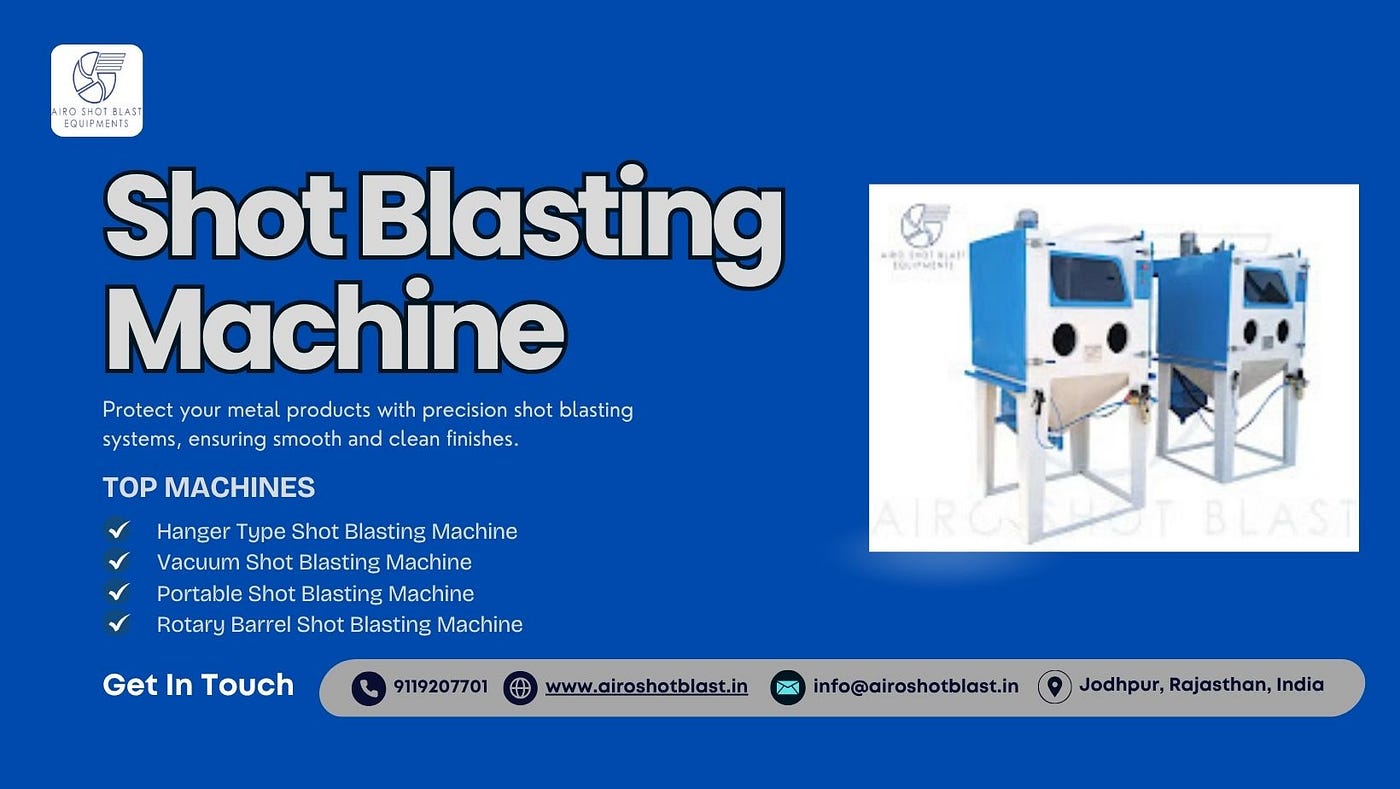
Understanding Shot Blasting Machines: Types, Working Principles, and Use Cases
In today’s fast-evolving manufacturing landscape, surface preparation has emerged as a decisive factor in product quality, durability, and…
Understanding Shot Blasting Machines: Types, Working Principles, and Use Cases
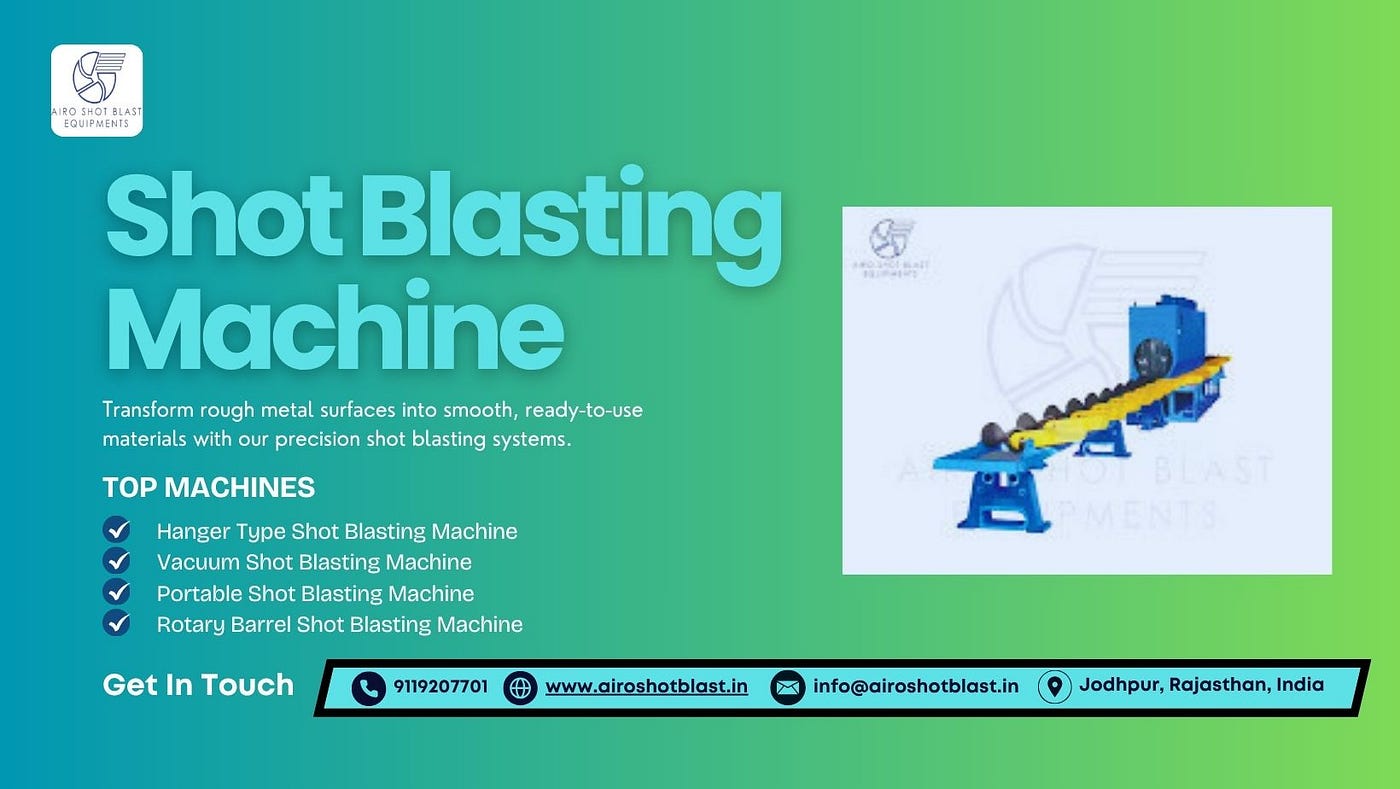
Shot Blasting Machine
In today’s fast-evolving manufacturing landscape, surface preparation has emerged as a decisive factor in product quality, durability, and compliance with industrial standards. Among the various surface treatment technologies available, shot blasting machine continue to gain attention for their efficiency, consistency, and industrial relevance.
As sectors such as automotive, construction, foundry, and heavy engineering scale up operations, understanding shot blasting machines — particularly their types, working principles, and real-world use cases — has become increasingly important.
Shot Blasting Machines: An Overview
Shot blasting machines are industrial systems designed to clean, strengthen, or texture surfaces by propelling abrasive media at high velocity. Unlike manual or chemical cleaning methods, shot blasting offers controlled, repeatable results with minimal environmental impact. The process is primarily used on metal components but is also applied to concrete, stone, and certain composites.
Industry experts note that shot blasting has transitioned from being a secondary finishing process to a core manufacturing step, especially where coating adhesion, fatigue resistance, and surface uniformity are critical.
Also Check — Shot Blasting Machine Manufacturers, Shot Blasting Machine Price in India, Shot Blasting Machine Manufacturers in India, Shot Blasting Machine Price
Working Principle: How Shot Blasting Machines Operate
At the heart of every shot blasting machine lies a straightforward yet powerful working principle. Abrasive media — commonly steel shots or grits — is accelerated using a blast wheel (turbine) or compressed air system. These abrasives strike the surface of the workpiece, removing rust, mill scale, paint, and contaminants through kinetic energy.
The process typically follows these steps:
- Abrasive media is fed into the blasting system
- A turbine or air nozzle accelerates the media
- High-speed impact cleans or textures the surface
- Used abrasives are collected, filtered, and reused
- Dust and fine particles are separated via dust collectors
This closed-loop operation ensures both cost efficiency and environmental control, making shot blasting suitable for continuous industrial use.
Key Types of Shot Blasting Machines
As industrial requirements vary widely, manufacturers offer multiple types of shot blasting machines, each tailored to specific applications.
Cabinet Shot Blasting Machines
Used for small to medium-sized components, cabinet machines provide enclosed blasting for precision cleaning. They are commonly found in workshops and maintenance facilities.
Tumble Type Shot Blasting Machines
Designed for bulk processing, these machines are ideal for nuts, bolts, castings, and forged parts. Components tumble inside the chamber, ensuring uniform surface treatment.
Hanger Type Shot Blasting Machines
Best suited for large, complex, or delicate parts, hanger type machines allow components to be suspended and rotated for complete exposure.
Table Type Shot Blasting Machines
Featuring a rotating table, these machines are used for flat or circular parts requiring consistent blasting from multiple angles.
Portable Shot Blasting Machines
Increasingly popular in infrastructure projects, portable systems are used for on-site cleaning of floors, bridges, pipelines, and ship decks.
Industry analysts highlight that selecting the correct machine type directly impacts productivity, abrasive consumption, and final surface quality.
Website -
https://www.shotblastingmachines.in/shot-blasting-machine
https://www.sandblastingmachine.in/shot-blasting-machine/shot-blasting-machine
https://www.sandblast.in/product/shot-blasting-machine-manufacturers
Industrial Use Cases and Applications
Shot blasting machines are now integral across a wide range of industries.
In the automotive sector, they are used to clean engine blocks, gears, and suspension components while also improving fatigue strength. The construction industry relies on shot blasting to prepare steel beams, plates, and rebars before coating or welding. In foundries, shot blasting is essential for removing sand and scale from castings, ensuring dimensional accuracy and surface integrity.
The shipbuilding and marine industry uses shot blasting extensively for hull preparation and corrosion control, while the railway sector applies it to wheelsets, tracks, and structural assemblies. Even aerospace manufacturing employs specialized shot blasting for stress relief and surface conditioning of critical components.
Why Shot Blasting Remains Industry-Relevant
Despite advances in alternative surface treatment methods, shot blasting machines continue to stand out for several reasons:
- High consistency and repeatability
- Improved coating adhesion
- Enhanced component lifespan
- Reduced chemical usage
- Lower long-term operating costs
Manufacturers also point out that modern shot blasting machines are increasingly automated, energy-efficient, and compliant with global safety and environmental standards.
Outlook: Growing Adoption Across Industries
With infrastructure development, automotive production, and heavy engineering projects on the rise, demand for shot blasting machines is expected to grow steadily. Automation, PLC-controlled systems, and improved dust management technologies are further driving adoption.
As surface quality becomes a competitive differentiator, shot blasting machines are no longer viewed as optional equipment but as strategic industrial assets.
Conclusion
Understanding shot blasting machines — their types, working principles, and use cases — provides valuable insight into modern manufacturing practices. As industries prioritize durability, efficiency, and sustainability, shot blasting continues to play a central role in meeting these objectives. For manufacturers aiming to improve surface quality and operational performance, shot blasting remains a proven and future-ready solution.
메타데이터
- post_id
- 7db6aa680c72
- slug
- understanding-shot-blasting-machines-types-working-principles-and-use-cases-7db6aa680c72
- url
- https://medium.com/@amarkhand33/understanding-shot-blasting-machines-types-working-principles-and-use-cases-7db6aa680c72
- canonical_url
- https://medium.com/@amarkhand33/understanding-shot-blasting-machines-types-working-principles-and-use-cases-7db6aa680c72
- author_url
- https://medium.com/@amarkhand33
- status
- ok
- fetched_at
- 2026-08-02 10:22:45