Why Social Security Shouldn’t Be Your Only Retirement Plan
For millions of Americans, Social Security represents peace of mind. After decades of working and contributing through payroll taxes, many…
Why Social Security Shouldn’t Be Your Only Retirement Plan
For millions of Americans, Social Security represents peace of mind. After decades of working and contributing through payroll taxes, many expect it to provide financial stability throughout retirement.
And it does.
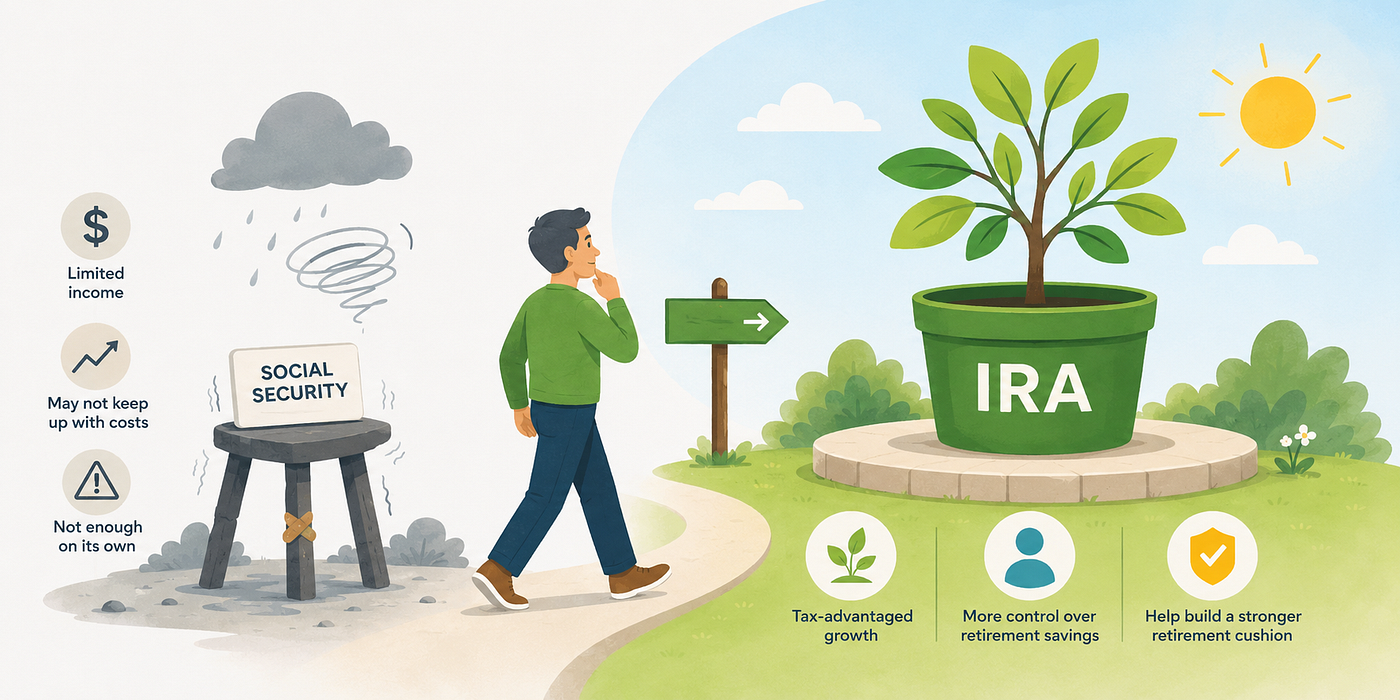
Social Security has long served as one of the most important pillars of retirement income in the United States. But it was never intended to be the only pillar.
As retirement costs continue to rise and Americans live longer than ever before, relying solely on Social Security may leave many retirees financially vulnerable. Recent research also shows that confidence in the program’s future is beginning to decline, reinforcing the importance of building retirement savings beyond government benefits.
Americans Continue to Rely on Social Security
Social Security remains a critical source of retirement income for millions of Americans.
According to **PlanGap’s 2026 Social Security Confidence Survey, 83% of Americans aged 45 and older say Social Security will play a major or moderate role in their retirement, and 60% expect it to provide at least half of their retirement income.**
These findings illustrate just how deeply Americans depend on Social Security to support their retirement years.
However, dependence doesn’t necessarily equal confidence.
The same survey found that 69% of respondents are not confident that Social Security benefits will remain at today’s levels, while nearly 68% worry they may not receive their full promised benefits.
Whether these concerns ultimately materialize or not, they highlight an important reality: retirement planning becomes more resilient when it’s built on multiple income sources rather than a single one.
Social Security Was Never Designed to Replace Your Entire Income
One of the biggest misconceptions about retirement planning is that Social Security should provide enough income to maintain your lifestyle after you stop working.
In reality, Social Security was created to replace only a portion of your pre-retirement earnings.
That means expenses such as housing, healthcare, travel, inflation, and unexpected emergencies often need to be supported by personal savings and investments.
This isn’t a flaw in the system, it’s how the program was designed.
Financial planners have long recommended combining Social Security with employer-sponsored retirement plans, Individual Retirement Accounts (IRAs), and other savings to create a more balanced retirement strategy.
Why Building Additional Retirement Savings Matters
No one can predict exactly how retirement will look 20 or 30 years from now.
Healthcare costs may increase.
Inflation may reduce purchasing power.
Tax laws may change.
Government programs may evolve.
While these factors are largely outside your control, one thing remains within your control: how consistently you save for retirement today.
Building your own retirement savings doesn’t replace Social Security — it complements it.
Instead of relying on a single monthly benefit, you’ll have multiple sources of income working together to support your retirement goals.
How an IRA Can Help Strengthen Your Retirement Plan
One of the simplest ways to build additional retirement savings is through an Individual Retirement Account (IRA).
IRAs offer tax advantages that can help your investments grow over time while giving you greater flexibility in retirement.
Traditional IRA
A Traditional IRA allows eligible contributions to grow tax-deferred until retirement. Depending on your income and participation in an employer-sponsored retirement plan, contributions may also be tax deductible.
For many investors, this means reducing taxable income today while allowing investments to compound over time.
Roth IRA
A Roth IRA offers a different tax advantage.
Although contributions are made with after-tax dollars, qualified withdrawals in retirement are generally tax-free.
For individuals who expect to be in the same or a higher tax bracket during retirement, a Roth IRA can provide valuable tax flexibility later in life.
Self-Employed or Own a Small Business?
Retirement planning isn’t limited to traditional employees.
If you’re self-employed or operate a small business, you have additional retirement savings options available.
A SEP IRA allows eligible business owners and self-employed individuals to make larger retirement contributions than Traditional or Roth IRAs, making it an attractive option for accelerating retirement savings.
A SIMPLE IRA provides small businesses with an easy way to offer retirement benefits while helping employees save consistently for the future.
Choosing the right account depends on factors such as your employment status, business structure, income, and long-term financial goals.
Don’t Let Uncertainty Delay Your Retirement Planning
The latest Social Security Board of Trustees Report projects that the Old-Age and Survivors Insurance (OASI) Trust Fund could be depleted in 2032 if no legislative changes are made. Even under that scenario, incoming payroll taxes would continue funding a significant portion of scheduled benefits, and lawmakers have multiple options to address the funding gap.
While no one knows exactly what future reforms may look like, waiting for certainty isn’t a retirement strategy.
The earlier you begin saving independently, the more time your investments have to grow through compounding.
Even small, consistent contributions can make a meaningful difference over the course of several decades.
Build a Retirement Plan You Can Control
Social Security remains an essential part of retirement planning and will likely continue to play an important role for millions of Americans.
But it was never intended to be your entire retirement plan.
Building additional savings through a Traditional IRA and a Roth IRA. If you’re a business owner, a SEP IRA or SIMPLE IRA can help create a more diversified and resilient retirement strategy.
The future will always include uncertainty.
Your retirement plan doesn’t have to.
References
- PlanGap. 2026 Social Security Confidence Survey. https://www.plangap.com/
- Social Security Administration. 2026 Annual Report of the Board of Trustees of the Federal Old-Age and Survivors Insurance and Federal Disability Insurance Trust Funds. https://www.ssa.gov/oact/tr/
메타데이터
- post_id
- 7dcfeeeffae4
- slug
- why-social-security-shouldnt-be-your-only-retirement-plan-7dcfeeeffae4
- url
- https://medium.com/wealthrabbit/why-social-security-shouldnt-be-your-only-retirement-plan-7dcfeeeffae4
- canonical_url
- https://medium.com/wealthrabbit/why-social-security-shouldnt-be-your-only-retirement-plan-7dcfeeeffae4
- author_url
- https://medium.com/@wealthrabbit
- status
- ok
- fetched_at
- 2026-07-08 19:15:55