The Risk of “Good Enough” AI in Legal Contexts
The Risk of “Good Enough” AI in Legal Contexts
The Risk of “Good Enough” AI in Legal Contexts
The Risk of “Good Enough” AI in Legal Contexts
In regulated environments, “almost correct” is not a margin of safety — it’s a source of risk.
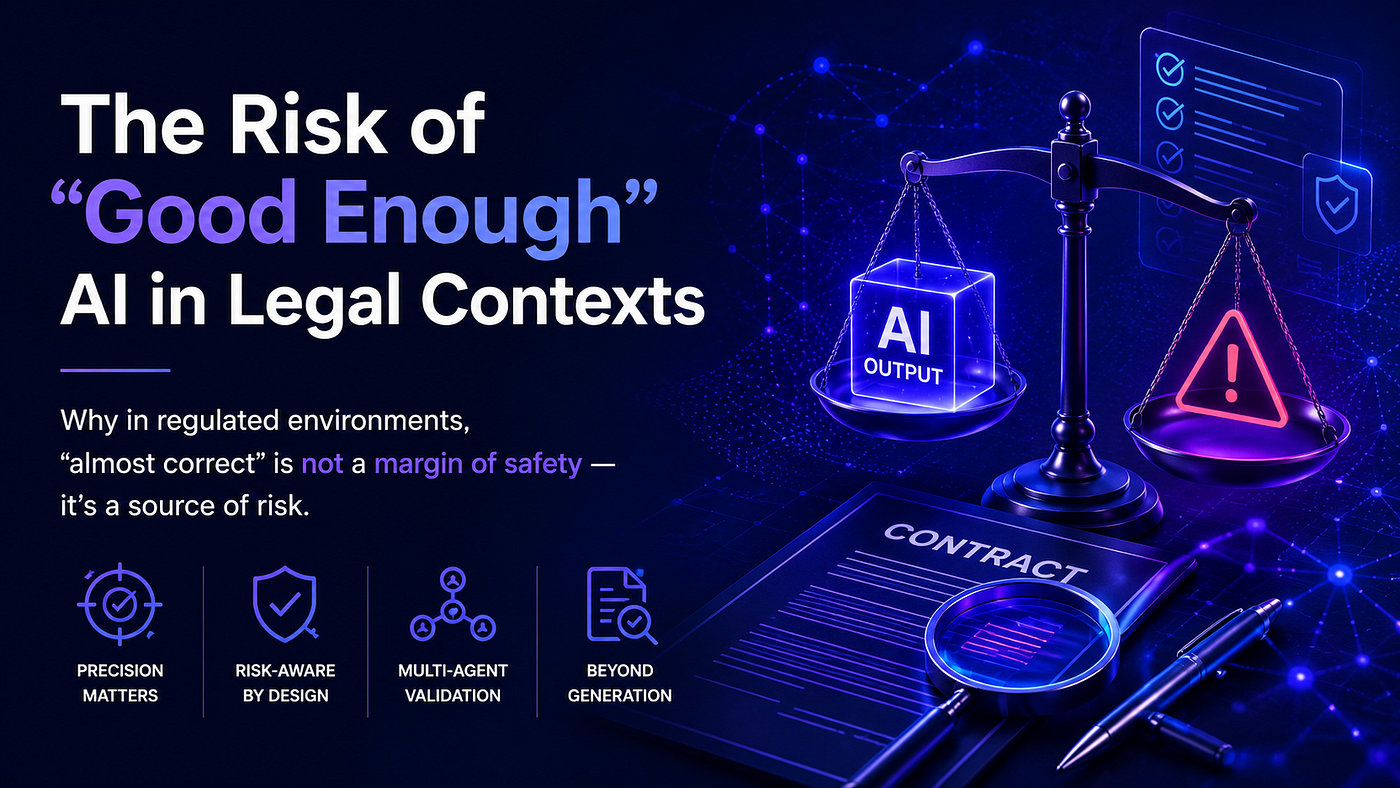
When “good enough” stops being enough
In many areas of technology, “good enough” is a perfectly acceptable standard.
A recommendation engine doesn’t need to be perfect. A marketing tool can tolerate some level of inaccuracy. Even productivity software is often judged by speed and convenience rather than precision.
But legal systems don’t work that way.
In law, the difference between correct and almost correct is not marginal. It can define outcomes, obligations, and liability. And when AI enters this space, applying a “good enough” mindset becomes not just insufficient — but potentially dangerous.
The illusion of acceptable accuracy
AI performance is often framed in terms of percentages. A system that achieves 95% accuracy sounds reliable, especially when compared to earlier generations of technology.
But that framing can be misleading.
In legal contexts, a 5% error rate is not a rounding issue. It means that one in twenty outputs may contain a flaw — a misinterpreted clause, a missing obligation, or a subtle inconsistency that only becomes visible later.
And unlike other domains, legal errors rarely stay isolated. They propagate.
A single incorrect assumption in a contract can affect interpretation, enforcement, and dispute resolution. What appears to be a minor imperfection at the generation stage can evolve into a much larger issue once the agreement is executed.
Why legal AI operates under different rules
Legal systems are inherently risk-sensitive. They are built around precision, consistency, and accountability.
Errors in this domain don’t just affect usability — they carry consequences. Financial exposure, regulatory non-compliance, and reputational damage are all part of the equation. And unlike in less critical applications, these consequences often emerge over time, not immediately.
This creates a fundamentally different threshold for AI systems used in legal workflows.
It’s not enough for them to be useful or efficient. They need to be dependable in a way that aligns with how legal processes operate: structured, verifiable, and resistant to hidden inconsistencies.
Where “good enough” breaks down
The limitations of “good enough” AI become particularly visible in core legal use cases.
Document generation is a clear example. An AI system can produce a well-structured contract that looks correct on the surface. But if it fails to account for jurisdictional nuances or evolving regulations, the risk is embedded directly into the document.
The same applies to legal interpretation. Even when the reasoning appears coherent, missing context or unvalidated assumptions can lead to conclusions that are difficult to rely on in practice.
Compliance introduces yet another layer of complexity. Regulations are dynamic, interconnected, and often context-dependent. Treating them as static inputs increases the likelihood of subtle but critical errors.
In all these cases, the issue is not that AI fails completely. It’s that it fails quietly.
Designing AI with risk in mind
If “good enough” is not acceptable, the alternative is not simply “more accurate AI.” It is a different approach to system design.
Risk-aware AI systems don’t treat generation as the final step. They incorporate additional layers that evaluate, validate, and contextualize outputs.
This is the direction taken by platforms like LegalTorch, where document creation is combined with risk analysis and clause-level evaluation. Instead of assuming that a generated agreement is correct, the system actively identifies potential weaknesses and aligns outputs with current legal frameworks.
This kind of design acknowledges a simple reality: in legal contexts, identifying uncertainty is just as important as producing content.

The role of multi-layer validation
Another important shift is moving from single-model outputs to systems that incorporate internal validation.
When multiple components are involved in the reasoning process, the system gains the ability to cross-check its own conclusions. Different perspectives can be compared, inconsistencies can be flagged, and assumptions can be challenged before a final output is produced.
This is the principle behind multi-agent architectures, where specialized agents collaborate within a structured workflow rather than operating as a single, monolithic model. In systems like VAIOT’s AI Legal Multi-Agent, this approach allows for a more controlled and auditable reasoning process, reducing the likelihood of systemic errors.
What matters here is not just redundancy, but structured interaction. Validation becomes part of the process, not an afterthought.
Even correct AI can lead to disputes
There is another dimension that is often overlooked.
Even when a contract is well-structured and correctly generated, disagreements can still arise. Interpretation, execution, and real-world conditions introduce uncertainty that cannot be fully eliminated at the drafting stage.
This is where the concept of legal infrastructure becomes broader than AI alone.
Systems need to account not only for how agreements are created, but also for how they are enforced and how disputes are resolved. Without this layer, even high-quality legal outputs remain exposed to real-world friction.
This is the role of frameworks like decentralized dispute resolution systems, where contracts, evidence, and outcomes are handled within a transparent and verifiable process. In VAIOT’s DDRS, this includes mechanisms such as escrow, structured evidence handling, and decentralized juror evaluation — extending the legal workflow beyond generation into resolution.
Moving beyond “good enough”
The idea of “good enough AI” is rooted in convenience. It assumes that small imperfections are acceptable as long as the overall experience is efficient.
In legal contexts, that assumption doesn’t hold.
What is needed instead are systems that are designed with risk as a core principle — systems that recognize uncertainty, validate outputs, and integrate multiple layers of control.
This doesn’t mean AI needs to be perfect. But it does mean it needs to be structured in a way that reflects the realities of the domain it operates in.
Final thought
“Good enough” is a useful benchmark in many areas of technology.
In law, it’s a liability.
As AI becomes more deeply embedded in legal workflows, the focus must shift from convenience to reliability — from generating answers to building systems that can be trusted.
Because in regulated environments, the real question is not how often AI is right.
It’s what happens when it isn’t.
About VAIOT
VAIOT offers LegalTech and DeLaw solutions to democratize access to legal services by leveraging AI and Blockchain. Proudly, we are the first VFAA-regulated digital asset issuer.
VAIOT- AI and Blockchain for Legal Innovation.
Read our AI Legal Assistant Lightpaper here.
For more information about VAIOT, visit our website www.vaiot.ai, or join our Twitter , Telegram Community, Discord Server or Youtube Channel for continuous updates.
The VAIOT Website, Platforms, Solutions, and Services, and in particular VAI Tokens, are not offered for use and purchase to natural and legal persons having their permanent residence or their seat of incorporation in any of the restricted areas as listed in VAIOT’s Whitepaper, in particular: USA, Germany, Puerto Rico, US Virgin Islands, Canada, China, Singapore, Afghanistan, Central African Republic, Cuba, Democratic Republic of the Congo, Eritrea, Iran, Iraq, Libya, North and South Korea, Somalia, South Sudan, Sudan, Yemen, Zambia (Restricted Areas).
메타데이터
- post_id
- 7de5c0bb0c39
- slug
- the-risk-of-good-enough-ai-in-legal-contexts-7de5c0bb0c39
- url
- https://medium.com/@vaiotltd/the-risk-of-good-enough-ai-in-legal-contexts-7de5c0bb0c39
- canonical_url
- https://medium.com/@vaiotltd/the-risk-of-good-enough-ai-in-legal-contexts-7de5c0bb0c39
- author_url
- https://medium.com/@vaiotltd
- status
- ok
- fetched_at
- 2026-06-10 21:21:38



