The Painter of Dancing Girls
Ballerinas, dancers in tutus in mirrored halls or on stage, captured in the execution of a plié — these are all motifs that became the…
The Painter of Dancing Girls
Ballerinas, dancers in tutus in mirrored halls or on stage, captured in the execution of a plié — these are all motifs that became the trademark of the artist who took his first breath on July 19, 1834, in Paris under his given name Hilaire Germain Edgar de Gas. Degas came from a bourgeois family and was not initially intended for an artistic career.
His father’s wishes included a law degree, which he abandoned in favor of art after a short time. Edgar Degas appears to have been a free spirit who didn’t care much for the rigid rules that also prevailed at art schools of the time, so he left the École des Beaux-Arts shortly after enrolling and took his artistic education into his own hands.
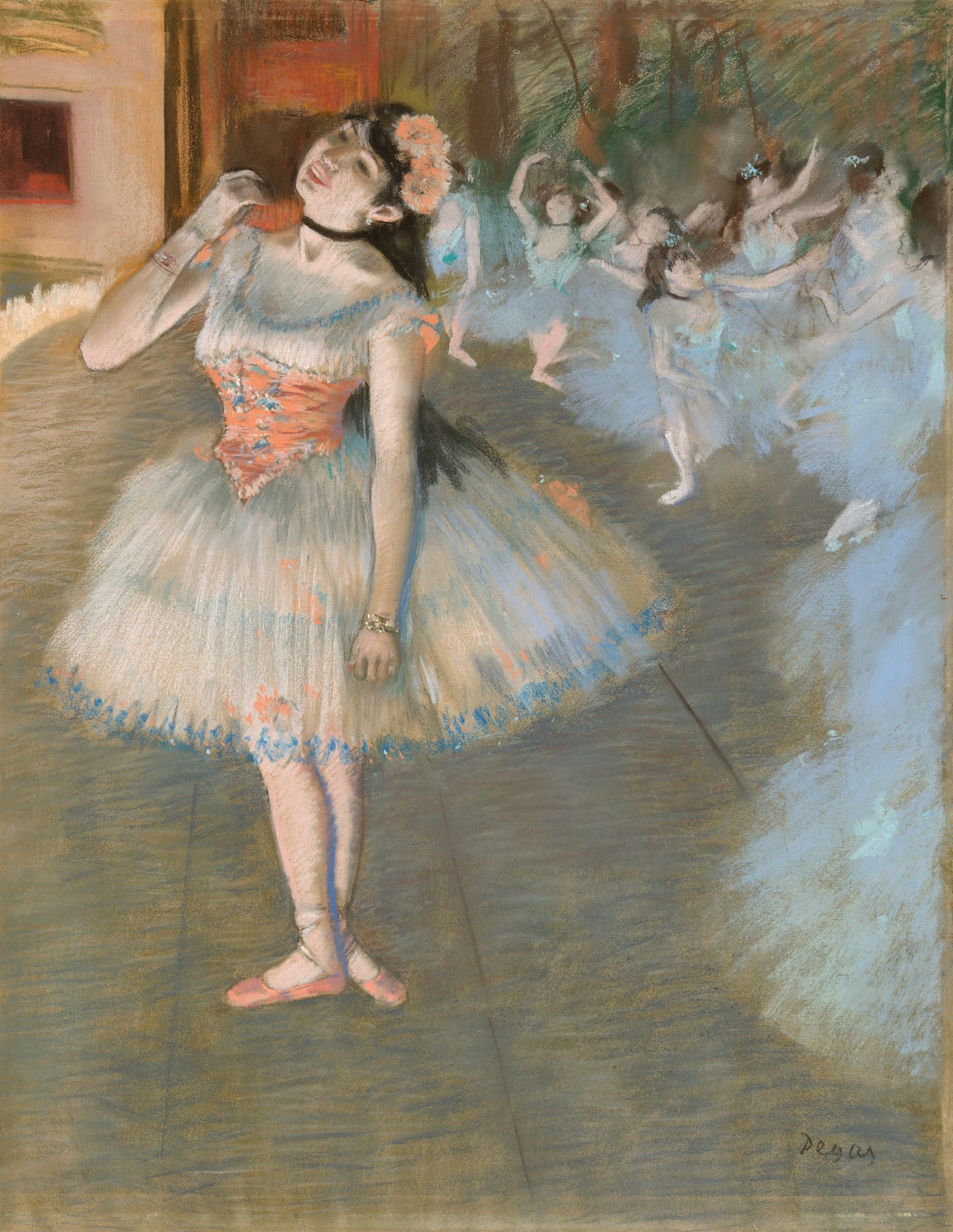
The Star, 1879/81, Edgar Degas; CC0 Art Institute Chicago
Although he is best known today for his dancers, he also explored other subjects, such as Parisian nightlife, women in boudoirs, or jockeys and horses. He also experimented with other techniques and media, such as photography and especially sculpture. He is often categorized as an Impressionist, but his works differ in so many ways from those of his contemporaries that such a categorization does not do him justice. An attentive observer will not find the typical features of this style epoch in Degas’ works, or only to a limited extent. Clear lines and well-structured compositions were more important to him than spontaneous brushstrokes captured on the banks of the Seine.
Did you also know that he created most of the works for which he is famous today and which even laypeople associate with his name, purely for economic reasons? It was not a personal preference for ballet, but the enormous debts accumulated by his brother that threatened the family, which drove him to paint what would sell well and fit the taste of the time.
Yet despite the initially purely economic reasons behind his many depictions of dancers, Degas’ works contain something else that is not immediately apparent. Comparing his works, it becomes noticeable that he always focuses on a moment within a rehearsal, before a performance, behind the scenes, or similar, but never the actual performance.
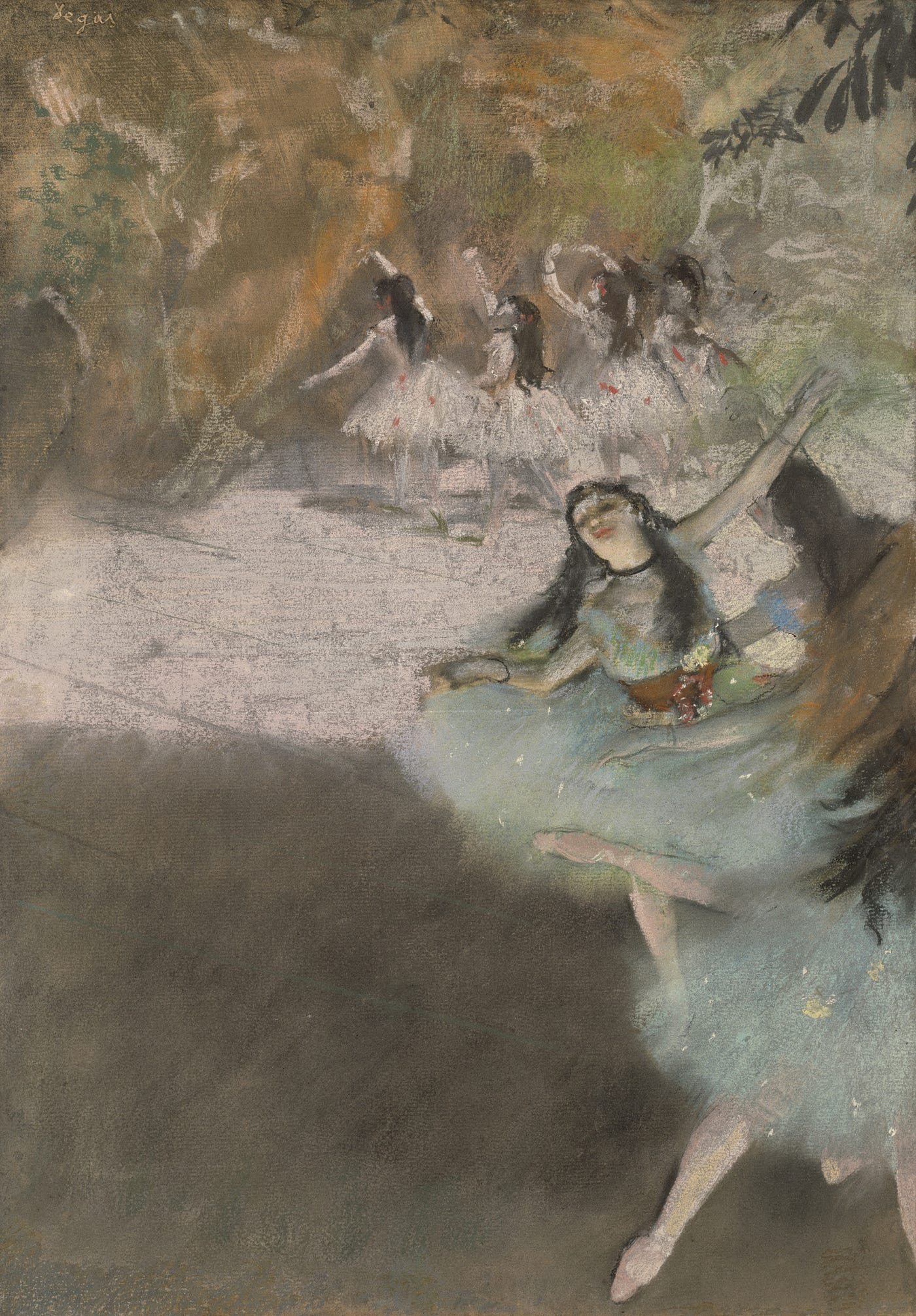
On the Stage, 1876–77, Edgar Degas; CC0 Art Institute Chicago
The dancers are always at the center of his works, captured in a pose that is an expression of dance and, thus, an expression of work in the broadest sense. Another characteristic is a composition that pushes the actual action to the edge of the image. Take, for example, his painting The Dance Class from 1872: here, the action takes place at the upper left edge of the painting, leaving the right side almost entirely empty. Individual dancers are only partially depicted or almost completely hidden by the piano on the left side of the painting.
In both instances, Degas employs stylistic elements of emerging photography and seemingly captures his impressions spontaneously. Behind each depiction of a dancer lies precise studies and sometimes numerous preliminary sketches. Although he rejected Impressionism himself and referred to himself as a Realist, he became an important representative of this style.
(Stephanie Schoger)
메타데이터
- post_id
- 7df49ccf7ccf
- slug
- the-painter-of-dancing-girls-7df49ccf7ccf
- url
- https://medium.com/@der_leiermann/the-painter-of-dancing-girls-7df49ccf7ccf
- canonical_url
- https://medium.com/@der_leiermann/the-painter-of-dancing-girls-7df49ccf7ccf
- author_url
- https://medium.com/@der_leiermann
- status
- ok
- fetched_at
- 2026-07-20 00:44:07