Can RuPay Pay While You Sleep? India’s Card Rail Meets the Age of AI Agents
Visa, Mastercard and Stripe have already taught AI agents how to pay. Here’s what an agentic future could look like on India’s own card…
Can RuPay Pay While You Sleep? India’s Card Rail Meets the Age of AI Agents
Visa, Mastercard and Stripe have already taught AI agents how to pay. Here’s what an agentic future could look like on India’s own card network.
This is a conceptual thought experiment exploring global payment trends, not a reflection of internal roadmaps, active projects, or technical specifications at any organization. It is an independent explainer for anyone curious about Indian fintech, UPI, RuPay, and AI-driven payments, built entirely from public sources, company announcements, regulator data, and industry reports. Any architecture described here is a generalized industry concept, inferred from what global networks have already published. It does not represent the views of, or any product under development at, any payment network or institution.
The moment a chatbot becomes a buyer
Picture this. It’s a Tuesday evening. You haven’t checked your kitchen, but your phone buzzes: “Ordered 2L milk, bread and eggs from your usual store, ₹847, arriving by 9 PM.” You didn’t open an app. You didn’t tap “Pay.” An AI assistant noticed you were running low, built a cart, and paid for it within limits you’d set weeks ago.
This isn’t science fiction. It’s called agentic commerce, and in the last twelve months it has gone from demo to deployed. The shift it represents is bigger than it first appears, because every payment system on Earth was built on one quiet assumption: a human is sitting there, clicking “Pay.”
When an AI agent transacts on your behalf, that assumption breaks. And three new questions appear that the old plumbing simply can’t answer.
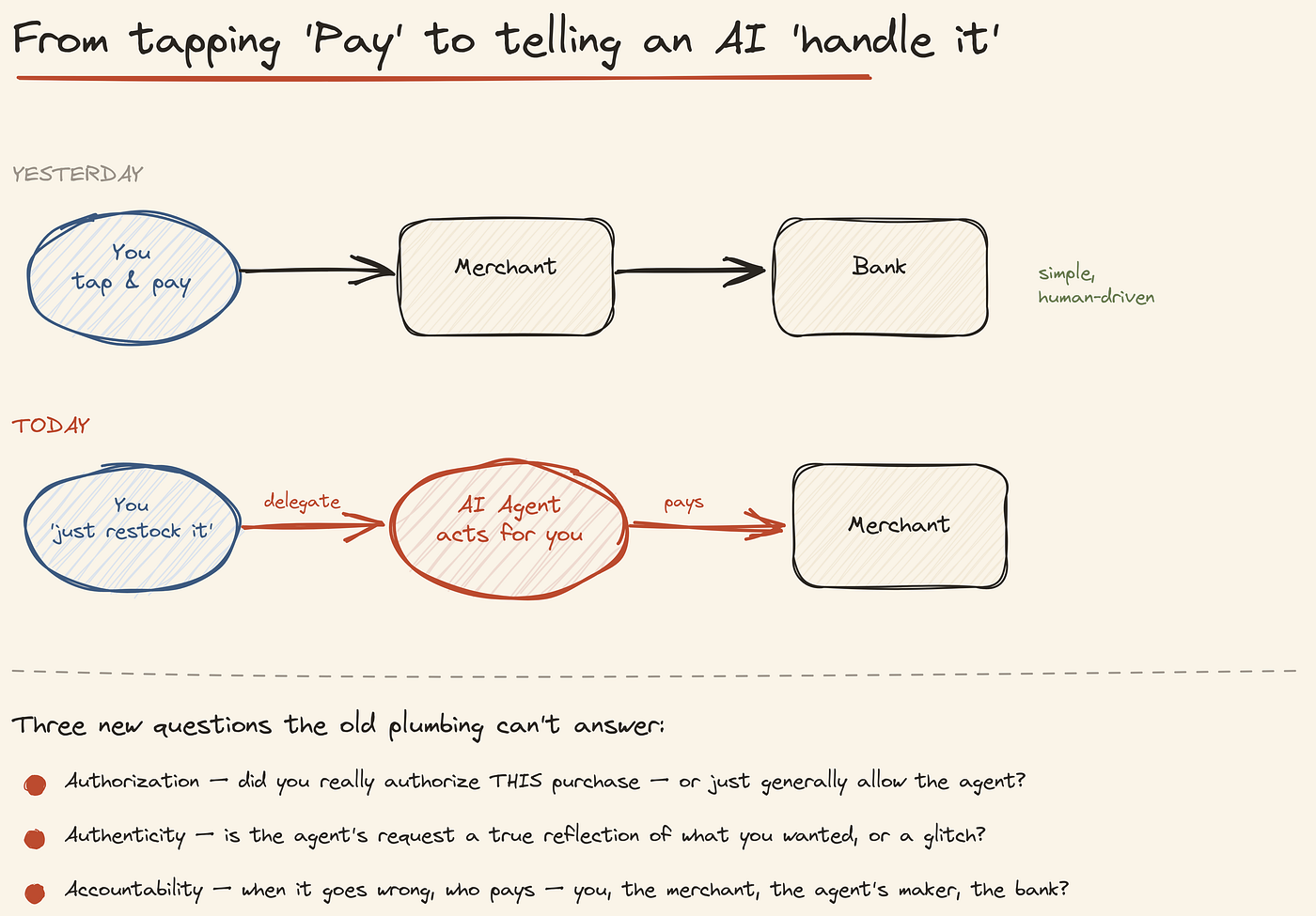
The quiet but profound shift agentic commerce introduces.
- Authorization : did you actually authorize this specific purchase, or just generally allow the agent to act?
- Authenticity : is the agent’s request a faithful reflection of what you wanted, or a glitch?
- Accountability : when something goes wrong, who eats the loss: you, the merchant, the agent’s maker, or the bank?
Answering those three questions, at scale and safely, is the entire game. And the global card networks have a head start.
How big is this, really?
It’s easy to dismiss agentic payments as hype. The numbers suggest otherwise though you should treat any single forecast with healthy skepticism, since analysts are measuring slightly different things.
The consensus range is striking. McKinsey estimates agentic commerce could drive $3–5 trillion in global transaction volume by 2030, with around $1 trillion in US retail alone. Morgan Stanley pegs it at 10–20% of US e-commerce by 2030; Bain says 15–25%. Gartner goes further on the business-to-business side, projecting that by 2028, 90% of B2B buying could be mediated by AI agents.
Even the conservative takes agree on direction: this is not a question of whether, only how fast. McKinsey’s analysis notes that ChatGPT alone already fields roughly 50 million shopping-related queries a day.
The reason it can move fast is subtle but important: AI agents “ride the rails” of existing commerce infrastructure. They don’t wait for new pipes to be built, they use the card networks, the checkout flows, and the bank accounts that already exist. Which is exactly why the companies that own those rails moved first.
What Visa, Mastercard and Stripe have already shipped
If you only remember one thing from this section: the global networks didn’t build agentic payments from scratch. They extended their existing tokenization systems; the same technology that already powers Apple Pay, saved cards, and tap-to-pay.

The global landscape: three networks, three angles, one shared protocol.
Visa — Intelligent Commerce. Visa’s approach is identity-first. Through its Trusted Agent Protocol, every AI agent gets a cryptographic identity and a special token : essentially a virtual card scoped with your rules (spend limits, merchant categories, validity). When the agent checks out, Visa’s network verifies “is this a known, trusted agent, acting within its limits?” before approving. Crucially, the merchant sees a perfectly normal Visa transaction — no integration change needed. It’s been live since May 2025, and Visa has since expanded its “Agentic Ready” program to Asia Pacific.
Mastercard — Agent Pay. Mastercard went intent-first. Alongside its Agentic Tokens, it built something called Verifiable Intent (a signed record) that travels with each transaction, saying “the user told an agent to do this specific thing.” The bank can then check: does this cart actually match what the user asked for? If you said “buy camping supplies” and the agent sneaks in a luxury watch, that contradiction gets flagged. Mastercard completed its first live agentic transaction on September 29, 2025, and rolled out to all US cardholders by November.
Stripe — Agentic Commerce Suite. Stripe came at it from the merchant side, with Shared Payment Tokens and a “Link” wallet that AI agents can use directly. A merchant integrates once, and any agent can transact with them.
And tying it all together is a shared protocol: Google’s AP2 (Agent Payments Protocol), a vendor-neutral format for these “mandates” the cryptographically signed permission slips at the heart of the whole system. In April 2026, Google donated AP2 to the FIDO Alliance (the same standards body that gave the world passkeys), where it’s now being shaped into a global standard with 60+ partners including Visa, Mastercard, PayPal and Coinbase.
So the picture, globally, is clear: the card networks have decided they will not cede agent-initiated commerce to fintech challengers without a fight.
Where does India stand?
Here’s the interesting part. On the UPI side, India is genuinely ahead. UPI processes a staggering volume of around 21–22 billion transactions a month as of late 2025, accounting for the overwhelming majority of India’s retail digital payments. And India has already run live agentic UPI pilots: a ChatGPT integration surfaced in October 2025, and a Claude integration around February 2026.
But those are pilots on the real-time-payments rail. On the card rail RuPay, there is no public agentic specification yet. That’s the gap worth talking about.
And it matters more than you might think, because RuPay’s card business has quietly exploded.

RuPay’s credit-card share, supercharged by UPI linkage.
When the RBI allowed credit cards to be linked to UPI in 2022, RuPay was first through the door. The result: RuPay’s share of India’s credit-card market jumped from around 3% in 2023 to roughly 18% by late 2025 and by transaction volume, UPI-linked RuPay credit now accounts for nearly 38% of all credit-card transactions in the country. Add the hundreds of millions of RuPay debit cards issued through the Jan Dhan financial inclusion programme, and you have a card network with extraordinary reach into exactly the population that global networks don’t serve well.
So the question naturally follows: if Visa and Mastercard can teach their cards to pay autonomously, why not RuPay?
What a domestic agentic credential could look like
Let me be clear that what follows is a conceptual sketch (an informed guess) at how an agentic layer could be built on a domestic card rail, based entirely on how the global networks have done it publicly. It’s the kind of design any fintech enthusiast could reason their way to.
The core idea borrows directly from Visa and Mastercard: a new kind of token. Think of it generically as a Domestic Agentic Credential (DAC) which is a virtual card credential, scoped with your rules, that an AI agent can hold and use, issued and governed by a country’s own payment network rather than a foreign one. (If India’s own rail, RuPay, were to implement such a thing, you might imagine it carrying a name like a “RuPay Agentic Mandate.” But the mechanics below are general and apply to any domestic switch handling agentic tokenization.)

Conceptual sketch: how a domestic agentic credential could flow on a card rail.
Here’s the flow, in plain terms:
- You set the rules. In your bank’s app, you connect a verified AI agent and define what it’s allowed to do :“groceries only, up to ₹3,000 per transaction, ₹10,000 a week, valid 90 days.”
- The agent gets verified. The agent (Claude, ChatGPT, Gemini, an Indian startup’s assistant) is checked against a registry of trusted, registered agents, think of it like a passport check. Only verified agents can play.
- A token is minted. The tokenization service issues the credential which is a virtual card number, completely separate from your real card, with your rules baked into it.
- The agent buys. When it’s time to purchase, the agent presents the credential just like any card. The transaction flows through the domestic network exactly like a normal card payment.
- The bank enforces. Your bank checks every single transaction against your rules before approving.
The elegant part (and this is true of Visa and Mastercard too) is that the merchant needs to change nothing. To a shop, the credential looks like an ordinary card. All the intelligence lives at the bank and the network, not at the checkout counter.
But what stops the AI from going rogue?
This is the question everyone asks, and rightly so. Handing a chatbot your card sounds terrifying. The answer is that the agent never actually gets your card and gets a tightly leashed token, and the bank acts as a bouncer on every transaction.

The safety model: limits you set, an agent that’s verified, a bank that enforces.
Say the agent tries to spend ₹847 at a grocery store. The bank’s check runs in milliseconds: Right kind of shop? Under the per-transaction limit? Within the weekly budget? All yes → approved. But if the agent tried to buy a ₹50,000 phone, or shop somewhere outside your rules, the transaction is blocked before any money moves. You pay nothing.
Three layers of protection stack up:
- You set the limits like merchant type, amount, time window. The agent can’t color outside the lines you draw.
- The agent is verified i.e registered and vetted, so an impersonator can’t masquerade as a trusted assistant.
- The bank enforces, every single time, not only at setup, but on each transaction.
And the most important principle, borrowed from how the global networks handle disputes: if a verified agent breaks the rules it agreed to, the liability falls on the agent’s maker and not on you. That single rule is what makes the whole thing trustworthy. It gives the companies building these agents a powerful financial incentive to keep them well-behaved.
The one thing only India could do
Here’s where it gets genuinely interesting, and where a domestic network has an edge no global player can match.
Visa and Mastercard’s agentic rails are online-only. Their tokens need a live network connection to authorize. But RuPay sits inside India’s National Common Mobility Card (NCMC) ecosystem , the “One Nation, One Card” system that powers offline metro, bus, and toll payments through a chip that works without any connectivity.
Imagine an AI agent that notices your metro card balance is low and tops it up before you get stranded at the turnstile and loads value onto an offline chip that then works in a tunnel with no signal, in a rural area with patchy data, anywhere. That’s a category of agentic payment the global networks simply cannot serve today.
It’s worth grounding how this could actually work, because the magic is really just hardware protocols doing their job. The offline chip, whether it’s a physical NCMC card or a secure element embedded in a phone or wearable and holds a small, self-contained balance and a tamper-resistant ledger. The agent never touches that chip directly over the internet; instead, the top-up happens through a proximity handshake. When your phone is near the chip (or is the chip, via an embedded secure element), a short-range protocol like NFC for a tap, or BLE for a slightly longer-range sync gets triggered and opens a brief authenticated session. In that session, the agent’s pre-authorized credential and its spending limits are written into the chip’s secure element as a signed value-load command. The chip verifies the signature against keys provisioned at setup, increments its offline balance, and logs the load in its internal ledger. From that instant, the chip is autonomous: when you tap at a gate, the reader and the chip settle the fare between themselves in milliseconds, with no network round-trip. The next time the chip does see connectivity, it reconciles its offline ledger back to the issuer. So the agent’s role is to keep the offline reservoir topped up during moments of connectivity, within the limits you set adding to the NFC/BLE handshake is simply the plumbing that moves a pre-authorized, signed value-load from the online world into the offline one.
Combine that with the reach of Jan Dhan that enables hundreds of millions of RuPay cards in the hands of people who’ve never had a traditional credit card; you get a vision of agentic payments that isn’t just about urban professionals telling ChatGPT to order groceries. It’s about an assistant that helps manage a subsidy disbursement, a daily-wage worker’s budget, or a small shopkeeper’s recurring supplier payments. Agentic commerce, for Bharat.
Why the next 18 months matter
The standards for how AI agents pay are being written right now, inside the FIDO Alliance, by Visa, Mastercard, Google, OpenAI and others. Whoever is in that room helps decide how trust, identity, and intent work for the next two decades of payments.
India has a genuine claim to that table. It runs the largest real-time payment system in the world by volume. It has a domestic card network with surging share and unmatched reach. It has already proven, through its UPI pilots, that agentic payments can work in an Indian context.
The open question is whether India shapes these standards as a co-author, or adopts them later as a consumer of rules written elsewhere. The technology gap is small and the global networks built agentic payments by extending infrastructure that RuPay also has. The window, though, is narrow. The global stack is hardening fast.
The milk-and-eggs example is small and a little silly. But the rail underneath it allows us to ask the question of who gets to define how a machine spends your money safely which will also become one of the most consequential infrastructure decisions of this decade. India helped write the playbook for real-time payments with UPI. The agentic chapter is being drafted now.
It would be a shame to read it instead of write it.
Enjoyed this? It’s an independent explainer aimed at India’s fintech-curious founders, students, product folks, and anyone watching the UPI/RuPay story unfold. If it helped you understand where agentic payments are headed, share it with someone who’d find it interesting. Thoughts and corrections welcome in the responses.
Sources: NPCI and RBI public data; McKinsey, Morgan Stanley, Bain and Gartner agentic-commerce forecasts; and public announcements from Visa, Mastercard, Stripe, Google and the FIDO Alliance (2025–2026).
메타데이터
- post_id
- 7e08f1be8cab
- slug
- can-rupay-pay-while-you-sleep-indias-card-rail-meets-the-age-of-ai-agents-7e08f1be8cab
- url
- https://medium.com/@madhavendra.p25/can-rupay-pay-while-you-sleep-indias-card-rail-meets-the-age-of-ai-agents-7e08f1be8cab
- canonical_url
- https://medium.com/@madhavendra.p25/can-rupay-pay-while-you-sleep-indias-card-rail-meets-the-age-of-ai-agents-7e08f1be8cab
- author_url
- https://medium.com/@madhavendra.p25
- status
- ok
- fetched_at
- 2026-06-20 20:29:01



