Loop Engineering Explained: 4 AI Agent Loops Every AI Developer Must Know in 2026
You’ve been prompting AI. The engineers building the best AI products have moved on to something else entirely, and it changes everything…
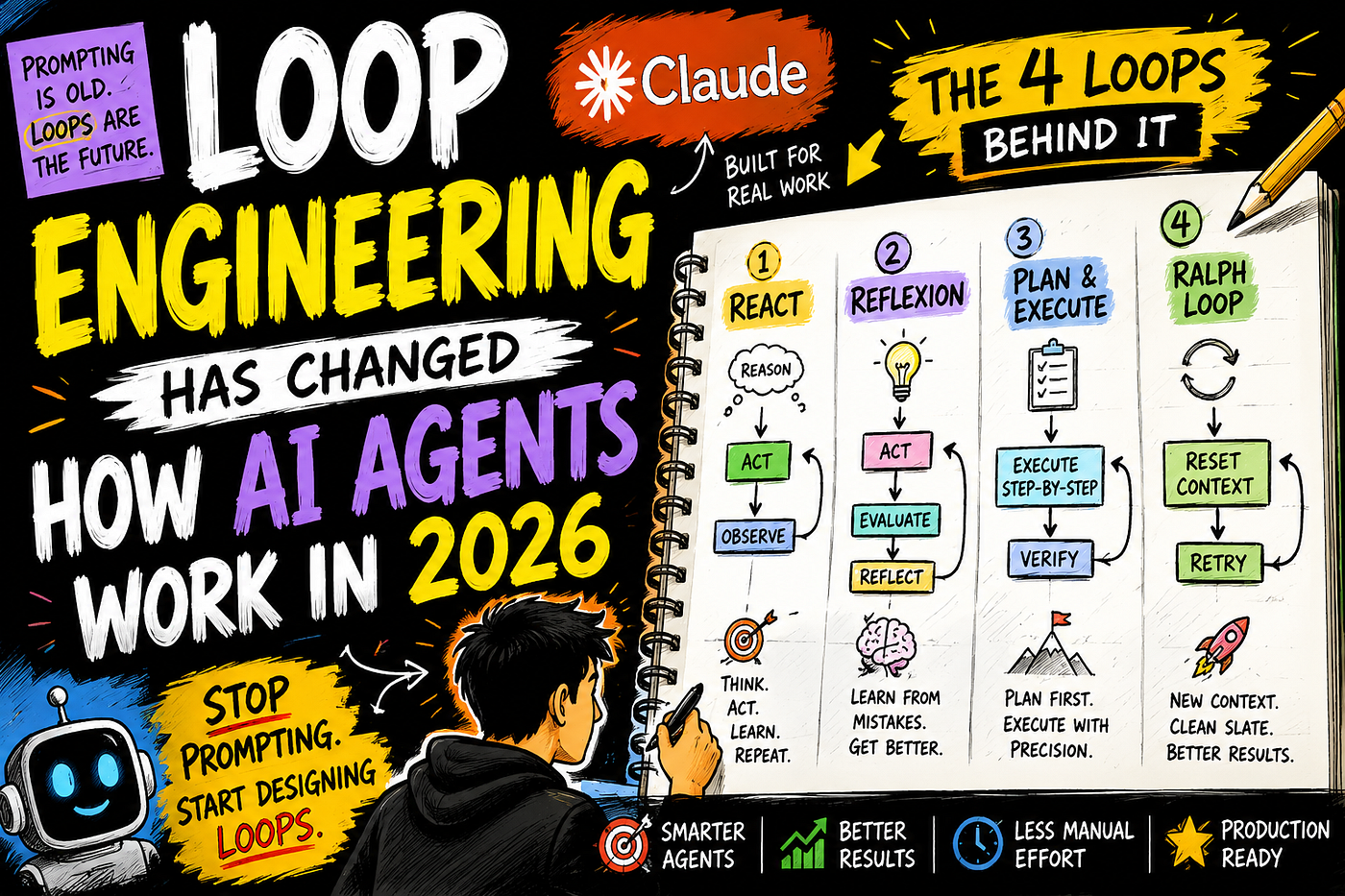
Photo from AI
Loop Engineering Explained: 4 AI Agent Loops Every AI Developer Must Know in 2026
You’ve been prompting AI. The engineers building the best AI products have moved on to something else entirely, and it changes everything about how AI agents actually work.
Every time you type the next instruction after your AI agent finishes a task, one thing becomes obvious:
You are the loop.
A post that reportedly reached more than 6.5 million views put a name to the solution:
Stop prompting your AI agent. Start designing the loop that prompts it for you.
That idea became known as Loop Engineering.
Instead of waiting for a human to decide what happens next, the agent evaluates its own progress, chooses the next action, and repeats until the goal is reached.
The human leaves the execution loop.
This article explains what loop engineering is, the four core loop patterns behind it, and how to choose the right one for your AI agent.
If you want more such information about AI, consider subscribing to my newsletter, where you will get noise-free AI information every week
Link for the newsletter: Newsletter
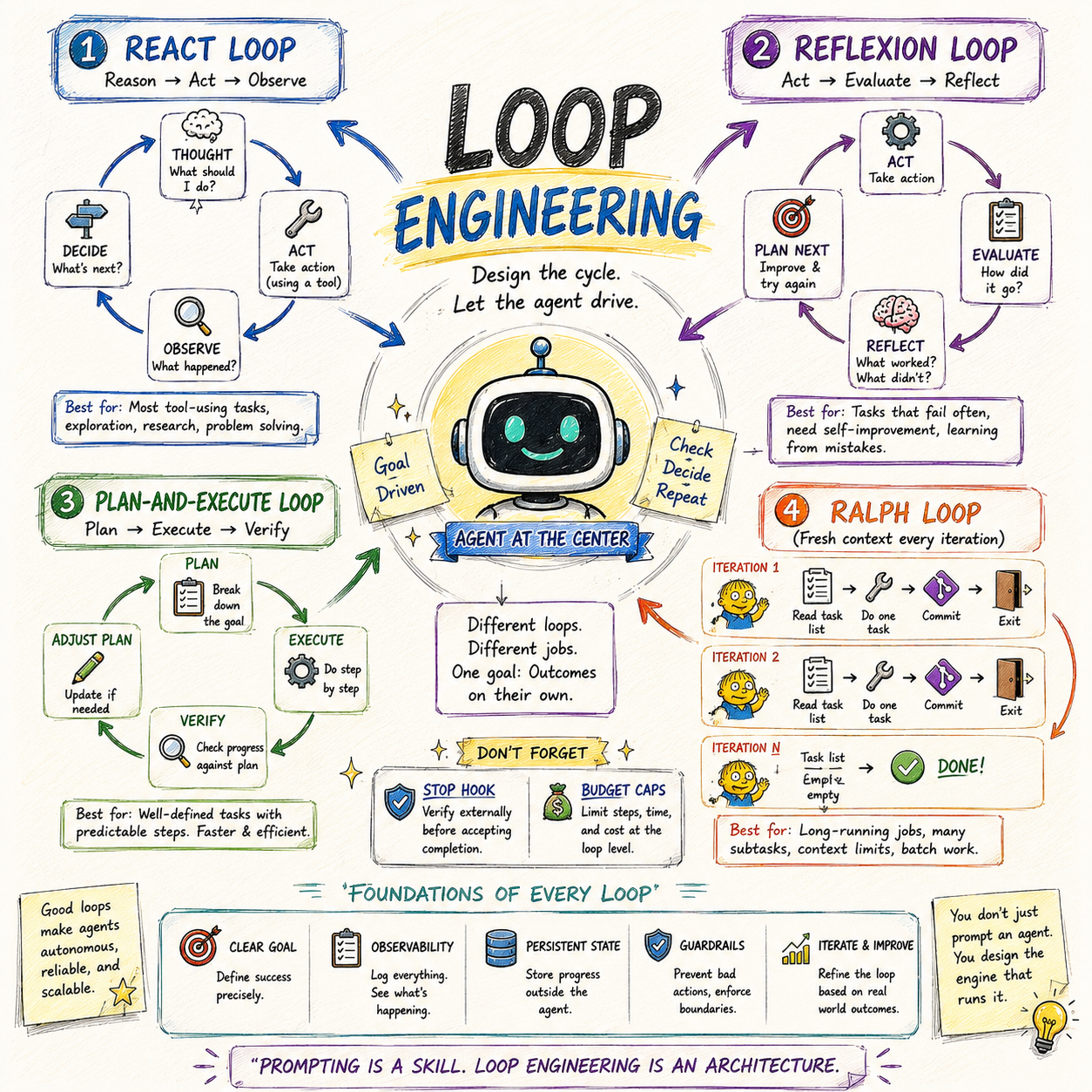
Photo from AI
What changed and why it matters
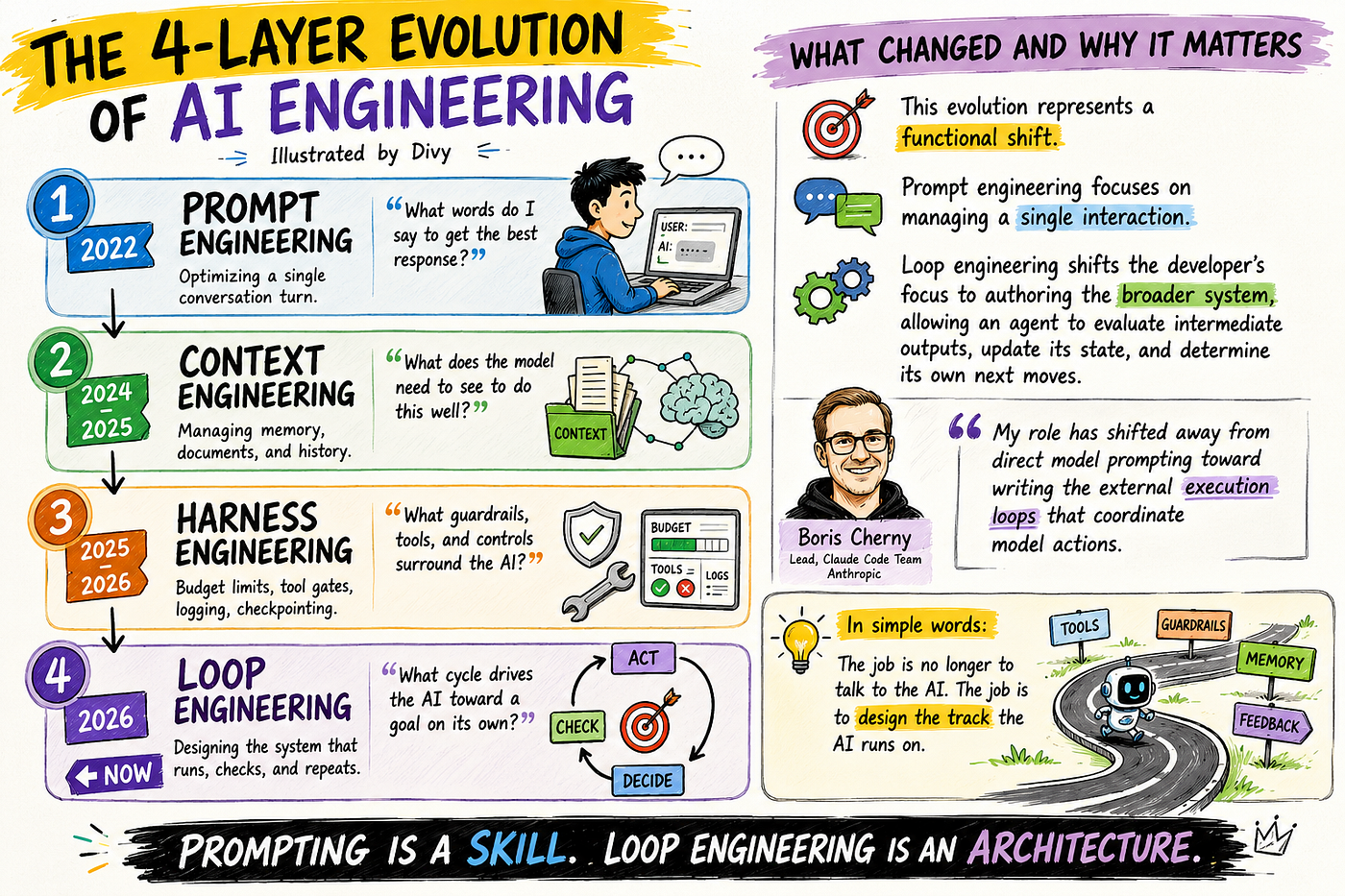
Photo from AI
To understand loop engineering, you need to see the path that got here.
AI has gone through four layers of engineering in the past four years. Each layer built on the one before.
This evolution represents a functional shift.
Prompt engineering focuses on managing a single interaction.
Loop engineering shifts the developer’s focus to authoring the broader system, allowing an agent to evaluate intermediate outputs, update its state, and determine its own next moves.
Boris Cherny, who leads the Claude Code team at Anthropic, validated this directly: his role has shifted away from direct model prompting toward writing the external execution loops that coordinate model actions.
In simple words: the job is no longer to talk to the AI. The job is to design the track the AI runs on.
Prompting is a skill. Loop engineering is an architecture.
What a loop actually is
An agentic loop is the simplest possible unit of useful agent work:
Do something. Check the result. Decide whether to stop or continue.
That is it.
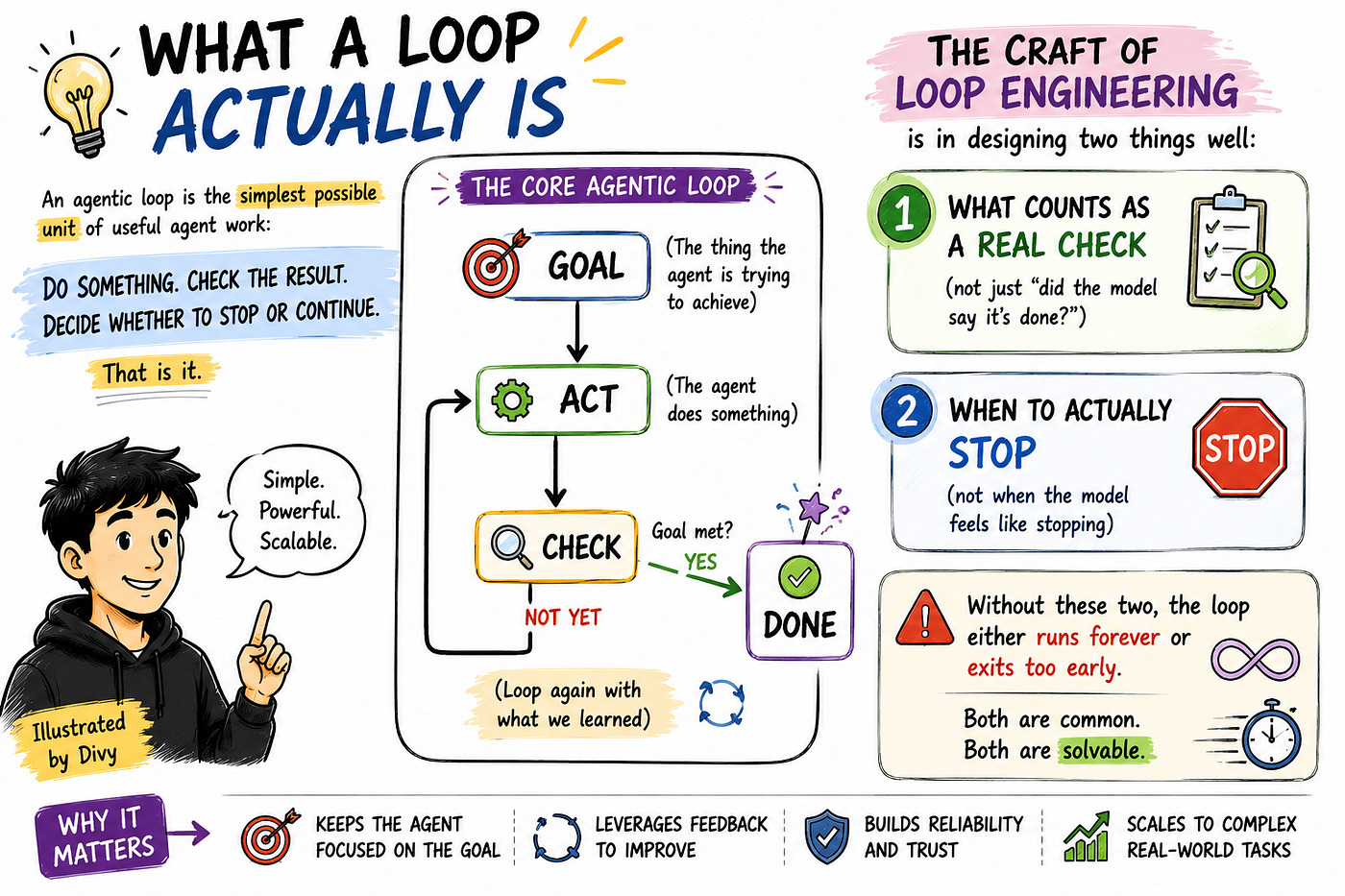
Photo from AI
The whole craft of loop engineering is in designing two things well:
- What counts as a real check (not just “did the model say it’s done?”)
- When to actually stop (not when the model feels like stopping)
Without these two, the loop either runs forever or exits too early. Both are common. Both are solvable.
The 4 loop types
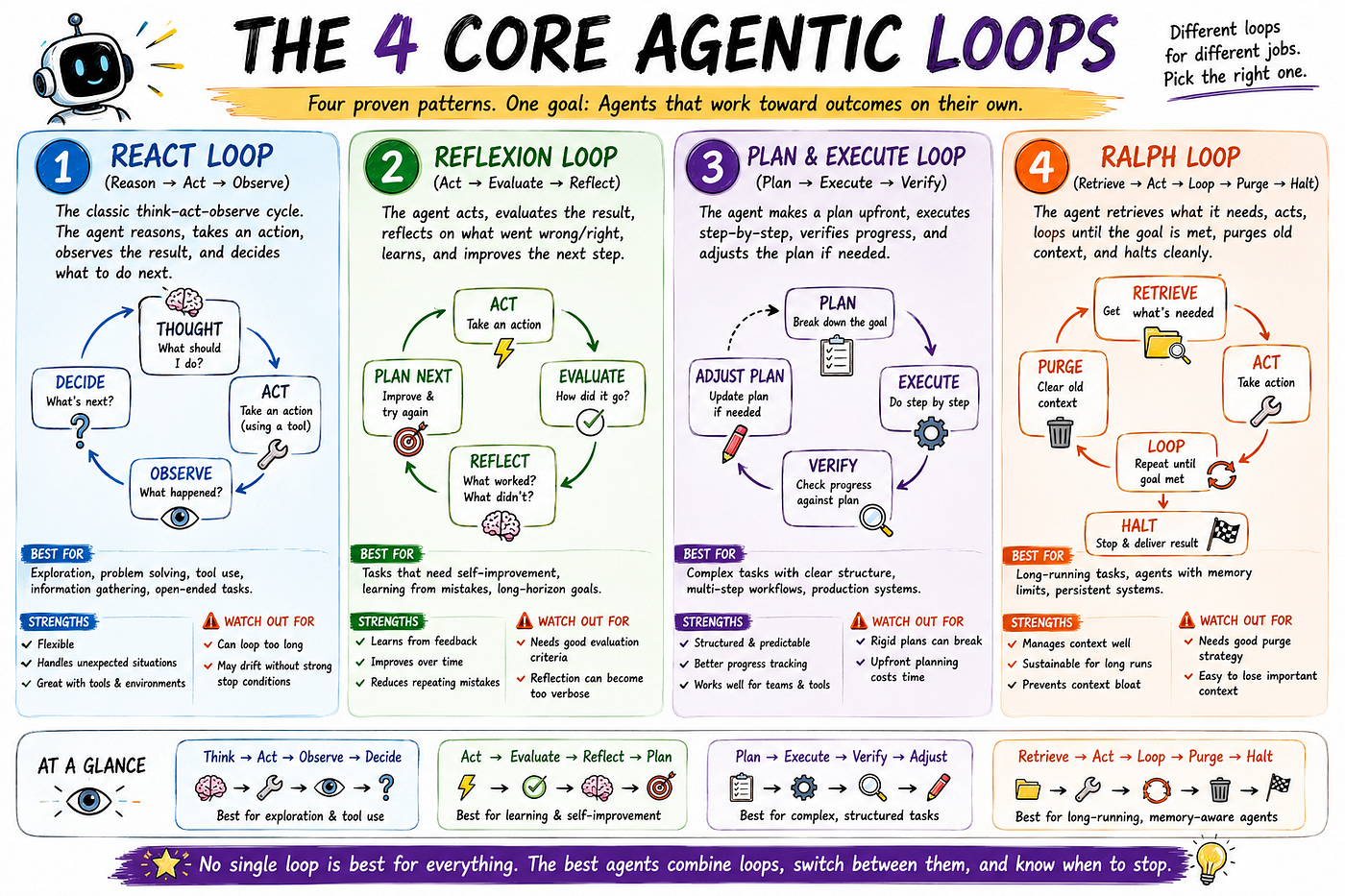
Photo from AI
Different loops suit different tasks. ReAct is the foundation. Reflexion builds a learning layer on top. Plan-and-Execute commits upfront. The Ralph Loop resets context on every iteration.
Here is each one explained simply.
Loop 1: ReAct (Reason → Act → Observe)
What it is: Before doing anything, the agent reasons about what to do. Then it acts. Then it observes the result. Then it reasons about the next step. Repeat.
Why it exists: Before ReAct, models just answered. They had no way to interact with tools or make decisions across multiple steps. ReAct, proposed by Yao et al. in 2022, established the core Thought-Action-Observation loop for the first time, creating a modern agent capable of actively thinking, making decisions, and executing complex tasks.
The simple version: The agent narrates what it is doing before it does it. That narration becomes a form of visible reasoning you can inspect.

Photo from link
# The ReAct loop in its simplest form
while not agent.has_final_answer():
    thought = agent.think(context)      # reason about what to do next
    action_result = agent.act(thought)  # do it
    context.update(action_result)       # observe the result, loop
When to use it: Tasks with external tools, APIs, or databases. When you need the reasoning to be transparent and checkable.
Loop 2: Reflexion (Learn from failure)
ReAct, but with a learning step added. After a failure, the agent generates a critique of what went wrong. That critique gets stored and injected into the next attempt.
Why it exists: The ReAct loop is complete but its thinking step relies on the model’s internal knowledge and lacks a mechanism for learning from failure. Reflexion builds that learning layer on top. After completing or failing a task, the agent generates a critique of what went wrong. That critique gets stored in memory and injected into the next attempt’s context.
The simple version: The agent reads its own mistakes and tries again differently.
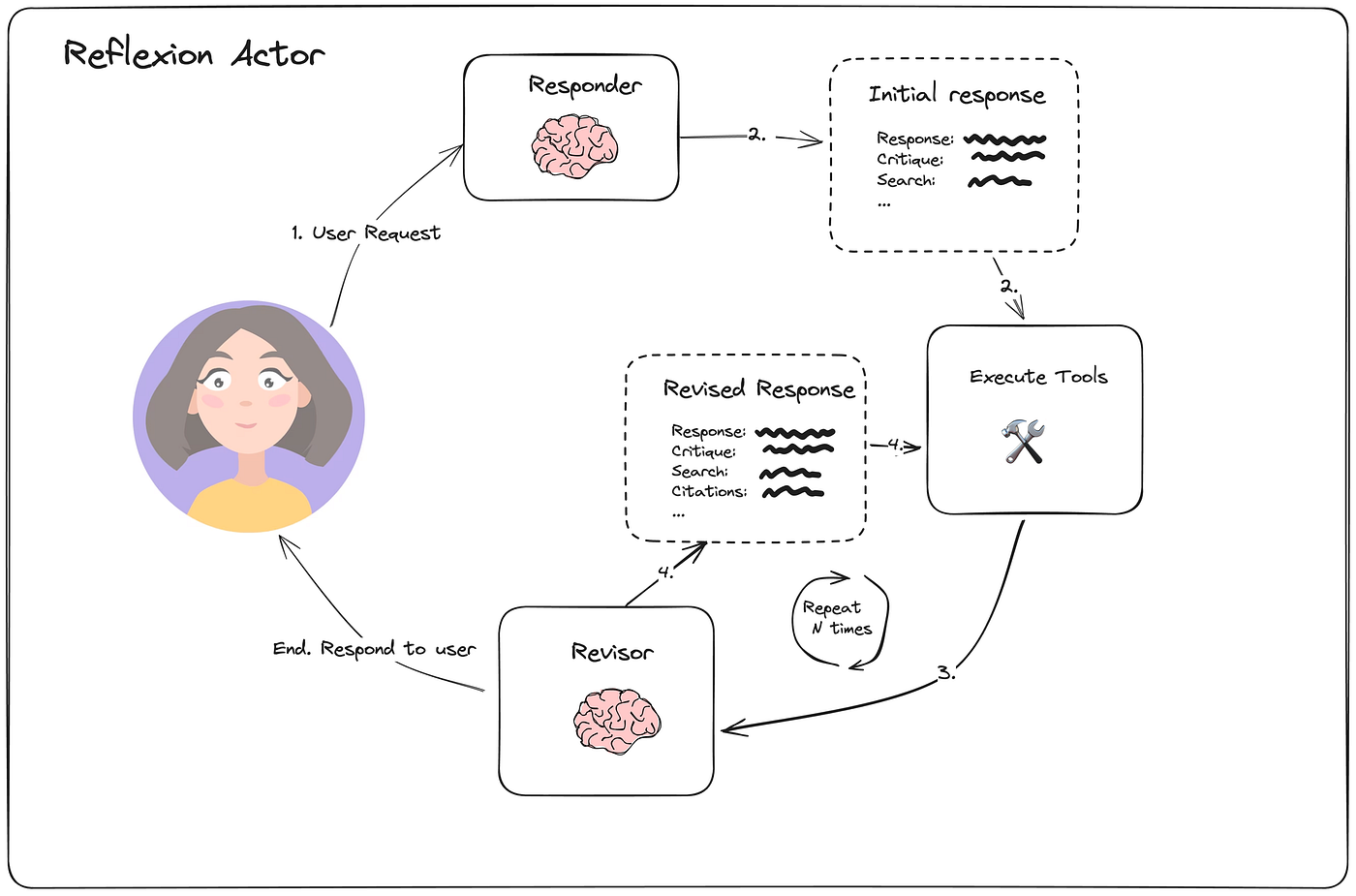
Photo from link
result = agent.run(task)if not result.succeeded:
critique = agent.reflect(result) # what specifically wentwrong?
memory.store(critique) # remember this for next time
result = agent.run(task, memory) # retry with the lessonWhen to use it: Debugging, code that needs to pass tests, creative work requiring iteration. More expensive than ReAct (requires extra model calls for the reflection step). Usually not worth the overhead for straightforward retrieval tasks.
Loop 3: Plan-and-Execute (Commit upfront)
The agent plans the entire task first, then executes each step in sequence without recalibrating between steps.
Why it exists: ReAct recalibrates at every step. That is adaptive but slow. Sometimes the task is clear enough that you do not need to rethink after every action. Planning once upfront and then executing is faster.
The simple version: Make the full plan first. Execute without second-guessing.
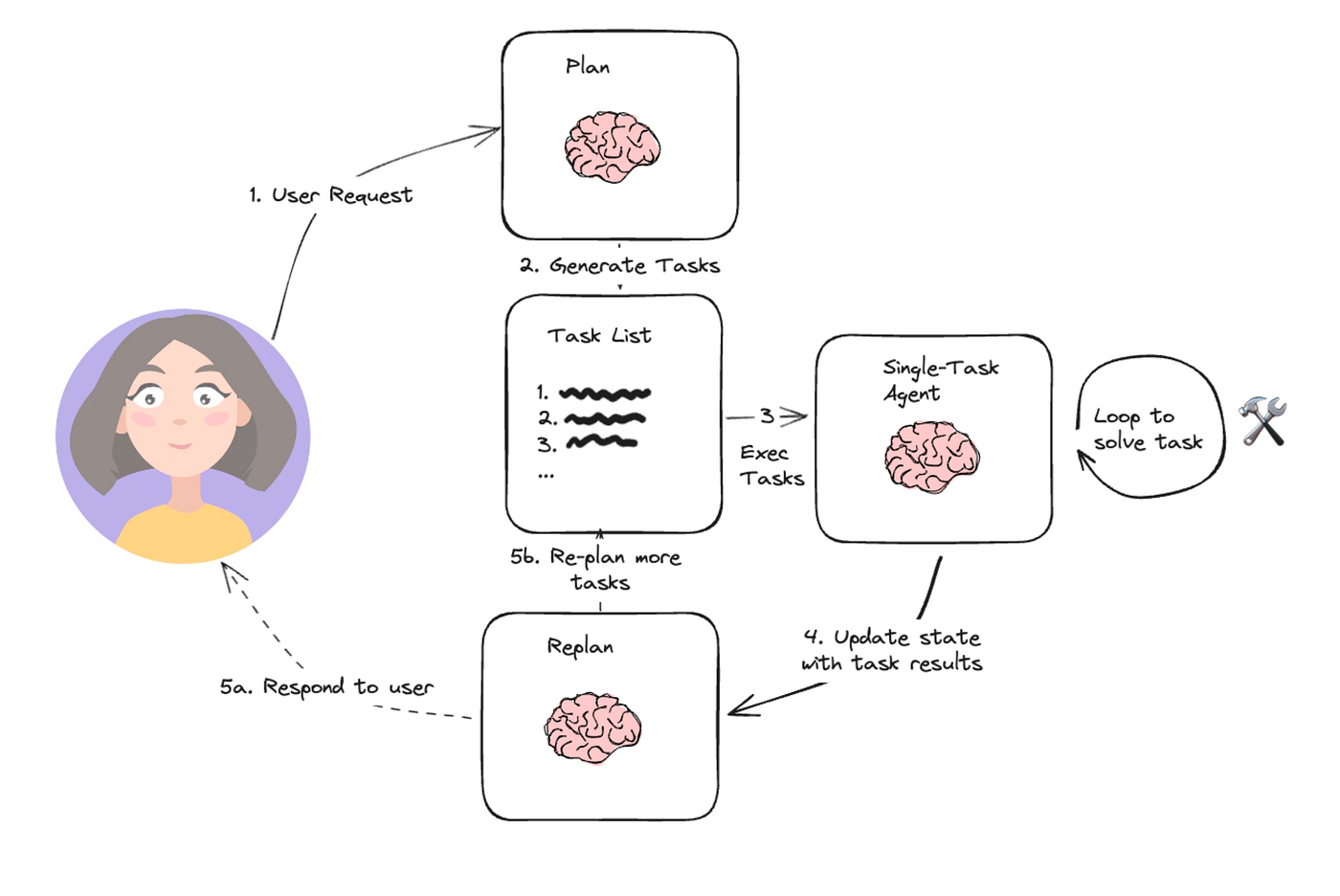
Photo from LangChain
plan = planner.create(task)      # plan all steps upfront
for step in plan.steps:
    executor.run(step)           # execute each step, no replanning
LangChain’s LLMCompiler reported a 3.6x speedup over sequential ReAct by running independent steps in parallel.
When to use it: Well-defined tasks with predictable steps. When speed matters more than adaptability. When early results are unlikely to change the approach.
Honest tradeoff: Less adaptive when early steps produce unexpected results. If step 2 fails, the rest of the plan is in trouble.
Loop 4: The Ralph Loop (Fresh context every iteration)

Photo from link
This is the surprising one. It looks too simple to work. It works.
Before anyone called it loop engineering, there was Ralph.
In early 2026, Geoffrey Huntley described running a coding agent inside a plain while loop: feed the agent the same prompt against a written spec, let it pick one task and implement it, then start a fresh instance and feed the identical prompt again. Repeat until the work is done.
He named it after Ralph Wiggum, the Simpsons character who announces “I’m helping!” while walking into doorframes.
A Ralph Loop (also known as the “Ralph Wiggum technique”) is an autonomous AI coding technique where a single AI agent is run in a continuous loop.
Why it works: The non-obvious insight is the context reset. A long agent session degrades as the window fills with old reasoning, dead ends, and stale file contents. Ralph sidesteps that entirely: every iteration is a new agent with a clean context that reads the current state of the repo and the task list from disk, does exactly one unit of work, commits it, and exits.
The simple version: Instead of one long agent session that eventually forgets what it was doing, you run many short sessions. Each one reads the latest state, does exactly one thing, and stops.
while task_list.has_pending():
    fresh_agent = Agent()           # new agent, completely clean context
    task = task_list.pick_one()     # pick exactly one task
    fresh_agent.complete(task)      # implement it
    task_list.mark_done(task)       # mark done, commit to disk
# Next iteration: fresh agent reads updated task list
When to use it: Long-running coding tasks, batch processing, anything that would take hours in a single session. The simplicity is intentional. Simple loops are debuggable. Complex ones are not.
The shift in what “value” means
Loop engineering, as framed in the June 2026 essay by Jonas Steinberger and Addy Osmani, treats the LLM as a single component within a larger, self-correcting state machine. They argue that the unit of value in AI has shifted from the response to the trajectory. If a model produces a bug on turn one, it does not matter. As long as the system detects the bug, executes a test, and fixes the error by turn four, the loop succeeded.
This is the insight most people miss.
In a chat, a wrong answer is a failure. In a loop, a wrong answer is just an intermediate step. The loop catches it, corrects it, and continues.
The goal of the engineer is not to get the AI to answer correctly. It is to design a loop where errors become inputs instead of outcomes.
What breaks without proper loops
Most people building AI agents hit these problems before they realize it is a loop design issue:
The model decides it is done when it is not. This is called premature exit. The agent reports success before the task is actually complete. A Stop Hook intercepts exit attempts and checks whether completion criteria are actually met, like tests passing or coverage hitting a threshold, before allowing the agent to stop.
Context rot. The longer an agent runs, the more its context fills with old reasoning, failed attempts, and stale data. Performance degrades. The Ralph Loop’s context reset solves this by design.
No real verification. The loop asks the agent “did you succeed?” and accepts the answer. That is not a check. A real check runs your tests, pings the endpoint, validates the output against a schema. Something external confirms success.
Infinite loops without budget caps. No stopping condition means no stopping. Budget limits and step maximums are loop-level concerns, not model-level ones.
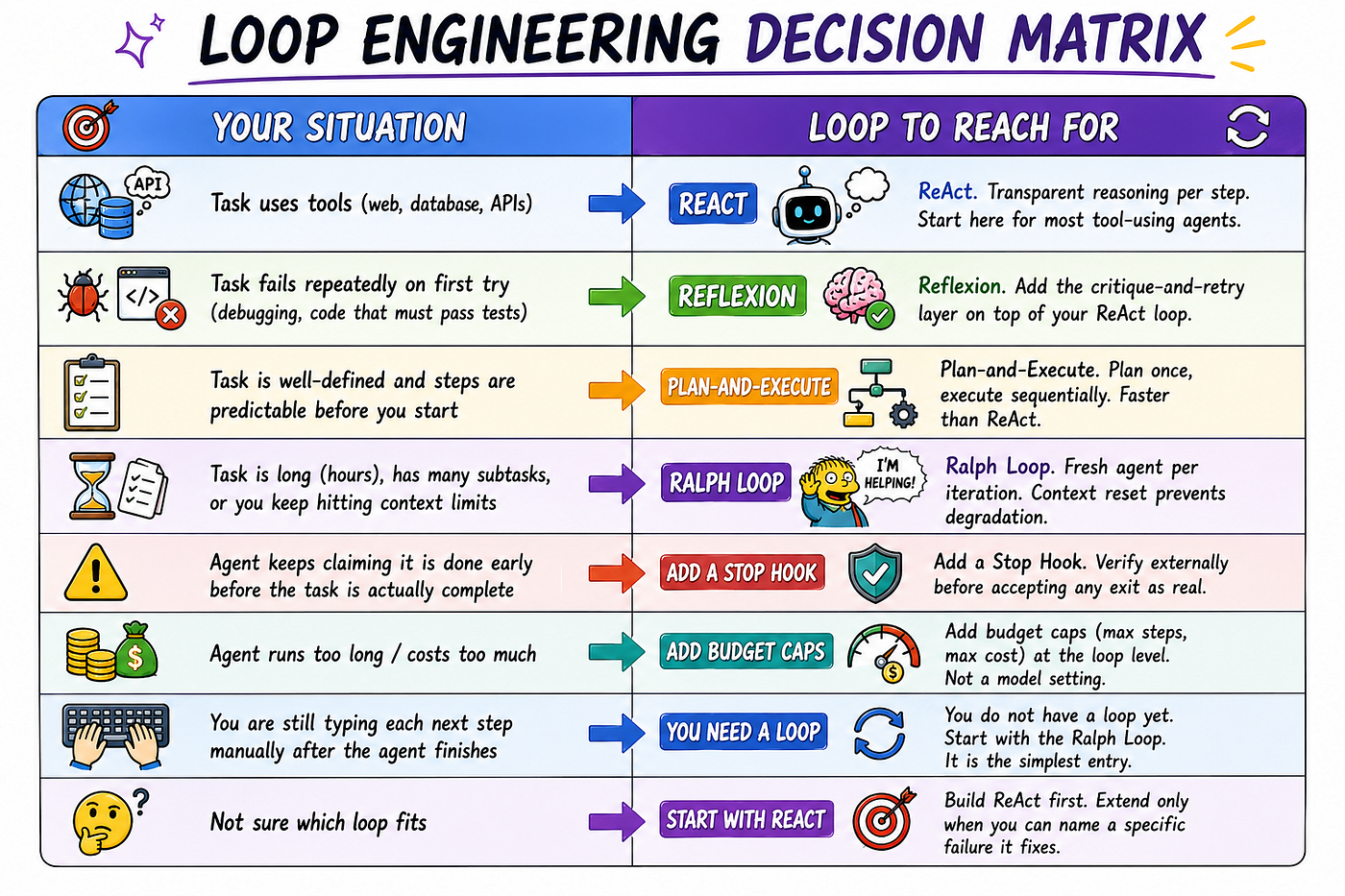
Decision framework
C
Key takeaways
- Loop engineering is the discipline of designing the cycle that drives an AI agent toward a goal, instead of manually prompting each step yourself.
- The 4 loop types: ReAct (reason before every action), Reflexion (learn from failure), Plan-and-Execute (commit upfront), Ralph Loop (fresh context per iteration).
- The unit of value has shifted. In a well-designed loop, a wrong answer on turn one is not a failure. It is an input that gets corrected by turn four.
- Most agent problems are loop problems: premature exit, context rot, no real verification, no budget caps. None of these are model problems.
- Start with ReAct for most tasks. Add Reflexion when failure is expected. Use Ralph when sessions get too long to stay coherent.
- The real check matters more than the right model. A loop that verifies against tests, schemas, or external endpoints is more reliable than a loop that asks the model if it succeeded.
The bottom line
- Prompt engineering was about the right words.
- Context engineering was about the right information.
- Harness engineering was about the right guardrails.
- Loop engineering is about something different: the right cycle.
Peter Steinberger’s observation in June 2026 put it simply: “You shouldn’t be prompting coding agents anymore. You should be designing loops that prompt your agents.”
The agents that work reliably for hours are not the ones with the best prompts. They are the ones running inside loops that check their own work, reset when they degrade, and stop when the goal is actually met, not when the model feels like it is.
The next time your agent stops too early, loops forever, or confidently hands you a wrong result, the problem is almost certainly not the model.
It is the loop.
References
- Loop Engineering: The Guide for AI Agents (Lushbinary) https://lushbinary.com/blog/loop-engineering-ai-coding-agents-guide/
- What Is Loop Engineering? Complete Guide (Tosea.ai) https://tosea.ai/blog/loop-engineering-ai-agents-complete-guide-2026
- Demystifying Loop Engineering (TechTalks) https://bdtechtalks.com/2026/06/22/ai-loop-engineering/amp/
- Agentic Loops: From ReAct to Loop Engineering (Data Science Dojo) https://datasciencedojo.com/blog/agentic-loops-explained-from-react-to-loop-engineering-2026-guide/
- The Agentic Loop: A Practical Field Guide (DEV Community) https://dev.to/truongpx396/the-agentic-loop-a-practical-field-guide-mnc
- Agentic Loops: Designing the Systems That Design Themselves https://promptengineering.org/agentic-loops-designing-the-systems-that-design-themselves/
메타데이터
- post_id
- 7e1852392cc2
- slug
- loop-engineering-explained-4-ai-agent-loops-every-ai-developer-must-know-in-2026-7e1852392cc2
- url
- https://medium.com/ai-engineering-simplified/loop-engineering-explained-4-ai-agent-loops-every-ai-developer-must-know-in-2026-7e1852392cc2
- canonical_url
- https://medium.com/ai-engineering-simplified/loop-engineering-explained-4-ai-agent-loops-every-ai-developer-must-know-in-2026-7e1852392cc2
- author_url
- https://medium.com/@yadavdivy296
- status
- ok
- fetched_at
- 2026-07-09 15:12:33