Tiny Experiments, Big Feelings:
Designing a PhD Life One Habit at a Time
Tiny Experiments, Big Feelings:
Designing a PhD Life One Habit at a Time
For over a year, I’ve been running small experiments on myself.
Not in the lab. Not with participants. In the quiet, repetitive, unglamorous space where a PhD actually happens: mornings that start with good intentions and end with a familiar heaviness; days that swing between focus and fog; weeks when progress is real but still doesn’t feel real.
This is a reflection written from within that process — part research diary, part design log, part attempt to name what’s happening without turning it into a performance. Personal details are intentionally blurred because the point isn’t a biography. The point is the pattern.
Photo by Vince Fleming on Unsplash
Why I Returned to Headspace (Even Though I Didn’t Want Another App)
I’ve tried to use Headspace for a long time, while also questioning the logic of adding another application to an already crowded system.
And yet, I kept coming back.
Not because Headspace is magic. But because I wanted a way to map my emotional state and energy — something that would help me see my days rather than just survive them. I wanted to take more control of how my days, weeks, and months unfold.
Headspace includes a short check-in questionnaire after sessions. When I returned to it with intention, I expected a shift. Something measurable. A small drop in stress. A dent in anxiety.
But the result stayed the same: stress and anxiety remained high.
That’s the part that landed hardest. The sense that I’m doing “the right things,” but my baseline stays elevated. That I’m exhausting myself just trying to feel normal. There are moments of joy, but when work and the PhD come into frame, everything becomes heavy again.
At some point, it starts to feel less like a temporary phase and more like a climate.
And I don’t want to live in that climate forever.
The Researcher in the Research
Photo by Malama Mushitu on Unsplash
I’m doing a PhD, but I’m also watching myself do it.
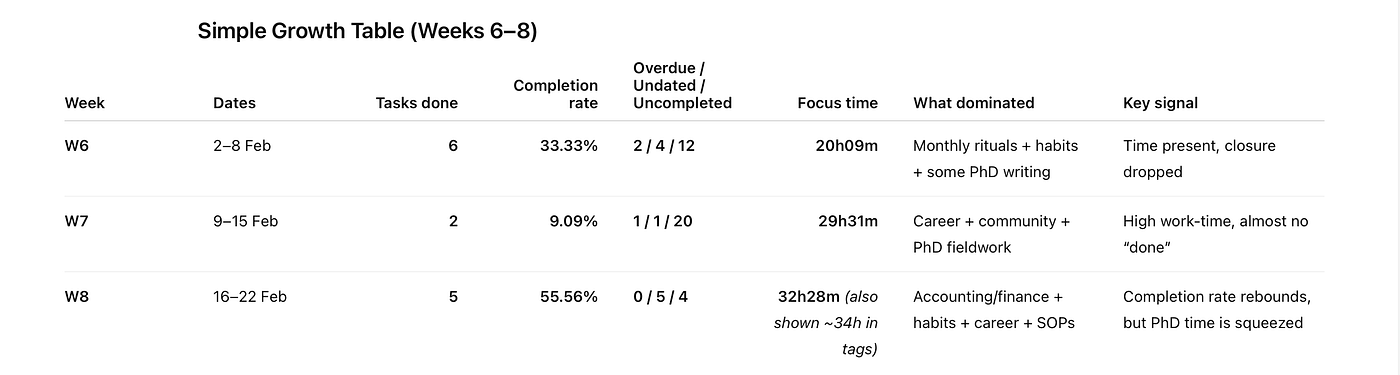
That’s not a metaphor — this has become one of the main ways I cope. I observe. I log. I adjust. I run tiny experiments. I gather evidence. I attempt to interpret the results.
The tools change, but the structure is similar:
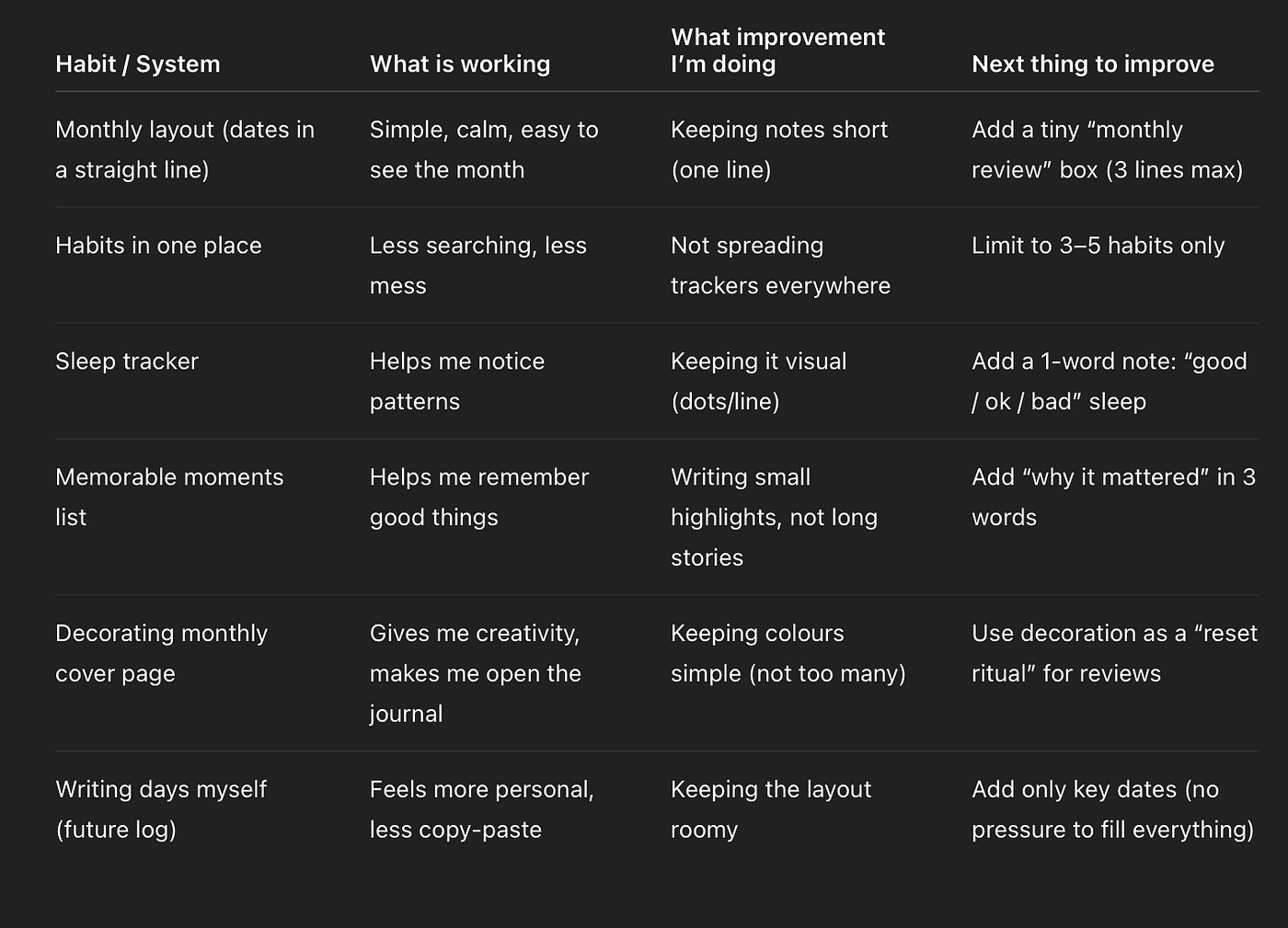
- Meditation / emotional check-ins (Headspace)
- Time management (TickTick)
- Environmental cues (Momentum, prompts, reminders)
- Soundscapes (instrumental music, rain audio)
- Writing as tracking (publishing reflections on a blog platform)
The goal isn’t productivity in the shallow sense. It’s a regulation. Clarity. A calmer mind that can do sustained knowledge work without collapsing into dread.
Sometimes these tools do help. They create small pockets of steadiness. They give me a sense of closure after I journal or tick off a habit. Furthermore, they reduce the internal noise.
But there’s a problem with how temporary that relief can be.
The Calm Doesn’t Last (And That’s Important Data)
Photo by Jeppe H. Jensen on Unsplash
After completing these routines, I often feel calmer.
Then the next day arrives — and the stress returns.
So I repeat the experiment: remind myself, You did something for your well-being. You took care of it. Now return to the work without panicking.
This has become an internal dialogue. A kind of self-coaching.
What makes it convincing — oddly — is visual evidence. Checkmarks. Logs. Photos. Proof that I actually did the thing. Not just the thing's intention.
There’s something psychologically stabilising about seeing the record accumulate across weeks and months. It counters the feeling that nothing is changing.
And yet, another voice interrupts that comfort:
What is this evidence for? Does it change the outcome? Does it move the thesis forward? Does it reduce the real pressure?
Sometimes the tracking feels meaningful. Other times it feels like a ritual that doesn’t pay rent.
That contradiction is part of the tension: I can feel calmer and still feel that it “doesn’t count.”
The Moment the Question Changed
At some point, I stopped asking:
“Which app will finally fix this?”
And started circling a harder question:
“What if none of these tools are solving the real problem?”
That’s where the reflection shifted. If the stress stays high after months of careful experimentation, the issue might not be a missing tool.
It might be avoidance.
Or more precisely: avoidance of one specific category of work.
The Real Roadblock: Writing (And the Fear Behind It)
Photo by Aaron Burden on Unsplash
When I look directly at the PhD itself, the clearest avoided task is writing.
There is “so much work to be done,” and the writing contains all of it: thinking, structuring, deciding, defending, committing. Writing turns the shapeless mass into something that can be judged.
And that’s where fear shows up.
Not necessarily fear of writing sentences — but fear of:
- not knowing what “done” looks like,
- not knowing what “good enough” looks like,
- starting and then realising the gap is bigger than expected.
There’s also a second avoided area behind writing: coding/technical work.
It’s not just “I don’t want to code.” It’s also: I don’t fully know what coding is in my context. The unknown becomes oversized. The imagined difficulty becomes heavier than the task itself.
And when someone in authority suggests, “you should start coding now,” it can trigger a familiar response: freeze, delay, organise everything around it — except the thing itself.
A Structural Problem Disguised as a Motivation Problem
One of the most uncomfortable realisations was simple:
I am not protecting the first hours of the day for thesis work.
I know the day gets consumed quickly. I know the mind is sharper earlier. I know my stress increases when I postpone the thesis.
And still, mornings fill with life-maintenance tasks:
- preparing food
- getting ready
- leaving the house
- cleaning
- checking messages
- planning the day
- reacting to other people’s expectations
Then suddenly it’s mid-morning, the cognitive load is higher, and the thesis becomes the heaviest item left on the list. That’s not a moral failure. It’s a predictable system outcome.
So maybe this isn’t only procrastination. Maybe it’s a design issue: the environment and routine are not engineered to make writing the default.
Photo by Kenny Eliason on Unsplash
What I’m Considering Next (Not Conclusions — Hypotheses)
I don’t want to end this reflection with a neat resolution. That wouldn’t be honest. I’m still in the middle of it.
But I do want to record the hypotheses I’m currently testing — because this is what “being a researcher in the research” looks like.
Hypothesis 1: Reduce choice at the start of the day
If the first action requires deciding what to do, I will drift.
So I want pre-built prompts and a pre-defined sequence:
- open laptop
- open the writing document
- respond to a small prompt
- write for a fixed window
No negotiation.
Hypothesis 2: Morning work must happen before life expands
If I wait until everything else is “handled,” writing won’t happen.
So the experiment is not “write for hours.” It’s: write first, even briefly.
Hypothesis 3: Small actions can be real actions
There’s a difference between “tiny tasks that soothe me” and “tiny tasks that move the thesis.”
I want to separate:
- actions that reduce anxiety (valuable)
- actions that advance the thesis (also necessary)
Then design a routine that includes both — without confusing one for the other.
Hypothesis 4: Ask what ‘finished’ means (even if it’s awkward)
Avoiding the conversation doesn’t reduce uncertainty; it preserves it.
I’m considering asking supervision questions like:
- What does a “finished” thesis look like in structure (chapters, expected contents)?
- What counts as a minimum viable contribution?
- What is the current priority: writing up, analysis, coding, or data collection?
- What is the next tangible deliverable, and what is its timeline?
Not because the answers will solve everything — but because clarity reduces fantasy-driven fear.
What I Want to Remember
Even after a year of tools, routines, and tracking, my stress can remain high. That doesn’t necessarily mean nothing is working. It may mean I’m working around the core difficulty rather than addressing it.
The tools aren’t pointless — but they are not the thesis.
So the ongoing question I’m holding is:
How do I design my day so that the PhD happens by default — without needing to be a different person first?
I don’t have the final answer yet.
But I’m documenting the evidence.
메타데이터
- post_id
- 7e1d198547b7
- slug
- tiny-experiments-big-feelings-7e1d198547b7
- url
- https://medium.com/designer-in-transit/tiny-experiments-big-feelings-7e1d198547b7
- canonical_url
- https://medium.com/designer-in-transit/tiny-experiments-big-feelings-7e1d198547b7
- author_url
- https://medium.com/@jain-pranjal
- status
- ok
- fetched_at
- 2026-06-14 11:28:49