Multi-Cloud vs Hybrid Cloud: How to Choose the Right Architecture for Your Business?
Cloud adoption is no longer a question of whether businesses should migrate it’s about how they should build an infrastructure that…
Multi-Cloud vs Hybrid Cloud: How to Choose the Right Architecture for Your Business?
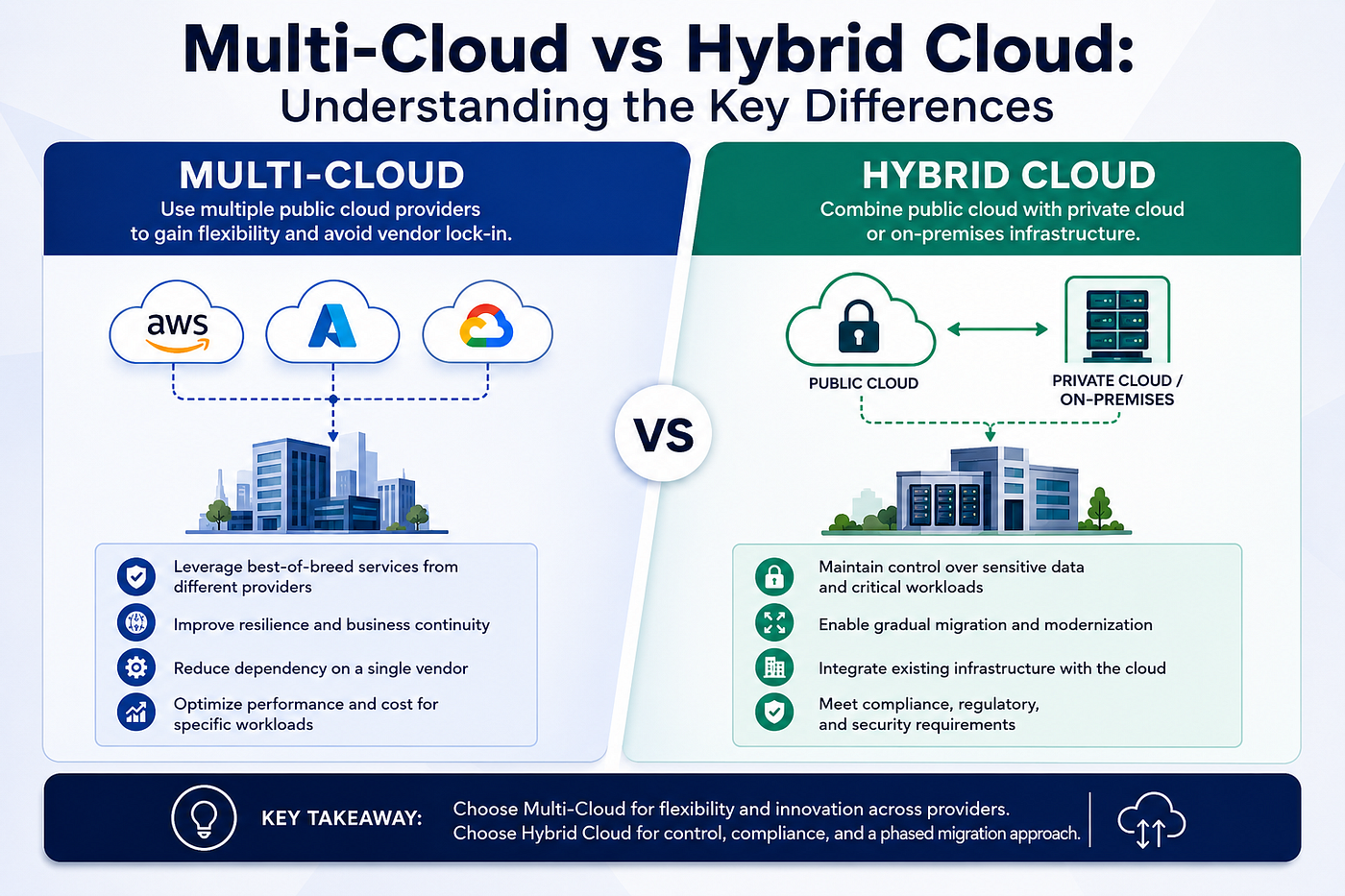
Multi-Cloud vs Hybrid Cloud
Cloud adoption is no longer a question of whether businesses should migrate it’s about how they should build an infrastructure that supports growth, security, and long-term flexibility. As organisations modernise applications and move workloads to the cloud, one decision often creates confusion: Should you choose a multi-cloud architecture or a hybrid cloud architecture?
Although these terms are sometimes used interchangeably, they solve different business challenges. Choosing the wrong model can increase operational complexity, raise costs, and make future migrations more difficult.
Whether you’re planning your first cloud migration, modernising legacy applications, or expanding into new markets, understanding these architectures helps you make better technology decisions before investing in infrastructure.
Multi-Cloud vs Hybrid Cloud: Quick Answer
Hybrid cloud combines public cloud services with private cloud or on-premises infrastructure, making it ideal for organisations that need to modernise gradually while keeping certain workloads under direct control.
Multi-cloud uses services from two or more public cloud providers. This approach gives businesses greater flexibility, reduces dependence on a single vendor, and allows workloads to run on the platform that best fits their technical or business requirements.
Neither architecture is universally better. The right choice depends on your existing infrastructure, compliance requirements, application portfolio, IT resources, and long-term business goals.
Why Understanding This Decision Matters
Choosing a cloud architecture affects much more than infrastructure. It influences how applications are deployed, how data is protected, how quickly teams can release new features, and how easily the business can scale in the future.
A well-planned architecture can help organisations:
- Reduce migration risks
- Improve application performance
- Strengthen disaster recovery
- Support regulatory compliance
- Control long-term cloud costs
- Avoid unnecessary vendor dependency
On the other hand, selecting an architecture without understanding its trade-offs often leads to higher operational overhead and expensive redesigns later.
What Is Multi-Cloud?
Multi-cloud is a cloud strategy where an organisation uses services from multiple public cloud providers instead of relying on a single vendor.
For example, a company might:
- Host customer-facing applications on Microsoft Azure
- Store backups in Amazon Web Services (AWS)
- Run AI or analytics workloads on Google Cloud
Each provider offers different strengths, pricing models, and specialised services. Rather than placing every workload in one environment, businesses select the provider that delivers the best value for each use case.
Why Businesses Choose Multi-Cloud
Organisations typically adopt a multi-cloud strategy to gain greater flexibility and resilience.
Reduce Vendor Lock-In
Depending on a single cloud provider can make future migrations more challenging. A multi-cloud strategy provides greater freedom when business priorities change.
Improve Business Continuity
Distributing workloads across multiple providers helps reduce the impact of regional outages or service disruptions.
Use Best-of-Breed Services
One provider may excel in AI services, while another offers stronger database performance or global networking. Multi-cloud allows businesses to take advantage of each provider’s strengths.
Meet Regional or Compliance Requirements
Some organisations must store data in specific geographic regions or comply with industry regulations. Multiple cloud providers can help satisfy these requirements.
Common Multi-Cloud Use Cases
A multi-cloud strategy is often appropriate when organisations need flexibility across different business functions.
Examples include:
- A SaaS company using different cloud providers for production and analytics.
- A multinational enterprise deploying workloads closer to regional customers.
- A healthcare organization separating sensitive workloads based on compliance requirements.
- A financial institution is improving resilience by distributing critical services across multiple providers.
What Is Hybrid Cloud?
Hybrid cloud combines public cloud services with private cloud infrastructure or on-premises environments, allowing workloads to move between connected environments when appropriate.
Instead of replacing existing infrastructure immediately, businesses extend it with cloud capabilities.
This approach enables organisations to modernise at their own pace while continuing to operate critical systems that cannot easily be migrated.
Why Businesses Choose Hybrid Cloud
Hybrid cloud is often selected by organisations with existing investments in infrastructure or strict security requirements.
Protect Existing Investments
Many businesses have applications that still perform well on-premises. Hybrid cloud allows these systems to remain operational while newer workloads move to the cloud.
Support Gradual Cloud Migration
Large-scale migrations rarely happen overnight. Hybrid cloud enables phased migrations that minimise operational disruption.
Meet Compliance Requirements
Industries such as healthcare, banking, and government often require sensitive information to remain within controlled environments.
Hybrid cloud helps organisations satisfy these regulatory obligations while benefiting from public cloud scalability.
Improve Operational Flexibility
Businesses can keep predictable workloads in private infrastructure while using public cloud resources to handle seasonal demand or unexpected traffic spikes.
Common Hybrid Cloud Use Cases
Hybrid cloud is commonly used when organisations need to balance innovation with operational stability.
Typical examples include the following:
- Retailers are keeping payment processing systems on-premises while hosting ecommerce applications in the cloud.
- Manufacturers connecting factory systems with cloud-based analytics platforms.
- Financial institutions maintain sensitive customer records in private infrastructure while delivering digital banking applications through the public cloud.
- Enterprises are modernising legacy applications without interrupting day-to-day business operations.
Multi-Cloud vs Hybrid Cloud: Understanding the Key Differences
Although both architectures involve cloud technologies, they address different business needs.

Multi-Cloud vs Hybrid Cloud
Hybrid cloud, on the other hand, focuses less on vendor diversification and more on connecting existing infrastructure with cloud services.
Which Architecture Fits Your Business?
There isn’t a universal answer. The right architecture depends on your business objectives, technical environment, and long-term roadmap.
Multi-cloud is often a better fit if your organization:
- Wants to reduce vendor lock-in
- Operates globally across multiple regions
- Needs specialised services from different providers
- Has mature cloud operations and governance
- Prioritises resilience across cloud platforms
Hybrid cloud is often a better fit if your organization:
- Still depends on legacy applications
- Must comply with strict data regulations
- Prefers a phased migration strategy
- Has significant investments in on-premises infrastructure
- Wants to modernize without disrupting business operations
In many cases, organisations begin with a hybrid cloud approach during migration and later adopt selected multi-cloud capabilities as their cloud strategy matures.
Real-World Business Scenarios
Scenario 1: A Growing Healthcare Provider
A healthcare organization stores patient records in a private environment to satisfy regulatory requirements while using public cloud services for appointment scheduling and analytics.
A hybrid cloud architecture allows the organisation to improve digital services without compromising compliance.
Scenario 2: A Global SaaS Company
A software company serves customers across North America, Europe, and Asia.
Instead of relying on a single provider, it distributes workloads across multiple public clouds to improve regional performance and reduce service dependencies.
For this organisation, a multi-cloud strategy offers greater flexibility and resilience.
Scenario 3: A Manufacturing Enterprise Modernising Legacy Systems
A manufacturer wants to introduce AI-powered predictive maintenance but still depends on legacy production systems.
Rather than replacing everything at once, the company extends its existing infrastructure with cloud services, making a hybrid cloud approach more practical.
Common Mistakes When Choosing Between Multi-Cloud and Hybrid Cloud
Choosing the right cloud architecture is not just a technical decision — it has a direct impact on how your business operates, scales, and manages risk. Many organisations move into cloud services before they fully understand how their workloads, security needs, and internal processes will be affected.
To make a better decision, it helps to avoid these common mistakes when comparing multi-cloud and hybrid cloud strategies.
Choosing an Architecture Based on Trends
It is easy to assume that using several cloud providers automatically creates a stronger infrastructure. In practice, added complexity only makes sense when it solves a real business problem.
Before choosing either approach, be clear about your business goals, technical limitations, and future growth plans.
Ignoring Existing Infrastructure
Organisations with significant investment in on-premises systems often underestimate how difficult it is to move everything at once.
A hybrid cloud strategy gives businesses room to modernise gradually while still supporting mission-critical applications that are not ready to move.
Underestimating Operational Complexity
Every additional cloud environment brings more monitoring tools, security policies, networking requirements, and management processes.
Without proper governance, cloud costs and operational overhead can rise quickly.
Focusing Only on Initial Costs
Many organisations compare cloud providers based only on pricing.
However, long-term costs also include:
- Data transfer fees
- Security management
- Integration development
- Monitoring tools
- Staff training
- Ongoing maintenance
Looking at the total cost of ownership gives a far more accurate picture than comparing infrastructure pricing alone.
Hidden Considerations Before Making Your Decision
Choosing the right architecture involves more than comparing technical features. Before moving forward, it is worth thinking through these business factors as well.
Compliance and Data Residency
Organisations in regulated industries often need tighter control over where data is stored and processed.
Hybrid cloud can make compliance easier by keeping sensitive workloads in private infrastructure while less-sensitive applications run in the public cloud.
Disaster Recovery and Business Continuity
Cloud architecture should support resilience, not just performance.
Multi-cloud can reduce reliance on a single provider by spreading workloads across multiple platforms.
Hybrid cloud, meanwhile, adds another layer of resilience by combining local infrastructure with cloud-based disaster recovery options.
Future Scalability
- It is important to think beyond current requirements.
- Will your organisation expand internationally?
- Will new digital services require specialised cloud capabilities?
- Will future acquisitions bring in additional infrastructure?
- Planning for growth now can help you avoid expensive architectural changes later.
Internal Skills and Resources
Cloud technology continues to evolve quickly.
Before introducing a complex architecture, assess whether your internal team has the skills to manage:
- Multiple cloud platforms
- Identity and access management
- Security monitoring
- Cloud networking
- Infrastructure automation
- Cost optimisation
If not, investing in training or working with experienced cloud specialists may reduce long-term operational risk.
How This Decision Impacts Your Cloud Migration Strategy
Cloud architecture and cloud migration are closely connected.
Many organisations start thinking about infrastructure only after they have already decided to migrate applications. In reality, cloud architecture should be part of the migration planning process from the very beginning.
Choosing the right architecture helps determine:
- Which applications should migrate first
- Which workloads should remain on-premises
- How data will be transferred securely
- How downtime can be minimised
- How business continuity will be maintained throughout the migration
Before choosing either a hybrid cloud or multi-cloud strategy, it is worth reviewing a comprehensive **cloud migration checklist** to identify infrastructure dependencies, business priorities, security requirements, and migration risks.
As migration planning progresses, organisations should also complete a pre-migration assessment checklist to evaluate application readiness, infrastructure compatibility, and workload dependencies before moving production systems.
Rather than treating migration as a one-time project, businesses should follow a **step-by-step cloud migration planning guide** that covers architecture selection, workload prioritisation, testing, security validation, and post-migration optimisation.
Taking these preparation steps can significantly improve migration outcomes while reducing unexpected costs and operational disruption.
Which Architecture Is Right for Your Business?
There is no single answer that works for everyone.
Instead, ask yourself these questions:
- Are you trying to modernise legacy infrastructure?
- Do you need to meet strict compliance requirements?
- Are you concerned about vendor lock-in?
- Do your applications require specialised cloud services?
- Does your IT team have experience managing multiple cloud environments?
- Are you planning gradual modernisation or a complete transformation?
If your main priority is integrating existing infrastructure while migrating at your own pace, a hybrid cloud is usually the better fit.
If flexibility, resilience, and provider independence matter more, a multi-cloud strategy may offer greater long-term value.
The right decision should support both your current operational needs and your future business strategy.
Conclusion
Choosing between multi-cloud and hybrid cloud is not about selecting the most advanced technology; it is about choosing the architecture that best supports your organisation’s goals.
Hybrid cloud offers a practical path for businesses that need to modernise gradually while keeping control over existing infrastructure. Multi-cloud provides greater flexibility for organisations that want to reduce vendor dependency and optimise workloads across multiple providers.
Before making this decision, it is important to evaluate your existing applications, security requirements, compliance obligations, operational capabilities, and long-term growth plans. A structured migration strategy helps ensure your cloud architecture aligns with business objectives rather than creating unnecessary complexity.
Organisations looking for practical guidance on cloud strategy and migration planning often work with experienced technology partners such as GuruTechnoLabs to evaluate infrastructure, reduce migration risks, and build cloud solutions that support long-term business growth.
Frequently Asked Questions
What is the main difference between multi-cloud and hybrid cloud?
Multi-cloud uses two or more public cloud providers, while hybrid cloud combines public cloud services with private cloud or on-premises infrastructure.
Which architecture is better for cloud migration?
For most organisations, hybrid cloud is the preferred choice during migration because it allows workloads to move gradually without replacing existing infrastructure all at once.
Is multi-cloud more expensive than hybrid cloud?
Not necessarily. Costs depend on workload distribution, networking, operational complexity, licensing, and management. Businesses should evaluate the total cost of ownership rather than infrastructure pricing alone.
Can an organisation use both hybrid cloud and multi-cloud?
Yes.
Many enterprises operate hybrid cloud environments while also using services from multiple public cloud providers. The right combination depends on business requirements and technology strategy.
메타데이터
- post_id
- 7e2255c7a23a
- slug
- multi-cloud-vs-hybrid-cloud-how-to-choose-the-right-architecture-for-your-business-7e2255c7a23a
- url
- https://medium.com/@GuruTechnolabs/multi-cloud-vs-hybrid-cloud-how-to-choose-the-right-architecture-for-your-business-7e2255c7a23a
- canonical_url
- https://medium.com/@GuruTechnolabs/multi-cloud-vs-hybrid-cloud-how-to-choose-the-right-architecture-for-your-business-7e2255c7a23a
- author_url
- https://medium.com/@GuruTechnolabs
- status
- ok
- fetched_at
- 2026-07-13 06:23:13






