Is America “an Enemy of Allah”?:What the Ḥajj and the Festival of Sacrifice Seek to Realize
A reflection on the Ḥajj, sacrifice, and the danger of turning Allah’s name into a sign of political hatred.
Is America “an Enemy of Allah”?
What the Ḥajj and the Festival of Sacrifice Seek to Realize
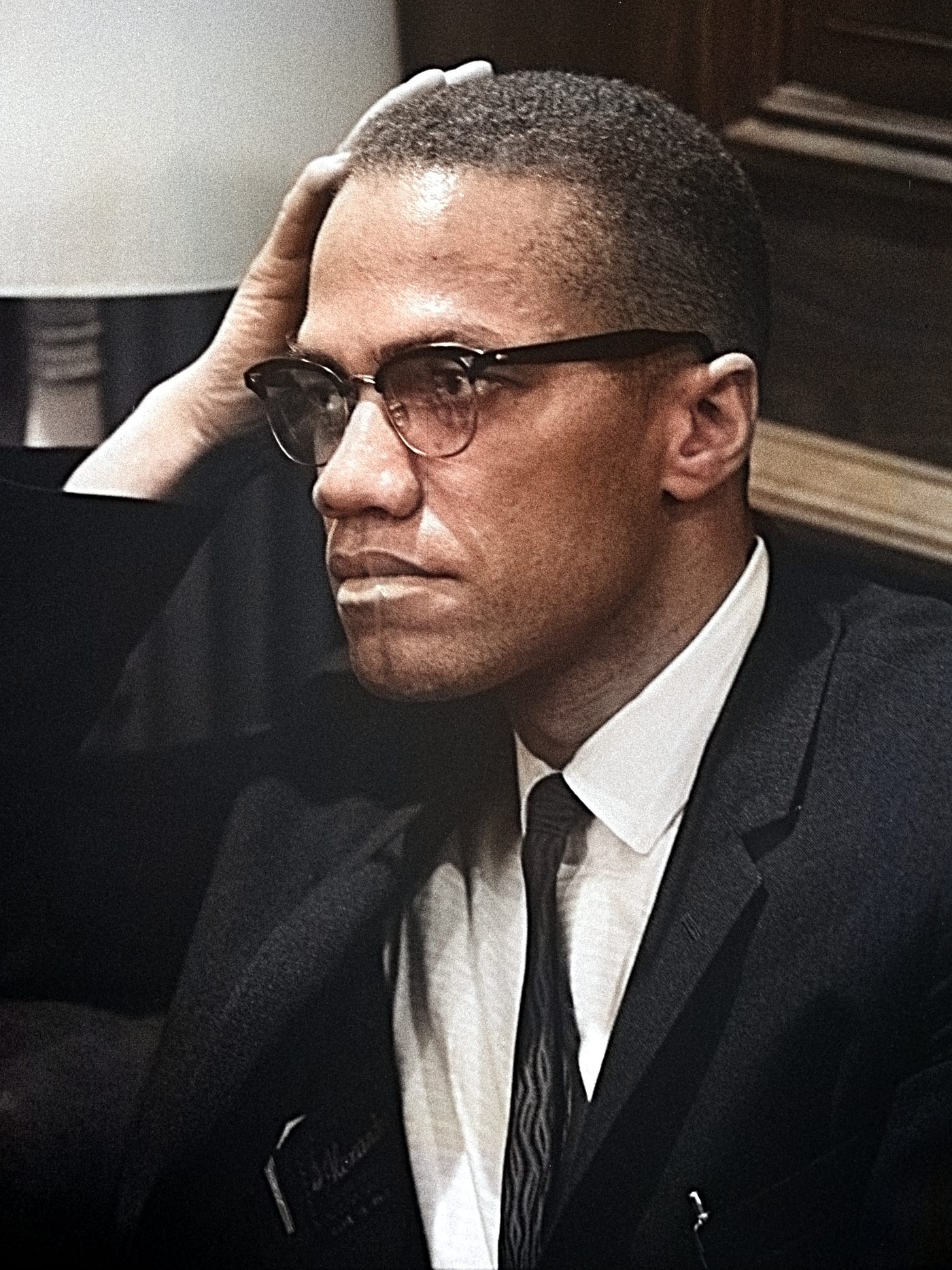
Malcolm X waiting for a press conference to begin on March 26, 1964
AI-Generated Summary
This essay begins from a sense of discomfort with the phrase “America is an enemy of Allah,” which appeared as a subtitle in a television program reporting on scenes from the Ḥajj, and reconsiders the original meaning of the Ḥajj and the Festival of Sacrifice.
In the original Arabic, the expression used may have been closer not to “enemy” itself, but to “being opposed to” or “being hostile to.” This difference matters, because it concerns whether confrontation is fixed as an essential condition or understood as a state that may change. The Ḥajj is, in essence, a place where human beings stand simply as human beings before Rabb al-ʿĀlamīn, beyond race, nationality, and wealth. Malcolm X’s experience of pilgrimage also shows this universality.
The sacrificial offering of the Festival of Sacrifice is not meant to deliver blood or flesh to Allah, but to express taqwā, and it may also serve as an occasion to restrain violence among human beings. Rather than fixing a particular country as “an enemy of Allah,” should not the true aim of the Ḥajj and the Festival of Sacrifice be to pray for the maṣlaḥa and peace of the entire world?
The Ḥajj Exposed to the Shadow of Attack
The season of the Ḥajj, the great pilgrimage, has come again this year. According to reports, on May 26, 1.7 million believers from around the world, more than the previous year, offered prayers at Mount ʿArafāt, where the Prophet Muḥammad — may Allah’s prayers and peace be upon him — is said to have delivered his final sermon. The Ḥajj thus reached its climax.[1]
Repeated Israeli airstrikes on Gaza, the West Bank, and Lebanon, involving civilian casualties. The U.S.-Israeli airstrikes on Iran that began on February 28, and the retaliatory drone and missile attacks on Gulf states. Although the situation has calmed after the ceasefire agreement, depending on circumstances, U.S.-related military facilities in Saudi Arabia, the country that holds the holy places, could also become targets of attack. Because of this tense regional situation, it seemed to me that this year’s Ḥajj was reported on more extensively than usual.
The Ḥajj as Reported
One such report was aired on TV Asahi’s Wide Scramble, under the title “The Great Pilgrimage to the Holy City of Mecca: Voices Criticizing the United States Amid the Iran Situation — ‘America Is an Enemy of Allah.’”[2]
What even made me shudder was the footage of a scene of prayer, introduced with the words: “Pilgrims from Iran raised angry voices in Mecca.” The subtitles read, “America is an enemy of Allah.” Moreover, the program explicitly subtitled the content of what was being shouted with force: “There is no god but Allah. America is an enemy of Allah. There is no god but Allah. Israel is an enemy of Allah.”
The audio is muffled, and because of the Iranian accent it is difficult to hear clearly. Yet if one listens carefully, their shouting does not seem to say, “America is an enemy of Allah” — ʿaduww. Rather, following the imam, they continue chanting loudly that “America is opposed to Allah” or “America is hostile to Allah” — ḍidd.[3]
Is America an “Enemy of Allah”?
Some may think that “enemy” and “hostile to” amount to the same thing. Yet there seems to be a reason why the imam leading the chant chose to say it in that way.
If one declares someone an “enemy,” then not only the U.S. government and the Israeli government, but all American citizens and all Israeli citizens are grouped together, labeled as “enemies,” and uniformly made objects of exclusion and curse.
In the Holy Qur’an, Iblīs — the devil — is named as an “enemy of Allah.” Only a true devil deserves such a name. This does not mean that there exists an enemy capable of opposing Allah. In other words, no enemy comparable to Allah as the Lord of all worlds can exist, and neither America nor Israel is an entity capable of standing against Him.
By contrast, if one says that something is “opposed to” Allah or “hostile to” Allah, then although that may have been the case at that moment, it also leaves open the implication that this condition may one day change. At least in Arabic, this difference exists. However loudly the words were shouted, there may still be a faint thread of hope in this choice of wording.
Words That Fix a State of War
However, if this is translated as “enemy,” and if the subtitle “America is an enemy of Allah” is placed in a program featuring the Ḥajj — supposedly the moment in a person’s lifetime when faith reaches one of its highest points — then for Japanese viewers, America becomes, not only for Iranians but for Muslims as a whole, an “enemy” forever.
Under the image of intense faith captured on screen, viewers may be led to believe that hostility toward America and antagonistic confrontation will never subside. If translation itself assists in fixing this hostility in place, it becomes very difficult to overturn.
Certainly, the situation is one on which it is almost impossible to comment lightly. The faith of those pilgrims cannot be denied, and the death of Iran’s Supreme Leader Ayatollah Khamenei in attacks by the United States and Israel,[4] as well as violence and killings against innocent civilians, may be evaluated as war crimes.
Nevertheless, it is far too sweeping to name countries such as America and Israel and place them under the category of “enemies of Allah.” Although Allah is not the banner of any national camp, such language incites, fixes, or amplifies hostility, collision, and curses at the level of nation-states. In the end, does it not merely create new victims?
What Is the Ḥajj?
The program also explained that the Ḥajj is one of the five obligations of Muslims,[5] and that whoever is able to go must perform it once in a lifetime. There was also a comment from someone who had experienced the pilgrimage, saying that it enables one to become “a person who does not lie.” Let us therefore go a little deeper into its Qur’anic basis and its effects.
The scriptural basis is the verse: “For Allah, people are obligated to make the pilgrimage to this House” (Sūrat Āl ʿImrān, 3:97). It is for Allah, and for nothing else. That it is an obligation imposed upon those who are able to make the journey can also be found in the ḥadīth in Ṣaḥīḥ Muslim, “The Book of Faith.”
There is also the verse: “Complete the Ḥajj and the ʿUmra for Allah” (Sūrat al-Baqara, 2:196). From these, the obligatory nature of the pilgrimage can be understood.[6]
The Effects of the Great Pilgrimage
The period of the Ḥajj falls in the pilgrimage months after Ramadan: Shawwāl, the tenth month of the Hijrī calendar; Dhū al-Qaʿda, the eleventh month; and the first ten days of Dhū al-Ḥijja, the twelfth month. Since this follows the Hijrī calendar, the period shifts forward by approximately eleven days each year. The places are the Kaʿba and ʿArafāt.
As for its effects, let us recall an episode concerning Malcolm X’s pilgrimage. Malcolm X, who had converted in prison within the context of the Black liberation movement, performed the pilgrimage to Mecca in April 1964. There he encountered many white pilgrims, people who until then had been nothing but “evil” to him. For him, white people had, in a sense, been “enemies” across the board.
What he saw there, however, was the sight of devout believers performing the pilgrimage, wearing the same pilgrimage garments as himself, no different from him in any essential respect. It was not only Black people who were beautiful. White people, too, were beautiful. And once again, beyond differences of race, ethnicity, origin, and personal history, there was the Creator.
Malcolm X’s Letter
Let us look at the letter he wrote after this experience.[7]
During these eleven days, I have eaten from the same plate, drunk from the same glass, slept on the same rug, and prayed to the same God with fellow Muslims. They were people with the bluest of blue eyes, the blondest of blond hair, and skin as white as daylight. In the words, actions, and conduct of the “white” Muslims, I felt the same kindness that I had felt among Black African Muslims from Nigeria, Sudan, and Ghana.
In this ancient holy land, I had never seen anything as wonderful as the sincere kindness and overwhelming spirit of true brotherhood that I received from people of every skin color and race. The kindness shown to me during this week by people of every skin color around me left me simply speechless and astonished.[8]
As Mere Human Beings
Here we see the manifestation of complete benevolence and a spirit of human brotherhood. Differences of skin color, differences between rich and poor, and differences between ruler and ruled are not called into question at all. One experiences this bodily, together with pilgrims gathered from all over the world.
As Malcolm X himself insisted, there should be an opportunity here to cast aside racism, to refuse captivity to skin color, and to acquire a humanism of those who take the Lord of all worlds as their Lord, living together as beings created by God.
Of course, the effects of the pilgrimage do not stop there. Love for Allah takes precedence over worldly matters such as property, family, work, and homeland. Patience is cultivated through the pilgrimage, including the journey to the holy places. The strengthening of faith, spiritual discipline, and atonement for sins are also bestowed upon believers in practical form.
In this way, the pilgrimage becomes an opportunity to engrave once again, upon both heart and body, the fact that one lives simply as a human being under the Lord of all worlds, the All-Merciful and the Compassionate.
The Sacrifice of the Festival
The Festival of Sacrifice, performed as the festival of the pilgrimage, also contains within it a wisdom for avoiding war.
According to the Holy Qur’an, the origin of the sacrificial offering is the command given through a dream from Allah to Ibrāhīm — Abraham — to offer his son[9] as a sacrifice. When the two had submitted to the command and placed their foreheads down upon the ground, Allah said:
“O Ibrāhīm, you have indeed fulfilled the dream. Thus do We reward those who do good. This was indeed a clear trial.” “And We ransomed him with a great sacrifice, and We left for him among later generations: Peace be upon Ibrāhīm.” (Sūrat al-Ṣāffāt, 37:104–109)
The basis for sacrifice itself is found in the verse: “For every community We have appointed a rite of sacrifice…” (Sūrat al-Ḥajj, 22:34).
There is also the verse:
“And the camels and cattle We have made for you among the rites of Allah. In them there is much benefit for you. So mention the name of Allah over them as they stand in rows. Then, when they have fallen down on their sides, eat of them and feed those who do not ask and those who do ask. Thus have We subjected them to you, so that you may give thanks.” (Sūrat al-Ḥajj, 22:36)
Thus it is revealed even that, after slaughtering the animals offered in sacrifice, their meat is to be given to those in need and to the poor.
The Purpose of Sacrifice Is Taqwā
“Neither their flesh nor their blood reaches Allah. Rather, what reaches Him is your taqwā. Thus has He subjected them to you, so that you may magnify Allah for His guidance to you.” (Sūrat al-Ḥajj, 22:37)
The Festival of Sacrifice is held for four days beginning on the tenth day of Dhū al-Ḥijja.
If, in this way, the purpose of sacrifice is an act by which human beings deliver their taqwā — their God-conscious devotion — to the Lord of all worlds, then if sacrifice is no longer performed, might we not lose the feeling of gratitude that comes from living by receiving life? At the same time, might we not lose the opportunity to express piety, lose sight of Allah, and become more prone to fall into idolatry?
And might we not also become unable to notice that we ourselves are being made objects of sacrifice? Under colonization, one may be turned into a slave — a human being only if liberated. Under globalization, one may become labor power as a consumable item for corporations and markets — to be liberated only by sacrifice or sale. Under wartime conditions, one is suddenly forced to become a sacrifice.
Violence That Should Have Been Resolved
There are also debates among cultural anthropologists concerning sacrifice. Some scholars, such as Claude Lévi-Strauss, are said to have cast sacrifice into the realm of fantasy, regarding it as nothing but “fiction,” just as the god to whom it is offered is fiction, and as having no reality for modern people.
On the other hand, there are also views that seek to understand the social function of sacrifice as something that attempts to remove internal violence among human beings: friction, hostile relations, jealousy, and disputes among neighbors. In other words, in addition to the orientation that denies useless killing out of piety toward the Lord of all worlds, sacrifice itself may also be expected to function as a vector for restraining war.
If we follow this line of thought, an interpretation becomes possible in which Cain’s offering, because it was not an animal, did not provide an outlet for violence, and Abel therefore became the sacrifice.[10]
Yet pilgrimage and the sacrifice that accompanies it are being performed on a large scale, while people continue to be exposed to the danger of airstrikes and drone attacks. Have we not gone astray somewhere?
Nothing Can Be Compared with Allah
Whether the great pilgrimage or the Festival of Sacrifice, both should originally be acts by which one bodily demonstrates that one takes Rabb al-ʿĀlamīn, the Lord of all worlds, as one’s Lord.
They should be occasions in which mercy is awakened, patience is cultivated, a sense of brotherhood among human beings overflows, taqwā toward Rabb al-ʿĀlamīn becomes the axis, and even the mutual sharing of food actually takes place.
If that is so, should not the words of prayer also change? We should pray for the earliest possible ceasefire and end to war, for stability in the region, mourn and offer condolences for the victims, and pray for peace for all human beings.
If, instead, these occasions become opportunities to confirm, share, and amplify hostility toward particular states or peoples, then does that not diminish the very meaning of the great pilgrimage and its sacrificial festival?
All the more so if such scenes are broadcast around the world. Islam and Muslims may be seen as nothing but bellicose and hostile, and the original image of mercy, compassion, and peace will never arise.
Praying for the Peace of the World
I have already introduced the theory of the objectives of law, according to which Islamic law aims at the realization of welfare — that is, the preservation and realization of the five matters: religion, life, reason, progeny, and property.[11] The great pilgrimage and sacrifice also play a role like blood circulation, supplying fresh oxygen for the realization of these objectives.
In such a context, discourse that names a specific country and declares it an enemy or a devil, when viewed in light of the original intent of Islam, may spread misunderstanding of Islam, deepen the gap between Muslims and non-Muslims, and even lead to intense rejection and exclusionary attitudes.
If the name of Allah is turned into a sign of political hatred, then for the believers who chant such words themselves, too, the existence of Allah as Rabb al-ʿĀlamīn, and their taqwā toward that existence, may become faint.
As the great pilgrimage and its sacrificial festival concretely symbolize, only when we practice the peace of the world regardless of differences in skin color, wealth, poverty, or language, and transmit that humanism to the world, can it lead to the realization of the maṣlaḥa of the whole world and to the removal of harm.
I myself hope to go on the Ḥajj one day.
Allāhu aʿlam — Allah knows best.
Notes
[1] “Makka dai-junrei ga saikōchō ni: Chūtō jōsei kinpaku mo zennen yori ōi 1.7 million sanka” [The Mecca Great Pilgrimage Reaches Its Climax: 1.7 Million Participate, More Than the Previous Year, Amid Tense Middle East Situation], Asahi Shimbun, May 27, 2026, 3:34 a.m., Istanbul, by Akira Nemoto.
[2] TV Asahi, Wide Scramble, “Seichi Mekka e no dai-junrei: Iran jōsei de Beikoku hihan no koe mo ‘America wa Arā no teki’” [The Great Pilgrimage to the Holy City of Mecca: Voices Criticizing the United States Amid the Iran Situation — “America Is an Enemy of Allah”], broadcast May 29, 2026.
[3] In Arabic, “enemy” is usually expressed as ʿaduww (عدوّ), while “being opposed to” or “being hostile to” is expressed by terms such as ḍidd (ضدّ). The latter indicates a relation of opposition, confrontation, or hostility, and differs in nuance from ʿaduww, which more directly labels someone or something as an “enemy.”
[4] “Iranian State TV Presenter Tearfully Announces the Death of Supreme Leader Khamenei,” BBC Japan, March 1, 2026.
[5] On the five pillars of Islam, see, for example, the ḥadīth found in Ṣaḥīḥ Muslim, “The Book of Faith.”
[6] Sūrat al-Ḥajj 22:27–28, which includes the phrase “that they may witness benefits for themselves,” is also a related passage showing that the pilgrimage has its own purposes. These benefits have often been understood as including both worldly and otherworldly benefits.
[7] Malcolm X, The Autobiography of Malcolm X, Japanese translation, Kawade Shobō Shinsha, February 20, 1993, “A Letter Written from the Heart,” pp. 413ff.
[8] This shock transformed his understanding of the Black liberation movement. After parting ways with his former organization, he came to advocate the solidarity of humanity. The following year, in 1965, he was struck down by bullets, reportedly from members of his former organization, during a lecture in New York.
[9] The Qur’anic text does not explicitly name the son who was about to be offered in sacrifice, but in Islamic tradition he is generally identified as Ismāʿīl.
[10] René Girard, Violence and the Sacred; Japanese translation: Bōryoku to Seinaru Mono, Series Universitas, 1982, pp. 7ff.
[11] See my essay “Is Islamic Law Merely a Set of ‘Strict Precepts’? What the Sharīʿa Seeks to Protect — Part One.”
Special Thanks to: ChatGPT
Cover Image:
Malcolm X waiting for a press conference to begin on March 26, 1964, Photo by Marion S. Trikosko, Public domain, via Wikimedia Commons.
Acknowledgements
This English version was prepared with the support of ChatGPT. The author gratefully acknowledges its assistance in translation and linguistic clarification.
Original version in Japanese:
메타데이터
- post_id
- 7e2a2c1d9f08
- slug
- is-america-an-enemy-of-allah-what-the-ḥajj-and-the-festival-of-sacrifice-seek-to-realize-7e2a2c1d9f08
- url
- https://medium.com/@assalaam.action/is-america-an-enemy-of-allah-what-the-%E1%B8%A5ajj-and-the-festival-of-sacrifice-seek-to-realize-7e2a2c1d9f08
- canonical_url
- https://medium.com/@assalaam.action/is-america-an-enemy-of-allah-what-the-%E1%B8%A5ajj-and-the-festival-of-sacrifice-seek-to-realize-7e2a2c1d9f08
- author_url
- https://medium.com/@assalaam.action
- status
- ok
- fetched_at
- 2026-06-17 08:20:12