America Didn’t Get Obese by Accident. It Built the Perfect Machine for It.
The modern food system solved scarcity, then quietly turned convenience, corn, chemistry, and scale into a daily overconsumption engine.
America Didn’t Get Obese by Accident. It Built the Perfect Machine for It.
The modern food system solved scarcity, then quietly turned convenience, corn, chemistry, and scale into a daily overconsumption engine.
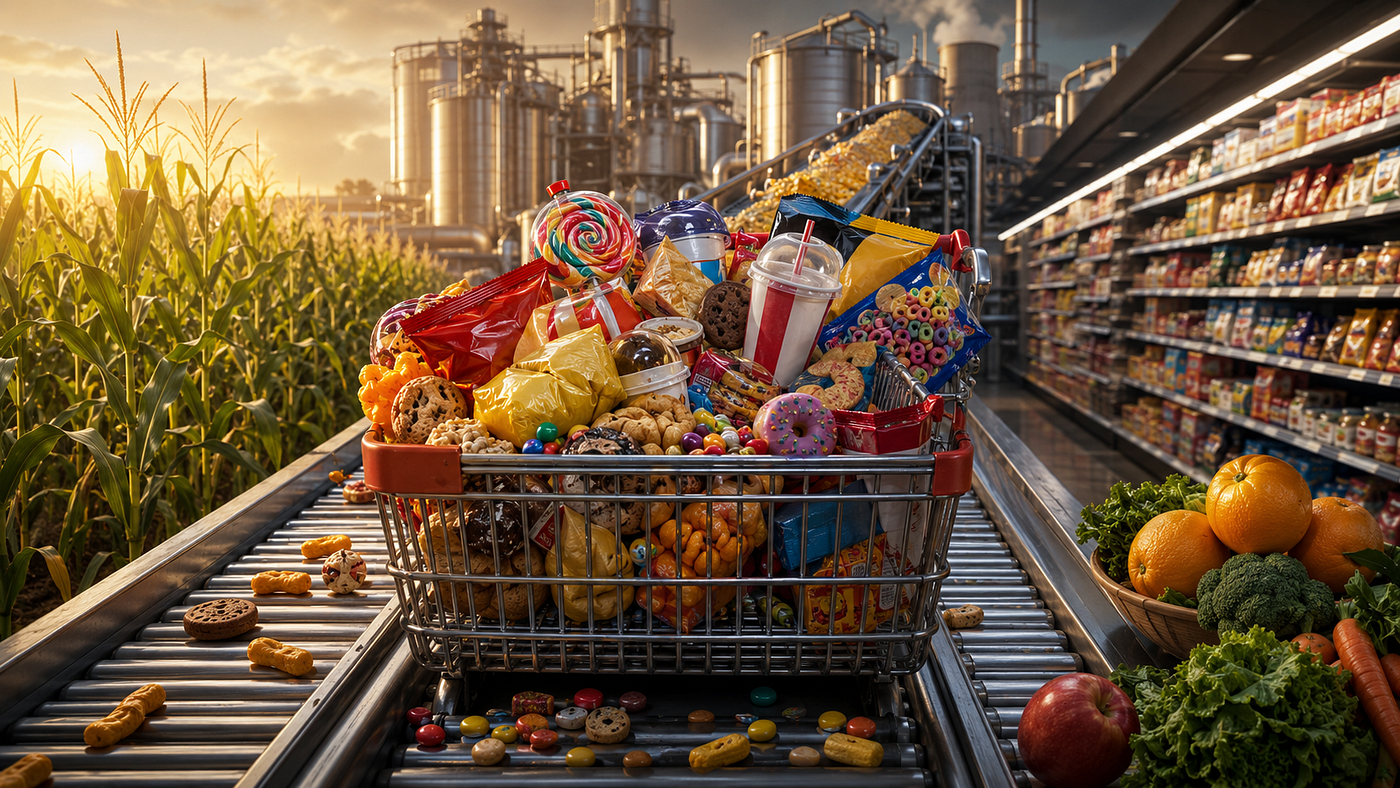
Image made in Nano Banana
I do not think America’s obesity problem is mainly a story about people suddenly becoming lazy.
That explanation is too easy. It is also too comfortable, because it lets the entire system off the hook.
The more honest story is harder to sit with: America became extremely good at producing cheap, convenient, addictive, shelf-stable food. Then, after building that machine, it acted shocked when people started eating like they lived inside it.
That is the part we rarely talk about properly.
We talk about calories. We talk about willpower. We talk about gym memberships, cheat days, keto, fasting, sugar, seed oils, carbs, and whatever the internet has decided to blame this week. Some of that matters. Of course it does.
But zoom out for a second.
The average person today is not making food choices in a neutral environment. They are making food choices inside an industrial system designed to make food cheap, available, tasty, portable, profitable, and easy to overeat.
That does not remove personal responsibility. I do not believe that. But it does explain why personal responsibility has become so difficult to practice.
Because the food around us was not mainly designed around health.
It was designed around economics.
We Used to Eat What the Land Allowed
For most of human history, people did not “choose a diet” in the way we do now.
Nobody was sitting around a fire debating whether they should go low-carb or try intermittent fasting. People ate what the land gave them. If the environment had roots, berries, fish, game, seeds, organs, insects, or seasonal fruit, that was the diet. Not because it was trendy, but because the alternative was starving.
And I do not want to romanticize that world.
Ancient life was not some perfect wellness retreat. There was famine, disease, parasites, food insecurity, injury, and very little medical help. If someone today says, “We should just eat like our ancestors,” they usually forget that many of our ancestors would have loved a supermarket, a fridge, and antibiotics.
But there is one thing ancient diets had that modern diets often do not: natural limits.
It was hard to overeat.
Food took effort to find, catch, grow, prepare, chew, digest, and preserve. Sweetness was rare. Fat was valuable. Salt mattered. The human body learned to crave these things because they were useful signals in a scarce environment.
Sweet often meant quick energy.
Fat meant dense calories.
Salt helped the body function.
The problem is not that we crave sweet, salty, and fatty foods. The problem is that modern industry learned how to manufacture those signals at scale, remove the natural limits around them, and put them in front of us all day.
Our biology did not suddenly become broken.
Our environment changed faster than our biology could handle.
Agriculture Built Civilization, But Not Always Better Nutrition
Agriculture was one of the biggest turning points in human history.
Once humans started domesticating plants and animals, civilization became possible in a new way. Settlements grew. Food storage improved. Populations expanded. Societies became more complex.
But agriculture also came with trade-offs.
When people rely heavily on a few staple crops, food becomes more predictable, but it can also become less nutritionally diverse. A society can produce more calories and still have people missing important nutrients.
That tension has never really gone away.
The food system can become more efficient without becoming healthier.
That is the theme that runs through the entire story.
More output does not automatically mean better nourishment. More calories do not automatically mean better food. More convenience does not automatically mean better health.
And once America began industrializing agriculture, that difference became impossible to ignore.
The Farm Became a Factory
Early American agriculture had a wide range of farms.
Some were smaller family farms serving households, local communities, and regional markets. Others were large cash-crop operations producing commodities for national and international trade. It was never one simple picture, but over time, the direction became clear.
Farming became less local and more industrial.
Railroads, grain elevators, meatpacking plants, national distribution networks, tractors, synthetic fertilizers, and university extension programs all helped transform agriculture into something bigger and more technical.
This was not all bad.
It massively increased productivity. It helped feed cities. It lowered costs. It made food more reliable. There is no serious argument that America could feed hundreds of millions of people on romantic nostalgia alone.
But the logic changed.
The farm was no longer just a place where food was grown. It became the first stage of a massive production chain.
Yields mattered.
Inputs mattered.
Debt mattered.
Machinery mattered.
Distribution mattered.
Commodity prices mattered.
The quality of the final meal was not always the central concern. The system was increasingly built around volume, efficiency, and market stability.
Then war accelerated everything.
World War I showed how important American food production could be to global supply. World War II pushed the system even further. America learned how to produce at scale in a way few countries ever had. Ships, weapons, vehicles, canned goods, powdered foods, preserved meats, dehydrated potatoes — the point was speed, storage, transport, and mass delivery.
That wartime mindset did not disappear when the war ended.
It moved into peacetime industry.
Food science advanced. Chemistry advanced. Fertilizer production expanded. Pesticides became more common. Machinery became more powerful. Farming started to look less like husbandry and more like manufacturing.
Again, this was not some cartoon villain plot.
A lot of these innovations were solving real problems. They helped prevent hunger, stabilize supply, and make food cheaper.
But they also created a food system with one major blind spot.
It knew how to produce abundance.
It did not always know how to produce health.
Then Corn Became Invisible
If there is one crop that explains modern American food better than almost anything else, it is corn.
Corn is not just corn on the cob.
Corn became animal feed. Corn became starches. Corn became oils. Corn became sweeteners. Corn became preservatives. Corn became ethanol. Corn became packaging. Corn became an invisible ingredient hiding inside the grocery store.
It is difficult to understand the American diet without understanding how central corn became to the industrial food system.
Hybrid seeds made corn more predictable and productive. Fertilizers and pesticides helped boost yields. Machinery allowed farms to cover more land with less labor. Government policy helped stabilize production and markets.
From a farming perspective, a lot of this made sense.
If you can grow a crop more reliably, at greater scale, with more predictable returns, why would you not? Farmers are not stupid. They respond to incentives like everyone else.
The issue is not that corn exists.
The issue is what happens when an entire food economy becomes extremely good at producing cheap raw material, then has to find endless profitable uses for it.
That is how food slowly turns into food products.
And one of the most important food products in this story was high-fructose corn syrup.
High-Fructose Corn Syrup Was Not Magic. It Was Economics.
High-fructose corn syrup did not take over because it was healthier.
It took over because it was useful.
It was cheap. It was liquid. It blended easily. It worked well in soft drinks and processed foods. It was convenient for manufacturers. And because of the economics around sugar and corn, it became an attractive replacement for traditional sugar in many products.
This is where the conversation often gets stupid.
Some people talk about high-fructose corn syrup like it is poison in a lab coat. Others respond by saying it is chemically similar to sugar, so there is nothing to see here.
Both views miss the point.
The issue is not just the molecule. The issue is the delivery system.
Fructose in an orange arrives inside a whole food. It comes with water, fiber, vitamins, minerals, texture, and structure. You have to chew it. Your stomach has to process it. It takes time. It creates some fullness.
That does not make fruit magical. It just means the body receives it in a very different context.
Fructose in a soft drink arrives as added sugar in liquid form. No chewing. No fiber structure. Very little satiety. It is easy to consume quickly and then move on as if nothing happened.
That is the real problem.
Not that one soda instantly ruins your body.
It does not.
The problem is that modern food products make small overconsumption incredibly easy. A drink here. A snack there. A breakfast cereal that does not keep you full. A fast-food meal that tastes good but somehow leaves you looking for something else two hours later.
That is how the system works.
Not through one dramatic act of overeating, but through small daily surpluses that feel normal.
The Genius of Ultra-Processed Food Is That It Does Not Feel Like Too Much
Most people do not become obese because they wake up and decide to eat an extra 1,500 calories every day.
That is not how it usually happens.
It is more boring than that.
You eat a little more than your body needs. Then you do it again. Then again. Then again. Maybe it is only 200 or 300 extra calories on many days. But the modern food environment makes that easy because so much of the food is designed to be fast, soft, tasty, energy-dense, and low in lasting fullness.
This is what makes ultra-processed food so powerful.
It does not always feel like overeating.
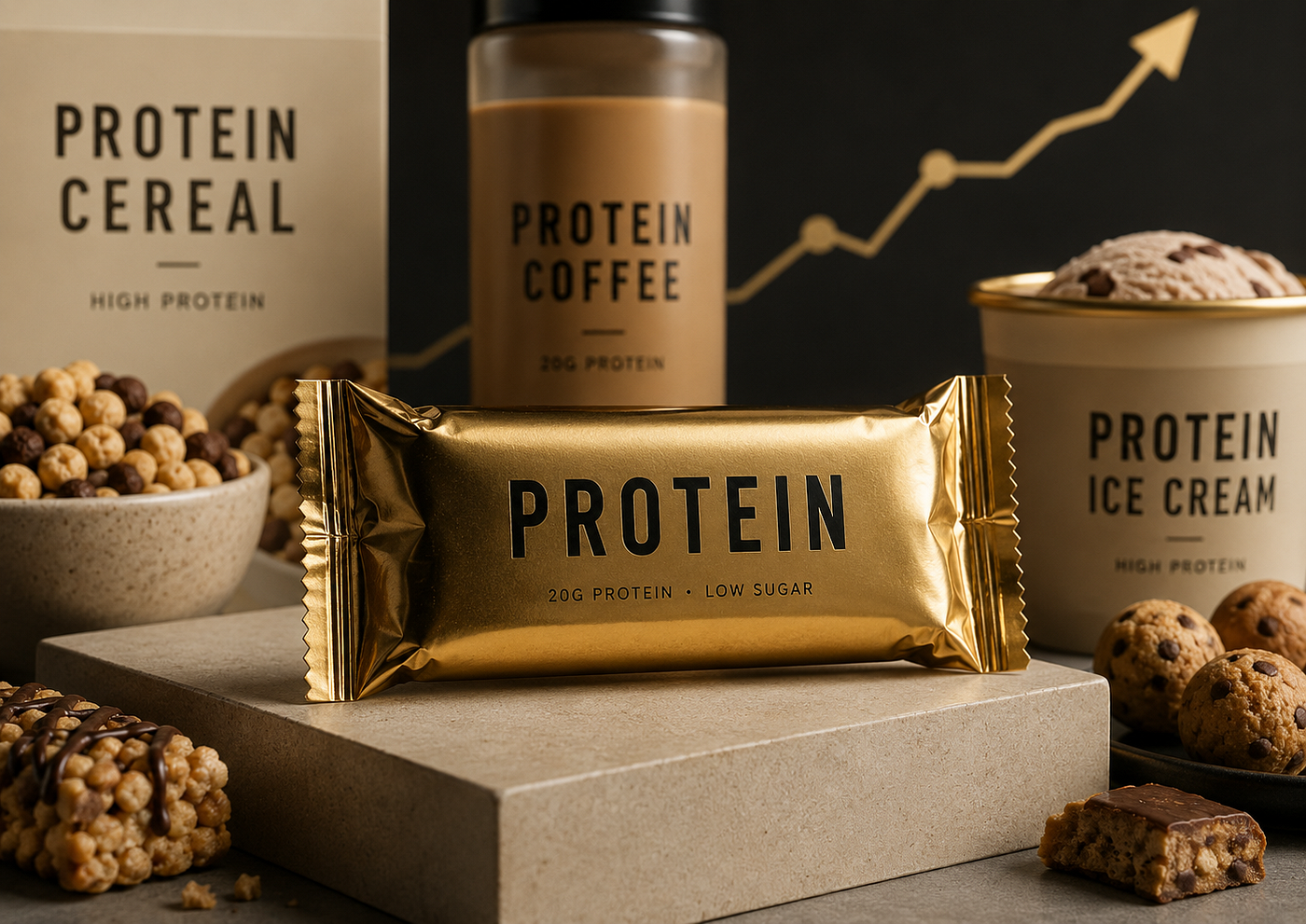
A bag of crisps does not feel like a feast. A sugary drink does not feel like a meal. A sweet coffee does not feel like dessert. A protein bar can feel like a responsible choice even when it is basically a candy bar wearing gym clothes.
The psychology is subtle.
You do not feel like you are doing anything extreme. You feel like you are just living a normal modern life.
That is what makes the problem so hard.
Obesity has been normalized not only because people eat more, but because the system has made overeating feel ordinary.
The food is everywhere. The marketing is constant. The portions are larger than they need to be. The cheapest options are often the least filling. The most convenient options are often the most processed.
And if someone is tired, stressed, underpaid, overworked, commuting, raising kids, or living in a neighborhood with poor access to fresh food, the idea of simply “making better choices” becomes a lot less simple.
Again, that does not mean choices do not matter.
It means the choices are being made on a tilted floor.
This Is Not an Anti-Farmer Argument
I think it is important to be fair here.
It is easy to turn this into a lazy attack on farmers, corn, capitalism, supermarkets, or America itself. That would be too simplistic.
Farmers are not the villains of this story.
Most farmers are operating under brutal economic pressure. They grow what the market rewards. They use the tools available to them. They respond to debt, land costs, weather, policy, commodity prices, and competition.
Food companies are also responding to incentives. If consumers buy cheap, tasty, convenient products, companies will make more of them. If shelf life reduces waste and increases profit, companies will chase shelf life. If sweetness sells, sweetness spreads.
The deeper problem is that the system measures success in ways that do not fully account for health.
Cheap calories look like a win.
Long shelf life looks like a win.
High yield looks like a win.
Fast service looks like a win.
Strong quarterly earnings look like a win.
But then the costs show up somewhere else: obesity, diabetes, heart disease, fatigue, poor diet quality, and a population that feels like it is constantly fighting its own appetite.
The bill does not disappear.
It just gets moved from the grocery receipt to the body.
The Real Lesson Is Not “Never Eat Processed Food”
I do not think the answer is to panic every time you see an ingredient label.
That is not realistic, and for most people it is not necessary.
Some processed foods are useful. Frozen vegetables are processed. Greek yogurt is processed. Tinned fish is processed. Protein powder is processed. Even bread is processed.
The word “processed” alone is not the issue.
The bigger issue is whether your diet is mostly built around foods that fill you up, nourish you, and make overeating harder — or foods that are engineered to be eaten quickly, repeatedly, and in large amounts without much fullness.
That is the practical line.
A meal built around meat, eggs, potatoes, rice, beans, vegetables, fruit, oats, yogurt, fish, or other whole foods is usually harder to overeat than a meal built around liquid calories, refined snacks, sweetened breakfast foods, and fast-food combinations.
Not impossible.
Just harder.
And in real life, “harder to overeat” matters.
Because most people do not need a perfect diet. They need a food environment that stops working against them every waking hour.
The Grocery Store Is Not Neutral
Once you understand this, the supermarket starts to look different.
The bright packaging. The cereal aisle. The soft drinks. The snack multipacks. The “healthy” bars. The frozen meals. The sauces filled with added sugar. The products designed to sit on a shelf for months and still taste exciting.
None of this is random.
It is the result of decades of food science, agricultural policy, manufacturing, logistics, marketing, and consumer psychology.
The modern grocery store is not just a place where food happens to be sold.
It is the final showroom of an industrial system.
And that system is brilliant at what it was built to do.
It can produce enormous amounts of food. It can keep products stable for months. It can move calories across a continent. It can make cheap ingredients taste expensive. It can create flavors that hit the brain harder than most whole foods ever could.
But it cannot care about your health for you.
That part is still on you.
Which is unfair, but true.
So What Do We Actually Do?
I do not think the solution starts with moral panic.
It starts with seeing the system clearly.
If we understand that many modern foods are built around economics first and health second, we can stop treating every struggle with food as a personal failure.
Sometimes the problem is not that you are weak.
Sometimes the problem is that you are surrounded by products designed to beat your fullness signals.
That changes the strategy.
Instead of asking, “How do I become disciplined enough to resist everything forever?” maybe the better question is, “How do I build a food environment where I do not need heroic discipline every day?”
That might mean keeping fewer snack foods at home.
It might mean eating more protein and fiber earlier in the day.
It might mean swapping liquid calories for drinks that do not quietly add hundreds of calories.
It might mean cooking simple meals, not perfect meals.
It might mean shopping around boring staples rather than exciting products.
It might mean accepting that convenience has a cost, even when the price tag looks cheap.
And yes, if you have the time and money to buy better food, that is a privilege. Not everyone has the same options. Any serious conversation about obesity has to admit that.
But wherever there is room to choose, the principle is the same.
Spend more of your food budget on things your great-grandparents would recognize as food, and less of it on products that were engineered in a boardroom to make you eat past fullness.
That is not a perfect rule.
It is just a useful one.
We Built This System. That Means We Can Understand It.
The strange thing about modern obesity is that it came from success.
America became too good at producing calories. Too good at preserving them. Too good at making them cheap. Too good at making them taste good. Too good at putting them everywhere.
The old problem was scarcity.
The new problem is abundance without boundaries.
That is why I think the obesity conversation needs to grow up. It cannot just be “eat less and move more,” even though energy balance matters. It cannot just be “the food companies are evil,” even though corporate incentives matter. It cannot just be “ban everything,” because convenience and affordability matter too.
The truth is more uncomfortable.
We built a food system that solved one set of problems and created another.
It helped defeat hunger, but it also made overconsumption normal.
It made food cheaper, but not always better.
It gave us endless choice, then quietly shaped those choices around profit, shelf life, and repeat consumption.
That is the machine we live inside.
And once you see it, you cannot unsee it.
The goal is not to hate modern food. The goal is to stop being naive about it.
Because America did not become obese by accident.
It built the system first.
Then the system did exactly what it was designed to do.
메타데이터
- post_id
- 7e2dc4cefc0d
- slug
- america-didnt-get-obese-by-accident-it-built-the-perfect-machine-for-it-7e2dc4cefc0d
- url
- https://medium.com/@justicendlovubusiness/america-didnt-get-obese-by-accident-it-built-the-perfect-machine-for-it-7e2dc4cefc0d
- canonical_url
- https://medium.com/@justicendlovubusiness/america-didnt-get-obese-by-accident-it-built-the-perfect-machine-for-it-7e2dc4cefc0d
- author_url
- https://medium.com/@justicendlovubusiness
- status
- ok
- fetched_at
- 2026-08-05 22:46:39