The Small U.S. Uranium Producer Basket Is Splitting
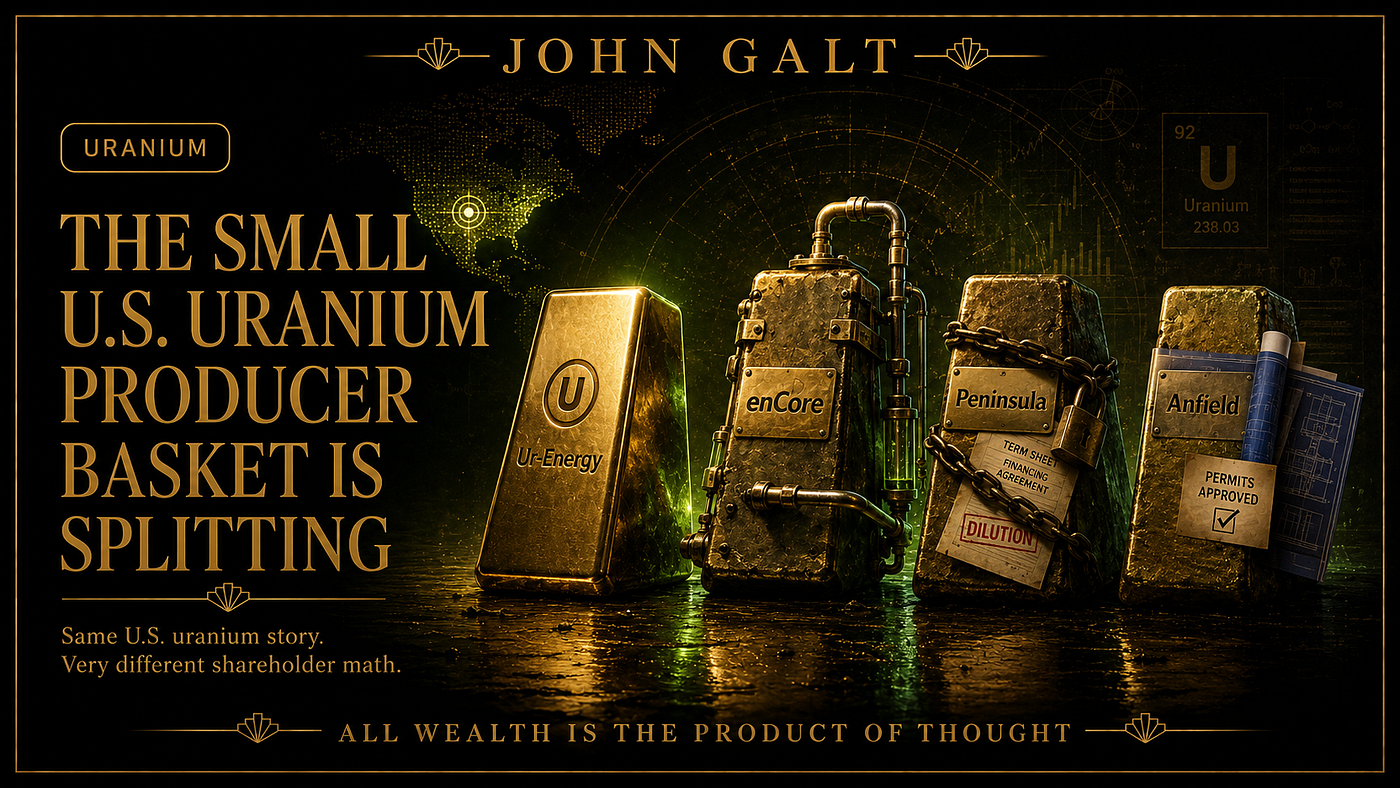
enCore, Peninsula, Ur-Energy and Anfield all sell the same domestic uranium story, but shareholders face very different tests.
The Small U.S. Uranium Producer Basket Is Splitting
enCore, Peninsula, Ur-Energy and Anfield all sell the same domestic uranium story, but shareholders face very different tests.
Four Names, One Misleading Basket
Ur-Energy sold 55,000 pounds of U3O8 in Q1 2026 and ended the quarter with 417,231 pounds of finished inventory. That single fact already separates it from much of the smaller U.S. uranium-producer basket.
The label sounds tidy: enCore Energy, Peninsula Energy, Ur-Energy and Anfield Energy are all ways to play the return of American uranium production.
But the equity stories are not tidy.
One company is trying to convert inventory and operating assets into visible cash flow. One is still proving that its ISR platform can run consistently while building a deeper project pipeline. One just raised money and brought dilution into the center of the story. One owns a potentially interesting hub-and-spoke development plan, but is not yet a current uranium producer in the way many investors casually use the word.
That distinction matters now because uranium investors are no longer being paid simply for owning a good slogan. “U.S. supply” is a powerful narrative. It is not a business model. Shareholders make money when pounds are produced, sold, funded and captured per share.
That is the part the basket label hides.
Ur-Energy’s Q1 numbers give investors something concrete to measure: pounds captured, pounds drummed, pounds shipped, pounds sold, finished inventory and cash. enCore’s recent updates point to progress at Alta Mesa East, Upper Spring Creek and now Dewey Burdock, but the stock still needs operating proof more than another ISR headline. Peninsula’s latest chapter is dominated by an A$36.1 million equity raising and a US$30 million Soul-Patts convertible note facility. Anfield has a larger updated PEA, a mill restart plan, equipment procurement, Velvet-Wood activity and a 2026/2027 timeline, but it remains a development and permitting story until proven otherwise.
This is the useful investor split.
A good uranium asset is not automatically a good mine. A good mine is not automatically a good company. A good company is not automatically a good stock. In small resource equities, the journey between those things can be expensive, slow and dilutive.
The U.S. uranium label gets investors through the door. Pounds per share decide whether they make money.
That leaves the real problem: if the uranium thesis is right, which of these companies can turn it into shareholder value before dilution, delays, operating problems or development risk absorb the upside?
Ur-Energy Has The Measurable Risk
Ur-Energy is not risk-free. It is just easier to analyze.
That is a compliment in this sector.
In Q1 2026, Ur-Energy reported 110,314 pounds captured, 95,599 pounds drummed, 103,956 pounds shipped and 55,000 pounds sold at an average realized price of US$70.98/lb, generating US$3.9 million of revenue. It also ended the quarter with 417,231 pounds of finished inventory in the conversion chain and US$122.8 million of unrestricted cash.
Those are not promotional adjectives. They are measurable things.
That matters because the smaller uranium space is full of companies whose value lives in future tense. Future production. Future permitting. Future funding. Future restart. Future economics. Ur-Energy’s near-term case is not built around a newly discovered dream. It is built around whether Lost Creek and Shirley Basin can produce more reliable pounds and whether that inventory converts into contracted deliveries and cash.
The company’s own operating focus is clear. At Lost Creek, management pointed to a sand filter system expected in Q2 2026 and water treatment work intended to improve flow rates that had been affected by fine particles. At Shirley Basin, initial operations started in April, with first resin deliveries to Lost Creek expected in summer 2026. The company has also highlighted combined permitted production and toll-processing capacity of 4.2 million pounds per year across Lost Creek and Shirley Basin.
Capacity is not production. Permitted pounds do not pay bills by themselves. But the path is visible.
That is the difference.
For Ur-Energy shareholders, the next layer of value is not another map or another strategic press release. It is whether the operational fixes at Lost Creek actually improve flow rates, whether Shirley Basin resin moves on schedule, and whether H2-weighted deliveries happen without turning into another “nearly there” uranium story.
The opportunity is practical. If production improves and inventory converts into deliveries, Ur-Energy has a clearer path to cash-flow credibility than the rest of this smaller group. Cash on hand also reduces the immediate financing pressure that can break shareholders in resource companies.
The warning signs are just as practical. A delay in flow-rate improvement, a slower Shirley Basin ramp, resin timing issues, or weak conversion from inventory into sales would damage the thesis quickly. The stock does not need investors to debate U.S. energy policy. It needs the plumbing to work.
Ur-Energy’s advantage is not that everything has been proven. It is that the proof points are now close enough to count.
enCore’s Pipeline Is Getting Deeper
enCore’s news flow since Q1 has been constructive. The company reported US$18.3 million of Q1 revenue and US$84.7 million of total liquidity as of May 8, 2026. After the quarter, it announced that drilling at Alta Mesa East extended uranium mineralization by more than 3,700 feet east of the nearest wellfield. It also reported construction progress at Upper Spring Creek, where the completed portion could process 1,600 gpm, equal to 50% of planned capacity, with management targeting 75% by the end of June and 3,200 gpm by the end of July.
enCore also added another important development: it received Bureau of Land Management authorization to begin construction at the Dewey Burdock uranium project.
That is not a small update. It gives enCore another visible development path beyond Alta Mesa and Upper Spring Creek, and it strengthens the argument that the company owns a broader U.S. ISR platform rather than a single-asset restart story.
But the investor interpretation should stay sober.
Construction authorization is not production. It does not prove flow rates, recoveries, operating costs, delivery timing or cash conversion. Dewey Burdock adds pipeline depth, but enCore’s near-term equity still depends on whether its operating assets can produce reliable pounds without constant explanation.
That is the current gap.
enCore’s shareholder story is not suffering from a lack of uranium properties. It has the ISR platform, the assets and the operating ambition. What it needs now is dull, repetitive evidence that the system can run: throughput, recoveries, cost control, consistent wellfield performance and cleaner quarterly production evidence.
The market usually likes excitement. ISR shareholders should prefer boredom.
A boring enCore quarter would show that construction milestones are turning into stable production. A boring update would show that Upper Spring Creek is not just mechanically progressing but becoming economically useful. A boring Alta Mesa update would move from mineralization extension toward permitted, mineable, financeable pounds that matter to existing shareholders. A boring Dewey Burdock update would show that construction authorization is moving toward a real project timeline rather than simply expanding the press-release inventory.
That is where the stock sits now.
enCore’s gap is not acreage, ambition or liquidity. It is operating proof: steady production, visible inventory movement and enough quarterly evidence to show that the ISR platform can run without constant explanation.
Resource investors love optionality until they have to pay for it twice.
enCore’s upside comes from turning its ISR footprint into a repeatable production platform. If Upper Spring Creek reaches the planned flow capacity, if Alta Mesa East moves toward a real expansion path, if Dewey Burdock becomes a credible future development asset, and if Rosita/Alta Mesa optimization begins showing up in results rather than language, the stock can start to look less like a repair job and more like a functioning producer with a pipeline.
But if the company keeps delivering construction-heavy updates while production remains hard to judge, the market may continue to discount the story. Liquidity can fund progress. It can also get consumed by optimization. The difference is visible only in the operating numbers.
enCore’s pipeline is getting deeper. Now the operating tape has to catch up.
Peninsula Bought Time With Paper
Peninsula’s story changed after its March 2026 quarterly report.
Not because Lance suddenly became irrelevant. Lance is still the asset. The change is that the financing package now sits in the middle of the shareholder math.
On May 14, Peninsula announced a fully underwritten A$36.1 million equity raising and a US$30 million senior secured convertible note facility from a Soul-Patts affiliate. The institutional component raised about A$29.2 million. The retail offer was sized at about A$6.9 million, but only around A$2.7 million was directly subscribed, leaving a A$4.2 million shortfall to the underwriters. Soul-Patts subscribed for A$10.4 million in the institutional component and underwrote up to A$4.0 million of the retail tranche.
Then came the machinery.
Peninsula’s extraordinary general meeting materials laid out approvals around the placement, the Soul-Patts convertible, potential issuance of about 119.0 million conversion shares, and 10.786 million warrants. The company later confirmed the definitive convertible note facility agreement, but the drawdown of the US$30 million facility remains subject to closing conditions that must be satisfied by July 31, 2026.
That is not just housekeeping. That is the investment case.
The optimistic version is simple enough: Peninsula raised the money it needed to keep advancing Lance, including Mine Unit 5 and associated production growth. If Lance ramps, the capital could prove necessary and rational. In mining, undercapitalized projects are not noble. They are usually just future disasters with better adjectives.
But money has a cost.
For existing shareholders, the issue is not whether Lance might produce uranium. It is whether enough of the economics remain with them after equity, convertibles, warrants and future funding needs are considered. A project can improve while the stock gets harder to own. That is not a paradox. That is resource finance.
The company has pointed to encouraging operational signs, including acidification work at Header House 14 being ahead of schedule and early head grades described positively. That is useful, but it does not override the capital-structure issue. The market now needs two proofs at the same time: that Lance can ramp operationally, and that the financing package was enough to bridge the company into value creation rather than merely postpone the next capital event.
The short-term checklist writes itself, although the consequences are not mechanical. The EGM matters. Facility conditions matter. Drawdown timing matters. Mine Unit 5 spending matters. Lance production data matters. If those pieces line up, Peninsula’s financing may look like painful but necessary medicine.
If they do not, it looks like the usual junior resource bargain: shareholders take the dilution first and wait for the proof later.
Peninsula may have bought time. Shareholders still need to know whether it bought enough.
Anfield Is Building A More Expensive Story
Anfield is the easiest of the four to misunderstand.
It owns a story that sounds like production leverage: Shootaring Canyon Mill, Velvet-Wood, Slick Rock, West Slope, a hub-and-spoke strategy, uranium and vanadium exposure, equipment procurement, and a restart path in the United States. That is a useful package in a strong uranium cycle.
But Anfield is not currently a uranium cash-flow story.
The company’s Q1 2026 6-K and MD&A pointed to several important developments. It had completed a US$6.0 million private placement in January and a US$4.0 million subscription by UEC Energy Corp. in February. It also highlighted an updated PEA covering Shootaring Canyon Mill and the Velvet-Wood, Slick Rock and West Slope mine assets.
The updated PEA now gives investors a much larger headline case than the older, more conservative numbers previously attached to the story. The company highlighted a US$606 million pre-tax NPV, a 106% pre-tax IRR, a US$533 million post-tax NPV and a 97% post-tax IRR, based on an 8% discount rate, US$100/lb uranium and US$9/lb vanadium. The model estimates average annual production of approximately 1.3 million pounds of U3O8 and 6.4 million pounds of V2O5 over a 15-year mine life, including peak production of 1.9 million pounds of uranium and 7.8 million pounds of vanadium.
Those numbers will get attention.
They should also be handled carefully.
The updated PEA is still a PEA. It is preliminary. It includes inferred resources. It is not a reserve statement, not a financing package and not operating proof. It describes a possible business case. It does not build the mill, permit every step, reopen the mines, validate the sequencing or protect shareholders from dilution.
The capital numbers are important because they pull the story back from the headline NPV. The PEA included a 12-month pre-production period and forecast approximately US$97 million of initial capital, including mill and mine permitting and licensing, mine development, mine facilities, equipment, Shootaring uranium-circuit refurbishment, construction of a vanadium circuit and tailings work. It also included another US$20 million of mine-related expenditures during the initial production year and estimated total life-of-mine costs of US$173 million, including sustaining capital.
That is the real Anfield question.
The headline economics are large. The company is small. The shareholder outcome depends on whether Anfield can finance, permit and execute that plan without giving away too much of the economics before the first real pounds arrive.
Since the report, Anfield has continued to push the development path. The most important update was not another PEA number. It was the Shootaring Canyon license-renewal and refurbishment work.
Anfield said it had been working with the Utah Department of Environmental Quality to address requests for additional information tied to the mill’s radioactive materials license renewal. It also completed eight additional monitoring wells, which management described as a key requirement before resuming full operations at Shootaring. That is a useful step because a conventional uranium mill is not restarted by investor enthusiasm. It needs regulatory clearance, environmental monitoring, engineering work and physical refurbishment.
The company has also started preparatory refurbishment work by removing existing leach tanks in the leach building. Management said the work is being done under the existing license and has two purposes: reducing reclamation obligations and preparing the facility for broader refurbishment. At the same time, Anfield is working with PSE Engineering on final detailed engineering designs, expects to complete the license renewal by the end of the year, and wants to be ready to move quickly once approval is received.
There is also a practical construction signal: Anfield has started building a temporary man camp on private company land outside the mill boundaries, designed to house up to 40 workers. That does not prove the restart will happen on schedule, but it shows the company is preparing for a more labor-intensive refurbishment phase. The company also said its refurbishment plans include upgrades targeting 1,000 tons per day of throughput capacity.
Anfield has also added a physical-readiness update. The company said it received the first custom-built underground haul truck from Young’s Machine Company after its 2025 equipment order. The truck is slated for Velvet-Wood first, with later relocation to Anfield’s Colorado mines once larger underground haul trucks are delivered. The company also said Young’s will supply underground loaders intended to support initial development and production at Velvet-Wood, JD-8 and Slick Rock.
That is better than vague “restart progress.” It gives investors actual things to monitor: the license renewal, the detailed engineering package, leach-tank removal, the man camp, equipment arrivals, the refurbishment budget, mine-readiness work, and whether the targeted 2027 Shootaring restart remains credible.
But it still does not turn Anfield into a current cash-flow story.
The license renewal is not complete. The refurbishment is not complete. The capital requirement is not fully financed in the evidence available here. The mill has not restarted. The throughput target is a plan, not operating evidence. Equipment procurement is more concrete than a slide deck, but it is still not mining, milling, cash flow or proof that the hub-and-spoke plan works at commercial scale.
Anfield has also announced completion of Phase One surface works at Velvet-Wood, with a targeted production start by the end of 2026. That adds another near-term item to watch. But the same discipline applies there too: targeted production is not produced uranium, and surface work is not the same as a mine generating cash.
Anfield’s upside is obvious enough. If the mill licensing advances, refurbishment scope remains manageable, Velvet-Wood progresses toward production, equipment arrives as needed, and the hub-and-spoke plan begins to look financeable, the company could become more than a discounted asset package. Its small market capitalization makes that optionality tempting.
Tempting is not the same as proven.
The shareholder risk is that every step between PEA and production costs time and money. Permitting can slip. Mill refurbishment can cost more than expected. Mine sequencing can disappoint. Vanadium assumptions can matter. Funding can dilute. A strategic asset can be real while the stock still struggles to capture the economics.
Anfield has the longest road in this group. The updated PEA makes the potential prize look bigger, but it also makes the execution gap more visible. Big numbers invite big questions.
The company is building a path. It has not yet proven the road.
The Ranking Is Really A Clock
The cleanest way to compare these four companies is not by who has the best uranium slogan.
It is by time-to-proof and equity damage.
Ur-Energy is the closest to a measurable operating case. It has production metrics, inventory, contracts, cash and named operational bottlenecks. That does not make the stock safe. It makes the debate specific. If Lost Creek improves and Shirley Basin contributes on schedule, the company has the clearest near-term path from uranium exposure to cash flow.
enCore sits behind that as an ISR execution story with a growing project pipeline. It has liquidity, assets, recent project progress and now Dewey Burdock construction authorization, but the next re-rating still has to come from operational consistency. Upper Spring Creek’s flow-capacity ramp, Alta Mesa East’s extension and Dewey Burdock’s construction path matter only if they translate into reliable pounds and economics.
Peninsula is now a funded-ramp story with equity-structure risk. The Lance asset may still justify the capital, but shareholders have to account for the cost of that capital. The company’s next proof is not only operational. It is financial: did the raise and convertible facility create a runway to value, or did they dilute shareholders before the production case had earned it?
Anfield is strategic development optionality with a bigger PEA headline and a still-unproven route to cash flow. The asset package may become more valuable in a domestic uranium cycle, but the gap between modeled economics and operating cash flow is still wide. It has to move through permits, refurbishment, mine work, equipment deployment, funding and execution before investors can treat the plan as a business.
That puts the group into four different buckets:
Ur-Energy is an operating ramp and cash-flow conversion story.
enCore is an operating repair and ISR proof story with a deeper development pipeline.
Peninsula is an asset story under financing pressure.
Anfield is a strategic development story with shareholder-capture risk.
The distinction matters because the uranium bull case can be right and still produce very different stock outcomes. A rising uranium price helps. It does not fix a weak cap table. It does not shorten every permitting timeline. It does not guarantee flow rates. It does not make a PEA financeable. It does not turn strategic validation into free money.
This is where resource investors get hurt. They buy the commodity thesis and forget the company’s bottleneck.
In this group, the bottlenecks are visible. Ur-Energy must deliver H2 production and sales. enCore must show stable ISR performance. Peninsula must turn expensive capital into Lance progress without coming back to shareholders too soon. Anfield must prove that its mill-and-mine plan can move from paper value to financed execution.
There is opportunity here, but it is not evenly distributed.
The most advanced story may have less theoretical torque but more evidence. The longest-duration story may offer more upside on paper but more ways for shareholders to lose the economics before production arrives. The financed story may now have a path, but at a cost. The platform story may have the assets, but still needs the operating tape.
That is the real shareholder map.
America may need more domestic uranium. Utilities may want secure supply. Politicians may like the slogan. None of that answers the owner’s problem.
The unresolved test is which of these four companies can deliver pounds before time, dilution and execution risk take the best part of the upside.

https://johngalt88.substack.com/
📩 Join Investor’s Handbook Digest — get the best investing, markets, and wealth-building insights each week.
메타데이터
- post_id
- 7e2f4759f3ee
- slug
- the-small-u-s-uranium-producer-basket-is-splitting-7e2f4759f3ee
- url
- https://medium.com/the-investors-handbook/the-small-u-s-uranium-producer-basket-is-splitting-7e2f4759f3ee
- canonical_url
- https://medium.com/the-investors-handbook/the-small-u-s-uranium-producer-basket-is-splitting-7e2f4759f3ee
- author_url
- https://medium.com/@johngalt88
- status
- ok
- fetched_at
- 2026-08-07 11:53:47