Chapter 20 of Moral Quandaries of the Libertine
There are, in my estimations and based on my experiences (all generalizations, even whether life is good, subjective and faulty in that…
Chapter 20 of Moral Quandaries of the Libertine
There are, in my estimations and based on my experiences (all generalizations, even whether life is good, subjective and faulty in that sense with experiences of humanity so vastly different), so many days, even at sixty, when one feels equivalent to how he did at twenty. There is that same painless body, even if slightly less flexible, and that same amorous, sonorous roar of lusty man in those pants full of ants perhaps regrettably less uncomfortable with the compulsion softened slightly, or more regrettably, never to be slumbered. Cicero’s blithe statement that the advantage of diminished sexual desire in not easily derailing logic one of the great advantages of getting older is apparently only the gift of those in ill health–the body and what it does and does not do and the myriad bacteria, fungi, and viruses establishing an ecosystem in this container always such a mystery, with the tiniest things like how or why one caught a cold such a mystery.
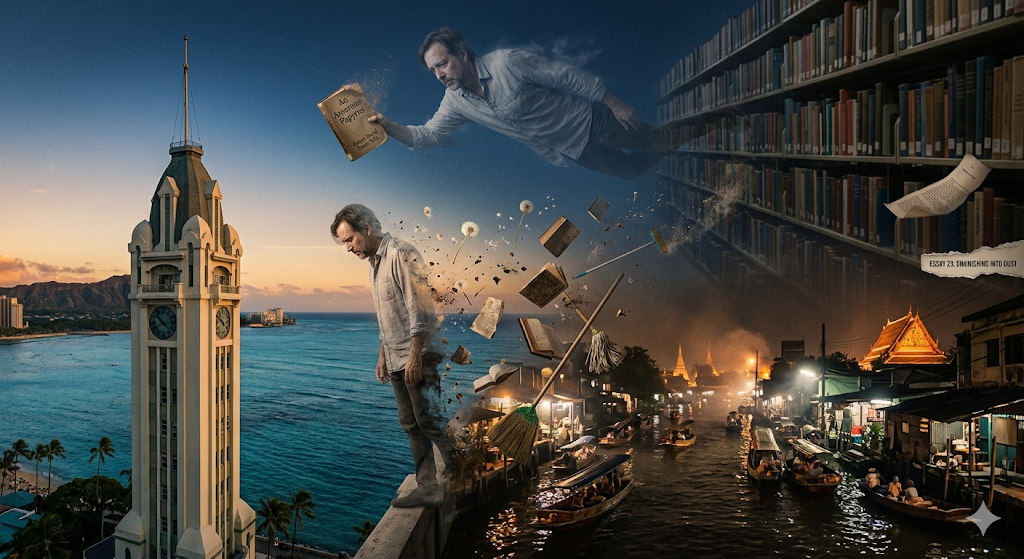
And yet on a particularly stressful day there will come upon him for at least a moment this sense that a frequent experience of the past is present, and not just imagined or remembered, but now experienced in an original way, and that one has just slipped off the conveyor belt of sanity, albeit ever so slightly, with one’s physical fitness and constancy of sanity the only bungee cord mechanism for resilience, and facile return. For me it occurred while I was vacuuming a corridor in a high rise office building in downtown Honolulu. My mind, if it knew where it was and what it was doing (certainly I continued the vacuuming so it was not entirely oblivious to where I was), it certainly was not the whole mind and was surely a small corner of the brain, for I thought I was walking along the Saen Saep canal in Bangkok that runs along Ramkhamhaeng Road–reverse cultural shock in my native land still taking its toll eleven months on. But it is also the mind that attributes good and bad to happenings and happenstance, and why should one’s deterioration or the passing of a generation be such a bad thing? Certainly, it is a messy route nature has taken to wipe away memory from an elderly man so replete in experiences and replace him with an infant who has to be schooled for twenty years, at least, to have a voice in the world, but as the Roman philosopher Seneca phrases it, with a new generation is a new direction into the inquiry of existence.
But that such a myriad of important incidents get tangled in the brain–inconsequential happenings unlike the slice of bread that burned on the edges when getting stuck in toaster or the viscous dog defecation that seemed to wax itself on sole and not in the soul and so dispersed from memory, never to be caught in its fabric, always like foul odor dissolving in clean air–is testament of the richness of an elder ‘s life experiences.
That was just one moment, and yet juggernaut it was nonetheless. It was like a wrecking ball wreaking havoc by discombobulating clarity of thought for a period of hours, and it can only be imagined what a day in which such thoughts would be. Transferred amongst myriad others in brambled coils of neurons or hindered by plaque or other residue of the brain, it is amazing that any of us have powers of understanding and recognition. And yet we think and we are alive. Anne Frank in her diary might have berated her mother for comparing her fate to others worse off and having a sanguine attitude from it, but the reality is that humans for better or for worse gain understanding on the acceptability of their situations by comparing themselves to others. Done to compare oneself to those imagined to have better lives and it engenders resentment but when done to imagine those who have harsher burdens (i.e me of a woman at the library who has an extreme form of osteoporosis or she in imagining someone else who cannot walk) and it can have a positive outcome. But then so can just appreciating the breath of life.
As the pre-Socratic philosopher Heraclitus says, “No man walks through the same river twice.” Everything is in a state of change even if humans are obtuse in recognizing this central fact of existence. Adam Smith in the Theory of Moral Sentiments says that humans romanticize famous individuals as having such glamorous lives and feel deeply saddened when that star has misfortunes as it suggests that no one is impervious to tragedy. In considering Donny Osmond or Michael Jackson, each had to pivot away from what once was and reinvent himself anew many times and this is life, confusing and discombobulating as it can be at times.
메타데이터
- post_id
- 7e5949414c8b
- slug
- chapter-20-7e5949414c8b
- url
- https://medium.com/@poetinasia/chapter-20-7e5949414c8b
- canonical_url
- https://medium.com/@poetinasia/chapter-20-7e5949414c8b
- author_url
- https://medium.com/@poetinasia
- status
- ok
- fetched_at
- 2026-06-09 15:37:30