Divenire. From mud to flame — the same artist, a different question.
by Valente Cancogni

Divenire. From mud to flame — the same artist, a different question.
by Valente Cancogni
There is a bronze sculpture called Divenire — Becoming — that asks to be read the way a text is read: from the first word to the last, from the bottom of the page to the top.
That instruction is not incidental. It is the work.
Cancogni himself describes the impulse behind the piece in terms that go back to the oldest question in Western thought:
“Perhaps this is the deepest reason for my sculpting: to give body to that panta rei Heraclitus spoke of — to fix in bronze the incessant metamorphosis of being.”
Heraclitus: everything flows. Nothing is, everything becomes. To fix that movement in bronze — a material that resists, that endures, that outlasts the body that made it — is itself a paradox. And it is precisely the right paradox for this work.
At the base, the matter is formless. It clusters and pushes upward in dense, irregular masses — not yet body, not yet anything. The artist names it without ceremony: mud. And behind the mud, Genesis 2:7 — “God then formed man from the dust of the earth and breathed into his face a breath of life.” But Cancogni adds a second echo, older and more intimate:
“Remember that you are dust” — the phrase that binds us indissolubly to the earth, principle and end of the natural cycle.
The material at the base is not merely bronze: it is the unformed condition of everything that will eventually exist. It does not know yet what it will become. That unknowing is its dignity.
From that density, the form rises. The middle section becomes a body — deliberately female, the artist is precise about this: woman as the one called to carry new life. The form is recognisable without being literal: curves that suggest rather than declare, the outline of a figure that bears the signs of existence without exhibiting them. The body has no head.
The decision is consistent with everything Cancogni has built before — the faceless corten figures, the archetypal forms that belong to no one and therefore to everyone. To give a head would be to give an identity. To withhold it is to preserve the universal.
This is, in his own words, “the flesh that suffers and rejoices — the struggle and weariness of living, but also the tension toward something else, an impulse to surpass oneself.” Not a body at rest. A body in transit.
At the apex, the bronze narrows and extends into a tongue of flame — or a breath, or a thought finally freed from the weight of matter. The spirit ascending.
Here Cancogni invokes Nietzsche: “Become what you are.” Not an instruction for the future, but a recognition of something already present and not yet realised — an inner imperative that the sculpture renders visible. The matter grows thinner toward the sky, not because it disappears, but because it has completed its transformation.
The reading is vertical, tripartite, theologically and philosophically grounded. Mud, body, spirit. Earth, flesh, fire. Heraclitus, Genesis, Nietzsche.
It is, in structure, a more explicitly guided work than anything he has made before.
And yet.
In La Sfera della Vita, the fractures were gold and the paradox was left open — available to whoever came to look, without a key. In Divenire, the artist provides the key himself. The work is not less beautiful for it. But it is differently beautiful: more resolved, more willing to accompany the viewer through each stage of the ascent.
This is not a contradiction. It is a tension — and a revealing one. The Sphere trusted silence. Divenire trusts the word.
The question this work poses — quietly, in bronze — is whether becoming ever stops.
The mud does not know it will become a body. The body does not know it will become flame. Each stage is complete in itself and incomplete without the next. And the viewer, standing before the sculpture, occupies all three positions at once: origin, transit, aspiration.
Cancogni writes that his works are “attempts to give visible form to universal questions, hoping they may resonate in the sensibility of whoever observes them — inviting reflection on one’s own, deeply personal, path of transformation.”
That invitation is what Divenire is. Not a statement. Not a monument. A question addressed to whoever is willing to read from the bottom up.
The thought has not changed across his body of work. The scale of the question has grown.
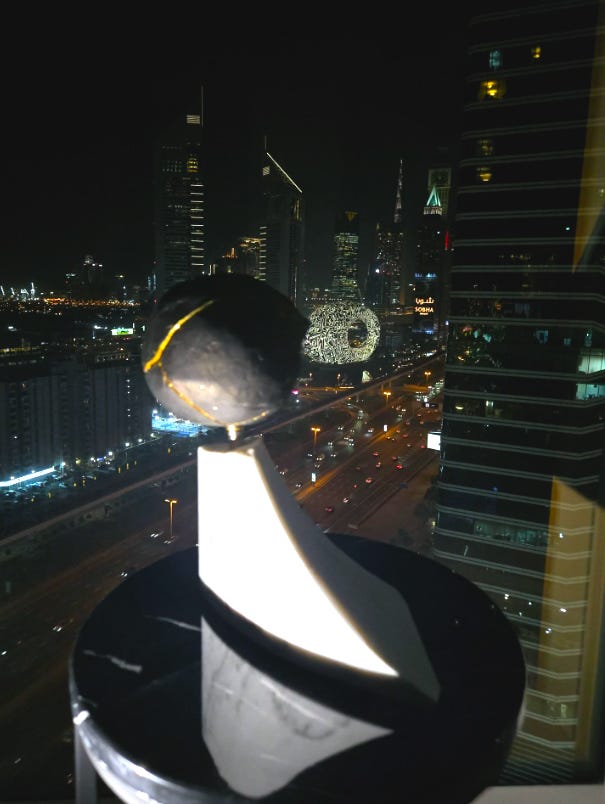
The faceless figures in corten steel carry it as archetype. The cracked sphere carries it as wound. Divenire carries it as cosmology.
Divenire is not a departure from the Sphere. It is what the Sphere was before it broke — and what it might yet become.
Divenire bronze, 2024, Valente Cancogni
메타데이터
- post_id
- 7e5b046f15e2
- slug
- divenire-from-mud-to-flame-the-same-artist-a-different-question-7e5b046f15e2
- url
- https://medium.com/@valentecancogni/divenire-from-mud-to-flame-the-same-artist-a-different-question-7e5b046f15e2
- canonical_url
- https://medium.com/@valentecancogni/divenire-from-mud-to-flame-the-same-artist-a-different-question-7e5b046f15e2
- author_url
- https://medium.com/@valentecancogni
- status
- ok
- fetched_at
- 2026-06-09 15:37:30